Archive for the ‘Lyme’ Category

Lyme & Babesia – A Potent Combination That’s Frequently Missed

https://www.lymedisease.org/wendy-adams-lyme-babesia/

Lyme and Babesia–a potent combination that’s frequently missed

By Wendy Adams, Bay Area Lyme Foundation

Unless you’ve been living under a rock for the last few years, you’ll have learned that tick-borne diseases are on the rise across the United States.

Many theories exist as to why this is the case. However, most scientists that study ticks and their habitats agree that a combination of reasons—including climate change and human encroachment into tick habitats—are at least partially to blame.

Although Lyme disease (caused by the bacterium Borrelia burgdorferi) is the most common disease that humans acquire from tick bites, ticks can unfortunately transmit several other bacteria, viruses, and parasites to humans.

Multiple infections can even be transmitted during the same bite. The confusing and overlapping disease symptoms caused by multiple infections makes it extremely difficult for doctors to recognize, diagnose and treat the different infections.

Borrelia burgdorferi and Babesia

The most commonly reported tick-borne disease after Lyme disease is babesiosis, caused by infection with the parasite Babesia. This parasite, just like its cousin, Plasmodium falciparum (malaria), infects red blood cells and can cause anemia, thrombocytopenia (low platelets) and other serious, sometimes life-threatening symptoms.

Babesia microti, the most common infectious parasite in the US, is typically found where Lyme disease is found—the Northeast, Mid-Atlantic, and Midwest, although most reported cases come from the Northeast.

But why the overlap in this geography with Lyme disease? It turns out that the presence of B. burgdorferi in an ecosystem facilitates the establishment of B. microti in ticks.

Co-infections likely

This means that ticks in locations infected with Babesia are also more likely to be co-infected with B. burgdorferi. At least one study in mice co-infected with Babesia and Borrelia showed that Babesia hindered the acquired immune response, including B and T cell production, such that Borrelia (Lyme) symptoms were enhanced.

Notably, Borrelia can affect the innate immune system—meaning that a co-infected individual might not be able to mount a sufficient immune response at either stage to fight either pathogen optimally.

Babesia is of special concern to doctors and scientists for a few reasons. Like Borrelia, the parasite can be transmitted by an infected mother across the placenta to an unborn child. The resulting infection can be dangerous in a newborn and has been documented in a case where the pregnant mother was not tested for babesiosis despite a Lyme diagnosis.

Another reason Babesia is concerning is its invasion of the blood supply. Babesia can survive blood banking conditions and hundreds of cases have been documented through blood transfusions.

Infected organ transplantation has also led to Babesia transmission and infection by this route is especially problematic. Transplant patients must take immunosuppressants in order not to reject the new organ, leaving them even more susceptible to opportunistic infections.

Babesia duncani—“Left Coast” Babesia?

As noted earlier, Babesia is a specific family or “genus” of pathogens and there are different species within the genus in different regions of North America.

The West Coast of the US has at least one species which infects humans: Babesia duncani (Babesia divergens has also been found in Washington state).

B. duncani doesn’t seem to be closely related to B. microti. Rather, it is more closely related to Babesia gibsoni, a species found in canines, and a parasite called Theileria.

Although there are very few reported cases of B. duncani, some research suggests that it has been found in human infections in other North American locales as well and there are transfusion-associated cases in the literature.

Interestingly, the strains from California—while looking the same under the microscope—differ in genetic sequence from other known Babesia strains (notably, a strain called WA1) on the West Coast. Therefore, there is significant genetic diversity even within the same B. duncani species.

Seroprevalence studies (which measure antibodies from a large population of blood serum samples) done in the 1990s showed that 3% of people in a Lyme-endemic community in Mendocino county had antibodies, and 16% of soldiers stationed at Fort Ord in Monterey county had antibodies to B. duncani.

Yet, strangely, despite the overlap in regionality of B. duncani and Lyme Borrelia in California, Oregon and Washington, B. duncani has not been found in Ixodes pacificus (western blacklegged) ticks. These are the ticks that harbor and transmit B. burgdorferi in the western US.

Found in a different tick

Scientists have found one tick, Dermacentor albipictus, the winter tick, that harbors B. duncani. D. albipictus is not known to bite humans often, instead spending almost their whole life on large mammals like deer or moose. These ticks also have been found to parasitize horses, cats and dogs in different parts of the country.
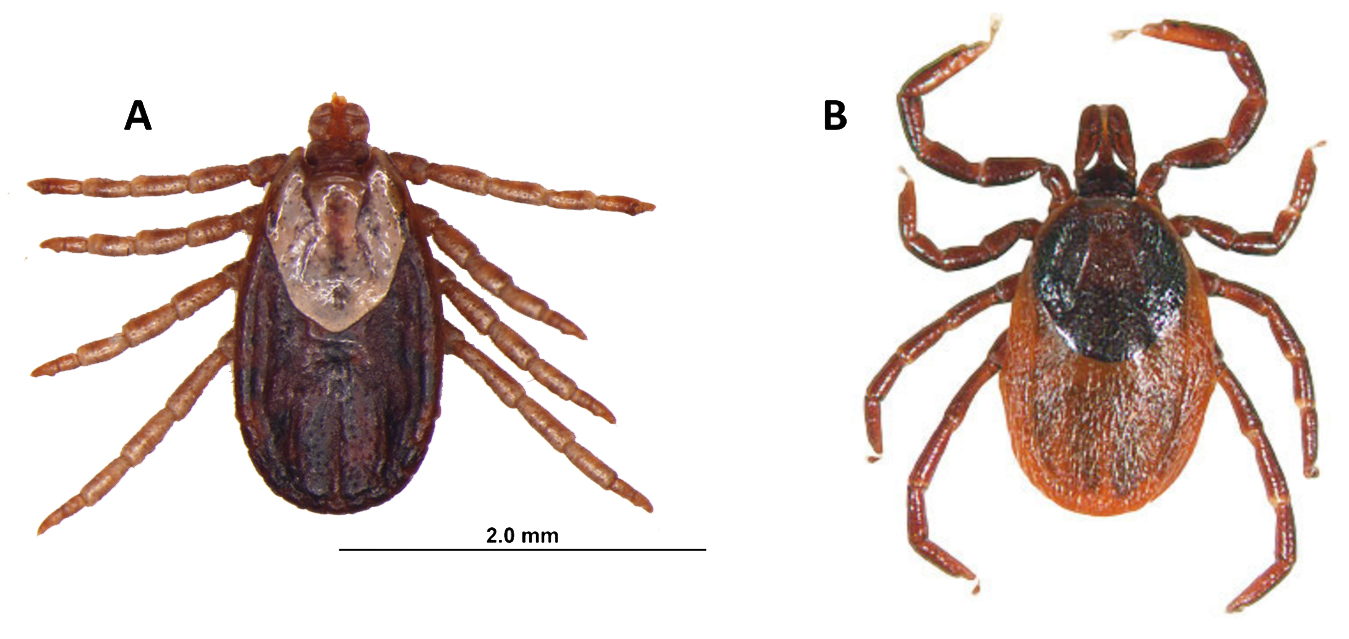
(A) Adult female Dermacentor albipictus. (B) Adult Female Ixodes pacificus
(A) Adult female Dermacentor albipictus. (B) Adult female Ixodes pacificus, image courtesy of TickEncounter, University of Rhode Island.

Clinically in humans, B. duncani can be very serious. It has been difficult to even study this species because the parasite could not be grown in a lab setting until very recently, and lab-infected mice and hamsters die within a few weeks of being infected.

The first human cases included two patients who died of the infection. Yet most doctors on the West Coast have never heard of it.

New studies show that B. duncani has acquired resistance to regular antiparasitic drugs including atovaquone, azithromycin, clindamycin, and quinine.

But recent in vitro studies sponsored by Bay Area Lyme Foundation have shown that an herbal compound studied and used in Africa against malaria (cryptolepis sanguinolenta) has shown positive treatment effects against both B. duncani and B. burgdorferi in in vitro studies.

Some physicians are already using this herbal medicine in their patients in the US. (Please note: this herb has shown some toxicity and should not be taken without physician supervision)

Doctors need to suspect additional tick-borne infections—many do not

While Babesia has only been a CDC-reportable disease for a decade, we do know it is the most commonly reported tick-borne infection after Lyme disease.

Despite that knowledge, babesiosis is typically not discovered until later, if at all. Obviously when a patient is infected with both a bacterium and a parasite, multiple drugs are usually required for effective treatment.

Research from the MyLymeData patient registry confirms the finding that Babesia is the most common co-infection among chronically ill patients.

Prompt and complete diagnosis of patients with tick-borne infections—bacteria, viruses and parasites, is paramount to giving patients the best chance at full recovery.

While Lyme disease is the most common tick-borne infection, there are others that can also cause congenital infections, severe disease and even death.

Testing for babesiosis is somewhat better than for Lyme, since a pathologist can actually see a Babesia parasite in red blood cells on a blood smear. However, it requires the doctor to suspect an additional tick-borne infection and order the blood smear analysis by the pathologist, which many do not.

Until we have more sensitive testing, (preferably unbiased, direct pathogen testing which detects ALL tick-borne infections), and more targeted, effective therapeutics, thousands of cases of Lyme and co-infections, including Babesia, will be misdiagnosed yearly, with sometimes fatal consequences.

Wendy Adams is Research Grant Director for the Bay Area Lyme Foundation and on its Advisory Board. She has served as a member of the federal Tick-Borne Disease Working Group and is a member of the Lyme Disease Advisory Committee of the California Department of Health.

References

Abraham, Amanah, et al. “Establishment of a Continuous in Vitro Culture of Babesia Duncani in Human Erythrocytes Reveals Unusually High Tolerance to Recommended Therapies.” Journal of Biological Chemistry, vol. 293, no. 52, 2018, pp. 19974–19981., https://doi.org/10.1074/jbc.ac118.005771.

“CDC – Babesiosis.” Centers for Disease Control and Prevention, 31 Mar. 2020, https://www.cdc.gov/parasites/babesiosis/index.html.

Djokic, Vitomir, et al. “Protozoan Parasite Babesia Microti Subverts Adaptive Immunity and Enhances Lyme Disease Severity.” Frontiers in Microbiology, vol. 10, 2019, https://doi.org/10.3389/fmicb.2019.01596.

Duncan, Kathryn T., et al. “Recent Reports of Winter Tick, Dermacentor Albipictus, from Dogs and Cats in North America.” Veterinary Parasitology: Regional Studies and Reports, vol. 22, 2020, p. 100490., https://doi.org/10.1016/j.vprsr.2020.100490.

Handel AS;Krugman J;Hymes S;Inkeles S;Beneri C; “A Case of Relapsed Vertically Transmitted Babesiosis.” Journal of the Pediatric Infectious Diseases Society, U.S. National Library of Medicine, https://pubmed.ncbi.nlm.nih.gov/32964924/.

Persing, David H., et al. “Infection with a Babesia-like Organism in Northern California.” New England Journal of Medicine, vol. 332, no. 5, 1995, pp. 298–303., https://doi.org/10.1056/nejm199502023320504.

Renard, Isaline, and Choukri Ben Mamoun. “Treatment of Human Babesiosis: Then and Now.” Pathogens, vol. 10, no. 9, 2021, p. 1120., https://doi.org/10.3390/pathogens10091120.

Research, MyLymeData Lyme Disease. “MyLymeData Chart Book Released – Information about Patients with Chronic Lyme Disease That Was Previously Unknown.” LymeDisease.org, 28 Feb. 2021, https://www.lymedisease.org/mylymedata-lyme-disease-research-report/.

Sanders, Lisa. “He Passed out Three Times in 10 Days. What Was Wrong?” The New York Times, 26 Aug. 2021, https://www.nytimes.com/2021/08/26/magazine/lyme-disease-babesia-tick.html.

Swei A; O’Connor KE; Couper LI; Thekkiniath J; Conrad PA; Padgett KA; Burns J; Yoshimizu MH; Gonzales B; Munk B; Shirkey N; Konde L; Ben Mamoun C; Lane RS; Kjemtrup A; “Evidence for Transmission of the Zoonotic Apicomplexan Parasite Babesia Duncani by the Tick Dermacentor Albipictus.” International Journal for Parasitology, U.S. National Library of Medicine, https://pubmed.ncbi.nlm.nih.gov/30367862/.

“Western-Blacklegged Tick.” TickEncounter, https://web.uri.edu/tickencounter/species/western-blacklegged-tick/.

Zhang, Yumin, et al. “Botanical Medicines Cryptolepis Sanguinolenta, Artemisia Annua, Scutellaria Baicalensis, Polygonum Cuspidatum, and Alchornea Cordifolia Demonstrate Inhibitory Activity against Babesia Duncani.” Frontiers in Cellular and Infection Microbiology, vol. 11, 2021, https://doi.org/10.3389/fcimb.2021.624745.

Harry E. Prince, et al. “Comparison of the Babesia Duncani (WA1) IGG Detection Rates among Clinical Sera Submitted to a Reference Laboratory for WA1 IGG Testing and Blood Donor Specimens from Diverse Geographic Areas of the United States.” Clinical and Vaccine Immunology, 1 Nov. 2010, https://journals.asm.org/doi/10.1128/CVI.00256-10.

_________________

For more:

Virginia Lyme Disease Bill Introduced

https://lymediseaseassociation.org/government/states/virginia/vas-delegate-reid-introduces-lyme-prevention-education-bill/

VA’s Delegate Reid Introduces Lyme Prevention & Education Bill

VA Del. David Reid

Delegate David A. Reid (D-House District 32) introduced Virginia HB 850, a Lyme disease bill, in House referral committee pending as of January 12, 2022. The bill pertains to Lyme disease; signage; instructional resources; and materials. It requires the Virginia Department of Conservation and Recreation to develop and post signage in each state park and interstate park that addressees appropriate steps that park visitors can take to prevent tick bites, how to identify Lyme disease, and where to seek treatment for Lyme and other tick-borne diseases. The bill requires the Department to install signage in areas in the Commonwealth that have been identified as most susceptible to Lyme disease first. Signage installation is to be completed in all state parks and interstate parks by January 1, 2028.

In addition, the bill requires the Secretary of Education, in collaboration with the Secretary of Health and Human Resources and the Secretary of Natural Resources, to develop instructional resources and materials to assist school boards and local and regional public libraries in establishing an education and awareness program to protect children from Lyme disease and other tick-borne infections.

Instructional resources and materials are required to be appropriate for school aged children; to provide information on the identification of ticks, recommended procedures for safe tick removal, and best practices to protect from ticks. These resources may include video productions, pamphlets, and demonstration programs to illustrate the sizes of various ticks, including sizes before and after each variety of tick has become engorged, to assist with the identification of a tick and the reaction on the skin that may result from a tick bite; and will be available to school boards and local and regional public libraries at no charge.

LDA NOTE: The Lyme Disease Association Inc. (LDA) was contacted by Virginia Delegate Reid almost a year ago to share his concerns about the spread of Lyme disease in the region and asked LDA to provide input into possible ideas for legislation to help stop the spread of Lyme disease. In a subsequent zoom meeting with LDA President Pat Smith, the LDA provided to him a number of possible ideas related to prevention and education, especially in parks.  

Read full HB 850 here

Read all details on HB 850 here

Read additional Virginia legislation here

Lyme Disease: The New Pharma Frontier That Will Never Happen

http://

Lyme: The New Pharma Frontier

Nov. 15, 2021

In this informative presentation, chuck full of facts and data, Dr. Raphael Stricker, a San Francisco internist and hematologist, and board member of LymeDisease.org, who is an internationally recognized leader in tick-borne disease diagnosis and treatment, discusses what it will take to develop new drug treatments for Lyme disease.

He shows that the Lyme disease epidemic is much larger than HIV/AIDS, HCV, and tuberculosis in the USA and may involve sexual transmission.  He calls on Big Pharma to take the lead in the global fight against Lyme disease.

Clearly, this will never happen.  Big Pharma and our corrupt public health ‘authorities’ and therefore mainstream research are too enamored with a shiny new Lyme “vaccine” which will reap in billions, of which they all will get a nice cut from, to be bothered by such mundane things like treatments, which would immediately help patients and alleviate suffering, but aren’t cash-cows like “vaccines.”  Just look at how COVID has been handled for a current example.  Doctors are screaming that there have been cheap, safe, treatments from the beginning of COVID, and that 500,000 lives could have been saved, but they are being censored, bullied, and persecuted by regulatory agencies – similarly to the way Lyme literate doctors have been treated.

I argue that the only path forward is to do the work ourselves with independent researchers without ties to Big Pharma and the government.  Historically, this is the only positive forward movement that has been made in Lymeland.

The sooner we wake up and realize our corrupt public health ‘authorities’, regulatory agencies, and research institutions that rely upon government grants are captured agencies the sooner we can fix this by going around the system not crawling in bed with it.

Reactivated Infections: A Possible Piece of the Chronic Illness Puzzle

https://www.globallymealliance.org/blog/reactivated-infections-a-possible-piece-of-the-chronic-illness-puzzle

Did you know that old infections can get reactivated due to COVID-19 or tick-borne illness?

For almost two years now, comparisons have been drawn between long-haul COVID-19 and long-haul tick-borne illness. In addition to many overlapping symptoms including persistent fatigue, brain fog, and pain, questions about the cause of these long-haul symptoms are also similar: Is it ongoing infection? Is it a dysregulated immune system? Is it inflammation? The answers may not be mutually exclusive.

There may also be another factor at play: old infections that get reactivated as a result of acute COVID-19 or tick-borne illness.

Many of us have dormant infections in our bodies. Those of us who had chicken pox as kids still carry varicella-zoster virus. For most of us, that virus stays dormant forever, but for some—particularly those who are immunocompromised or who suffer extreme stress—the virus can reactivate later as shingles.[i]

Another example is Epstein-Barr virus, which causes mononucleosis. While 95% of adults probably carry this virus, for many it is always dormant, and they don’t even know they have it [ii]. Others, like myself, are not so lucky. My own case of infectious mononucleosis dragged on, slipping into chronic active Epstein-Barr virus. Though my acute symptoms of swollen glands and sore throat cleared up, fatigue, and low-grade fever persisted for two years. I later learned that my body could not adequately fight Epstein-Barr because I also had underlying, untreated tick-borne infections including Lyme disease, babesiosis, ehrlichiosis, and possible bartonella. I spent another several years battling those tick-borne illnesses into remission, including one shattering relapse. So focused was on I treating those infections—which also caused fatigue and fever—that I sometimes forgot I had Epstein-Barr virus.

But the body does not forget. A few years ago, after a particularly stressful period in my life, I had a minor flare-up of symptoms. Though not bedridden again, I was more tired than usual. Long-gone joint and muscle aches returned. I panicked that my tick-borne illnesses were back in full force. And while they were reactivated a bit, tests revealed that what was really flaring was Epstein-Barr virus. I’d forgotten that the virus that had originally sent me to bed all those years ago could come back, too.

That episode was an important wake-up call to me, and I hope it will be for other Lyme warriors too: not all symptoms we have are Lyme-related. We have to remember what else our bodies harbor, what else can reactivate when our immune systems are down.

On the flip side, we also have to remember that Lyme can be a relapsing illness, as my doctor describes it. Research proves that Lyme bacteria can persist after antibiotic treatment. This means that the bacteria can lie dormant, and slowly start replicating at a later point, particularly if the body is under some kind of stress. “High level stress is like walking into a minefield of ticks,” my doctor once said. Stress can be external, like from a tough job situation or a hard breakup. It can also be physical, like from an acute illness such a cold or COVID-19.

Luckily, my own long-haul case of COVID-19 did not cause a flare-up of any of my underlying infections. My doctors hope this means that as I’ve grown healthier over the years, my body has become more resilient. But other COVID-19 long-haulers have experienced reactivation of other illnesses, like the patients described in “For These 17 COVID Long Haulers, Reactivated Viruses May Be to Blame” on verywellhealth.com.

For all of us long-haulers, it’s important that we don’t get tunnel vision about the illnesses we deal with on a day-to-day basis. We must also consider other, older infections in our bodies, and how they might impact recovery.

[i] https://www.verywellhealth.com/long-covid-latent-viral-reactivations-5205269?utm_source=facebook&utm_medium=social&utm_campaign=shareurlbuttons&fbclid=IwAR3FaE8sJJGxhShKcWzI3f0EKbkTml8QzQdnh742oVIsSsMLPlqnD4QXXlg#citation-5

[ii] Womack J, Jimenez M. Common questions about infectious mononucleosis. Am Fam Physician. 2015;91(6):372-376

Writer

Jennifer Crystal

Opinions expressed by contributors are their own. Jennifer Crystal is a writer and educator in Boston. Her work has appeared in local and national publications including Harvard Health Publishing and The Boston Globe. As a GLA columnist for over six years, her work on GLA.org has received mention in publications such as The New Yorker, weatherchannel.com, CQ Researcher, and ProHealth.com. Jennifer is a patient advocate who has dealt with chronic illness, including Lyme and other tick-borne infections. Her memoir about her medical journey is forthcoming. Contact her via email below.

Email: lymewarriorjennifercrystal@gmail.com

_______________

**Comment**

Many avoid stating it, but vaccines can also be a physical stress that can reactivate latent infections.  I’ve witnessed this personally in Lyme/MSIDS patients who have had symptoms come roaring back after getting a vaccine.  Vaccines are not without risk and for Lyme/MSIDS patients they pose a significant risk due to an already dysfunctional immune system and an overwhelming amount of inflammation.

Please see: 

Forty Years of Evidence on the Efficacy & Safety of Oral & Injectable Antibiotics for Treating Lyme Disease in Adults & Children: A Network Meta-Analysis

https://journals.asm.org/doi/10.1128/Spectrum.00761-21

Forty Years of Evidence on the Efficacy and Safety of Oral and Injectable Antibiotics for Treating Lyme Disease of Adults and Children: A Network Meta-Analysis

ABSTRACT
Lyme disease (LD) is a heavy public health burden. The most common manifestations of LD include erythema migrans (EM), Lyme neuroborreliosis (LNB), and Lyme arthritis (LA). The efficacy and safety of antibiotics for treating LD is still controversial. Thus, we performed a network meta-analysis (NMA) to obtain more data and tried to solve this problem. We searched studies in the databases of Embase and PubMed from the date of their establishments until 22 April 2021. Odds ratios (ORs) were used to assess dichotomous outcomes. A total of 31 randomized controlled trials (RCTs) involving 2,748 patients and 11 antibiotics were included.
  • Oral amoxicillin (1.5 g/day)
  • oral azithromycin (0.5 g/day)
  • injectable ceftriaxone
  • injectable cefotaxime were effective for treating LD (range of ORs, 1.02 to 1,610.43)
  • Cefuroxime and penicillin were safe for treating LD (range of ORs, 0.027 to 0.98)
  • Amoxicillin was effective for treating EM (range of ORs, 1.18 to 25.66)
  • Based on the results, we thought oral amoxicillin (1.5 g/day), oral azithromycin (0.5 g/day), injectable ceftriaxone, and injectable cefotaxime were effective for treating LD
  • Cefuroxime and penicillin were safe for treating LD.
  • Amoxicillin was effective for treating EM.
  • We did not observe evidence proving the advantage of doxycycline in efficacy and safety for treating LD, LA, LNB, and EM of children or adults.
  • We did not have sufficient data to prove the significant difference of efficacy for treating LA and LNB in adults and LD in children, the significant difference of safety of oral drugs for treating LD, and the significant difference of safety of drugs for treating EM.