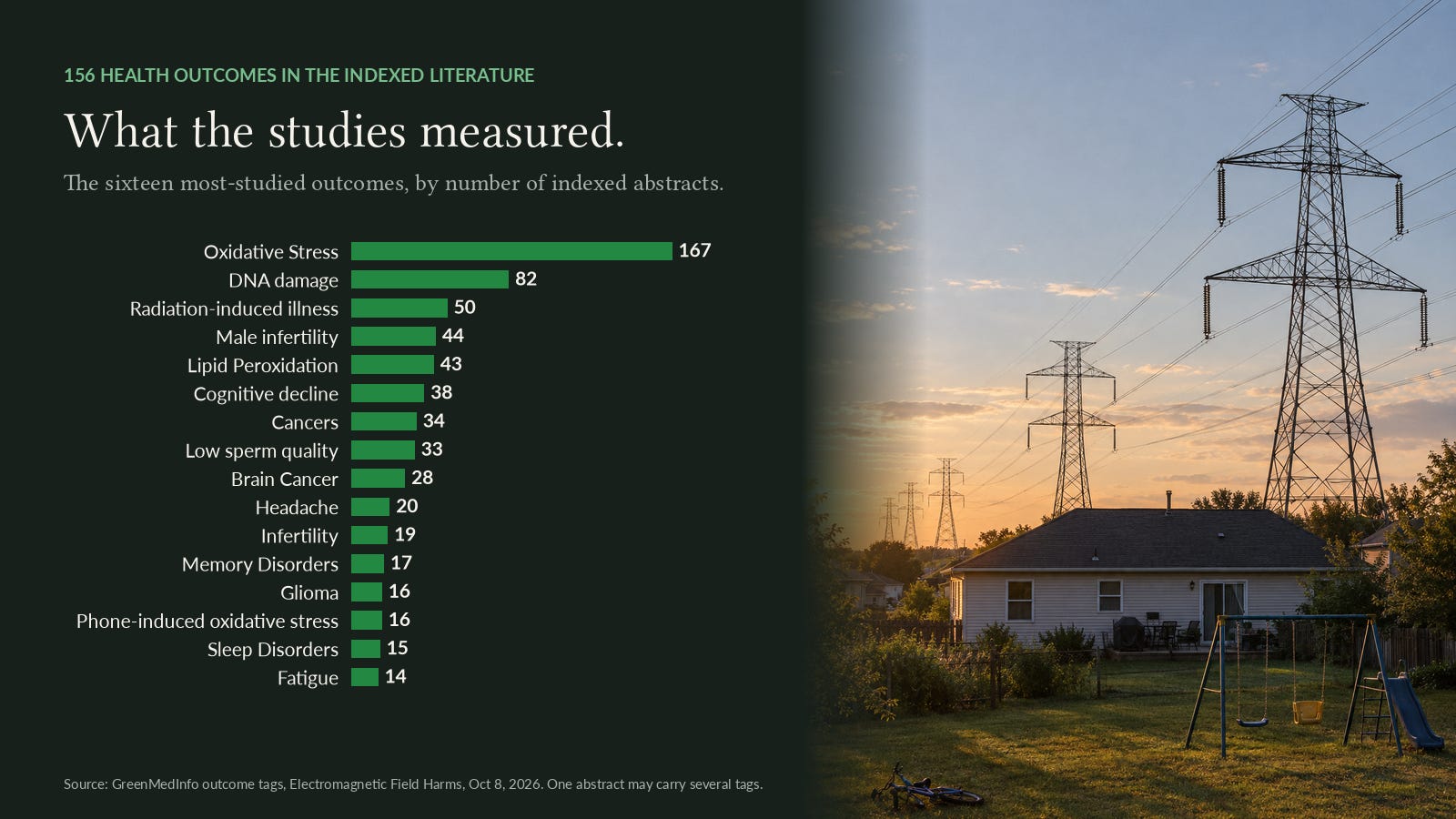
For more than fifteen years, GreenMedInfo has indexed the peer-reviewed literature on electromagnetic field exposure under a single heading: Electromagnetic Field Harms. As of this week, that page holds 1,009 research abstracts, tagged to 156 distinct health outcomes and 30 natural substances studied for protective effects. Every record links to its PubMed entry. Anyone can read it. Nobody in the federal government has ever been asked to.
Until now.
This article does three things. It explains, in plain language, what the index actually shows — including the parts that cut against the easy story. It explains why the timing matters, which comes down to a 1996 rulebook and a 2021 court decision that was never answered. And it shows you how to file a comment in five minutes, whether you are a parent with a story or a physician with a caseload.
The outcomes with the most studies behind them are not exotic. They are oxidative stress (167 abstracts), DNA damage (82), male infertility (44), lipid peroxidation (43), cognitive decline (38), cancers (34), low sperm quality (33), brain cancer (28), headache (20), sleep disorders (15) and fatigue (14). Further down the list: childhood leukemia, acoustic neuroma, salivary gland disease, hearing disorders, ALS, Alzheimer’s, autism spectrum disorders, birth defects, hypothyroidism, autoimmune disease. (See link for article)
_______________
**Comment**
Lyme/MSIDS patients need to take the deleterious health effects of EMF seriously as it compounds their symptoms and is a known ‘illness intensifier.’ I highly recommend this article as Ji corrects many details used by EMF supporters as well as shows you how to quickly file a comment on either your experience or evidence. Please take the time to do so. Deadline is October 21, 2026
Mebendazole has reached human brain-tumor trials, while the astrocytoma case for fenbendazole and ivermectin still rests chiefly on preclinical research. It then explains why current molecular diagnoses matter, especially the distinction between IDH-mutant astrocytoma and IDH-wildtype glioblastoma, and traces the experimental rationale from the original benzimidazole observations to newer studies in IDH-mutant and pediatric glioma models.
The clinical appraisal examines five mebendazole reports, separating dose-finding from efficacy testing and identifying what missing control groups, historical comparisons, post-treatment selection, and mixed diagnoses prevent us from concluding. The laboratory appraisal distinguishes fenbendazole from flubendazole, includes the published figure correction, and examines ivermectin’s mitochondrial and autophagy findings without treating a molecular mechanism as a clinical outcome. The final argument connects drug exposure, neurological and hepatic safety, disclosure, reproducibility, and meaningful endpoints to a concrete research program. The conclusion calls for controlled, independently auditable studies that can earn a therapeutic claim or retire it.
Doctors are being peppered with questions about a new category of drugs for use in cancer. A patient who asks whether mebendazole, fenbendazole, or ivermectin might help treat astrocytoma has asked a legitimate scientific question. The answer requires considerably more care than a declaration that these are antiparasitic drugs, because a molecule’s original indication does not determine every biological action it can exert. It also requires more care than a collection of favorable laboratory results, because an effect in cultured cells must survive a demanding sequence of tests before it can support a claim about a person with a brain tumor. The published record contains enough substance to justify serious investigation, and enough unresolved questions to make confident therapeutic promises premature.
The evidence reviewed here does not establish that institutions suppressed an effective astrocytoma treatment. It does establish that the decisive treatment comparisons remain incomplete. We should direct criticism toward that demonstrable gap and ask who will close it. Public and philanthropic funding can support trials whose value lies in answering a clinical question even when the eventual product offers limited commercial reward. Funding decisions should account for disease burden, biological plausibility, and the information a study can produce. Investigators and advocates should disclose relevant patents, equity, product sales, and referral arrangements, while sponsors should commit in advance to reporting unfavorable results.
A defensible next program would begin with molecularly characterized patient-derived models and independent replication across laboratories. It would test each candidate separately, then justify each proposed combination with concentration-response and interaction experiments. The investigators should include normal neural and hepatic systems to examine selectivity, use exposure ranges that a human development program could realistically investigate, and report failures alongside successes. For mebendazole, formulation and polymorph require explicit characterization. For every candidate, the relevant question concerns active, sustained exposure at the tumor site, which requires evidence beyond an administered dose or a transient concentration in plasma. (See link for article)
Episode 595: Can Lyme Affect Folate in the Brain? Dr. Lindsey Wells on Autism, PANS/PANDAS & FRAA
What if some of the depression, anxiety, brain fog, cognitive dysfunction, OCD, speech changes, and other neuropsychiatric symptoms experienced by people with Lyme and other vector-borne diseases involve more than the infection itself?
In this episode of the Tick Boot Camp Podcast, Matt Sabatello sits down with Dr. Lindsey Wells, ND, a Connecticut naturopathic physician whose work focuses heavily on children with Lyme Disease, PANS/PANDAS, autism spectrum disorder, neurodevelopmental conditions, and other vector-borne diseases.
Her study explored an intriguing question: could some people with Lyme disease, Bartonella, Babesia, or other vector-borne infections also have an immune-mediated problem that prevents enough folate from reaching the brain?
The findings open an important new area of investigation. (See link for article and interview)
_________________
**Comment**
The study found that nearly 62% of patients with tick borne illness tested positive for folate receptor alpha autoantibodies.
The study also found that Bartonella was the most common individual infection identified among FRAA-positive patients.
Important excerpt:
She discusses research suggesting that proteins associated with animal dairy may share similarities with folate receptor structures. Through a molecular mimicry mechanism, antibodies generated against those proteins could potentially cross-react with folate receptors.
Dr. Wells therefore commonly incorporates dairy removal when addressing FRAA-positive patients.
She also discusses clinical observations suggesting that FRAA levels can fluctuate and may rise during periods of infection or physiological stress.
Another important point is a routine folate blood test can not determine FRAA status. The FRAT Folate Receptor Autoantibody Test, a specialty blood test designed to detect autoantibodies to folate receptor alpha is required.
Dr. Wells has seen clinical improvements in these patients in anxiety, OCD, cognition, communication, and other neuropsch symptoms by using folinic acid (Leucovorin) as it utilizes another folate transport mechanism to deliver folate to the CNS.
HHS Launches Agency-Wide Actions to Strengthen Vaccine Injury Research, Reporting, and Patient Care
WASHINGTON, D.C.—OCTOBER 8, 2026— The U.S. Department of Health and Human Services (HHS) this week launched a series of actions to strengthen how the federal government identifies, documents, investigates, and responds to health problems reported following vaccination, with a focus on improving patient care and generating better evidence about potential vaccine-related injuries.
To address health problems Americans report after vaccinations, HHS:
Opened a new National Institutes of Health (NIH) clinic dedicated to studying and caring for patients experiencing health problems following vaccination;
Proposed reimbursing physicians for reporting suspected vaccine-related injuries to the Vaccine Adverse Event Reporting System (VAERS) through a new Centers for Medicare & Medicaid Services (CMS) policy, bringing vaccine reporting in Medicare in line with typical Medicare reimbursement policies;
Will require electronic health records to capture vaccine-related adverse events so that information can follow patients across the health care system; and
Is modernizing the Centers for Disease Control and Prevention’s (CDC) VAERS to make reporting simpler and improve the tools available to researchers and medical professionals investigating potential safety signals.
“We must listen to patients and families who report vaccine injuries—not dismiss or gaslight them,” said HHS Secretary Robert F. Kennedy, Jr. “President Trump and I are building a health system that takes them seriously, follows the evidence, and uses what we learn to make vaccines safer. This is how we earn back trust in our public health institutions.”
NIH Opens Clinic for Patient Care and Research
On October 5, NIH opened a new clinic dedicated to studying and caring for patients experiencing health problems following vaccination. HHS and NIH leaders marked the opening with a ribbon-cutting ceremony at NIH’s Bethesda campus.
The clinic brings specialized patient care and scientific investigation together, allowing NIH clinicians and researchers to evaluate patients, study their experiences, investigate potential causes, and identify better approaches to care. By connecting patients directly with clinicians and researchers, NIH will expand access to evaluation and care while advancing scientific understanding of health problems reported following vaccination.
CMS Proposes Reimbursing Physicians for VAERS Reporting
For the first time, CMS has proposed reimbursing physicians for the time they spend submitting reports of suspected vaccine-related injuries to VAERS, bringing vaccine reporting in Medicare in line with typical Medicare reimbursement policies.
VAERS relies on reports from health care professionals, patients, caregivers, vaccine manufacturers, and others to help identify potential vaccine safety concerns. CMS proposes the reimbursement policy to reduce barriers to physician reporting and encourage health care professionals to document suspected adverse events following vaccination.
Electronic Health Records to Capture Vaccine-Related Adverse Events
Federal health information technology standards overseen by the HHS Office of the National Coordinator for Health Information Technology will now require electronic health records to capture vaccine-related adverse events so that this information can follow patients across the health care system.
The requirement will give health care professionals a more complete picture of a patient’s medical history and reduce the need for patients to repeatedly recount the same information when receiving care from different providers.
CDC Modernizing VAERS
CDC is modernizing VAERS to make adverse-event reporting simpler, more accessible, and easier to use.
In August, CDC solicited bids for a new contract to overhaul the system. On September 28, CDC announced a new contract to make VAERS accessible on mobile devices and improve the tools available to researchers and medical professionals investigating potential safety signals. Earlier this year, CDC also added a VAERS QR code to Vaccine Information Statements provided to parents and patients for each vaccine administered.
Together, these Department-wide actions will connect patient care, physician reporting, medical records, clinical research, and federal safety monitoring. They will help HHS better identify and investigate potential vaccine injuries, improve care for patients, and use what it learns to strengthen vaccine safety.
________________
**Comment**
Not to be a ‘Debbie Downer,’ but I’m not expecting much from this. The fact the COVID kill shots are till being pushed tells me everything I need to know.
The ULTIMATE PHARMA POWER GRAB: New Bill Aims to Strip CDC Oversight and Automate Vaccine Approvals
Del Bigtree sounds the alarm on S.3323, warning that this legislation is an open play for COMPLETE PHARMACEUTICAL CONTROL over every vaccine decision made in America.
Oct. 12, 2026
In this crucial clip from The HighWire, Del Bigtree exposes S.3323, the Family Vaccine Protection Act, a dangerous legislative maneuver designed to hand total power over U.S. vaccine policy directly to pharmaceutical manufacturers.
Under the bill, the CDC director would be stripped of independent oversight, legally required to automatically adopt Advisory Committee on Immunization Practices (ACIP) recommendations unless the agency can clear an onerous burden of proof and publish its review.
Additionally, the legislation forces ACIP to fast-track newly licensed vaccines and new indications based strictly on the manufacturer’s timeline.
Bigtree warns that this is a calculated, aggressive play for absolute corporate dominance over our public health programs, and that the public must mobilize to push back immediately.
Did industry capture help silence COVID shot safety warnings? The BMJ’s findings demand an answer from lawmakers.
The Independent Medical Alliance (IMA), a national coalition of independent physicians, researchers and clinicians, today called on Congress to end the regulatory capture that may have contributed to the COVID vaccine safety failures documented by The BMJ.
The BMJ found that CDC and FDA officials were warned that the data mining tool they relied on to scan vaccine injury reports was blind to signals from the Pfizer and Moderna mRNA shots. Officials kept the tool and told the FDA scientist who raised the problem to back off. Then they assured the public there were no safety signals.
Pfizer and Moderna had record years. Pfizer’s Comirnaty brought in roughly $37 billion to $38 billion in each of 2021 and 2022. Moderna went from $803 million in revenue in 2020 to more than $18 billion in 2021, almost entirely from Spikevax.
The CDC didn’t run its second promised analysis until 2022. When it did, the analysis flagged myocarditis and other events as safety signals week after week, even as the CDC director publicly described the results as showing nothing unexpected.
Throughout the rollout, the federal government acted as regulator, largest buyer, liability shield, and, with Moderna, development partner. Several senior officials who oversaw these products later took high-paying jobs in the pharmaceutical industry.
“Congress needs to connect the dots and find out exactly where the pressure to overlook this data came from,” said Dr. Joseph Varon, President and Chief Medical Officer of the Independent Medical Alliance. “Frontline doctors, me included, were speaking up about the injuries we were seeing from the COVID shot. They used flawed FDA and CDC data to shut us down.”
IMA is calling on Congress to enact five reforms.
1. Separate the functions. The FDA’s biologics center authorized the mRNA shots and also controlled the safety analysis that could have raised questions about them. The CDC promoted vaccine uptake while co-running VAERS. Post-market vaccine safety should sit in an office that does not answer to the people responsible for vaccination rates, and whose findings cannot be overruled because they might fuel “rhetoric.”
2. Slow the revolving door. Senior officials who personally handled authorization, labeling or safety-signal decisions for a class of products should be barred for a set number of years from taking a paycheck, consulting contract or board seat with any manufacturer of that class. The FDA should also publish an annual accounting of where its departing medical reviewers go.
3. Make safety analyses public from day one. Any emergency product that floods VAERS should automatically trigger at least two pre-specified data mining methods, including one designed to catch effects shared across a product class. Post weekly results to a public docket the same week they’re produced. If a method is known to be insensitive, every official statement that cites it should say so.
4. Protect the scientist who brings bad news. Ana Szarfman was a career FDA officer. She was told to hold off, and when she persisted, to stop. Congress should give federal safety scientists who flag defects in active surveillance systems statutory protection, including a private right of action if they are removed from the work for speaking up.
5. Put practicing physicians in the room. Safety rules that affect every household shouldn’t be written only by people who will never treat the 24-year-old with chest pain. Frontline doctors need a real seat at the table.
“We’re done accepting ‘trust us’ from agencies that kept a broken alarm running and then pointed to the silence,” Varon said. “If they want the public’s trust back, they can start by taking the fox out of the henhouse.”
The BMJ investigation is available at bmj.com. To arrange an interview with one of our doctors, contact Lynne@imahealth.org.
An open letter to Springer Nature, ACM, Sage, and The BMJ, exposing discrepancies between their published claims and editorial correction policies—with highlighted policy-versus-passage exhibits and a demand for stronger scientific accountability and the issuance of formal corrections.
This investigation is part of a broader effort to establish accountability for the use of misinformation designations against identifiable Americans.
In September 2026, we launched Restore the First, a national citizens’ coalition bringing together 20 organizations and eight independent media outlets to address censorship, government accountability, and enforceable protections for First Amendment rights.
The coalition was convened by six Americans named in the original “Disinformation Dozen” report. Our work now extends beyond the conduct of government agencies and technology platforms to a question of scientific accountability: What happens when published research perpetuates inaccurate or unsupported allegations against the very people targeted for censorship?
We are calling on scientific publishers to examine the documented discrepancies, correct consequential errors, and strengthen their correction policies so that no individual is denied an impartial review because of their views or reputation.
The institutions that claim authority to identify misinformation must themselves be accountable for the accuracy of their claims.
The Organization Behind the Blacklist Now Faces Federal Scrutiny
In a striking development, Imran Ahmed, CEO of the Center for Countering Digital Hate—the organization responsible for the original “Disinformation Dozen” campaign—is now the subject of U.S. government deportation proceedings. In September 2026, a federal district court dismissed his lawsuit challenging the government’s actions, and Ahmed appealed.
Although these immigration proceedings do not constitute a judicial finding that CCDH’s research was false, they place renewed scrutiny on an organization whose allegations helped shape media coverage, government pressure, and subsequent academic publications.
The question for scientific publishers is unavoidable: Did they independently scrutinize CCDH’s evidence before lending their institutional authority to allegations against identifiable Americans?
The credibility of a scientific claim must rest on its evidence—not on the influence or perceived authority of the organization promoting it. (See link for article)
The Federal Advisory Committee Act (FACA) requires that advisory committees serving the executive branch operate with strict public transparency, establishing that meetings must generally be open to public attendance and announced in advance via the Federal Register.