“ONE OF THE GREATEST CRIMES AGAINST HUMANITY THIS CENTURY”: The BMJ Exposes the mRNA Safety Cover-Up
The BMJ reveals federal health officials knowingly relied on a broken surveillance system to mask vaccine harms while ordering internal whistleblowers to “cease and desist.”
The foundational narrative of the COVID-19 vaccine rollout has collapsed.
A devastating investigation by The BMJ reveals that the CDC and FDA were not merely “incompetent”, they were actively deceptive.
Armed with the knowledge that their primary safety-monitoring algorithm was mathematically incapable of detecting harm, federal officials suppressed the truth to maintain an illusion of vaccine safety.
The facts, now exposed through internal emails and Senate investigative records, confirm a coordinated betrayal of the American people:
MATHEMATICAL MASKING: The FDA utilized an empirical Bayesian algorithm that they knew was broken. Because the system was flooded with reports for mRNA vaccines, it suffered from “masking”, effectively silencing alerts for heart inflammation, neurological damage, and sudden death.
DELIBERATE IGNORANCE: As late as 2022, CDC Director Rochelle Walensky admitted the agency had not even performed standard PRR analyses for over a year. When those standard, functional analyses were finally run, they immediately flagged hundreds of severe safety signals that the government had previously claimed didn’t exist.
THE SILENCING OF DISSENT: When career medical officer Dr. Ana Szarfman and statistician William DuMouchel attempted to fix the flawed methodology, they were muzzled by FDA leadership. Dr. Peter Marks and others explicitly ordered them to “cease and desist,” fearing that accurate safety data would damage “vaccine confidence” and provide ammunition to critics.
A CALCULATED BETRAYAL: Officials knew their system had blind spots; they were warned repeatedly by their own staff; and yet they continued to cite the “lack of signals” to reassure the public and clinicians. They traded the bodily safety of millions of Americans for the protection of a government-mandated pharmaceutical campaign.
Americans were not just misinformed; they were systematically lied to by the very agencies tasked with their protection.
This report provides the documentation of a profound breach of trust, a calculated suppression of medical evidence that denied the public the right to understand the risks they were forced to take.
Footnotes
Provenance and peer review: Commissioned; externally peer reviewed.
Competing interests: This account is adapted from an upcoming book about covid-19 and the vaccines, written by David Willman and Peter Doshi. Doshi is senior editor, The BMJ Investigations Unit. (See top link for entire article and references)
_________________
**Comment**
Before the first COVID shot, Sayer Ji warned that FDA’s own safety watchlist made rigorous post-market surveillance indispensable. A key detection system with a now proven and documented blind spot should have been a shot over the bow at the time, but senior officials instead worried about ‘public confidence’ in ‘vaccines’ and Meta records show pressure to restrict truthful side-effect information. ‘Vaccine” censorship was (and still is) prolific.
In 2021, Israel’s Ministry of Health sent out an alarm that they were seeing “a large number of reports of myocarditis, particularly in young people.”
These warnings went nowhere.
Pfizer, a private company and the manufacturer of the vaccine, received detailed case-level reports of hospitalizations and deaths. The public, and independent scientists, did not. The underlying record was never made public. The authors had to publish an anonymized version themselves as a supplementary file so that others could examine the evidence.
Five years. That’s how long this took to surface. Source
“This is the smoking gun for turbo cancers,” Nicolas Hulscher, an epidemiologist, tells Dr. Drew and Dr. Kelly Victory.
He says a new case study shows synthetic Pfizer mRNA vaccine plasmid fragments recovered directly from the aggressive tumor of a 35-year-old male.
“He received these mRNA injections. And then about 100 days later, he went to the ER and they found a giant cardiac sarcoma that was filling up his left atrium,” says Hulscher. “He got a booster, and then it spread to his brain, and he died because of bleeding into his brain stem.”
The paper, titled “Fatal Cardiac Intimal Sarcoma in a 35-Year-Old Male Following COVID-19 mRNA Vaccination,” details a previously healthy man whose tumor demonstrated an explosive 10-day doubling time. Tissue testing identified three synthetic spike-encoding fragments and the plasmid origin-of-replication sequence embedded within the tumor tissue.
“These were literally inside of that tumor,” says Nic. “We find the weapon at the scene of the crime now. And so turbo cancer is not a myth. It’s very real.”
The Allison Inquiry in Canada is the first inquiry by Canadian lawmakers into COVID-19 injection injuries. It is chaired by Member of Parliament Dean Allison and is non-partisan.
Approx. 11 Min
Sept. 14, 2026
Sen. Ron Johnson and Canadian MP Chris Lewis discuss alleged COVID-19 vaccine side effects and “turbo cancer” claims at the Allison Inquiry in Canada. Johnson raises questions about COVID vaccine safety, cancer, clinical-trial data and Pfizer’s unblinding, while Lewis shares his mother’s cancer story after vaccination.
The explosive Parliament Hill hearing has reignited debate over COVID-19 vaccines, vaccine injuries, cancer claims and the handling of long-term safety data.
Sept. 13, 2026
Former WHO Director Breaks Silence on ‘Vaccine’ Injury
“I was this grotesque, unrecognizable version of myself.” ~ Patricia Leidl
Sept. 11, 2026
Veteran Detective Helen Grus was suspended, charged with discreditable conduct, and subjected to a multi-year disciplinary tribunal after she noticed a sudden spike in unexplained infant deaths, which caused her to look into the department’s database and flag the trend to her superiors.
Sept. 10, 2026
Carrie Sakamoto describes severe neurological complications, including facial paralysis and spinal problems, which she says followed COVID-19 shot.
Sept. 9, 2026
After 40 years of active construction work and robust health, 74-year-old John Philip Grant experienced sudden, life-threatening hematological and pulmonary complications after the COVID shot.
“My blood platelets had gone down to zero… I didn’t know if I was going to live.”
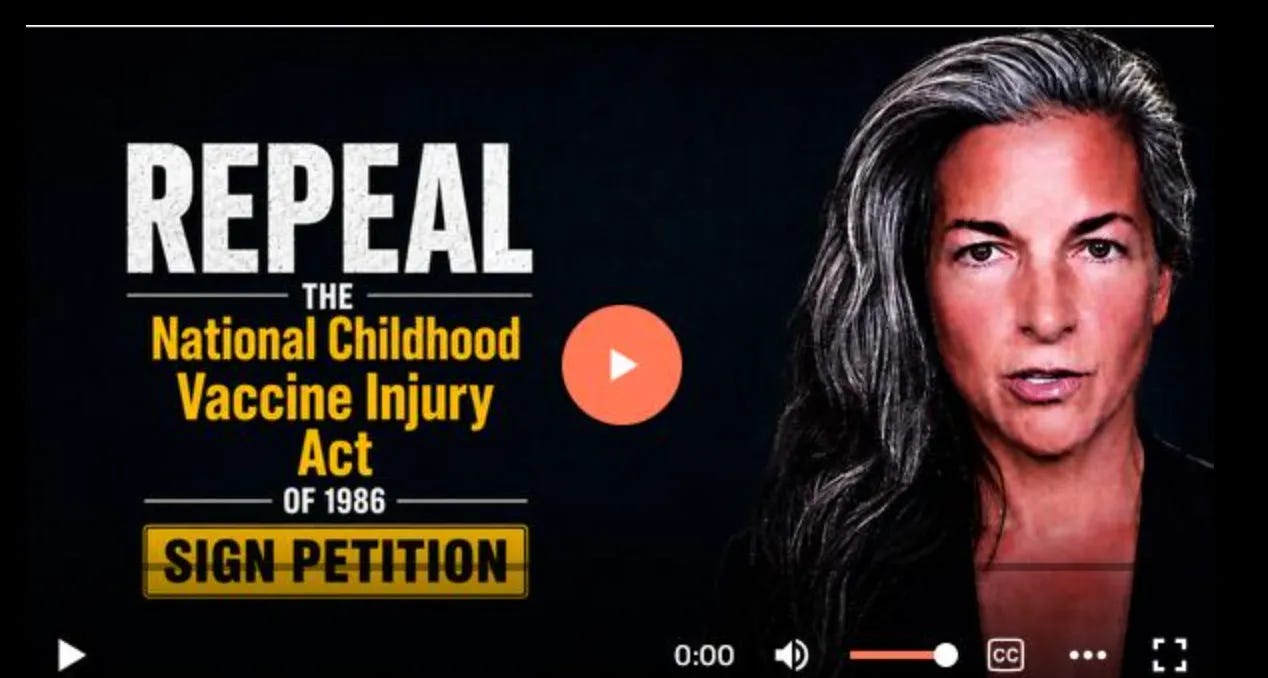
I’m again asking you to sign our petition to repeal the 1986 vaccine law.
For 40 years, vaccine manufacturers have been protected from legal responsibility when their products injure people.
Now, bills to repeal the 1986 law are finally before both chambers of Congress. We have a real chance to change the law. The tide is turning in our favor.
We are at just over 20,000 signatures. Our next goal is 50,000.
We had some technical issues with a previous version of the petition form. Those problems have been fixed.
You don’t have to be an American to sign. We welcome signatures from around the world.
It is NVIC’s position that the 1986 National Childhood Vaccine Injury Act should return to its original form before the vaccine safety, civil liability and compensation provisions were destroyed by weakening congressional amendments, agency rule making changes, and the tragically flawed U.S. Supreme Court decision effectively removing product design defect liability from vaccine manufacturers.
Who Decides What Counts as Medicine? Rob Verkerk Explains How to Fix the Food-Drug Divide
By The ANH Team On 09/10/20260
ANH founder Rob Verkerk explains why outdated food-drug definitions restrict consumer access to natural health options—and how a more proportionate system could better protect both choice and safety.
Listen to the audio version of this article:
The following is a transcript of an interview with Rob Verkerk, PhD, and ANH-USA’s Editorial Director, Michael Ames-Sikora.
Today I’m speaking with ANH founder and executive director Rob Verkerk about Beyond Binary Food-Drug Definitions: A Case for US and EU Modernization. Accepted for publication on July 20, 2026, and expected to appear in spring 2027, the paper was written by Rob as lead author and principal investigator, ANH legal researcher Chimnonso Onyekwelu, and our general counsel, Jonathan W. Emord—the “FDA Dragon Slayer,” who holds the record for the most legal victories against the agency. At its heart, the paper asks whether laws that force products into either a food or drug category still make sense when modern science shows that foods and natural compounds can have meaningful effects on health. In the conversation that follows, Rob and I discuss the paper’s key ideas, what they mean for consumers, and how we can build a better regulatory system.
Mike Ames-Sikora: Rob, you’re the founder and executive director of ANH. What made you want to tackle the way foods and drugs are defined?
Rob Verkerk: Mike, it’s really been over 25 years that I have seen that definitions are the mechanisms that Big Pharma and Big Food use to control what you can buy, what you can say. Particularly in the drug area, the drug definition controls the therapeutic space. It also really impacts what someone can buy, what you can be told about a product, and also whether or not it’s going to actually be found in a practitioner’s toolkit.
Ames-Sikora: Your paper argues that the law draws on increasingly artificial lines between foods and drugs. Why should anyone outside the legal profession care? And why should the average consumer care?
Verkerk: Well, our paper goes back over 100 years, looking at 18 different jurisdictions around the world, but focuses especially on the US and the European system. And when you take that kind of bird’s-eye view of what has been going on for over a century, you see that the initial justification for having regulation around foods and drugs was extremely laudable. It was very well-meaning. It really was about protecting consumers from dangerous goods, mis-sold goods, mislabeled goods, and whether they were drugs or of foods. What you see over the passage of time is this sleight of hand in which essentially the definitions have now become mechanisms to control specific categories of products for the benefit of those corporations. So we now have a rather ridiculous situation where essentially foods and drugs, fast foods, and ultra-processed foods are amongst the most dangerous foods that we consume, yet they’re perfectly legal. They fit those definitions. They can be unsafe. And we’ve got a situation where drugs that are licensed, that can carry claims like safe and effective, are amongst the leading causes of death in industrialized societies. Peter Gøtzsche’s work suggests that the that drugs may in fact be the 3rd leading cause of death in industrialized societies like the US or Europe.
Ames-Sikora: Yeah, and my understanding of that statistic too is that these are not abused drugs. These are properly prescribed medications that are used as intended.
Verkerk: 100%. Yeah, properly prescribed medications. The 3rd or 4th leading cause of death in industrialized countries.
Ames-Sikora: So you argue that these definitions can protect the pharmaceutical industry’s hold on the therapeutic market. How does that work?
Verkerk: Essentially, if you want to make any kind of disease treatment, disease prevention claim, you have to be channeled down the drug pathway. So it doesn’t matter how much science you’ve got to show that turmeric or rosemary or black cohosh, name any botanical or nutrient out there, it doesn’t matter how much science says this might reduce your risk of disease, you are disallowed from making that claim. Yet if you’ve gone through the drug pathway, you’ve essentially paid to play in order to get your license. You can shout your claim from the rooftop. And in fact, what’s even more interesting, you can shout claims that the science that got you the license never made at all, given that you can also make off-label claims. So generally speaking, drug companies will get a specific claim, that’s their pay-to-play license, but then medical doctors will often use the products off-label. Now, if you’re selling a nutrient, even if it has similar effects, even if the science is comparable, even if the science is stronger than the drug with little or no side effects, you cannot make the claim because you cannot discuss the product in any way in relation to the diagnosis, treatment, or prevention of disease.
Ames-Sikora: Yeah, we saw this with the cherry and walnut growers. I remember covering that for ANH over the years. So what does this mean for prevention and for people who already live with chronic disease?
Verkerk: Well, the biggest problem is that it means they can’t get the products that are most likely to be effective. The reality is that if we talk about prevention, primary prevention is actually trying to stop a disease happening in the first place. And we know the science around primary prevention is primarily around non-pharmaceutical interventions. So things like getting people to eat the right food at the right time in the right place in the right way, getting people to move in the right way or to respond to stress in a way that doesn’t harm them, or to spend less time sitting. These are all non-pharmaceutical interventions, and there’s very, very good science around them. Yet what’s happened is that the primary prevention space increasingly is dominated by pharmaceutical interests. So, you know, the use of vaccines to prevent disease, putting people on lifelong drug use, for the use of statins amongst those over 50, for example, which is a fantastic money spinner if you’re a statin manufacturer. The evidence is relatively weak in the sense that it doesn’t work for everyone, and for some people the side effects can be atrocious. Yet that’s viewed as a standard approach, either as primary or secondary prevention.
So if you look at the incredible science that shows how micronutrients and botanical substances and other substances taken from nature’s treasure trove can be used to bring our body into balance–let’s remember that it’s not usually the drug or even the botanical, the nutrient that itself is creating the shift. What it does is change the environment or the pathway in order to allow the body to self-heal. We sometimes forget how much work our body, our immune system, our neurological system, our endocrine system is doing to get things back into order. And that’s one of the ways in which non-pharmaceutical interventions can be really, really critical for prevention. for lifelong prevention that would have a massive impact on reducing chronic and degenerative disease. But these definitions prevent anyone from talking about it, so it doesn’t find its way into the mainstream approach or vocabulary.
Ames-Sikora: What has modern nutrition science revealed that these legal categories struggle to accommodate?
Verkerk: Well, nutrition science has moved on a great deal. That’s one of our primary arguments in the paper, that essentially there’s a whole catalogue of science that shows that nutrients can have a profound effect on disease. Governments recognize this. Mike, you’ll know in our FDA Modernization Act challenge that is running currently, where basically we presented the FDA and the Department of Health and Human Services with over 100 different nutrient disease claims that government agencies themselves are making. There’s a specific clause in the FDA Modernization Act that was written by none other than Jonathan Emord in the 1990s that basically said, look, you’ve reserved any kind of disease claim to the category of drugs. But because there are nutrients out there, how about a system that if you, as the authoritative agency, determines that the science says that there is a nutrient-disease relationship, then everyone can use that. That would avoid companies having to do lots of research on nutrients and disease, and then at the end of that, possibly after having spent hundreds of thousands of dollars, to be told, sorry guys, you’re a drug, you can’t sell the product.
So this is a fantastic pathway. Now there are— we found over 400 of these claims that the National Center for Complementary and Integrative Health, the Office of Dietary Supplements, the CDC, even the FDA are making. And we presented these to the HHS and said, look, we believe that these should be able to be used as authoritative statements under the clause in the FDA Modernization Act. And they’ve said, sorry, we have a little disclaimer that says these cannot be regarded as authoritative statements under the FDA Modernization Act. So it’s a crazy situation that says we are authorities that are making authoritative statements, but in this case, we’re not going to regard these as authoritative statements. So at the moment, they’re making none. And there’s still censorship of any nutrient disease claims. So we’ve got to push that particular roadblock over.
Ames-Sikora: You know, Rob, critics might hear this and assume that you’re calling for less regulation, which could expose them to unsafe supplements or even false hope. How would your proposed approach continue to protect consumers from unsafe products and exaggerated claims?
Verkerk: Well, basically, you’ve got to match the regulatory burden to the risk and the strength of the claim to the evidence. So there’s nothing that we’re doing in terms of modernizing definitions. That’s what we’re proposing—the definitions now are outdated and they don’t match the rapid development of nutritional science and health sciences. So essentially, what we would argue is that there is no additional risk at all. In fact, quite the reverse. It would reduce the risk because more people would be encouraged to take safer products that would essentially have a big impact on reducing their health risks, as well as ensuring that that there are adequate regulations already available that prevent companies from selling unsafe products. So yeah, unfortunately, that argument doesn’t hold a lot of water. And I think another part of our argument generally around some of the other initiatives that we have is that there’s always going to be a degree of uncertainty around any claim. And we strongly advocate this idea of communicating the amount of uncertainty clearly. And of course, Jonathan Emord was central in developing the qualified health claim regimen in the United States, and that’s what it’s all about.
So it’s about accurate communication of the science, and at the moment the definitions prevent that.
Ames-Sikora: What would a more sensible system look like? And if policymakers adopted one central recommendation from your paper, what should it be?
Verkerk: It should be: modernize the definitions. We need to see the food definition broadened. We’ve known since the time of Hippocrates that foods can have medicinal effects. There is copious amounts of evidence for that. And of course, the drug definition massively overlaps the food definition with the exception of very specific exemptions. So the Dietary Supplement Health and Education Act obviously gives an exemption for dietary supplements to make structure-function claims, but they cannot in any way relate to disease. Now, we need to have a system that allows claims about effects that will also be related to disease, but the system needs to be about proportionality. So you need proportionate assessment and not just an automatic push for products that are therapeutic in action to only be forced down the drug pathway.
Ames-Sikora: Well, great. Well, I look forward to seeing this paper finally see the light of day and for it to get a reaction from the public and the scientific community.
Verkerk: Yes. In essence, Mike, what the paper is about is laying down the intellectual academic foundation for why we need to change definitions. You’re going to be very involved, as I am, as all of us will be, in the advocacy program that actually works with Congress and with senators in order to change these definitions. And the interesting thing, we’ve done a lot of work in terms of what modifications may need to be made to bring them in line with the science. And it doesn’t involve a complete rewrite of the definitions. In fact, sometimes it involves only very small changes, but they can have profound effects, and they will work for millions of Americans. And that’s the solution.
ANH-USA will launch a major advocacy program once the paper is published—and we’ll be looking for your support to push through amendments to various food and drug related definitions. Stay tuned!
FDA’s proposed GRAS reform could deliver long-overdue transparency to what’s in America’s food supply—but unless the agency modernizes its approach to natural ingredients, consumers may pay the price in reduced innovation, choice, and access.
With GRAS reform being a headline priority for Secretary Kennedy shortly after he came into office, FDA has finally moved to reform a key pathway for how certain food ingredients come to the market known as the GRAS (Generally Recognized as Safe) system. That is overdue. But the agency’s proposed cure—delivered as a proposed rule on August 10—could punish the natural product sector. Simply put, these changes could make it harder to access a variety of functional foods, health foods, and ready-to-drink products that millions of consumers rely on.
Post a comment to the FDA’s docket calling for more rational reform of the GRAS system.
Proposed changes to the FDA’s GRAS (Generally Recognized as Safe) rules—backed by RFK Jr.’s push to clean up junk and ultra-processed foods—could create a sweeping pre-approval system that threatens access to thousands of safe, natural supplement ingredients.
While reform is needed to curb harmful additives, past FDA decisions show the agency has approved questionable synthetic ingredients—raising concerns that new authority could unfairly target natural products instead.
This is a pivotal moment for health freedom: without public pushback, regulatory overreach could restrict supplement access under the guise of food safety reform.