FDA Panel Just Barely Recommends Molnupiravir. Data Show Birth Defects in Rats
Health advisors vote 13 for and 10 against Molnupirivir for COVID-19 Patients. Issues with lack of evidence of efficacy against new variants and birth defects cause doubt.
The FDA may or may not take the weak recommendation by a health advisory committee. With 43% of the health advisors voting against recommendation, and the data on Molnupiravir lacking, the US awaits the decision by FDA on its recommendation position on Merck’s alleged “wonder drug”.
I had written early on the extraordinary hypocrisy of Molnupiravir, given that the press had advanced a press-release (not a peer-reviewed study) on the efficacy and safety of the drug. Even now, the peer-reviewed literature only includes studies with less than 20 patients for first-in-human and dose variation study.
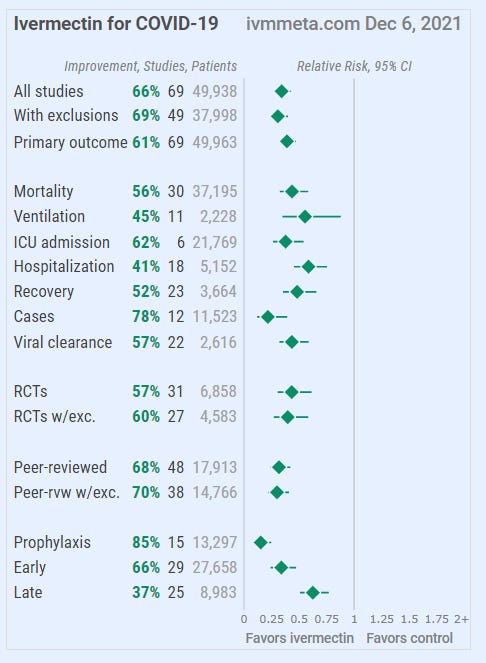
Merck had decided to do an “interim analysis” of an ongoing clinical trial, and yet compared to the very strong evidence in support of Ivermectin in the reduction of hospitalization and risk of death (See https://ivmmeta.com).
So what made the 10 health advisors skeptical?
For one, data from studies in pregnant rats showed birth defects.
“Given the large potential population affected, the risk of widespread effects on potential birth defects has not been adequately studied,” said Dr. Sankar Swaminathan of the University of Utah School of Medicine, who voted against the drug.”
With another example of hypocrisy, one panelist said that if the FDA restricts the use of molnupiravir in pregnant women, they would be denying women choice.
“I don’t think you can ethically tell a woman with COVID-19 that she can’t have the drug if she’s decided that’s what she needs,” said Cragan, a panel member and staffer with the Centers for Disease Control and Prevention. “I think the final decision has to come down to the individual woman and her provider.”
Read that again.
When FDA panelists start considering the level of evidence available for their favorites pharma partners, and start arguing for informed consent and health freedom when it comes to vaccines, we can start taking them seriously.
Until then, they are just going through the motions and abusing the public trust and they, and the FDA’s decisions, do not deserve our respect or attention.
_________________
**Comment**
And yet, that same woman, or man, or even a medical doctor can not “decide” that they need ivermectin or HCQ because, well – that’s just bad and regulatory groups will pounce upon you. Hypocrisy indeed.
Read this article on a comparison between Molnupiravir and ivermectin.
The cost of a complete five-day course of Molnupiravir is $700 — or $70 per pill. That amounts to a 4,000% markup over what it costs Merck to make the drug.
Citing 2013 prices provided by the WHO, Campbell said a five-day course of ivermectin — 10 3mg pills — costs $0.53. (However, at today’s U.S. prices, 10 3mg pills cost about $39).
India and Argentina no longer fear COVID, they simply treat it. Sub-Saharan Africa is void of COVID due to widespread river blindness which was brought under control by insecticides and by large-scale distribution of ivermectin since 1989.
But, the only drug offered U.S. patients is the expensive, worthless drug remdesivir which caused more than 500 deaths in the first year of usage. There have been 20 deaths in 19 years of ivermectin usage. Source
The FDA, spurred by “multiple” reports of ivermectin ‘poisoning,’ lied when it put out a post on it causing “serious harm, seizures, coma, and even death”. When the author inquired on how many is “multiple,” she was told FOUR. Yet, the FDA had no trouble approving remdesivir which has caused far more deaths.
But now, they are offering another expensive, worthless drug.
Lyme disease in an African American child with Down’s syndrome
Welcome to another Inside Lyme Podcast with your host Dr. Daniel Cameron. In this episode, Dr. Cameron discusses the case of a 3-year-old African American child with Down’s syndrome, developmental delays and disseminated Lyme disease.
“A case of disseminated Lyme disease in a child with skin of color” was published by Bax and colleagues in the journal Pediatric Dermatology.¹ The child, who had trisomy 21 (Down’s syndrome) and developmental delays, had a history of playing outside in an area where ticks were observed.
According to the authors, the young girl had experienced a high fever for 9 days and had a 5-day history of rashes. The rashes were asymptomatic and would wax and wane. They consisted of “scattered ill-defined 2-5 cm erythematous patches on the back, abdomen, and upper and lower extremities,” a pattern consistent with disseminated Lyme disease.
There were other manifestations of Lyme disease, as well. “While the patient could not verbalize pain, her mother noted that she was walking less and was not tolerating her leg braces or shoes,” wrote the authors. “She also appeared increasingly fatigued and agitated.”
The doctors ruled out COVID-19, inflammatory syndrome (MIS-C), and Incomplete Kawasaki’s syndrome. “Incomplete Kawasaki’s syndrome was also considered given her hand/foot erythema, skin lesions, fingertip desquamation, and elevated CRP.”
Laboratory tests supported the diagnosis of Lyme disease. The child showed “significant improvement” with 14 days of amoxicillin.
“African Americans in Borrelia burgdorferi-endemic regions have been reported to have higher rates of extracutaneous sequelae, such as arthritis, and lower rates of erythema migrans compared with Caucasians, suggesting that the characteristic rash in skin of color may go unrecognized until more severe symptoms manifest,” the authors wrote.
They did not address the challenges in diagnosing Lyme disease in people with Down’s syndrome and development delays. Fortunately, the 3-year-old toddler presented with a disseminate Lyme disease rash, symptoms, and functional problems, which led to an accurate diagnosis. This would have undoubtedly been more difficult without these findings.
Treatment
The authors did not discuss long-term outcomes or treatment concerns. In some cases, Lyme disease patients may have a co-infection which would require different types of treatment. For instance, amoxicillin would not be effective in treating Anaplasmosis and Babesia.
The following questions are addressed in this Podcast episode:
Have you treated children with Down’s syndrome and developmental delays for Lyme disease?
What were the diagnostic and treatment challenges in working with this child?
Have you also treated children and adults of color? If so, what diagnostic and treatment challenges do they pose?
Tell me about your experience with Lyme disease in children on the autism spectrum.
Thanks for listening to another Inside Lyme Podcast. Please remember that the advice given is general and not intended as specific advice to any particular patient. If you require specific advice, please seek that advice from an experienced professional.
Inside Lyme Podcast Series
This Inside Lyme case series will be discussed on my Facebook page and made available on podcast and YouTube. As always, it is your likes, comments, and shares that help spread the word about this series and our work. If you can, please leave a review on iTunes or wherever else you get your podcasts.
References:
Bax CE, Clark AK, Oboite M, Treat JR. A case of disseminated Lyme disease in a child with skin of color. Pediatr Dermatol. Sep 13 2021;doi:10.1111/pde.14770
Fix AD, Pena CA, Strickland GT. Racial differences in reported Lyme disease incidence. Am J Epidemiol. Oct 15 2000;152(8):756-9. doi:10.1093/aje/152.8.756
Don’t miss TONIGHT’s live video premiere of “What is Ivermectin?” Join us at 7pm ET on our YouTube channel to watch the short documentary explaining the medicine’s history and significance. FLCCC President and Co-Chief Medical Officer, Dr. Pierre Kory will introduce the film and then our very own, Betsy Ashton will conduct an interview with the filmmaker, Adrian Urso, after. As a bonus, viewers will be able to interact with our doctors, Dr. Pierre Kory and Dr. Paul Marik in real time. Join here
First discovered in 1973, ivermectin won the Nobel Prize in 2015. What makes this drug so extraordinary? Watch the full story during our live premiere on Thursday, Dec. 9 at 7 p.m. ET on our YouTube channel: youtube.com/c/FLCCCAlliance
Fauci is the highest-paid federal employee in the U.S., and 68% of his $437,000 a year salary comes from bioweapons research
Instead of safeguarding public health, Dr. Anthony Fauci turned the National Institutes of Health into an incubator for pharmaceutical products, and essentially sold the entire country to the drug industry
Fauci has had a hand in creating the vaccine gold rush. In 2000, he met with Bill Gates, who asked to partner with the NIH in an agreement to vaccinate the world with a battery of new vaccines. In 2009, this agreement was rebranded as “The Decade of Vaccines,” the objective of which was to implement mandatory vaccinations for every adult and child on the planet by the year 2020
One of the darkest stains on Fauci’s career, aside from his role in the COVID pandemic, was his handling of the HIV epidemic. Suppressing the use of repurposed drugs, Fauci zeroed in on AZT, a toxic drug that has killed an estimated 300,000 AIDS patients
The similarities between the AZT scandal and what’s happening today with the COVID jab and remdesivir are striking. Again, Fauci has suppressed all treatments using inexpensive and nontoxic drugs. U.S. taxpayers have paid for research, while drug companies have raked in the profits, all while having zero liability for injuries and deaths
In this interview (in link above), Robert F. Kennedy Jr., an environmental activist and attorney turned ultimate freedom fighter, discusses his latest book, “The Real Anthony Fauci: Bill Gates, Big Pharma, and the Global War on Democracy and Public Health,” which is a must-read if you want to know more about the behind-the-scenes of this giant fraud. We could talk for hours and not cover but a fraction of what’s in this book, which Kennedy calls a “devastating indictment of Tony Fauci.” Go here for video transcript.
In a nutshell, Kennedy describes how Fauci turned the National Institutes of Health into an incubator for pharmaceutical products, and essentially sold the entire country to the drug industry. The book is an incredibly well-referenced record of his history of decimating human health, and exposes him as a self-serving charlatan.
I particularly enjoyed how Kennedy placed Fauci in the context of Rockefeller’s legacy with respect to Bill Gates, who developed an alliance with Fauci over 20 years ago. Rockefeller set us on a course of toxic, profit-driven medicines synthesized from the byproducts of the oil refinery process a century ago, and Gates picked up where he left off and then collaborated heavily with Fauci.
The Decade of Vaccines
Fauci, in turn, has had a hand in creating the vaccine gold rush. In 2000, he met with Bill Gates, who asked to partner with the NIH in an agreement to vaccinate the entire population of the world with a battery of new vaccines. In 2009, this agreement was rebranded as “The Decade of Vaccines,” the objective of which was to implement mandatory vaccinations for every adult and child on the planet by the year 2020.
“I show how they use the pandemic simulations, working very closely with the intelligence agencies, with the big media companies and the major pharmaceutical companies to make that happen,” Kennedy says.
“Gates calls what he does philanthropy capitalism, [the idea that] you can use philanthropy to make money. He had a foundation where he has sheltered $50 billion in tax-free money. And, he continues to have absolute control over it. He uses that money to gain control of public health agencies in our country and the World Health Organization.
He’s created a lot of his own [organizations] with Dr. Fauci and a lot of these quasi-governmental agencies that people think are governmental. They’re actually front groups of the pharmaceutical industry like GAVI and SEPI …
He uses this battery and this control of the WHO to set pharmaceutical or medical policy, public health policy around the globe, in a way that maximizes the profits from his stakeholding in these big pharmaceutical companies.
I also show he’s simultaneously doing the same thing to control the global food supply … [He’s] really trying to change both public health and food policies in ways that benefit corporations that he’s invested in and that he’s partnered with.”
Fauci’s Lethal Handling of the AIDS Epidemic
Gates didn’t lure Fauci to the dark side, however. Fauci had already spent decades playing with people’s lives and sacrificing public health for profit. One of the darkest stains on Fauci’s career, aside from his role in the COVID pandemic, was his handling of the HIV epidemic.
The first cases of AIDS surfaced in 1981. Initially, the AIDS program was run by the National Cancer Institute, a separate institute inside the Health and Human Services Department (HHS). The general belief was that AIDS had a chemical etiology caused by drug use. This all changed when the HIV virus was discovered.
Fauci started working for the NIH in 1968 as a clinical associate in the Laboratory of Clinical Investigation at National Institute for Allergy and Infectious Diseases (NIAID). He became director of the NIAID in 1984, the year after the discovery of the HIV virus, and was appointed director of the Office of AIDS Research in 1988, when that office was established. As explained by Kennedy, Fauci essentially built the NIAID around an AIDS drug called AZT.
“AZT was a chemotherapy formulation that was so toxic it killed all the rats when they gave it to them. The inventor of AZT felt that it was unsafe for any human use, so he didn’t even patent it,” Kennedy says.
“Very early on, the National Cancer Institute had found that when you put AZT in a culture of HIV, that killed the HIV, not surprisingly. It killed anything it touched. And so, Fauci partnered with the manufacturer of AZT … He guided that formulation through the regulatory process and tried to fast track it. He cheated terribly on the clinical trials.
In the clinical trials, it was killing everybody. It literally kills everybody who takes it. But he was able to keep the people in the treatment group alive by giving them huge numbers of blood transfusions. It does keep them alive for the eight weeks, and based upon that eight-week trial, he got approval for AZT. It was unprecedented.
As Kary Mullis, who won the Nobel Prize for discovering the polymerase chain-reaction (PCR) technique, said, with any chemotherapy drug, you’re supposed to give it to somebody for two weeks. Chemotherapy is designed to kill every cell in the body, but hopefully it kills tumor cells first, and you can take the person off it. The tumor dies, if you time it right, and the person doesn’t die.
If you put somebody on that for life, like Tony Fauci was doing, every one of them is going to die. And that’s what happened. Meanwhile, there were a lot of drugs at that time that were being repurposed. Local, community-based doctors in San Francisco and New York who were treating the AIDS community were finding that these drugs treated the symptoms of AIDS, and they stopped people from dying.
Fauci made a deliberate crusade to sabotage those, to make sure they were not available to sick people, in order to make sure that AZT would be the only solution. And AZT was the most expensive drug in history. It was $10,000 for a one-year supply [while costing just $5 per dose to manufacture, plus U.S. taxpayers paid for all of the research and development of the drug] …
Tony Fauci basically created this template that he then used over the next 45 years, to develop toxic drug after toxic drug. He killed early treatment, and killed any protocol that competed with his pharmaceutical enterprise. A lot of people have died [as a result].”
Although a bonanza of money was made with AZT, it pales in comparison to Pfizer making out like a bandit with its COVID shot. The U.S. taxpayers paid $20 billion to fund the research, and another $10 billion to market the COVID jab. Pfizer created the best-selling drug in the world and will make $35 billion from it this year.1 Even better, unlike AZT, this is absolutely risk-free and they can never be sued for injuries.
Everything in Fauci’s Career Is Groundhog Day
An estimated 330,000 people have died from AZT alone. Overall, the similarities between the AZT scandal and what’s happening today with the COVID jab and remdesivir are striking. Again, Fauci has discouraged the use of any prevention for COVID-19, and any treatment using inexpensive and relatively nontoxic drugs such as hydroxychloroquine or ivermectin.
U.S. taxpayers funded the research while drug companies have made an estimated $100 billion in profits from the shots in a single year, all while having zero liability for injuries and deaths even as people are being coerced into taking them.
“Everything in Tony Fauci’s career is Groundhog Day,” Kennedy says. “Again, and again, and again, he is repeating the same behavior and it is paying off. And he has this way of talking where he never really says anything. And this habit of just lying, and lying, and lying …
I knew a lot about what happened during the HIV crisis because my uncle, Ted Kennedy, was chair of a health committee at that time. Teddy was the first presidential candidate to court the gay vote, and I was running his campaign at that time …
In the health committee, his primary concern for most of the time was AIDS. I talk about this in my book.
Finally, Fauci was called in front of Congress, and was just fileted. Henry Waxman and all of these well-known Democratic congressmen were saying, ‘What the hell are you doing? You’ve produced nothing. You’re totally incompetent.’ After that, his career was over, and he decided at that point, ‘OK, I’m going to work on getting these repurposed drugs on the market.’
He did that for a couple of years, and he had a project, which was a dual track project where they could, without going through the clinical trials and FDA randomized, placebo controlled trials, they could get approval for these drugs, so that people could get insurance for them and pay for them. So, I was deeply involved in this for many, many years, and I’ve known Tony Fauci for a long time.
I have insights on who he really is, that most liberal Democrats are utterly ignorant of. He is the opposite of everything they believe. He is the architect who turned our public health system over to the pharmaceutical industry. He does not do public health. And there is no metric at NIH, where they look and say, ‘We are improving public health.’
The only metric they have is, ‘How many vaccines have we given? How many pharmaceutical drugs have we sold? How much kickback money are we getting into the agency?’ As I explain in the book, this agency has become an incubator for the pharmaceutical industry.”
Gain-of-Function Research Under Fauci’s Watch
Fauci is responsible for an annual budget of about $6.1 billion. He gets another $1.6 billion from the military to do bioweapons research, which is where 68% of his $437,000 a year salary comes from. (Fauci is the highest-paid federal employee in the U.S. Second-highest is the president, at $400,000 a year.)
“That’s why he had to do that gain-of-function shenanigans in Wuhan,” Kennedy says. “He had to do it, because he had to hold on to his salary. And most of his salary comes from bioweapons research …
Gain-of-function research has never provided a single scientific or medical development that has assisted us in responding to pandemics. Not one. But Fauci continues to do it, because it is critical to his salary. And it’s critical to that funding stream.”
Now, the bulk of the NIAID’s funding was intended to be used to study American health and to improve it; to eliminate infectious allergic diseases and autoimmune diseases. Instead, under Fauci’s watch, the chronic disease epidemic has exploded.
This, despite the fact that between Fauci, Gates and the U.K. Wellcome Trust, they control 63% of the biomedical research on earth through their funding. Over his career, Fauci alone has distributed more than $930 billion in research grants through the NIAID. You could say they control all of it, really, because they also have the capacity to dry up funding to projects they don’t want done.
Ruthless Fauci
Case in point: Something happened in 1989, triggering a series of epidemics — autism, food allergies, Tourette’s Syndrome, narcolepsy, ADD/ADHD, speech delay, language delay, rheumatoid arthritis and autoimmune diseases like juvenile diabetes. All of them sprang up right around 1989. Why? What’s causing them? It’s Fauci’s job to find out, but he refuses to, and he blocks anyone else from digging too deep.
“Tony Fauci’s job is to say, why did that happen? It has to be an environmental toxin. Genes don’t cause epidemics. They provide the vulnerability, but they cannot cause an epidemic. You need an environmental toxin. All we have to do is figure out which one started in ’89, and became ubiquitous the same year. But if anybody tries to do that study, Fauci will ruin their career.”
Top suspects include vaccines, which dramatically increased in ’89, and virtually all of the chronic diseases that have skyrocketed are listed as potential side effects on the manufacturers’ inserts. The herbicide glyphosate also became ubiquitous around that time, and really exploded in 1993 when RoundUp Ready corn was invented. GMOs, other pesticides, ultrasound and PFOAs are other potential culprits.
“Our kids are swimming around in a toxic soup. And it could be all of those things, or it could be one or another, but it’s easy to find out. You just do the science. And that science is easy to do, but it will never be done as long as Tony Fauci’s in office, because he doesn’t want us to know — because those are the industries he has survived by protecting,” Kennedy says.
Fauci Works on Behalf of Big Pharma
Kennedy goes on to explain how Fauci works on behalf of Big Pharma, and why he’s become so important for the drug industry.
“Between 2009 and 2016, about 230 drugs were approved by the FDA, all of which came out of his shop. So, he is an incubator for Pharma.
And here’s what he does: At his lab, he has petri dishes filled with every virus [imaginable], and he has scientists that are messing around with different molecules and different poisons, and they’ll drop those poisons into a petri dish and see if it kills the culture. If it kills the culture, then he has a potential antiviral drug.
The next step is, they give it to rats, and see if it kills the rats. If most of the rats survive, now you have a potential antiviral that may work in humans. Then, he farms it out to a big university. Now the person it goes to at the university is usually a very powerful person. It’s the dean of the medical school, or the chair of one of the departments, and they run the clinical trials, which is extremely lucrative.
So, they will do the Phase 1 trial, and they’ll recruit maybe 100 people for the trial. Fauci gives that principal investigator maybe $20,000 per recruit. The university skims off 50% to 75% of that. So, now, that university is hooked into the system.
Then, if the drug works in Phase 1 and Phase 2, then they have to bring in big groups of people — 10,000 people — and you’re talking about hundreds of millions of dollars. And they have to bring in a pharmaceutical company that now takes control of about half the patent.
Tony Fauci’s agency keeps a share of the patent. For example, they now collect royalties on the Moderna [COVID] vaccine. [The NIAID] gets half the royalties, billions of dollars. The university researcher keeps some of the patent, so he is now permanently attached to Tony Fauci and will do anything he says, and the university itself is getting some of that patent.
So, it’s hundreds of millions of dollars that are going to these universities every year, in addition to the grants that he’s giving, and he can cut all that off if somebody at the university does the wrong study.
Once the drug goes through Phase 3, it goes to the U.S. Food and Drug Administration. Fauci says, ‘Well those are independent scientists at FDA.’ The panel is called VRBPAC [Vaccines and Related Biological Products Advisory Committee], and they’re NOT people who work for the FDA. They’re outside persons who are brought in.
Well, where are they brought in from? They’re Tony Fauci’s principal investigators from all the universities, who are working on his other projects, and they’re brought in to rubber stamp the drug …
They OK it and give it a license, because they know that, next year, their drug is going to be in front of that committee, and they are going to want the committee to rubber stamp them. So, that committee never says no. It always green lights everything, and it’s completely controlled by Fauci. He controls the whole process …
Every expert you see on CNN is on Tony Fauci’s payroll, and CNN will never tell you that. It will say, ‘This is an independent virologist, he’s an immunologist at Baylor University, or Stanford, or Harvard.’ They’re not telling you where that guy’s bread is being buttered, and that the person who’s buttering it is Tony Fauci, with your taxpayer dollars. The whole system is just fixed.”
Fauci’s Past and Rotten Character Are Catching Up on Him
As more and more of Fauci’s lies and his funding of sadistic experiments on animals and aborted fetuses are coming to light, Kennedy predicts Fauci will be forced to resign, especially as the book comes out and people really start to understand what he’s been up to all these years.
“Nobody who was not a sadist in his soul would allow [the beagles being eaten by sandflies] experiment to happen,” Kennedy says. “Yet, Tony Fauci deemed that the best use for $450,000 of U.S. taxpayer money, with all of the screaming needs in public health.
But it’s not just $450,000. Millions and millions [of dollars] he has put into these sadistic experiments where they’re torturing animals to death. Like you’d see in a schoolyard with little boys, who don’t know any better and need to be told, ‘You don’t do that to another creature.’ Fauci doesn’t have that instinct, it’s lacking.
It explains what he has done during COVID — denying early treatment to millions of Americans and forcing them to suffer and die in their homes, or on ventilators and remdesevir, which is a deadly toxic drug, rather than get treated and be healthy.
And punishing, silencing, censoring, delicensing, discrediting any doctor who tries to say, ‘Wait a minute, I’ve been treating patients, and my patients aren’t dying, because I’m using hydroxychloroquine, ivermectin’ and an entire battery of repurposed drugs that we now know treat virtually all COVID cases.
Seventy to 90% of COVID deaths and hospitalizations could have been prevented, and there are hundreds of studies that support that. Yet, he forbids people from doing it. That is a sociopath …
And shutting down a million businesses, is that really going to save lives? There’s no study that indicated it would … We have 4.2% of the global population, and we had 14.5% of the deaths. Why is anybody listening to this guy? There’s no Health Minister in the world who has a worse track record than Tony Fauci.
There are many countries that had 1/100th of our death rate per million in population. And guess what? Those are mainly the African and Asian countries, that as a matter of course are giving ivermectin for river blindness and hydroxychloroquine for malaria control.”
In support of Kennedy’s assertion that Fauci will be forced to resign, you can view his recent grilling November 4, 2021, by Sen. Rand Paul in front of Congress. What is most impressive are the comments, which are virtually unanimously disparaging Fauci.
Fauci’s Lethal, Illegal Experiments on Children
In his book, Kennedy includes a chapter on some of the animal trials Fauci funded. He also tells a far grimmer story, where the guinea pigs were Black and Hispanic children. At least 85 of these children died, but the number could be as high as 1,000 or so. Fauci got these children by arranging for foster care programs in New York and six other states to assign children who had lost their parents to AIDS to participate in drug studies.
These children had no guardian, so they were illegal studies. To do a clinical trial on children, you need to have a guardian appointed who puts their interests first, ahead of the drug companies. Fauci didn’t want that, so he allowed these studies to go forward without a legal guardian for any of these kids. No one was watching out for them. The trials weren’t even done by licensed medical professionals.
“They were mainly Dominican immigrants, who were deeply compassionate, who discovered in the middle that they were actually being hired to treat these children as guinea pigs, and they were killing huge numbers of them. Many of the kids didn’t even have HIV, so they had no possible benefit from the drug, which is illegal.
Yet Fauci got away with all of it. I believe there was a Congressional investigation for a brief time, but like everything that gets near him, it kind of peters out. The BBC did a documentary on these kids back in 2004 called ‘Guinea Pig Kids.’
They interviewed these children, [one] who said, ‘I took the drugs. They made me feel sick. I was vomiting, I couldn’t eat, I was tired all the time, it was painful, and I refused to take it.’
And when they refused, they were sent to another of Tony Fauci’s principal investigators at Columbia Presbyterian who installed a feeding tube to force feed these children these toxic chemotherapy drugs that they refused to take … As bad as Beagle gate is, what he did to these Black and Hispanic children is even worse.”
COVID-19 — The Culmination of Fauci’s Criminal Enterprise
As for the COVID-19 pandemic, Kennedy equates it to the culmination of Fauci’s career. In the book, he recounts how Fauci has been a key figure in pandemic planning — not necessarily how to prevent one, but how to create it, as infectious disease mortality had dropped so dramatically that infectious diseases were becoming an increasingly low priority.
So far, every single pandemic that has been dramatized has turned out to be a complete fraud, and the same can be said for COVID. All the while, billions of dollars were spent on vaccines.
“They’ve taken all of these lessons they learned from all the other fake pandemics and rolled it into coronavirus,” Kennedy says. “Now, I want to make clear, I’m not saying that coronavirus is not a pandemic, or that it doesn’t kill a lot of people. It does. But we’ve all been manipulated by an exaggeration of cases, the exaggeration of deaths, the obscuring of data, all of the manipulations that they’ve done to us.
[In the book] I have a picture that somebody got from a Freedom of Information Act request. It’s a March Madness graph of all of the different pandemics — fake pandemics — [Fauci] has tried during his career, all converging with the grand winner being coronavirus. And [Fauci] signed it, somebody on his staff made it.
But it was Tony Fauci’s triumph, winning March Madness. It’s basically a picture of his career. Him trying every three or four years a new fake pandemic, and finally hitting on all eight cylinders with coronavirus. It’s like it’s a joke, and we are the punchline …
Here’s what I would say to people. We have to stop this. This is the hill that we all have to die on. If you are a parent, and you let them give this [COVID shot] to your child, you are not doing your job as a parent. If you are a doctor, you are committing malpractice to give this to a child. We all need to resist.
I would say that every American who sees what’s happening has to start engaging in civil disobedience every day. And that may mean going to a store and telling them, if they demand a vaccine passport, that you are not going to patronize that store anymore. It may mean resisting on the job. Do not quit! Make them fire you. Because then you have a lawsuit.
Right now, the best thing is to make them fire you for not taking an emergency use authorization vaccine, because there are no approved vaccines in this country available to any American. It was a myth, it was a hoax, it was a chicanery for them to say, ‘We approved this Comirnaty vaccine.’ If you go on Pfizer’s website, it will tell you, ‘We do not make Comirnaty available in the United States.’
Why are they trying to go after our kids? Here’s why. The vaccines can only get liability protection once they are approved. The only way they get liability protection is if they’re on the child’s vaccination schedule. And then, once the CDC votes them onto the child vaccination schedule, then they get liability protection, even for adults.
One lawsuit can bankrupt the company if they didn’t have liability protection. So that’s why they’re going after our kids. They need it to get that liability protection. And we need to stop them from the collateral damage they’re going to cause to an entire generation of children; 26 million children will get a vaccine that’s been tested on 1,300 kids, with catastrophic results.”
WASHINGTON, DC – JUNE 30: Dr. Anthony Fauci, director of the National Institute for Allergy and Infectious Diseases, testifies at a hearing of the Senate Health, Education, Labor and Pensions Committee on June 30, 2020 in Washington, DC. The committee is examining efforts to contain the Covid-19 pandemic while putting people back to work and kids back in school. (Photo by Kevin Dietsch-Pool/Getty Images)
Dr. Anthony Fauci who has come under intense pressure lately is even in for more trouble, this time with with courts. Dr. Fauci has been severely criticized recently by both the media and the American public for his role in the Covid-19 pandemic. And while all efforts to get him to come clean before Congress proved abortive, Judicial Watch seem to have found a way to finally get the truth out of him. The organization revealed it has filed a lawsuit against Dr. Fauci alongside the U.S. Department of Health and Human Services (HHS) for the employment contracts; financial, conflict of interest, and confidentiality disclosure documents; and job description of National Institute of Allergy and Infectious Diseases (NIAID) Director Anthony S. Fauci, M.D., as well as royalties paid to NIH employees by outside entities. (See link for article)
_____________________
SUMMARY:
The lawsuit was filed when NIH failed to comply with three FOIA requests.
The documents, if obtained will reveal the conspiracy Fauci is part of.
World’s First Vaccine Murder case against Bill Gates, Adar Poonawalla filed in India’s High Court. [Kiran Yadav Vs. State and ors.Criminal Writ Petition (St.) 18017 of 2021]
Petitioner has sought prosecution of AstraZeneca’s (Covishield) manufacturer Bill Gates, his partner Adar Poonawalla and other Government officials and leaders involved in the murder of a 23 year old man, who lost his life because of vaccination. The deceased took the Covishield vaccine by believing in the false narrative that the vaccine is completely safe and also owing to the compliance requirement set by the Railways that only double vaccinated people would be allowed to travel.
The Government of India’s AEFI (Adverse Event Following Immunisation) Committee has recently admitted that the death of Dr. Snehal Lunawat, was due to side effects of the Covishield vaccine. The said report has exposed the falsity of the claim made by vaccine syndicate that vaccines are totally safe.
Petitioner has claimed Rs. 1000 crores ($ 134 million USD) compensation and has asked for interim compensation of Rs. 100 crores ($ 13.4 million USD).
Petitioner has also sought Lie Detector, Narco Analysis Test of accused Bill Gates and others. (See link for article & lawsuit.)
___________________
Lastly, here’s the latest on legal actions regarding “Vaccine” Mandates:
In this update, California Civil Rights attorney Leigh Dundas explains the full ramifications of the nationwide walkout and strike that happened in November protesting the COVID-19 vaccine mandates that mainstream media didn’t cover. Dundas also states there are far more that are unvaccinated than the media and corrupt public health authorities are reporting.
Dr. Reiner Fuellmich practices law in Germany and in California, and has been exposing the crimes against humanity by the Globalists who have inflicted the false COVID-19 narrative on the public and mandated their dangerous bioweapons called “vaccines” through his Corona Investigative Committee for the past two years. It has been called “Nuremberg 2.0” by many, as expectations have been that there would be some kind of trial in an international court of law where these criminals would be prosecuted.
Dr. Fuellmich recently revealed much of what his Corona Investigative Committee has found in a meeting in Poland, and he made clear that the judicial system is owned and controlled by the Globalists, and justice will not be found in today’s courts.
He stated:
The only way to end this is by the people rising up and telling the authorities that this is the end of the line.
It is not the courts of law. The courts of law, maybe we can use them to clean things up. But I am afraid that they are not even good for that. Because they are so infiltrated by the other side that we’re going to have to setup a whole new judicial system. Source
Damning’ Ivermectin Tape Exposes Pressure by Big Pharma to Suppress Ivermectin, RFK, Jr.’s New Book Reveals
Robert F. Kennedy, Jr.’s new book, “The Real Anthony Fauci,” includes a revealing transcript — printed here — of a conversation with Dr. Andrew Hill, who admitted to caving to pressure to downplay the benefits of ivermectin as a COVID treatment.
Dr. Andrew Hill, author of a favorable analysis of ivermectin studies.
He had subsequently performed a “neck-wrenching” U-turn on the issue, claiming the studies comprised “low certainty” of value and that more trials were needed.
Lawrie was trying to persuade Hill to participate in and co-author an immediate review of all published ivermectin studies in the medical literature, to be conducted by the eminent Cochrane Network, which uses thousands of volunteers to make high-quality, independent treatment recommendations.
“It was an exciting opportunity,” Kennedy writes. “Under normal circumstances, Hill should have pounced on this chance to serve as lead author with some of the world’s most prestigious researchers. He was nevertheless noncommittal.
The article states that Lawrie spoke to Hill by Zoom and the call was recorded.
“Dr Lawrie asked Hill to explain his U-turn on ivermectin, which his own analysis found overwhelmingly effective. ‘How can you do this?’ she inquired politely. ‘You are causing irreparable harm.’ Hill explained that he was in a ‘tricky situation’ because his sponsors had put pressure on him. Hill is a University of Liverpool virologist who serves as an adviser to Bill Gates and the Clinton Foundation. He told me his sponsor was Unitaid.
“Unitaid is a quasi-governmental advocacy organization funded by the Bill & Melinda Gates Foundation (BMGF) and several countries — France, the United Kingdom, Norway, Brazil, Spain, the Republic of Korea and Chile — to lobby governments to finance the purchase of medicines from pharmaceutical multinationals for distribution to the African poor.
“Its primary purpose seems to be protecting the patent and intellectual property rights of pharmaceutical companies — which, as we shall see, is the priority passion for Bill Gates — and to ensure their prompt and full payment. About 63 percent of its funding comes from a surtax on airline tickets.
“The BMGF holds a board seat and chairs Unitaid’s Executive Committee, and the BMGF has given Unitaid $150 million since 2005. Various Gates-funded surrogate and front organizations also contribute, as does the pharmaceutical industry.
“The BMGF and Gates personally own large stakes in many of the pharmaceutical companies that profit from this boondoggle.Gates also uses Unitaid to fund corrupt science by tame and compromised researchers like Hill that legitimizes his policy directives to the WHO.
“Unitaid gave $40 million to Andrew Hill’s employer, the University of Liverpool, four days before the publication of Hill’s study. Hill, a Ph.D., confessed that the sponsors were pressuring him to influence his conclusion. When Dr. Lawrie asked who was trying to influence him, Hill said, ‘I mean, I, I think I’m in a very sensitive position here …’”
Please take the time to read the article in the top link. You won’t regret it. It’s all right there. Conflicts of interest and researchers cow-towing to ‘the powers that be.’ In this case everyone’s genuflecting to Unitaid.
Best quote:
“Yeah. Well, I don’t know how you sleep at night, honestly.” – Dr. Tess Lawrie
All around the world, disinformation articles are being written and read that claim that there is no evidence that Ivermectin saves lives, reduces hospitalization, or reduces symptoms of COVID-19. Such as this one. INFURIATING.
Every one of those articles is wrong. Every last one.
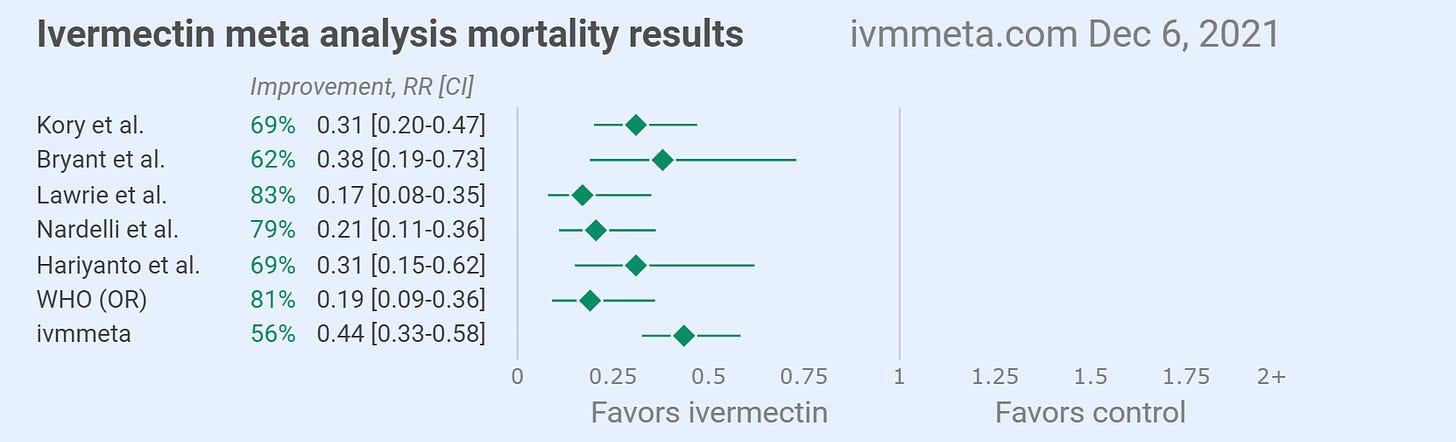
The clinical studies that do exist, and the consilience of the real-world data (RWD), show that early use of ivermectin reduces mortality by somewhere between 50 and 85%.
Patients are suing hospitals in multiple states to have judges decide whether a doctor should be ordered by the court to write a prescription for ivermectin.
In some cases, the family wins, and the patient recovers.
In some cases, the patient dies before a ruling.
This is moronic.
Look, we cannot use “Compassionate Use” laws due to the delay that the paperwork processing by FDA requires.
A legal analyst published their opinion on Montana’s “Right to Try” law. This was reviewed recently in the context of COVID-19. From The Billings Gazette:
In a recent newsletter from the Montana Medical Association obtained by the Montana State News Bureau, Justin Cole, a partner at Garlington, Lohn, & Robinson, PLLP, wrote “in short, the ‘Right to Try’ Act under either federal or state law does not compel a provider to prescribe any particular medication or therapy.”
Cole went on to write the act “does not create substantive rights for a patient to compel a provider to administer any given medication. Rather, it permits a provider to either prescribe or not prescribe, providing immunity for the provider, in either case, based on a narrow set of circumstances that must be met before the Right to Try Act applies.”
The act, Cole continued, “should not supplant a provider’s medical decision-making (whether to prescribe or not prescribe certain medications or therapies) within appropriate standards of care, based on the facts and circumstances presented to the clinician.”
The Montana Right to Try law requires a patient to have received a recommendation for a drug from their treating health care provider, among other requirements.”
Let’s say the analysis is correct. Since public health and the medical juggernaut has decided to misrepresent and ignore the science on the life-saving benefits of ivermectin, the people need to take matters into their own hands and pass bills into laws that in circumstances in which one of the outcomes of disease progression is death, patients (or patients families) can order a physician to write a script for any drug that the family has provided evidence that shows potential reduction in risk of death.
The On Demand laws should also have two additional steps:
no medical board can prosecute any physician for providing a script under these circumstances
doctors and hospitals are free from liability for adverse events or patient’s deaths if the patient invokes their On Demand rights
This has to happen in all states NOW. Consider sending this article to your State Congressional Representative and all of your contacts.
Science shows that ivermectin saves lives. The effect is stronger and more clear than that for remdesivir, and there is far, far more evidence that ivermectin is effective than for molnupiravir.
This video was produced as evidence in a legal case to obtain a temporary restraining order against Sentara Healthcare System. That is where Dr. Paul Marik, the most highly published Critical Care Intensivist in the world, is being prohibited from giving his critically ill ICU patients the medicines in the MATH+ Protocol he believes will save their lives—and for which mountains of scientific evidence exists. The video presents four brief synopses of the experiences of critically ill COVID-19 patients who survived after receiving components of the MATH+ Hospital Protocol in the ICU.
The son of one of the patients in the video had to file a court order compelling the hospital to provide his mother with ivermectin. Another patient was life-flighted to a MATH+ hospital in Houston after being denied the protocol at his local hospital. The story of a man—who was nearly placed on a ventilator but was given MATH+ components instead— is featured; as well as the story of a rapidly deteriorating COVID patient whose attending physician gave his patient ivermectin— and ultimately saved his life.
A Chicago area judge also recently saved a grandfather’s life by telling Edward’s Hospital to “step aside” and prescribe ivermectin. The doctor stated:
“Every day after ivermectin, there was accelerated and stable improvement,” said Dr. Bain, who administered the drug in two previous court cases after hospitals refused. “Three times we’ve shown something,” he told me. “There’s a signal of benefit for ventilator patients.”
Despite our corrupt public health ‘authorities’ and the corrupt American Medical Association (AMA), the American Pharmacist Association (APhA) and the American Society of Health-System Pharmacists (ASHP) threatening doctors and pharmacists, 12,700 doctors and scientists have signed the Rome Declaration and have endorsed ivermectin as a COVID treatment.