Archive for the ‘Ticks’ Category

Mid-Ohio Valley Sees Rise in Lyme Disease

https://www.newsandsentinel.com/news/community-news/2020/09/mid-ohio-valley-sees-rise-in-lyme-disease/

Mid-Ohio Valley sees rise in Lyme Disease

Parkersburg resident Kristin Carvell inspects her dog Siren for ticks after a walk at City Park. (Photo Provided)

PARKERSBURG — Despite summer being over, warm weather and ideal circumstances for ticks remain and it is important to understand the potential consequences of bites.

According to the Mid-Ohio Valley Health Department, lyme disease cases have been on the rise in the region.

(See link for article)

____________________

**Comment**

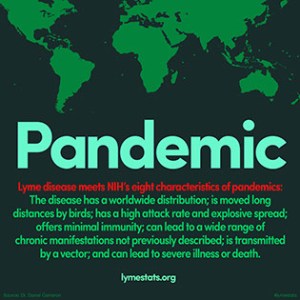
Remember ticks are in many other places besides wooded and grassy areas. Migrating birds drop them virtually anywhere. Also remember that Lyme is just the ‘tip of the spear’ and numerous pathogens can be transmitted simultaneously in a singular tick bite.

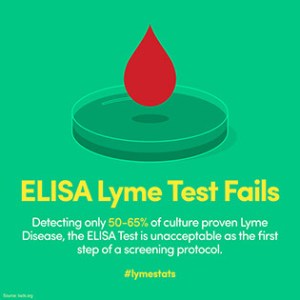
Reports have come in from around the world announcing the unabated spread of ticks and Lyme/MSIDS yet virtually nothing has changed in Lyme-land. Doctors still utilize abysmal testing, are uneducated on tick-borne illness – misdiagnosing a majority of patients, utilize ineffective treatment, and abuse patients by not listening to them and labeling them hypochondriacs.

Ticktective Podcast & Video Series

https://www.bayarealyme.org/blog/ticktective-podcast/

FOR IMMEDIATE RELEASE

Media Contact:
Tara DiMilia, 908-947-0500, tara.dimilia@TMstrat.com

Bay Area Lyme Foundation Launches Ticktective™ Podcast

PORTOLA VALLEY, Calif., September 30, 2020 — Bay Area Lyme Foundation, a leading sponsor of Lyme disease research in the US, announces the launch of the Ticktective podcast and video series.  Ticktective is a Bay Area Lyme Foundation program designed to investigate the latest scientific knowledge and advances in Lyme and tick-borne diseases. The podcast offers insightful discussion with researchers, physicians, patients, and thought leaders in the field.

“Because the science surrounding tick-borne disease is so complex and there are so many unanswered questions, Ticktective aims to share firsthand perspectives about the challenges of Lyme in ways that will intrigue more scientists, physicians and patients to join our battle towards making Lyme disease easy to diagnose and simple to cure,” said Linda Giampa, executive director, Bay Area Lyme Foundation.

There are more than 400,000 people diagnosed with Lyme disease each year in the US, and millions of Americans live with persistent Lyme disease (PLD) caused by an ongoing bacterial infection. The current “gold standard” diagnostic for Lyme disease misses up to 60% of cases of early stage Lyme disease, and if not treated promptly, Lyme may progress to a debilitating stage, becoming difficult, or impossible, to cure. Bay Area Lyme Foundation has funded over 100 research projects at 37 institutions across the US in a mission to find solutions for these patients.

“I’ve always had an insatiable curiosity, and my own diagnosis of Lyme disease has driven me to use this curiosity to find answers that will help lead to solutions for all tick-borne diseases,” said Ticktective host Lia Gaertner, who is the director of education and outreach for Bay Area Lyme Foundation and holds degrees in environmental science and ethnobotany.

Initial Ticktective interviews include conversations addressing the challenges of developing a diagnostic for Lyme disease, the scientific techniques being used to overcome these challenges, what motivates researchers taking on this challenge, and the frustration of patients.

  • 2020 Emerging Leader Award Winner Jacob Lemieux, MD, DPhil of Harvard University discusses the similarities and difference of Lyme disease and malaria, the promise of next-generation sequencing for developing a diagnostic, his lab’s role in COVID-19 research, and the intersection of COVID-19 and Lyme disease.
  • 2020 Emerging Leader Award Winner Artem Rogovsky, DVM, PhD of Texas A&M University discusses what he learned from radioactive ticks, why he is aiming to develop a direct diagnostic for Lyme, and how a conversation at a kids’ birthday party ignited the innovative idea for this diagnostic concept.
  • Liz Horn, PhD, MBI is principal investigator for the Lyme Disease Biobank, which aims to enable and accelerate research by providing scientists with the biological samples needed to conduct important experiments. The Biobank has enrolled over 900 participants and currently supports more than 55 research projects.
  • Singer-songwriter Dana Parish, who not only has numerous chart-topping singles, but has also become a strong advocate for people with Lyme disease after a tick bite in 2014 that progressed to a persistent infection despite antibiotic treatment. She discusses how she is “fighting the good fight,” and making progress in her personal battle and for the cause.

“I was driven to become a songwriter as I wanted to make people feel understood, knowing that the best songs are personal yet universal. With that same spirit, it’s been vital to me to use my voice to be honest about what I’ve learned about the travesty of tick-borne diseases. In an area of medicine filled with misinformation, Ticktective is bringing valuable insights and help straight to the Lyme community. I’m thrilled to have had the opportunity to share my Lyme experience with listeners of Ticktective,” said Parish, whom Gaertner refers to as a fierce champion for the under-represented Lyme community.

Listen to the Ticktective podcast here. Check out other resources of Bay Area Lyme Foundation, including printable fact sheets, videos, educational tools and more, and follow us on and Facebook, Twitter, LinkedIn and Instagram.

About Lyme Disease
The most common vector-borne infectious disease in the country, Lyme disease is a potentially disabling infection caused by bacteria transmitted through the bite of an infected tick to people and pets. If caught early, most cases of Lyme disease can be effectively treated, but it is commonly misdiagnosed due to lack of awareness and unreliable diagnostic tests. There are more than 400,000 new cases of Lyme disease each year, according to statistics released in 2018 by the CDC. As a result of the difficulty in diagnosing and treating Lyme disease, more than one million Americans may be suffering from the impact of its debilitating long-term symptoms and complications, according to Bay Area Lyme Foundation estimates.

About Bay Area Lyme Foundation
Bay Area Lyme Foundation, a national organization committed to making Lyme disease easy to diagnose and simple to cure, is a leading public not-for-profit sponsor of innovative Lyme disease research in the US.  A 501c3 non-profit organization based in Silicon Valley, Bay Area Lyme Foundation collaborates with world-class scientists and institutions to accelerate medical breakthroughs for Lyme disease. It is also dedicated to providing reliable, fact-based information so that prevention and the importance of early treatment are common knowledge. A pivotal donation from The LaureL STEM Fund covers overhead costs and allows for 100% of all donor contributions to Bay Area Lyme Foundation to go directly to research and prevention programs. For more information about Lyme disease or to get involved, visit www.bayarealyme.org or call us at 650-530-2439.

Two Exotic Disease-Carrying Ticks Identified in Rhode Island & First Case of Parasitic Soft Ticks Reported in New Jersey

https://www.sciencetimes.com/articles/27511/20200929/two-exotic-disease-carrying-ticks-identified-rhode-island.

Two Exotic Disease-Carrying Ticks Have Just Been Identified in Rhode Island

Sep 29, 2020

Local authorities in Rhode Island announced that two new tick species were identified on Block Island. The tick species were traced back to Eurasia and Asia origins.

Dr. Danielle Tufts from Columbia University identified the two species Haemaphysalis longicornis (Asian long-horned tick) and Haemaphysalis punctata (red sheep tick), reported the state’s Department of Environmental Management (DEM). (See link for article) 

Two Exotic Disease-Carrying Ticks Had Just Been Identified in Rhode Island

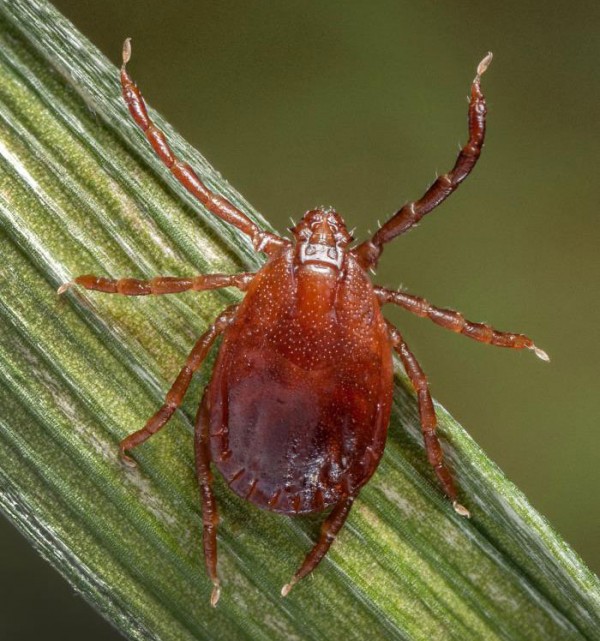
(Photo: Asian long-horned tick, adult female dorsal view climbing on a blade of grass – Photo by James Gathany; CDC)

____________________

**Comment**

Both ticks are considered live-stock pests but they can and do bite humans, transmitting diseases.  Farmers, hunters, and hikes are at greater risk.

  • The red sheep tick is identified with Tick paralysis, Tick Borne Encephalitis virus, Tribec virus, Bhanja virus, Crimean-Congo haemorrhagic fever virus, Babesia bovis, Theileria recondita, Coxiella burneti, Francisella tularensis.  http://www.bristoluniversitytickid.uk/page/Haemaphysalis+punctata/17/#.X3S-TS2ZOWgCattle: Babesia major, Babesia bigemina, Theileria mutans, Anaplasma marginale and Anaplasma centrale

    Sheep: Babesia motasi, Theileria ovis

H.-punctata-female-dorsal-0-300x225

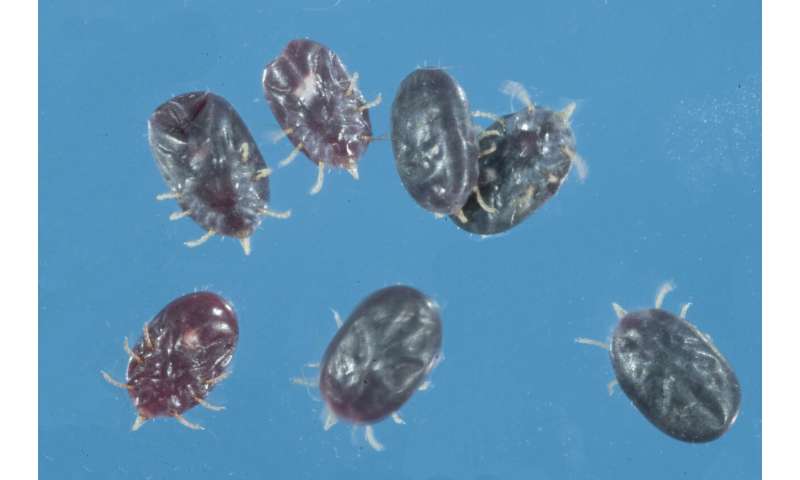
Red sheep tick, Adult female dorsal view

https://medicalxpress.com/news/2020-09-jersey-1.html

Bat tick found for the first time in New Jersey

Bat tick found for the first time in New Jersey

A tick species associated with bats has been reported for the first time in New Jersey and could pose health risks to people, pets and livestock, according to a Rutgers-led study in the Journal of Medical Entomology.

This species (Carios kelleyi) is a “soft” . Deer ticks, which carry Lyme disease, are an example of “hard” ticks.

“All ticks feed on blood and may transmit pathogens (disease-causing microbes) during feeding,” said lead author James L. Occi, a doctoral student in the Rutgers Center for Vector Biology at Rutgers University-New Brunswick. “We need to be aware that if you remove from your belfry, attic or elsewhere indoors, ticks that fed on those bats may stay behind and come looking for a new source of blood. There are records of C. kelleyi biting humans.”  (See link for article)

___________________

**Comment**

A few important points:

  1. A related species, Carios jersey, was found in amber 2001
  2. C. kelleyi has been found in 29 states so far
  3. Public health risk remains unknown, but it has been found to be infected with harmful pathogens in other states
  4. There are reports of this tick feeding on humans
  5. The bat it feeds on regularly roosts in attics and barns
  6. It has been identified with rickettsia and borrelia (Lyme):  https://www.sciencedirect.com/topics/agricultural-and-biological-sciences/carios
I can’t help but notice the bat connection, as well as the following:

https://www.newsbreak.com/news/2058858379813/first-case-of-parasitic-soft-ticks-reported-in-new-jersey  The current pandemic has been accompanied by cases of other illnesses and diseases such as African Swine Flu, Ebola, Bubonic Plague, West Nile Virus, Dengue outbreaks around the world.

Why Should We Care About Lyme Disease: A Colorful Tale of Government Conflicts of Interest, Probable Bioweaponization, and Pathogen Complexity

iu

Why Should We Care About Lyme Disease?

A Colorful Tale of Government Conflicts of Interest, Probable Bioweaponization, and Pathogen Complexity

September 25, 2020

By Alicia Cashman, MS, Lyme patient and Advocate

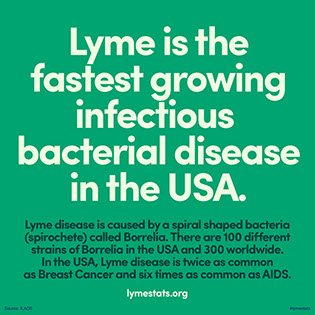
According to a report, one million are predicted to get Lyme disease in the U.S. and 2.4 million in Europe. This makes it more prevalent than Breast Cancer, AIDS, West Nile Virus, H1N1, and Ebola.  Authorities warn that ticks transmitting Lyme disease are spreading rapidly and to new geographical areas.  Nearly everyone is exposed to ticks just from gardening or hanging out in your backyard. And due to COVID-19 isolation, more and more people are getting outside which puts them at a higher risk for tick exposure. 
001_fastest316x316

Lyme disease was described in Europe as far back as the 1800’s as causing dermatological, neurological, rheumatological, and neuropsychiatric problems, but this early history has largely been lost and forgotten. It wasn’t until 1965 when Polly Murray began to be plagued by mysterious ailments, followed by the rest of her family and others in her hometown of Lyme, Connecticut that it began to get noticed. Unable to obtain help from doctors, she began a personal investigation and contacted the state health department.

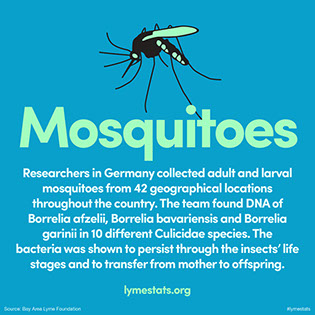
This eventually led to the 1982 discovery of the etiologic agent of Lyme neuroborreliosis in the Ixodid hard tick by Willy Burgdorfer.  Borrelia burgdorferi (Bb), named after it’s discoverer is commonly known as Lyme disease after the town, and is mostly transmitted by ticks although there is research to indicate sexual as well as congenital (mother to fetus) transmission. Bb has also been found in mosquitoes, horse flies, and deer flies amongst others.

42_congenital316x316

What Exactly is Lyme Disease?

There are two answers to this question.

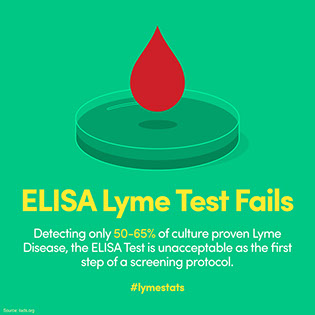
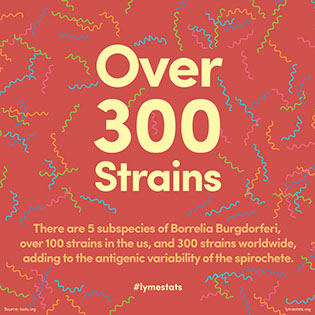
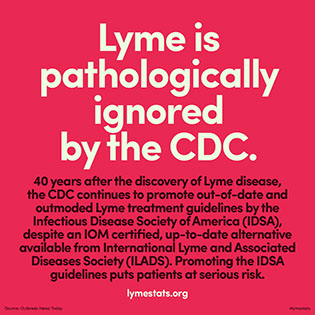
The first answer is the accepted narrative from our public health officials at the Centers for Disease and Control and Prevention (CDC), whom direct medical doctors regarding testing, diagnosis, and treatment. In lockstep with the CDC is the Infectious Diseases Society of America (IDSA). This accepted narrative simplistically states that a singular bacterium, Borrelia burgdorferi, from the bite of an infected tick causes a “classic” bullseye rash, fever, headache, and fatigue and merely requires 21 days of doxycycline to be cured.  While the CDC website states Lyme is diagnosed based on symptoms, physical findings (e.g., rash), and tick exposure, history has repeatedly shown a heavy reliance upon faulty testing that misses 70% – 86% of cases, due to omitting two of the most specific bands due to vaccine involvement. It also makes perfect sense due to the fact there are 300 strains of borrelia and counting worldwide, with 100 strains and counting in the U.S. Current CDC testing only tests for ONE strain. The CDC website makes it clear that only their “validated” testing should be used.
002_ignored316x316

The second answer is based upon real-life experience with patients which defies the accepted narrative. For this reason some doctors have formed their own group called the International Lyme and Associated Diseases Society (ILADS) which has differing guidelines and indeed an entirely different paradigm regarding tick-borne illnesses.  These doctors primarily diagnose clinically based upon symptoms but also use smaller CLIA-certified labs for more sensitive testing. In brief, these doctors have observed that Lyme disease can be relapsing in nature and persistent in the body making the CDC mono-therapy insufficient. Research has shown that not only are ticks coinfected with numerous pathogens but in fact patients are coinfected as well, further demonstrating the ineffectiveness of CDC treatment.
45_symptoms316x316

       39_lyme316x316

Why is There Polarization in the Medical Community Regarding Lyme Disease?

Recently, epidemiologist Dr. Wittkoski stated that money for research prior to the discovery of Lyme disease used to be independently obtained, but since has become ever more dependent upon government grants. The gate-keeper of this $5 billion annual pot of money is NIAID’s Dr. Anthony Fauci who has held this powerful position since 1984, which is in the same timeline as Lyme disease. Fauci is a fan of “big science” or randomized controlled trials (RCTs) as well as in a simplistic germ theory where one germ is solely to blame with one treatment curing it. Lyme disease often does not fit into this simplistic four cornered box.  It is also clear that those entrusted with public health have severe conflicts of interest owning patents on everything from test kits and vaccines, to the very pathogens they study to create products from which they profit financially, all the while making public health policy. They also own the patents on their approved and required “validated” testing that they have rigged for their patent purposes.


According to former Justice official John Loftus, Nazi scientists brought to the U.S. after WW2 may have test-dropped “poison ticks.” It should be noted that Loftus’ reputation for gathering accurate, hard-hitting information is strong. (See: “The Belarus Secret: The Nazi Connection in America.”)

When Polly Murray made her now-famous call to the Connecticut health department to report the strange epidemic among children and adults in her town, her initial reception was lukewarm. However, some weeks later, she got an unexpected call from a Dr David Snydman, of the Epidemic Intelligence Service (EIS), who was very interested. He arranged for fellow EIS officer Dr Allen Steere to get involved. By the time Mrs. Murray turned up for her appointment at Yale, the doctor she had expected to see had been relegated to the role of an onlooker. Allen Steere had taken charge – and his views were to shape the course of Lyme medicine for the next thirty years, up till today. (You can read about Murray’s journey in “The Widening Circle: A Lyme Disease Pioneer Tells Her Story”)

To understand the significance of all this, we need a closer look at the Epidemic Intelligence Service, the EIS.

The EIS is an elite, quasi-military unit of Infectious Disease experts set up in the 1950’s to develop an offensive biowarfare capability. Despite the banning of offensive biowar in the 1970’s, the crack troops of the EIS continue to exist, ostensibly for non-offensive research into “emerging disease” threats, a blanket phrase covering both bioweapon attacks and natural epidemics at the same time. Graduates of the EIS training program are sent in to occupy strategic positions in the US health infrastructure, taking leadership at federal and state health agencies, in academia, industry and the media. The organisation also extends its influence abroad, training officers for public health agencies in Britain, France, the Netherlands etc. 

In fact a high proportion of Steere camp Lyme experts are involved with the EIS. Given that the EIS is a small, elite force, (in 2001 the CDC revealed there were less than 2500 EIS officers in existence since the unit was first created in 1951 [xiii]), it seems incredible that so many of America’s top Infectious Disease experts would devote their careers to what they themselves claim is a “hard-to-catch, easily-cured” disease. Source


In 1995 when the director of Plum Island, Dr. Harley Moon, was asked for tick research records, he insisted there wasn’t any paperwork on tick experimentation.  Now, thanks to recently declassified documents, we know for a fact that the outbreak in Lyme, Connecticut is directly linked to a U.S. bioweapons program.  

We also know that between 1966 and 1969, the U.S. military released 282,800 lone star ticks made radioactive with Carbon-14 across Virginia sites along bird migration routes. The radioactive marking allowed researchers to track the ticks’ spread using Geiger counters over several years.

Before these experiments, lone star ticks were not found above the Mason-Dixon Line. Within years of the Virginia releases, they had established populations on Long Island for the first time. Two tick experts consulted about these releases said they “were aghast” and “you’d never be able to do that now.” Source

We have lone star ticks in Wisconsin now.

Further demonstrating this corruption is the fact there is a literal Cabal doing all the research for Lyme disease that protects each other and the accepted narrative.  Research funding for tick-borne illness is scant and therefore highly competitive. It is common knowledge that in order to receive government funding you must toe the line and parrot the accepted CDC narrative.

Recently, there has been push-back.

  • Congressman Smith has started a DOD inquiry into the bioweaponization of ticks.

  • A pathologist has accused the CDC of Lysenkoism to perpetuate Lyme disease and is suing them for $57.1 million.

  • Twenty four patients are behind a federal antitrust lawsuit against six members of the IDSA and eight insurance companies. They claim they have been denied care and were harmed under existing insurance and medical protocols. The lawsuit has resulted in numerous settlements which remain secret with sealed documents.

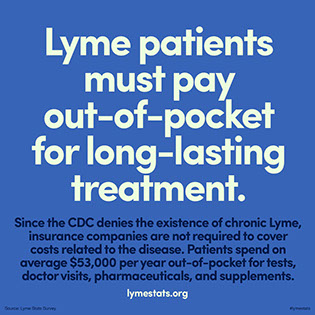
Thousands of other patients with Lyme disease have also been denied medical coverage due to the unscientific, antiquated, and tyrannical CDC Lyme guidelines. Insurance companies hide behind these guidelines and are the ones who call and rat doctors out who depart from them to state medical boards who then complete in-depth investigations which can lead to hefty fines, educational requirements, and even loss of medical licensing.  The real reason behind this is quite simple: insurance companies don’t want to pay. 

Why Lyme Disease is Complicated

Both factions agree on two things: 1) it’s best to simply avoid ticks in the first place with preventative measures. 2) if bitten, the earlier the diagnoses and treatment is, the better the outcome. The only rubs are, despite prevention people still get bitten, some are infected congenitally or potentially sexually, as well as through other insects. Early diagnosis is difficult due to the heavy reliance upon 40 year old abysmal testing. Doctors also continue to take a “wait and see” approach which delays things further.  They are also woefully uneducated on tick-borne illness and blindly follow the accepted narrative, often due to fear of persecution. These issues continue on unchanged. Due to the potential severity of illness this can cause, ILADS educates doctors to discuss immediate prophylactic treatment of black-legged tick bites with patients, as an appropriate course of antibiotics has been shown to prevent the onset of infection. 

Borrelia Persistence and Strain Diversity

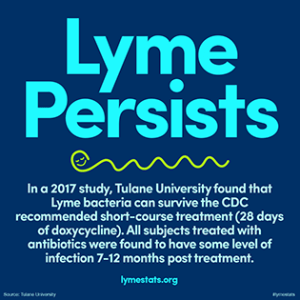
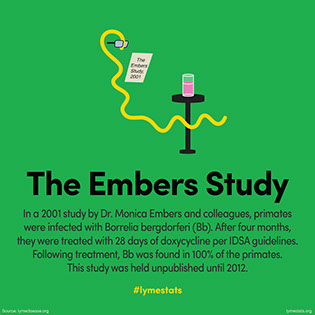
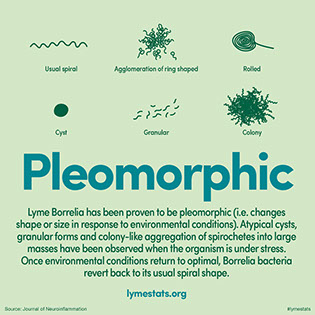
The reason for this prompt treatment is due to the fact that treatment failures have been seen in nearly every antibiotic study ever done. With Lyme disease, time is truly of the essence. Borrelia is a complex organism that research has shown to be slow-growing and shape-shifts to evade treatment. Borrelia exists in four different forms: spirochete (cork screw shaped), L-form (lives in cells), microscopic cyst form (non cell wall), and biofilm (a protective colony).  Borrelia can change shape whenever it feels threatened and can lie dormant until conditions are beneficial. This complexity allows it to sequester in tissues throughout the body and persist in immunopriviledged sites like synovial fluid and the brain. Public authorities; however, deny persistent infection and state that patients are either suffering from a syndrome or they are imagining it all.  Lyme patients have been told for decades it’s “all in their heads.”

Further complicating things, there are 37 known species, 12 of which are Lyme disease related to date, but this is continually being updated.  Strains differ in clinical symptoms and presentation as well as geographic distribution; however, putting Bb strain diversity into a geographical box is a huge mistake as the bird, reptile, fox, rodents, and humans are never confined to one location and migrate freely taking ticks and their pathogens with them. To this day people are still being told they can’t have Lyme disease because it doesn’t exist in their state.

Coinfection Involvement

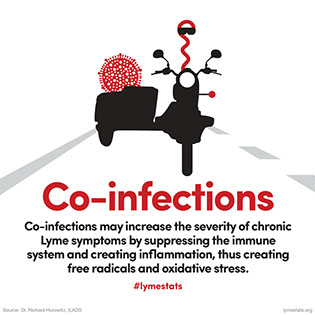
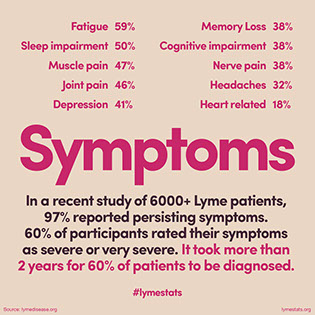
Garg et al. recently reported what has been seen in doctors’ offices all around the world: “microbial infections in patients suffering from Tick borne diseases (TBDs) do not follow the one microbe, one disease Germ Theory as 65% of the TBD patients produce immune responses to various microbes.” Patients are often infected with multiple pathogens, some of which are opportunistic and others which are tick-borne pathogens transmitted by the same tick bite. What scant research exists on this topic shows that coinfected patients have more severe illness for a longer duration of time. According to a study the most common co-infections were Babesia (32%), Bartonella (28%), and Ehrlichia (15%) while a study in Canada found that the most common were Bartonella (36%), Babesia (19%), and Anaplasma (13%).  Doxycycline won’t touch many of these coinfections, which is why patient after patient remains ill after taking standard CDC treatment. Yet, despite this common experience and smaller case studies on this topic, large randomized controlled trials have not been done, so public authorities just sniff, look the other way, and continue to dole out their ineffective mono therapy.

Hopefully this article clarifies why everyone should care about Lyme disease, why it is so difficult to get medical help, why it’s so hotly contested, and why it’s so hard to get appropriate treatment.


Go here for an excellent read on how our government has a long and sordid history of experimenting upon an unsuspecting public, how ticks have been manipulated in a lab and dropped from airplanes.

‘I Have Alpha Gal Syndrome, The Meat Allergy That Can Develop After Getting A Tick Bite’

https://www.womenshealthmag.com/health/a34062828/alpha-gal-syndrome-tick-bite-meat-allergy/

‘I Have Alpha Gal Syndrome, The Meat Allergy That Can Develop After Getting A Tick Bite’

“At first, I thought it was a strange coincidence that I kept getting sick after weddings.”
 
tick bite, tick bite photos, alpha gal syndrome ags, tick bite meat allergy
MEGHANN CHAPMAN

Early summer of 2017, I was a mother of five and wife living on a small family farm in southwest Virginia, where I worked as a wedding photographer. One evening after shooting a wedding, I had severe stomach pain and cramping, and then I started vomiting. I figured I had a bad case of food poisoning.

As a wedding vendor, I ate whatever the guests ate, which was typically some sort of barbecue, beef, or steak. That evening, I’d had a prime rib for dinner. But throughout the next several wedding weekends, I continued to experience waves of sickness. At first, I thought it was a strange coincidence that I kept getting sick after weddings. (See link for article)

_______________________

**Comment**

Here’s the tells:

  • severe stomach pains again after eating meat 
  • hands and feet began itching
  • hands and feet began to swell
  • entire body was covered in huge two- to three-inch welts
  • felt faint
  • throat and tongue swelled up

Here’s the rub….the patient is the one who read about AGS and went equipped to the doctor mentioning the possibility of tick-borne illness, particularly Alpha gal, but true to form, the doctor knew ZILCH about it. Due to this patient’s preparedness, the doctor quickly researched it and inquired what tests to use.  Sure enough, the patient tested positive.

This patient was so sensitive she couldn’t even handle breathing the air in the kitchen if someone cooked meat.  Then, she was bitten by another Lone Star tick and developed an allergy to dairy, her pet goats, dogs and horses.

Evidently some become normal in a couple of years but others never get over the allergy.

The patient carefully reads ALL labels and has to be her own advocate as even doctors will prescribe her things in mammalian gelatin or gelatin caps.

She states she’s had to develop healthy alternatives like oat milk, plant-based butter, and cashew cream for cheese.

meghann-3-1600376253

After her diagnosis, Meghann initially thought she could continue eating pork, but she experienced severe skin reactions due to AGS.  COURTESY

For more:  https://madisonarealymesupportgroup.com/2019/08/17/alpha-gal-syndrome-how-to-diagnose-treat-and-prevent-the-tick-borne-red-meat-allergy/

https://madisonarealymesupportgroup.com/2019/06/30/lone-star-tick-known-to-cause-red-meat-allergy-found-in-northern-wisconsin-report/

https://madisonarealymesupportgroup.com/2017/01/12/tick-related-red-meat-allergy-found-in-minnesota-wisconsin/

https://madisonarealymesupportgroup.com/2018/05/04/arkansas-woman-develops-deadly-meat-allergy-after-tick-bite/

https://madisonarealymesupportgroup.com/2019/07/12/sudden-red-meat-allergy-made-eating-painful-for-mom-and-its-all-because-of-a-tick-bite/

https://madisonarealymesupportgroup.com/2020/08/17/when-it-comes-to-ticks-lyme-disease-is-only-the-beginning/