LymeMIND: Looking Towards the Future
http://” data-wplink-url-error=”true”>a; gyroscope; picture-in-picture” allowfullscreen></iframe> Approx. 12 Min

https://www.lymedisease.org/mervine-coments-tbdwg-nov17/

Phyllis Mervine delivered the following remarks by telephone at the November 17 meeting of the Tick-Borne Disease Working Group.
Good morning. I am Phyllis Mervine, Founder and President of LymeDisease.org, the oldest Lyme patient advocacy nonprofit in the country.
I and other patients have submitted written and oral comments to the Working Group over the past few years. We have also served on subcommittees. I want to emphasize 5 points from these comments.
1. Pat Smith is one of my heroes, but no single person should have to carry the burden of representing the entire patient community on the Working Group. Please make sure more patients are represented next year. Patients deserve to have fair representation and strong voices on this group.
2. We also need more transparency in how Working Group members are picked. HHS ignored our petition of over 38 thousand signatures to remove Gene Shapiro. Dr. Shapiro has conflicts of interest and a long history of disrespectful conduct toward the Lyme community. He has served as an expert witness against ILADS doctors in medical board prosecutions and is a named defendant in a federal lawsuit that charges IDSA guidelines authors and insurance companies with conspiring to deny medical care to Lyme disease patients. Dr. Shapiro’s anti-patient bias on this Working Group has borne out our concerns about his participation. Patients deserve better.
3. Geographic limitations which hinder timely diagnosis should be removed. They make it more difficult for people in states the CDC labels “low endemic” to get diagnosed and treated. Northern California is a case in point. We’ve asked the CDC to revert to the county-based maps so high-risk counties within low-risk states can be identified more easily. We’ve asked the CDC to remove the geographic restrictions from their surveillance case definition to help patients to be diagnosed quickly and avoid chronic disease.
4. The CDC should not be taking sides between the IDSA and ILADS as they have been doing for years, in violation of federal guidelines about peer review. Most patients with chronic Lyme are treated by ILADS doctors because IDSA doesn’t provide any effective treatments for chronic Lyme. Let doctors know there are two standards of care.
And finally,
5. Tick-borne disease educational materials developed for doctors need to present the spectrum of scientific and clinical perspectives on tick-borne diseases, not just IDSA. The CDC should not take partisan positions in professional turf wars that benefit the IDSA to the detriment of sick patients.
Thank you for your attention.
By the way, my friend and neighbor with ALS, who I told you about in January, and who was belatedly diagnosed with tick-borne diseases, died in July. He was 72.
Phyllis Mervine has advocated for the rights of Lyme patients for more than 30 years.
___________________
For more letters to the TBDWG: https://madisonarealymesupportgroup.com/2020/11/06/the-proof-is-in-the-pudding-my-letter-to-the-tbdwg/
https://madisonarealymesupportgroup.com/2020/08/27/the-lyme-voices-you-didnt-hear-at-tbdwg-meeting/
https://www.lymedisease.org/torrey-idsa-insurance-settlement/

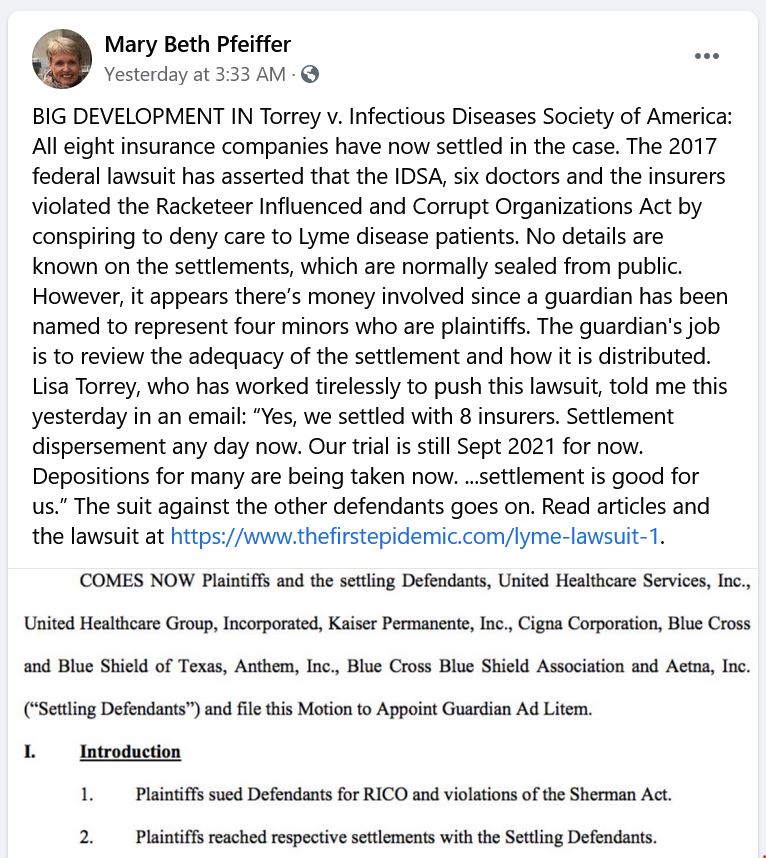
All eight insurance companies named in Torrey v. Infectious Diseases Society of America have settled the case, according to journalist Mary Beth Pfeiffer on Twitter.
That’s the federal lawsuit filed by a group of Lyme patients against the IDSA, six authors of the IDSA Lyme treatment guidelines, and the insurance companies.
The companies involved are:
The named individuals in the case are
As is typical in such circumstances, no details have been released. According to lead defendant Lisa Torrey, a trial date has been set for September 2021.
Please note that the 7 men listed make up The Cabal which continues to do faulty, biased research only on the acute stage of Lyme disease. Their studies are rigged to only accept those with EM rashes and positive blood serology testing which misses 70-86% of those infected. The studies have a short followup. They refuse to study the sickest patients who continue to be plagued with symptoms. They refuse to admit these people are even infected. To them these suffering patients are just imagining it.
https://www.lymedisease.org/tbdwg-patient-viewpoint-prevails/

The current session of the federal Tick-Borne Disease Working Group is drawing to a close. This panel has been meeting since June 2019 and its 2020 Report to Congress is due in December.
On November 17, it held what may have been its most significant meeting to date. This was as much for what it told us about the people on the panel and the entities they represent–as well as the public vote that was taken.
The most important and by far the most contentious item on the agenda was Chapter 7 of the upcoming Report to Congress.
This chapter encompasses many of the themes that the patient community cares most deeply about:
Indeed, the drive to address these problems was why Lyme advocates fought so hard for the formation of the Working Group in the first place. The idea was to bring divergent voices to the table—including those of chronic Lyme patients—to jointly hammer out ways to help members of a marginalized community obtain the care they need and deserve.
And it is precisely those patient concerns that certain members of the Working Group (and the agencies or organizations they represent) cannot stomach, which has been evident from the start.
An early example of this was when the Department of Health and Human Services selected the IDSA’s Eugene Shapiro, MD, for the panel. Shapiro has publicly denigrated Lyme patients for decades and actively worked against their interests. Among other things, he is a named defendant in Torrey v. IDSA et al, a federal lawsuit claiming he and others have colluded with insurance companies to deny care to Lyme patients.
Furthermore, at this panel’s first meeting in June of 2019, Co-chair David Walker announced that the previous Working Group had focused enough on Lyme disease. He didn’t think this panel should spend any more time on it. (He researches rickettsial infections and apparently wanted the group to pay more attention to that topic.)
Alas, such minimizing of the concerns of chronic Lyme patients has been evident from Walker and a few others ever since.
Eugene Shapiro skipped a lot of meetings early on, handing over his proxy to Walker. This meant Walker voted on behalf of Shapiro whenever the opportunity arose. Thus, for much of his time on the Working Group, Shapiro took no part in anything remotely resembling consensus-building—which at a minimum requires hearing and considering other viewpoints before casting a vote. You can’t consider other perspectives if you are not in in a position to hear them.
When he did participate, Shapiro disparaged any mention of persistent infection in Lyme, calling the concept “nonsense” and “unsubstantiated.” He opposed references to the ILADS guidelines and belittled any mention of the MyLymeData patient registry. “Propaganda,” he spat out. “No scientific validity.”
That all happened in previous meetings. Other efforts to gut Chapter 7 by diluting its contents (or throwing it out the window) took place behind closed doors. This violated the Federal Advisory Committee Act—FACA—which governs the Working Group and requires open meetings. The panel’s lone patient representative, Pat Smith, rightly called this out and forced the anti-Lyme cabal to address the issue in public.
Now, on November 17, the rubber was hitting the road. At this last full “working meeting” before finalization of the report, a big question in the Lyme community was “What will happen to Chapter 7?”
In a nutshell, Walker, Shapiro and Dennis Dixon (of the National Institutes of Health) tried again to torpedo it. They offered the same-old, same-old complaints, wanting to re-litigate issues such as the patients’ right to obtain access to the care they need to get well, shared medical decision-making, two standards of care, and—horror of horrors—persistent Lyme disease. (Even though the chapter’s major recommendations had been approved by the panel months ago.)
Walker termed these items “totally irrelevant to the chapter.” He and his team accused Pat Smith and her panel colleague Captain Scott Cooper of “railroading” their own ideas through the Working Group, and generally tried to block the chapter from being included in the recommendations to Congress.
Pat and Captain Cooper didn’t stand for it. They kept calling for a vote on the chapter in its current form, which the others resisted. At one point, Pat lost her cool and really read the riot act to Walker and the others. She justifiably pointed out that this chapter had gotten more scrutiny—both in public meetings and in behind-the-scenes shenanigans—than any other chapter in the report. They were trying to scuttle the issues that patients care most about—but seemed reluctant to go on the record as doing so.
She finally said (I’m paraphrasing): “Put up or shut up. Vote yes or no. Let the public and Congress see where you stand.”
And after some more foot dragging, the panel voted. And look at the results:
The motion passed, 8-6. The patient viewpoint prevailed. Chapter 7 of the Report to Congress remains intact. Those who voted against it are expected to submit a minority response, to be included at the end of the chapter.
By the way, Shapiro signed off the call after the vote on Chapter 7, even though there was more work to be done. It gave the appearance that he only dropped in to try to kill that chapter on behalf of the IDSA. When that didn’t work, oh well, who cares about the rest of this stuff?
The absolute final meeting of the 2019-2020 Working Group is scheduled for December 2. Click here for information about submitting written or verbal comments and to register to attend the meeting online.
TOUCHED BY LYME is written by Dorothy Kupcha Leland, LymeDisease.org’s Vice-president and Director of Communications. She is co-author of When Your Child Has Lyme Disease: A Parent’s Survival Guide. Contact her at dleland@lymedisease.org.
https://globallymealliance.org/jacks-story/

This blog post is part of our People to Highlight Series during our 2020 Year-end appeal. Each week we’ll be spotlighting a GLA community member who has helped to advance our mission. To support GLA: DONATE HERE
by Jack Terry
Lyme disease has impacted my life incredibly, both in the present and in retrospect. I experienced a variety of symptoms, including but not limited to overwhelming fatigue, bone and joint pain, frequent headaches, trouble focusing, and neuropathy. After a few years of depression symptoms that never seemed to greatly improve, it was time for a change. We tried a holistic approach, testing my physical health too; at long last, we got an answer when my Lyme test came back positive.
For years I wasn’t sure if what I was experiencing was real. I wasn’t seeing any improvement with my mental health, and over time more and more physical symptoms came up
Being diagnosed with Lyme disease has given me many answers for a variety of health episodes in the past, such as kidney failure. My diagnois has been debilitating because Lyme disease is challenging, yet productive because I feel more connected to my body and what I need to be doing for it to feel its best. For years I wasn’t sure if what I was experiencing was real. I wasn’t seeing any improvement with my mental health, and over time more and more physical symptoms came up.
One simple blood test has given me my life back, and I’d encourage anyone looking for a potential answer to consider looking into Lyme disease if they are dealing with unexplained symptoms.

My mom was the one who found Global Lyme Alliance. She is an avid researcher, and she searched endlessly for ways to help myself and people like me. That’s how she came across GLA. Global Lyme Alliance has given me hope. Knowing that there’s a community dedicated to helping those who suffer from this debilitating disease helps because I know that it’s not in my head. They make me feel heard, unlike some doctors I’ve seen in the past.
It’s so difficult to give back to an organization that already gives so much, but I decided to use the GLA platform to start a fundraiser for Lyme disease. I created the fundraiser for two reasons: to help fund important research for improving diagnostic tests and to spread awareness of how debilitating this disease is for those not treated soon enough. It frustrates me that countless people are undiagnosed and suffering from this illness without knowing the root cause; nobody should have to experience the pain endured from chronic Lyme.
I was overwhelmed with the number of people who showed their support to me and others like me. I raised over $8,300 for GLA. With this fundraiser, I felt like I was able to support a group that cares so much about this cause. If we all joined together, imagine the progress we could make!
As you may know, GLA is solely funded by donor support. Due to COVID-19, we have been unable to hold our usual fundraising events. Please donate below if you’d like to support GLA, our programs, and our mission.

