Archive for the ‘Ticks’ Category

No Lyme Disease in California? That’s a Misplaced Impression

https://www.lymedisease.org/raeena-lari-lyme-in-california/

No Lyme disease in California? That’s a misplaced impression

Oct. 25, 2021

By Raeena Lari

Lyme disease is the most common and the fastest-growing vector-borne disease in the country, and constitutes a significant public health threat, with  476,000 new cases each year from 2010 to 2018.

This is a zoonotic bacterial infection transmitted to humans by the bite of infected blacklegged ticks, also known as deer ticks, found in 56 of 58—or 97%—of all counties in California.

Ticks are arachnids that attach to humans or animals to feed on blood. They are called vectors because when they feed on a Lyme-infected animal, they transmit it to the next human or animal they bite. The primary infective agent of Lyme is the spirochete bacteria Borrelia burgdorferi.

There is a misplaced impression that Lyme disease does not exist in California. In reality, tick season is year-round in California; a recent study found disease-carrying ticks near beaches, in equal rates to woodland habitats, in parts of northwestern California.

A single bite can transmit many diseases, termed co-infections, which makes the illness severe and complicated. The bite, unlike that of a mosquito, does not cause immediate irritation. In addition, nymphal ticks are the size of poppy seeds that are hard to detect.

Symptoms can be immediate or gradual

Some people get immediate symptoms (such as bone-crushing fatigue, fever, sore throat, migratory musculoskeletal pain, cognitive problems and sleep disturbances), while others experience a gradual onset of the same symptoms and descent into ill health. The myriad symptoms mimic many different diseases, earning Lyme the moniker “The Great Imitator,” making it harder to diagnose.

Lyme diagnostic tests remain unreliable and the classic bull’s-eye rash only shows in a subset of patients. Even when present, it may appear in a part of the body not noticeable—like the back of the head—or not recognizable.

Early diagnosis and treatment is key for a quick recovery, and that is where awareness can be life-altering. If left untreated, Lyme disease can affect all organs of the body, including the brain, nervous system (causing meningitis and encephalitis) and heart (causing Lyme carditis and sometimes death).

To increase awareness, Santa Clara County has promoted National Lyme Disease Awareness Month and the Centers for Disease Control and Prevention’s online Tick Lunch and Learn Series on its Facebook pages. In addition, the Board of Supervisors passed a commendation in August 2020 to recognize the prevalence of Lyme disease.

I applaud Supervisor Dave Cortese (now State Senator) and the County of Santa Clara Board of Supervisors’ actions. I am confident that they will continue to bring attention to this important issue.

My family was exposed at a Santa Clara County park. The debilitating illness took us to 26 different doctors and specialists over an entire year, before a diagnosis was eventually made because of the widespread and mistaken notion that Lyme does not exist in California.

Let’s make this statewide

This needs to be extended throughout our state. Nonprofit organizations like LymeDisease.org and the Bay Area Lyme Foundation are working to raise awareness and support medical research. Their websites, as well as that of the California Department of Public Health, provide invaluable information including simple prevention strategies.

COVID and Lyme disease have many overlapping symptoms and similarities, creating the potential for misdiagnosis. In a subset of Lyme patients, symptoms can persist even after treatment, reminiscent of long-haul COVID. Long-haul COVID and chronic Lyme also have overlapping longer term symptoms such as extreme fatigue, pain and cognitive dysfunction.

We must recognize the struggle of millions suffering because long-haul COVID and chronic Lyme have become persistent infections for them. Our medical system needs resources and support to treat, cure and eradicate the diseases, otherwise the number of chronically ill and disabled people will continue to grow exponentially, triggering economic and social ramifications that will impact us all.

Raeena Lari, a resident of San Jose, serves as vice chairperson of the County of Santa Clara Health Advisory Commission. This article was published in the San Jose Spotlight.

Increase in Tick Bites During COVID-19 Pandemic

https://danielcameronmd.com/increase-in-tick-bites-during-covid-19-pandemic/

Increase in tick bites during COVID-19 pandemic

tick-bites-COVID-19

In a recent article, “Effects of COVID-19 Pandemic on Reported Lyme Disease, United States, 2020,” McCormick and colleagues assessed how the pandemic might influence the risk of tick bites and affect patients seeking medical care and the reporting of Lyme disease cases.

“The data suggested that individuals were more likely to spend time outside, more likely to visit the CDC website describing tick bite removal, were less likely to visit an ER, and tested for Lyme disease,” according to the authors.¹

Approximately 50% of U.S. residents spent more time outdoors in 2020 than in 2019, but fewer tick bite–related emergency department visits and Lyme disease laboratory tests were reported, according to a survey by Porter Novelli.¹ “Only 20.9% of respondents reported spending less time outdoors in 2020.”

Furthermore, there was an 25% increase in visits to the CDC’s website page which describes tick bite removal procedures.

ED visits for tick bites

Despite an increase in tick bite exposures, there was a decrease in the number of individuals visiting the Emergency Department (ED) for tick bites and fewer tests for Lyme disease. “The largest relative decreases were observed in May,” according to the authors.

During the month of May, between 2017 and 2019, there was an average of 12,693 ED visits for tick bites. However, in May 2020, only 5,845 ED visits for tick bites occurred. And, the number of Lyme disease tests decreased by 25%.

“These findings suggest that the risk of acquiring Lyme disease was similar or potentially higher in 2020 compared with risk during prior years, but fewer persons sought care, and fewer positive laboratory reports were referred for case investigation.”

The authors point out, “Lyme disease case reporting for 2020 might be artificially reduced due to coronavirus disease–associated changes in healthcare-seeking behavior,” the authors point out.

 Editor’s perspective

I have had Lyme disease patients who have put delayed visiting the Emergency Department or their doctor’s office during the COVID-19 pandemic.  I’ve also had Lyme disease patients who were initially tested for COVID-19 but not Lyme disease. Their treatment for Lyme disease was delayed, making it more difficult to treat them.

New Maps Show Where Citizen Scientists Found Infected Ticks

https://www.lymedisease.org/balf-interactive-tick-maps/

New maps show where citizen scientists found infected ticks

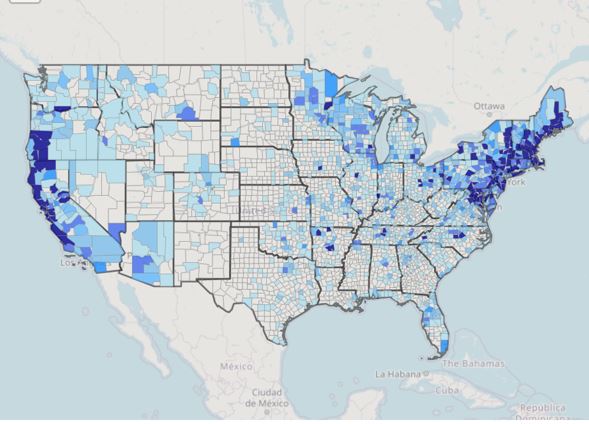
Want an easy way to see where disease-carrying ticks have been found throughout the United States?

Check out the new interactive tick maps recently launched by the Bay Area Lyme Foundation.

The maps are based on data published in mSphere, a multidisciplinary open-access journal of the American Society for Microbiology.

The information came from ticks submitted by citizen scientists as part of BALF’s Free Tick Testing Program, which ran from 2016 to 2019.

The study found infected Ixodes ticks in 116 counties which were not previously identified by the Centers for Disease Control as having them.

The testing program collected more than 20,400 ticks. 8,954 were Ixodes ticks, capable of carrying the most common tick-borne pathogens.

The research was conducted through a partnership between Bay Area Lyme Foundation, Northern Arizona University, Colorado State University and the Translational Genomics Research Institute (TGen).

The study evaluated the distribution and prevalence of the four most common tickborne pathogens:

  • Borrelia burgdorferi sensu lato, the group which causes Lyme disease
  • Borrelia miyamotoi, which causes tick-borne relapsing fever
  • Anaplasma phagocytophilum, which causes human granulocytic anaplasmosis
  • protozoan pathogen, Babesia microti.

The program tested two types of ticks:

  • Ixodes scapularis, also known as the blacklegged tick or the deer tick, which are found in the Northeast, Midwest and South;
  • Ixodes pacificus, also known as the western blacklegged tick, which lives in the West
The interactive maps only represent data from this citizen science study. They do not represent the total risk of tick-borne infections in the US.

An eye-opening look

“These maps will be eye-opening for many Americans as it makes it easy to see that ticks carrying disease-causing bacteria can be commonly found across the US,” stated Tanner Porter, MS, a research associate at TGen and the lead author on the study.

“If you aren’t aware of the possibility of ticks, either in your backyard or whilst traveling, you are unlikely to look for them – but an unseen tick can still transmit a pathogen and cause disease. It is important for everyone to know to look for ticks, be aware of the pathogens that they carry, and takes steps to mitigate their risk.”

This new study expands on previous research identifying ticks capable of carrying Lyme and other tick-borne diseases in 83 counties (in 24 states) where these ticks had not been previously recorded.  These included:  Alabama, Arizona, Georgia, Illinois, Indiana, Iowa, Kansas, Kentucky, Louisiana, Michigan, Minnesota, Montana, Missouri, Nevada, North Carolina, Ohio, Oregon, South Carolina, Tennessee, Texas, Utah, Virginia, Washington, and Wisconsin.

The study builds on recently released CDC data that added 100 counties to the list of those with disease-carrying ticks.

PRESS RELEASE SOURCE: Bay Area Lyme Foundation

Sexual Transmission of Lyme Borreliosis? The Question That Calls For An Answer

tropicalmed-06-00087-v2 (1)

Sexual Transmission of Lyme Borreliosis? The Question That Calls for an Answer

Natalie Rudenko * and Maryna Golovchenko

Citation: Rudenko, N.; Golovchenko, M. Sexual Transmission of LymeBorreliosis? The Question That Calls for an Answer. Trop. Med. Infect. Dis. 2021, 6, 87. https://doi.org/10.3390/ tropicalmed6020087

Copyright: © 2021 by the authors.
Licensee MDPI, Basel, Switzerland.

This article is an open access article distributed under the terms and conditions of the Creative Commons Attribution (CC BY) license (https://creativecommons.org/licenses/by/4.0/).

Biology Centre Czech Academy of Sciences, Institute of Parasitology, Branisovska 31, 37005 Ceske Budejovice, Czech Republic; marina@paru.cas.cz
* Correspondence: natasha@paru.cas.cz; Tel.: +420-387775468

Abstract:

Transmission of the causative agents of numerous infectious diseases might be potentially conducted by various routes if this is supported by the genetics of the pathogen. Various transmission modes occur in related pathogens, reflecting a complex process that is specific for each particular host–pathogen system that relies on and is affected by pathogen and host genetics and ecology,
ensuring the epidemiological spread of the pathogen. The recent dramatic rise in diagnosed cases of Lyme borreliosis might be due to several factors: the shifting of the distributional range of tick vectors caused by climate change; dispersal of infected ticks due to host animal migration; recent urbanization; an increasing overlap of humans’ habitat with wildlife reservoirs and the environment of tick vectors of Borrelia; improvements in disease diagnosis; or establishment of adequate surveillance. The involvement of other bloodsucking arthropod vectors and/or other routes of transmission (human-to-human) of the causative agent of Lyme borreliosis, the spirochetes from the Borrelia burgdorferi sensu lato complex, has been speculated to be contributing to increased disease burden. It does not matter how controversial the idea of vector-free spirochete transmission might seem in the beginning. As long as evidence of sexual transmission of Borrelia burgdorferi both between vertebrate hosts and between tick vectors exists, this question must be addressed. In order to confirm or refute the existence of this phenomenon, which could have important implications for Lyme borreliosis epidemiology, the need of extensive research is obvious and required.

_________________

**Comment**

SO DO IT ALREADY!

How long must we wait?  I think 40 years is sufficient.

Reminder:  the climate has little to nothing to do with tick and disease proliferation.  Ticks are remarkably ecoadaptive according to independent researchMigrating birds and photo-period have a great hand in it and would explain why tropical ticks are found in Canada (and other Northern climates) and Canadian ticks are found in the topics. Climate change is a popular topic that fits into the current accepted narrative, which is why it is being pushed regarding ticks, despite evidence to the contrary (which is frankly ignored by mainstream research).  Researchers need grant money, and in order to obtain that, they must genuflect to corrupt, mafia overlord Dr. Anthony Fauci, which simply means they must tout the accepted narrative or miss out on funding.  According to a former French Health Minister, real science no longer exists due to the fact Big Pharma is also exerting pressure on scientific publications.

Sad but true.

http://

Symposium on Tick-borne Diseases

Nov. 6, 2014

At approx. 6:10, Dr. Burrascano delves into sexual transmission and discusses animal studies that show animal to animal transmission. Viable Lyme organisms have also been found in human secretions.

For more:

New Tick-Borne Virus Discovered in Japan

http://www.sci-news.com/medicine/yezo-virus-10132.html

New Tick-Borne Virus Discovered in Japan

Oct 4, 2021 by Enrico de Lazaro
Scientists have isolated a new orthonairovirus from two patients showing acute febrile illness with thrombocytopenia and leukopenia after tick bite in Hokkaido, Japan.
Transmission electron microscopy of YEZV particles negatively stained with 2% phosphotungstic acid. Image credit: Kodama et al., doi: 10.1038/s41467-021-25857-0.

Transmission electron microscopy of YEZV particles negatively stained with 2% phosphotungstic acid. Image credit: Kodama et al., doi: 10.1038/s41467-021-25857-0.

Orthonairoviruses are tick-borne viruses in the genus Orthonairovirus, the family Nairoviridae.

They cause sometimes fatal febrile illnesses in humans and other animals.

Of 15 species within the genus, four species comprise known human pathogens:

  • Crimean-Congo hemorrhagic fever virus
  • Nairobi sheep disease virus
  • Dugbe virus
  • Kasokero virus

The newly-discovered orthonairovirus, named Yezo virus (YEZV), is the causative agent of an acute febrile illness characterized by thrombocytopenia, leukopenia, and elevation of liver enzymes and ferritin.

“At least seven people have been infected with this new virus in Japan since 2014,” said Dr. Keita Matsuno, a virologist in the International Institute for Zoonosis Control at Hokkaido University.

The Yezo virus was discovered after a 41-year-old man was admitted to the hospital in 2019 with fever and leg pain after being bitten by an arthropod believed to be a tick.  (See link for article)

__________________

Highlights:

  • Patient also had gait disturbance, and appetite loss
  • A second patient had similar symptoms
  • Genetic analysis of blood samples showed a virus closely related to Sulina virus and Tamdy virus, detected in Romania and Uzbekistan, respectively.
  • They found antibodies in local deer, raccoons, and the RNA in 3 major species of ticks
  • Researchers state it’s highly likely that the virus causes illness when transmitted via ticks
  • The team’s paper was published in the journal Nature Communications

_____

F. Kodama et al. 2021. A novel nairovirus associated with acute febrile illness in Hokkaido, Japan. Nat Commun 12, 5539; doi: 10.1038/s41467-021-25857-0