Archive for the ‘Ticks’ Category

The Unusual Cell Wall of the Lyme Disease Spirochete Borrelia Burgdorferi is Shaped by a Tick Sugar

https://www.nature.com/articles/s41564-021-01003-w

The unusual cell wall of the Lyme disease spirochaete Borrelia burgdorferi is shaped by a tick sugar

Tanner G. DeHart, Mara R. Kushelman, Sherry B. Hildreth, Richard F. HelmBrandon L. Jutras

Published Nov. 24, 2021

Abstract

Peptidoglycan—a mesh sac of glycans that are linked by peptides—is the main component of bacterial cell walls. Peptidoglycan provides structural strength, protects cells from osmotic pressure and contributes to shape. All bacterial glycans are repeating disaccharides of N-acetylglucosamine (GlcNAc) β-(1–4)-linked to N-acetylmuramic acid (MurNAc). Borrelia burgdorferi, the tick-borne Lyme disease pathogen, produces glycan chains in which MurNAc is occasionally replaced with an unknown sugar. Nuclear magnetic resonance, liquid chromatography–mass spectroscopy and genetic analyses show that B. burgdorferi produces glycans that contain GlcNAc–GlcNAc. This unusual disaccharide is chitobiose, a component of its chitinous tick vector. Mutant bacteria that are auxotrophic for chitobiose have altered morphology, reduced motility and cell envelope defects that probably result from producing peptidoglycan that is stiffer than that in wild-type bacteria. We propose that the peptidoglycan of B. burgdorferi probably evolved by adaptation to obligate parasitization of a tick vector, resulting in a biophysical cell-wall alteration to withstand the atypical torque associated with twisting motility.

__________________

**Comment**

Evidently this change is unprecedented and has not occurred in any other known organism.  The modification, which comes from the tick itself, allows for elasticity which supports motility of borrelia to move through tissue and cartilage.  A carbohydrate unique to ticks is absorbed by borrelia.

This finding could lead to potential diagnostic tests and treatments that target this unique sugar.

Nebraska Wakes up From Long Coma. Admits Lyme Disease Exists There

https://dhhs.ne.gov/Pages/Joint-Release—Bacteria-That-Causes-Lyme-Disease-Detected.aspx

Joint Release – Bacteria That Causes Lyme Disease Detected

For Immediate Release: 12/10/2021
 

MEDIA CONTACT

Jeff Powell, (402) 471-6223, jeff.powell@nebraska.gov

Emilee Longuski, (402) 385-4770, Emilee.Longuski@WinnebagoTribe.com

Julie Rother, (402) 375-2200, Julie@nnphd.org

Logos

Lincoln, Neb. – Recently, the Department of Health and Human Services (DHHS) was notified by the Northeast Nebraska Public Health Department of two cases of Lyme disease locally acquired within their jurisdiction. Both patients reported likely exposure around the same time frame at sites located near one another in Thurston County.

Due to the association between both cases, a coordinated environmental investigation involving DHHS, the Northeast Nebraska Public Health Department, and the Winnebago Public Health Department was completed at the suspected exposure sites. Ixodes scapularis (commonly called deer tick or the blacklegged tick) were collected from the sites of likely exposure.

Thurston County is now the fourth known county (Douglas, Sarpy, and Saunders were identified in 2019) in the state to have established black-legged tick populations. A subset of the ticks collected was sent to the CDC’s Division of Vector-Borne Disease and Creighton University for testing in an attempt to detect pathogens vectored by the tick including the bacteria (Borrelia burgdorferi) responsible for causing Lyme disease.

Ticks submitted to Creighton University and CDC came back positive for Borrelia burgdorferi indicating that the bacteria that causes Lyme disease is circulating in the tick population in the area. These results mark the first ever detection of Borrelia burgdorferi in Nebraska’s blacklegged tick populations and the first definitive evidence of Lyme disease cases acquired locally in the state.

The detection of an established population of black-legged ticks in Nebraska with evidence of detectable pathogens heightens concern of further establishment of the tick vector and its associated pathogens in other areas of the state. DHHS will continue to work with the Northeast Nebraska Public Health Department, the Winnebago Public Health Department, and other state public health partners on surveillance efforts for blacklegged and other medically important ticks.

While tick activity may be slowing down with colder weather, blacklegged ticks can be active year-round. There are simple steps people can take to protect themselves against tick bites.

Prevention steps include:

  • Use an EPA approved insect repellent containing DEET, picaridin, IR3535, oil of lemon eucalyptus, para-menthane-diol, or 2-undecanone.
  • Treat clothing and gear such as boots, pants, socks, and tents with products containing 0.5% permethrin.
  • Dress in long-sleeved shirts, pants, and socks when outside.
  • Do frequent tick checks after being outdoors and remove attached ticks promptly with fine-tipped tweezers. Don’t forget to check pets for ticks after being outdoors as well.
  • Shower as soon as possible after being outdoors.

Ticks are generally found near the ground, in brushy or wooded areas. They cannot jump or fly. Instead, they climb grasses or shrubs and wait for you to brush against them. This is called “questing”. When this happens, they hang on to you with small claws and then find a spot to attach and take a blood meal.

What to do if you find an attached tick:

  • Remove the attached tick as soon as you notice it by grasping with fine-tipped tweezers, as close to the skin as possible, and pull it straight out. Early removal can minimize and often eliminate the chance of infection. After removing the tick, thoroughly clean the bite area and your hands with rubbing alcohol or soap and water.
  • Avoid using nail polish, petroleum jelly, or heat to make the tick detach from the skin. These methods are not effective and may increase the risk of disease transmission.
  • Watch for signs of illness such as rash or fever in the days and weeks following the bite, and see a healthcare provider if these develop. Be sure to let your healthcare provider know you were recently bitten by a tick.

For more information visit the following links:

CDC Ticks Website: https://www.cdc.gov/ticks/index.html

CDC Lyme Disease Website: https://www.cdc.gov/lyme/index.html

CDC Preventing Ticks on Pets Website: https://www.cdc.gov/ticks/avoid/on_pets.html

DHHS Press Release, “Blacklegged Tick Identified in Nebraska: https://dhhs.ne.gov/Pages/Blacklegged-Tick-Identified-in-Nebraska.aspx

Placeholder text for an image.To be replaced by appropriate text
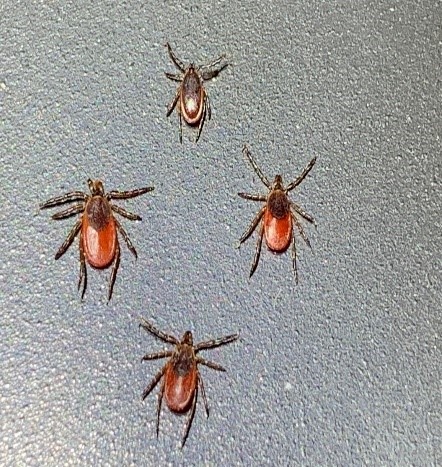
Image. Four (3 female; 1 male) Ixodes scapularis (black-legged ticks) collected from two exposure sites. The male Ixodes scapularis is located at the top of the image with the three other ticks being female Ixodes scapularis. Photo courtesy of Jeff Hamik (DHHS).


_____________________

**Comment**

And you thought Rip Van Winkle was a myth.

Deer Ticks Parasitizing Big Brown Bats in NY

https://academic.oup.com/jme/advance-article-abstract/doi/10.1093/jme/tjab174/6425286?redirectedFrom=fulltext

Ixodes scapularis (Ixodida: Ixodidae) Parasitizing an Unlikely Host: Big Brown Bats, Eptesicus fuscus (Chiroptera: Vespertilionidae), in New York State, USA

Journal of Medical Entomology, tjab174, https://doi.org/10.1093/jme/tjab174
Published:  11 November 2021

Abstract

Ixodes scapularis Say is a three-host tick that has been recorded feeding on over 150 different species of terrestrial vertebrates (mammals, birds, and reptiles). This tick is found throughout the northeastern, coastal southeastern, and upper midwestern United States and is considered the most significant vector of tick-borne pathogens to humans in North America. Despite its ubiquity and broad host range, I. scapularis previously has not been reported feeding on bats (Chiroptera). However, during 2019 and 2020, larvae and nymphs of I. scapularis were recovered from big brown bats, Eptesicus fuscus (Palisot de Beauvois), at four locations in rural New York State, USA. All Ixodes infested bats were injured and found on the ground; therefore, parasitism by I. scapularis was likely opportunistic. Nonetheless, the large number of pathogens known to be associated with bats and the frequency with which I. scapularis bites people suggest that this host–tick relationship is of at least potential epidemiological significance.

Tick Study Assumes ‘Climate Change’ Alters Tick Movement but Provides No Data

https://parasitesandvectors.biomedcentral.com/articles/10.1186/s13071-021-05096-4

Letter to the editor

Open Access

Published:

Errata in East Coast tick study: retort to Tufts & Diuk-Wasser

John D. Scott

Abstract

The authors overlook the first report of Haemaphysalis punctata in the Western Hemisphere documented by a pioneer acarologist in 1910. The authors assume that climate change alters movement of ticks, but provide no data. The authors’ assumptions are only opinions, and must be corrected and challenged.

Letter to the Editor,

Tufts & Diuk-Wasser purport that their discovery of the red sheep tick, Haemaphysalis punctata (Acari: Ixodidae), on Block Island, Rhode Island, USA, is the first report of this tick species in the Western Hemisphere [1]. However, Hadwen reported H. punctata at Winnipeg, Manitoba 111 years earlier [2]. Moreover, H. punctata was reported by C.L. Koch, at Para, Brazil in 1847. Therefore, Tufts and Diuk-Wasser have overlooked previously published scientific research on the presence of H. punctata in the Western Hemisphere.

Tufts & Diuk-Wasser allege that range expansion of ticks is due to climate change. In fact, the ambient temperatures on Block Island are modulated by the Gulf Stream, and there are no data (i.e. historical daily mean temperatures over the past 100 years) to substantiate climate change on this coastal island. In reality, multiple abiotic and biotic factors contribute to the distribution of H. punctata, including

  • dog travel
  • suitable hosts
  • photoperiod
  • songbird migration
  • livestock imports
  • seasonal weather variation
  • dislocation of parasitized songbirds during trans-Atlantic storms

Based on a recent Scandinavian tick-host study [3], researchers on bird ticks reported H. punctata parasitizing songbirds, and these avian hosts have the potential to widely disperse H. punctata, especially during bidirectional migration. In North America, passerine migrants disperse ticks, particularly during northward spring migration [4]. Pertinent to native ticks, the blacklegged tick, Ixodes scapularis, which is indigenous east of the Rocky Mountains, is eco-adaptive. For example, at Kenora, Ontario, this tick species survives temperatures ranging from − 44 °C to + 36 °C. This is a temperature differential of 80 °C. Any research to link ticks to climate change has been inconclusive and unsubstantiated.

Not only did the authors miss the initial discovery of H. punctata in North America, they unfortunately failed to justify any finite effect of climate change on ticks.

References

  1. Tufts DM, Diuk-Wasser MA. First hemispheric report of invasive tick species Haemaphysalis punctata, first state report of Haemaphysalis longicornis, and range expansion of native tick species in Rhode Island. USA Parasit Vectors. 2021;14:394.  Article  Google Scholar
  2. Hadwen S. Note on the finding of Haemaphysalis punctata at Winnipeg, Manitoba. Can Entomol. 1910;42:221–2.  Article  Google Scholar
  3. Wilhelmsson P, Jaenson TGT, Olsen B, Waldenstöm J, Lindgren P-E. Migratory birds as disseminators of ticks and the tick-borne pathogens Borrelia bacteria and tick-borne encephalitis (TBE) virus: a seasonal study at Ottenby Bird Observatory in south-eastern Sweden. Parasit Vectors. 2020;13:607.  Article  Google Scholar
  4. Scott JD, Clark KL, Foley JE, Bierman BC, Durden LA. Far-reaching dispersal of Borrelia burgdorferi sensu lato-infected blacklegged ticks by migratory songbirds in Canada. Healthcare. 2018;6:89.

______________________

For more:

Japan: Tick-Borne”Yezo Virus” Can Infect Humans

http://

Japan: Researchers discover new tick-borne “Yezo virus” that can infect humans

Oct 27, 2021
Researchers in Japan have discovered a new tick-borne virus that can infect humans and named it ‘Yezo virus,’ as explained a Hokkaido University virologist on Wednesday. The tick borne virus was first noticed in 2019 when a patient developed a fever after a tick bite and had a negative test result of the known tick borne viruses.
Mastuno described the symptoms as such:
“when you are infected with Yezo virus, it may take a couple of days to a maximum of two weeks to show some symptoms like fever or loss of appetite. And then you will have very high fever reaching to the 39 degrees Celsius. And it will last for one week or two weeks.
For more: