Archive for the ‘Ticks’ Category

Lyme & Herxheimer Reaction in Newborn

https://danielcameronmd.com/lyme-disease-herxheimer-reaction-newborn/

Lyme disease and herxheimer reaction in newborn

Newborn with lyme disease and herxheimer reaction being examined by doctor.

The Herxheimer reaction, also referred to as a Jarisch-Herxheimer reaction, is “a transient clinical phenomenon that occurs in patients infected by spirochetes who undergo antibiotic treatment.”¹ It was first described in patients with syphilis but has also been associated with other spirochetal infections including leptospirosis, Lyme disease, and relapsing fever. The reaction is associated with the onset of new symptoms or a worsening of existing symptoms in patients receiving antibiotic treatment.

In 2020, investigators published a case involving a 13-year-old boy with Lyme arthritis, a common manifestation of Lyme disease, who developed a Herxheimer reaction when treated with doxycycline. On the 7th day of treatment, the boy developed a low-grade fever and severe arthralgias with intense hip, ankle and cervical spine pain and myalgias.

You can read more about the 13-year-old boy’s case in an earlier blog “Herxheimer reaction in a 13-year-old boy with Lyme disease.” 

Newborn with herxheimer reaction

In their article “Lyme disease in a neonate complicated by the Jarisch–Herxheimer reaction,”  Prodanuk and colleagues² describe the case of a 21-day-old infant who was admitted to the hospital with decreased activity, poor feeding and abdominal distension.

The parents removed an engorged tick from the infant’s forearm 5 days earlier. An EM rash was present at the site of the tick bite.

“Given the erythema migrans lesion at the site from which the engorged tick was removed, we made a presumptive diagnosis of Lyme disease and administered IV ceftriaxone,” the authors write.

Two hours after treatment began, the infant developed a fever, tachycardia and other symptoms consistent with the Jarisch–Herxheimer reaction.

Testing for Lyme disease was negative.

Clinicians should also “be aware of the possibility of the Jarisch–Herxheimer reaction during the initial phase of treatment.”²

Several studies, they warn, indicate “newborns with findings consistent with early localized disease may also be at higher risk for disseminated disease.”

“Given the limited data for neonates and the possible predisposition of this population to disseminated Lyme disease, clinicians should strongly consider administering IV antibiotics to target Lyme disease,” the authors suggest.

Patients can experience a broad range of symptoms resulting from a herxheimer reaction, explains Nykytyuk and colleagues, including fever, severe polyarthralgias, myalgias, chills, hypotension, nonpruritic, nonpalpable rash, tachycardia, nausea, headache, strengthening of existing or occurrence of new symptoms of the underlying disease.¹

The exact cause of Jarisch-Herxheimer reactions is still unknown. “At first, the role of an endotoxin in the development of JHR was suggested, but later experimental studies showed that spirochetes do not have biologically active endotoxins,” the authors explained.¹

References:
  1. Dhakal A, Sbar E. Jarisch Herxheimer Reaction. [Updated 2022 Apr 28]. In: StatPearls [Internet]. Treasure Island (FL): StatPearls Publishing; 2022 Jan-. Available from: https://www.ncbi.nlm.nih.gov/books/NBK557820/
  2. Prodanuk M, Groves H, Arje D, Bitnun A. Lyme disease in a neonate complicated by the Jarisch-Herxheimer reaction. CMAJ. 2022 Jul 18;194(27):E939-E941. doi: 10.1503/cmaj.220112. PMID: 35851530; PMCID: PMC9299745.

______________

Lyme Disease Research in Review: Triumphs, Trials, and the Path Forward

https://www.lymedisease.org/lyme-disease-research-review/

Lyme disease research in review: triumphs, trials, and the path forward

As always, the world of Lyme is complicated with both good news and bad. Looking back over the past year, I want to highlight a few of the biggest scientific advances that stand out in my mind.

Co-Infections

First I want to share something that science keeps validating—the majority of patients with persistent symptoms following a diagnosis of Lyme disease have co-infections.

This means they are infected with two or more pathogens (such as bacteria, viruses, or fungi) at the same time. These co-infections (including COVID-19) complicate the immune response and likely increase the chance of developing chronic Lyme.

As I wrote about previously, North America is “ground zero” for babesiosis, which is likely playing a much greater role in patients with chronic Lyme than we know. In the MyLymeData study, over 60% of patients report they were diagnosed with an additional tick-borne infection along with Lyme. For most of them, it’s Babesia.

In July 2024, researchers conducting a Lyme disease pilot study at North Carolina State University discovered that all seven participants were infected with Babesia, and six out of the seven were co-infected with at least one (sometimes two or more) species of Bartonella.

Babesia is a parasite, similar to malaria. It requires a separate test and special anti-parasitic medications outside of the standard tests and antibiotics used for Lyme disease alone.

Diagnostics

As I wrote about in December 2023, Borrelia (Lyme) has some unique features allowing it to hide from our immune system. That stealth technique, which keeps the number of bacteria low in the blood stream, also makes it difficult for standard blood tests to detect Lyme disease. In April of 2024, Dr. Michal Tal and her team published another clue as to how Borrelia hides from the immune system.

Right now, all eyes are on the six teams competing in the LymeX diagnostic challenge as they move forward with their innovations. These will hopefully result in a more accurate test becoming available to the public than the standard outdated test that has been around since 1994. (Note: Lyme X Phase 3 winners will be announced soon.)

While an accurate Lyme diagnostic is absolutely needed, I cannot ignore the fact that ticks in North America are known to transmit over 18 different pathogens.

In August of 2024, a team of biologists at City University of New York Graduate Center produced a genetic analysis of 47 different strains of Borrelia. This may pave the way for improved diagnosis, treatment, and prevention of Lyme disease.

I hope that with this new genetic mapping, we will finally be able to take advantage of the next-generation metagenomic testing which is capable of detecting multiple pathogens.

Treatment

One of the top priorities of patients with chronic Lyme disease is finding an effective treatment.

Two recent studies have shown that combination therapy for Lyme, and combination therapy for Babesia work better than monotherapy.

But not everyone responds favorably to pharmaceuticals. One reason for this, may be a condition called alpha-gal syndrome (AGS).

AGS is triggered by the bite of a tick and causes an allergy to anything derived from red meats including some medications. An estimated 450,000 people have AGS in the U.S., making it the tenth most common food allergen.

If enacted, the Alpha-Gal Inclusion Act would require the FDA to list alpha-gal as a major allergen and require labeling to include it as an ingredient.

Mast cell activation syndrome

Another complicating factor common in patients with chronic Lyme is mast cell activation syndrome (MCAS). MCAS can make patients extremely sensitive to certain types of chemicals, foods and additives.

In fact, MCAS is such an important topic, in 2024 we devoted an entire issue of the Lyme Times to Mast Cell Activation Syndrome which you can download and read for free.

Alas, there is nothing simple about treating complex medical conditions triggered by the bite of a tick. Many of the patients I know who’ve gotten better took years before they found the root cause of their misery followed by the right combination of treatment that worked.

In 2023 we devoted an entire issue of the Lyme Times trying to answer the question: What does it take to get better?

My hope is that we continue to see scientific progress in finding better diagnostics and treatment. And if you are struggling with a chronic illness, please do not give up hope.

LymeSci is written by Lonnie Marcum, a physical therapist and mother of a daughter with Lyme. She served two terms on a subcommittee of the federal Tick-Borne Disease Working Group. Follow her on X: @LonnieRhea   Email her at: lmarcum@lymedisease.org.

_______________

**Comment**

To my knowledge, treating this complex illness has hardly moved forward in over 40 years.  The medical industrial complex is myopically focused on ‘vaccines,’ which are big money makers for both Big Pharma and the government, which owns patents on many aspects of them.  As long as this remains the singular focus, patients will not be treated properly.  Further, as long as ‘consensus basedmedicine reigns, innovative doctors who dare to use their God-given brains to help patients will continue to be persecuted, leaving patients to suffer.  As it is, the only true help for Lyme/MSIDS is to get to an independent, trained, and experienced Lyme literate doctor.

For more:

Medical Detective #4: How to Survive in a Tick-Filled World

https://www.lymedisease.org/survive-in-tick-filled-world/

MEDICAL DETECTIVE #4: How to survive in a tick-filled world

This article was originally posted on Dr. Richard Horowitz’s Medical Detective Substack. You can find more helpful content by subscribing here

If I were to conjure up a global menace in a teeny-tiny package, I wouldn’t have to look far for inspiration. It’s already there, crawling down the legs of a deer or a dog and up the stalk of grasses or shrubs or plants in your garden, all primed and ready to latch on to your tender skin and take a nice big chomp!

It’s a tick-filled world and we’re stuck living in it.

And you know what’s making it worse? Climate change. The warmer the weather, the easier it is for ticks to breed. Increases in global temperatures increase the reproductive rates of insects, so we are seeing an explosion of not only pathogen-filled ticks, but also mosquitos that are potentially transmitting West Nile, Zika virus, Chikungunya, Dengue, other viruses and even malaria in the US.

The same pest-pocalypse is happening to other biting insects like fleas, mites, lice, etc. that can transmit a broad range of organisms, including Bartonella (more about this in future articles).

So remember, these insects, including ticks, may contain multiple bacteria, viruses, and parasites, and getting one bite can lead to more than one disease.

In fact, in my 40+ year experience treating chronically ill individuals, co-infections with multiple bacteria, viruses, and parasites are the rule, not the exception. And people usually end up getting multiple bites from ticks over their lifetime because these unbelievably annoying creatures are spreading rapidly and present in every corner of the globe (even Antarctica!).

Gruesome–but necessary–reading

Learning about how ticks live and feed makes for pretty gruesome reading.

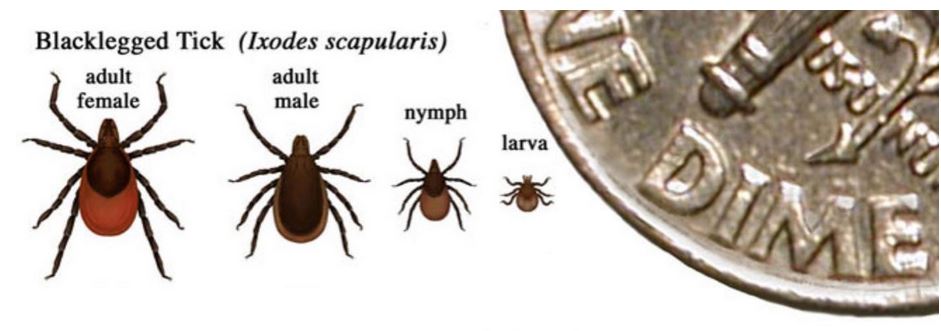
Suffice to say that they go through four life stages: egg, six-legged larva, eight-legged nymph, and adult. The only course they have on their menu is blood, thanks to their bites on either animals or humans.

If they bite an animal that’s already carrying a pathogen, they can then transmit that bug to the next unlucky recipient of their cunning. Hopefully that won’t be you!

[Image from the Forest Service, USDA.]

And get this–some of these ticks are hermaphrodites, like the rapidly spreading Asian bush tick, Hemophylis Longicornis, which means they can reproduce without mating. This also means that they are reproducing more rapidly than other ticks.

Although they haven’t been proven yet to transmit some of the multiple infections now being found in them (Borrelia burgdorferi, i.e., Lyme disease, tularemia, Rickettsia like Rocky Mountain Spotted fever, Heartland, and Bourbon viruses), time will tell.

In Asia, these same ticks can cause alpha gal syndrome, the “red meat allergy” as well as SFTS (Severe Fever and Thrombocytopenia Syndrome), a potentially fatal illness.

Bottom line: if you get bitten, you want to know what kind of tick it is, and what pathogens it contains.

Different varieties in different regions

As you’ve unfortunately realized by now, there are many varieties of ticks that live in different areas of the U.S. (I’ll discuss this in an upcoming posting, but for now you can check this map: https://www.cdc.gov/ticks/data-research/facts-stats/geographic-distribution-of-tickborne-disease-cases.html.)

Not every tick is a carrier of a pathogen–only the black-legged deer tick can transmit Lyme Disease, for example–so getting bitten doesn’t automatically guarantee that you’ll get sick. But enough ticks are infected in this country and abroad, and can spread any or more of these 20 diseases with just one bite, as you can see from this CDC list:

Where Are Ticks Lurking?

Ticks are tenacious, and can be found even in urban environments you’d think would be free of them. According to the New York City Department of Health, for example, there were 3,323 (2,482 new ones and 741 positive ones from previous years) reported cases of Lyme disease in NYC residents in 2023. This is up from 2,524 cases in 2022.

There were also 77 reports of anaplasmosis and 116 of babesiosis in 2023. I suspect that these cases were picked up while in any of the city’s many parks, but who knows?

These numbers are likely gross underestimates of how bad the problem truly is, because several of the diseases we will be discussing can’t easily be picked up on standard blood tests, and doctors may not know to always look for them since some of the symptoms are non-specific and overlap other illnesses.

As I’ve said in earlier posts, last year alone, the CDC reported 476,000 cases of Lyme disease in the US, and their recent implementation of a revised case definition reported that case counts are rising where the incidence was 1.7 times the annual U.S. average in 2017–2019, an overall 68.5% increase, rising with patient age.

If you’re going outside to an environment where ticks are hiding—going to a park, hiking on trails in fields or forests, or while gardening, for example—follow these tips.

Tick Lookout Tips

  • Ticks can’t ‘officially’ fly, although static electricity from animals results in ticks being pulled by these electric fields across air gaps measuring several of their body lengths, resulting in leaps that one could almost define as flying. They also don’t jump, so they have to crawl from host to host as their primary means of attachment. They lurk. They wait. (This is called “questing.”)
  • The little monsters are clever enough to detect a potential host by sensing body heat, moisture, odors, or carbon dioxide; or by the vibrations of someone passing by. Although the deer tick (Ixodes scapularis in the northeastern US) or Ixodes pacificus (in the Pacific US), can sense your presence from 12 feet away and come running, some of these ticks like the lone star tick (Ambylomma Americanum) can sense your heat and carbon dioxide from up to 50 feet away. They will come after you to bite you from quite a distance, even if you are not in high grass or directly exposed.
  • As soon as they can climb onto where they aren’t wanted, they either latch on in one spot, or take their time wandering around your body where skin might be thinner and easier to bite.
  • So when you go outside, stay in the middle of any trails, away from tall grasses, branches, and leaves. Try not to brush up against any foliage. Ticks also like to quest in border areas in the yard or park and near bird feeders.
  • If you have a yard, keep the grass short. If you have a compost pile, or piles of leaves, stay out of them!
  • Don’t sit directly on the ground, on large stones or fallen logs, or on stone or brick walls.

This is part one of a two-part series about ticks originally published on Substack by Dr. Richard Horowitz. You can read the second part in the next Substack

See also:

“Medical Detective” series brings information you need to know

MEDICAL DETECTIVE #1: An overview of Lyme disease signs and symptoms 

MEDICAL DETECTIVE #2: How Will I Know If I Have Lyme Disease?

MEDICAL DETECTIVE #3: Let’s Talk About Lyme Rashes

Dr. Richard Horowitz has treated 13,000 Lyme and tick-borne disease patients over the last 40 years and is the best-selling author of  How Can I Get Better? and Why Can’t I Get Better? You can subscribe to read more of his work on Substack or join his Lyme-based newsletter for regular insights, tips, and advice.

______________

**Comment**

Dr. Horowitz is incorrect concerning ‘climate change’ making ticks and the diseases they carry worse.  Independent research has clearly shown ticks are on the move due to migrating birds and photoperiod (not to mention agents of our own government purposely infecting ticks with pathogens and then kicking boxes full of them out of airplanes).  Further, research blaming ‘climate change’ for every ill under the sun is based on biased research using an erroneous model.

Utilizing erroneous models was also clearly seen during the COVID psyop and continues to this day.

A bought out, biased media is also using corrupt data to spread this climate alarmism.

Due to highly sought after government grants, researchers have also fallen prey to conducting biased research, making claims that are not supported by data.

A train of articles have come out on how research and medicine have been hijacked and are completely driven by an unholy alliance with Industrygovernment, and University research facilities Besides being unethical, which should be troublesome on its own, it causes patient suffering.

‘Science’ is funded primarily by industry and this conflict of interest means there is little honest research being done.

Lyme Disease Triggers GBS

https://danielcameronmd.com/lyme-disease-guillian-barre-syndrome/

Lyme disease triggers Guillian-Barre Syndrome

lyme-disease-guillain-barre

In a letter to the editor entitled “Lyme Disease as an Extremely Rare Cause of Guillain‑Barré Syndrome in India,” Sudheer Varma Y and colleagues describe the case of a 50‑year‑old woman who suddenly developed difficulty swallowing, slurred speech, and weakness and numbness in both upper and lower limbs.

Guillain-Barré Syndrome (GBS) is an autoimmune disorder in which your immune system mistakenly attacks the peripheral nerves surrounding the brain and spinal cord. GBS symptoms typically include weakness and/or tingling sensations in the legs, which can spread to the arms and upper body.

This patient also reported having three episodes of loose stools, two episodes of vomiting, and one episode of fever with chills and rigors.

A neurological exam found bulbar palsy of the ninth and tenth cranial nerves, reduced tone in all four limbs, absent deep tendon reflexes in the lower limbs, and absent bilateral plantar reflexes.

“Nerve conduction study suggested a demyelinating sensory‑motor polyneuropathy affecting both the upper and lower limbs, leading to a diagnosis of Guillain‑Barré syndrome (GBS),” the authors state.

The patient then developed lower motor neuron type of bilateral facial nerve palsy, which prompted testing for Lyme disease. Test results were positive and the woman was diagnosed with Guillain‑Barré Syndrome secondary to Lyme disease.

The patient was treated with intravenous immunoglobulin (IVIg), gabapentin, and a 14‑day course of IV ceftriaxone.

References:
  1. Varma YS, Kumar V, Agarwal K, Biswas R, Adil M. Lyme Disease as an Extremely Rare Cause of Guillain-Barré Syndrome in India. Neurol India 2024;72:1102.

For more:

Molecular Detection of Lyme, Babesia, and Anaplasma in Canadian Ixodes Ticks

https://www.jelsciences.com/abstracts/1838

Molecular Detection of Borrelia burgdorferi sensu lato, Borrelia miyamotoi, Babesia odocoilei, Babesia microti and Anaplasma phagocytophilum in Ixodes Ticks Collected across Canada

John D Scott* and Catherine M Scott

Volume5-Issue10
Dates: Received: 2024-09-28 | Accepted: 2024-10-18 | Published: 2024-10-22
Pages: 1321-1337

Abstract

Tick-borne zoonotic diseases are a profound challenge to healthcare practitioners, and an overwhelming scourge to patients worldwide. On the whole, patients have great difficulty getting diagnosed and treated, and often become chronically ill. In this study, we tested 224 ticks consisting of Ixodes angustus, Ixodes pacificus, and Ixodes scapularis. Using real-time PCR and nested PCR, we obtained the following positives:

  • Borrelia burgdorferi sensu lato (n = 74)
  • Borrelia miyamotoi (n = 4)
  • Babesia odocoilei (n = 82)
  • Babesia microti (n = 1)
  • Anaplasma phagocytophilum (n = 8)

Markedly, B. odocoilei and B. burgdorferi were detected in I. scapularis ticks nationwide. As well, the Canada-wide prevalence of B. burgdorferi s.l. and B. odocoilei in I. scapularis adults was 40% and 36%, respectively. The statistical ratio of B. odocoilei to B. microti in I. scapularis adults was 60 to 1. Babesia odocoilei is, unquestionably, the predominant Babesia sp. across Canada. We provide the first report of B. odocoilei in an I. angustus tick. In addition, we unfurl the first report of B. odocoilei in I. scapularis in British Columbia, Alberta, Saskatchewan, Manitoba, Prince Edward Island, and Newfoundland and Labrador.

From a professional healthcare standpoint, I. scapularis ticks are just as likely to be infected with Babesia odocoilei as Borrelia burgdorferi s.l. Since people spend considerable time in outdoor areas, clinicians must be familiar with current acumen in tick-borne zoonotic diseases.