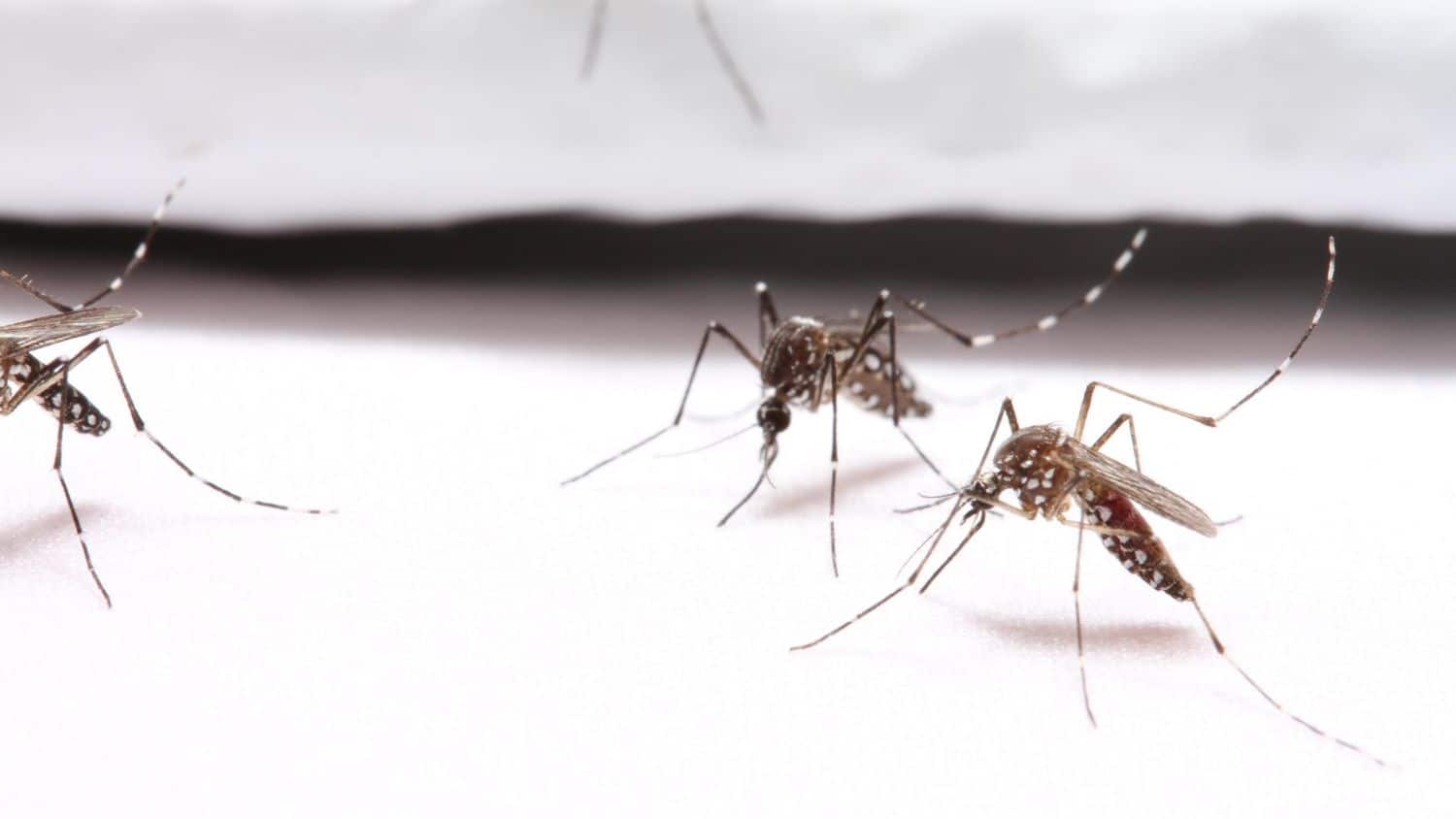
Archive for the ‘mosquitoes’ Category

Gates Funded Factory Breeds 30 Million Mosquitoes For Release in 11 Countries, GE Mosquitoes Vaccinate a Human & USDA Air Dropping “Edible” Vaccines That Are Hazardous if Ingested

https://rumble.com/v1gy22f-gates-funded-factory-breeds-30-million-mosquitos-per-week-for-release-in- Video Here  (Approx. 3 Min)

“The mosquitoes being produced in this factory carry bacteria called Wolbachia that block them from transmitting dengue and other viruses, such as Zika, chikungunya and yellow fever, to humans. By releasing them to reproduce with wild mosquitoes, they spread the bacteria, reducing virus transmission and protecting millions of people from illnesses.”

Article: https://www.gatesnotes.com/Health/Mosquito-Factory

Interestingly, these are the same viruses Ivermectin was shown to treat:
https://www.science.org/content/article/antiparasitic-drug-has-bonus-effect-mosquitoes
https://www.ncbi.nlm.nih.gov/pmc/articles/PMC7564151/

Please read this on Wolbachia, which may not be as safe as thought:

___________________

https://www.wpr.org/box-200-mosquitoes-did-vaccinating-malaria-trial-thats-not-joke

A box of 200 mosquitoes did the vaccinating in this malaria trial. That’s not a joke!

By Max Barnhart
Published:   Wednesday, September 21, 2022, 8:59pm

One Seattle morning, Carolina Reid sat in a room with nine other volunteers, each waiting to take part in a clinical trial for a new, experimental malaria vaccine.

Reid’s turn came. She put her arm over a cardboard box filled with 200 mosquitoes and covered with a mesh that keeps them in but still lets them bite. “Literally a Chinese food takeout container” is how she remembers it. A scientist then covered her arm with a black cloth, because mosquitoes like to bite at night.

Then the feeding frenzy began.

“My whole forearm swelled and blistered,” says Reid. “My family was laughing, asking like, ‘why are you subjecting yourself to this?'” And she didn’t just do it once. She did it five times. (See link for article)

____________________

SUMMARY:

  • The insects deliver live malaria-causing parasites genetically modified to not make people sick
  • The body creates antibodies against the weakened parasite
  • They used mosquitoes rather than a needle to save money
  • The small trial of 26 people showed efficacy for a few months (each gets paid $4,100 to participate)
  • The researchers believe this approach could result in a vaccine more effective than the current GSK RTS,S vaccine which has an efficacy of 30-40%.
    • RTS,S targets only one out of more than 5,000 proteins the parasite produces
  • Countries curb malaria by using netting, insecticidal sprays, anti-malarial drugs, and by releasing GM mosquitoes that supposedly can’t bite or lay eggs.
  • Others have attempted to make a vaccine from disarmed parasites using CRISPR, despite scientists warning that GM bugs could be weaponized, and that there are real risks with genetic manipulation.
  • To test this approach, participants had to get another round of bites but this time containing the real malaria parasite
    • out of 14 exposed to malaria 7 contracted it showing the vaccine was only 50% effective.  Our of the other 7, the protection only lasted a few months.
    • those that contracted it were given a drug to clear the infection
Similarly to COVID, cheap, effective treatments for malaria already exist but aren’t nearly as sexy or lucrative as GM bugs

https://www.naturalnews.com/2022-09-20-usda-air-dropping-vaccines-from-helicopters-across-13-states

USDA air dropping vaccines from helicopters across 13 states, using vaccine “bait” deemed HAZARDOUS if ingested

(Natural News) The USDA, like many federal agencies, is deeply invested in the business of extermination. For example, most people don’t realize that the USDA mass murders millions of birds every year through deliberate poisoning campaigns. Natural News has published the USDA’s list of bird extermination from 2009 (PDF), showing how the agency murdered over four million birds in 2009 alone.

That program is called “Bye Bye Blackbird,” and it’s just one of many mass extermination programs run by the USDA. Another program involves the USDA mass murdering foxes, coyotes, bears, mountain lions, bobcats and river otters. As Natural News reported in 2018:

According to the latest report, the federal program last year killed 357 gray wolves; 69,041 adult coyotes, plus an unknown number of coyote pups in 393 destroyed dens; 624,845 red-winged blackbirds; 552 black bears; 319 mountain lions; 1,001 bobcats; 675 river otters, including 587 killed “unintentionally”; 3,827 foxes, plus an unknown number of fox pups in 128 dens; and 23,646 beavers.

Also in 2018, the USDA was caught murdering hundreds of kittens in incineration ovens as part of a medical experimentation operation. As NaturalNews reported in 2018:

…[T]he USDA has been experimenting on kittens by feeding them parasite-riddled raw meat for two or three weeks so their feces can be collected. Then they are killed via incineration. And at the end of the “study,” Bishops says, the USDA admitted that the baby animals were healthy.

(See link for article)

____________________

SUMMARY:

  • Now the USDA is using a fleet of helicopters to drop rabies vaccines disguised as food flavored with fishmeal in the following 13 states:
    • Alabama
    • Maine
    • Pennsylvania
    • West Virginia
    • Virginia
    • Tennessee
  • This tasty morsel will also be eaten by many other wildlife animals – including pets
  • It doesn’t even bother to claim these vaccines are safe: see its Oral Rabies Vaccine and Bait Information page here.)
    • the Safety Data Sheet warns:  Potentially hazardous to health if any of the following should occur: Ingestion, parenteral inoculation, droplet or aerosol exposure of mucous membranes or if broken skin is exposed to infectious fluids or tissues.  That same warning sheet also says, “Localized skin lesions are possible” if exposed.

  • And of course, many of these “potentially hazardous” vaccines will wash into local waterways, which the safety sheet specifically warns against:  Do not allow undiluted product or large quantities of it to reach ground water, water course or sewage system.
  • Oh, and if you do find them, you are supposed to “Incinerate in EPA licensed Bio/Medical waste facility.”

But I’m sure “climate change” is to blame.

DARPA, Insects, Mad Science & Us

https://www.organicconsumers.org/bytes/mid-summer-madness-resistance?

GENETIC ENGINEERING

DARPA, Insects, Mad Science and Us

Tessa Lena writes in Mercola.com:

“Irresponsible use of new and very advanced technologies by the military is life-threatening.

Engineered viruses can be used to edit genes in a target species, including in a heritable manner.

‘Insect Allies’ is a DARPA (U.S. military’s Defense Advanced Research Projects) program designed to genetically modify mature plants in a live environment by releasing insects infected with genetically modified viruses.

Some scientists, although on board with genetic modification in principle, are questioning DARPA’s motives and raising concerns.

Researchers in Singapore, as well as DARPA in the U.S. have developed ‘remote-controlled insects.’

The craziest crazies have somehow escaped the asylum and installed themselves in high positions of power. Insane, they are coming up with one bad idea after another and barking orders at us, mad shine in their eyes and saliva coming out of their mouths. They are crazy — and in charge of institutions, schools, newspapers and armies.

They are running around with their high-tech pistols filled with high-tech poisons and their little sadistic CRISPR scissors. They are crazy — yes, they are crazy — and they are killing us slowly, and sometimes not so slowly. Welcome to the future where toxicity is health and the old crazy is the new normal. We are not crazy — they are crazy — and they have been from the beginning. And in 2020, they stopped pretending. What now?

You may think that you have seen it all but here is a great idea. Take some insects, infect them with a genetically modified virus designed to genetically edit mature plants in real time, and release them. Release them into wild and repeat, ‘it’s safe and effective.’

Sweet idea, right? Well, DARPA thought so, and so in 2016, they started a project called “Insect Allies” that is designed to do that. (This is a different project from Oxitec’s controversial release of GM mosquitos.)

DARPA’s official story is that in the name of national security, a good way to protect the American crops from potential threats is to genetically modify them using GM viruses as genetic modifiers and insects as flying syringes. And that they just need to test it!… Some suspicious peasants may foolishly wonder: What will happen in the short term and in the long term to the people who eat those plants, to the people and animals possibly bitten by those insects, to the wild insects who mate with the infected insects, and to all other life in the area and beyond that may get impacted? What ridiculous nonsense. Here is the answer, peasant: No one knows — and importantly, no one cares. Any more questions?”

Learn more: DARPA, Insects, Mad Science, and Us: Nowhere To Hide:

https://www.globalresearch.ca/darpa-insects-mad-science-us-nowhere-hide/5788125

http://

For more:

Trainee Pilot Dead After Mosquito Bite

https://www.bbc.com/news/uk-england-suffolk-62065525

Trainee pilot from Suffolk died after mosquito bite, inquest hears

Oriana Pepper at the controls of an airplaneImage source, Family Photo
Image caption,

Oriana Pepper’s family said she “loved nothing better than to go flying”

A trainee commercial airline pilot died after she was bitten by a mosquito and developed an infection that spread to her brain, an inquest heard.

Oriana Pepper, 21, of Bury St Edmunds, Suffolk, died five days after she was bitten while in Antwerp, Belgium last July.

Suffolk’s senior coroner Nigel Parsley said it was an “unfortunate tragedy for a young lady who clearly had a wonderful career ahead of her”.

(See link for article)

____________________

**Comment**

I post this unfortunate story for a few reasons:

  • Ticks aren’t the only bugs that can kill you.
  • Location of the bite, IMO, is important.  If you are bitten on the head, neuro/cognitive issues can develop sometimes within hours.
  • This woman was prescribed antibiotics but had to go back to the hospital where she collapsed and died only three days later.
  • Cause of death was recorded as septic emboli in the brain by staphylococcus aureus which is abundant on the body and usually harmless, but is the leading cause of skin and soft tissue infections such as boils, furnuncles, and cellulitis.
  • The cause of death also mentioned an insect bite to the forehead also contributing.
  • The article says nothing about insect-transmitted pathogens or if they tested her for them but which probably played more of a role than is being given credit.
  • Lyme disease often mimics cellulitis.
  • Mosquitoes carry EEE, whicc can cause severe brain inflammation and has a mortality rate of 30%. Many who do recover continuing to have neurological problems. Six Wisconsin counties have reported cases in horses.

  • Mosquitoes also transmit Western equine encephalitis, St. Louis Encephalitis, and West Nile Fever to humans.
  • Please see the following regarding mosquitoes and Lyme disease:

…results show that DNA of Borrelia afzelii, Borrelia bavariensis and Borrelia garinii could be detected in ten Culicidae species comprising four distinct genera (Aedes, Culiseta, Culex, and Ochlerotatus). Positive samples also include adult specimens raised in the laboratory from wild-caught larvae indicating that transstadial and/or transovarial transmission might occur within a given mosquito population.

BTW: the last study on the potential of other bugs transmitting Lyme (minus the German study on mosquitos) was done over 30 years ago.  And, while no spirochetes were isolated from the hamsters, antibodies were foundeven back then.

I would like to point out the extreme hypocrisy regarding antibodies. Regarding COVID, the PCR, an unmitigated disaster has been used daily for over two years to pick up antibodies. This faulty test which was never intended to diagnose patients has been used to quarantine people even if they aren’t sick.  When it comes to Lyme; however, finding antibodies in anything isn’t enough to prove infection.  Now why is that? 

One little detail is understanding the CDC owns patents on the very tests being used – demonstrating a clear conflict of interest. A few other details: the CDC only allows what serves its vested interests and conveniently disposes anything that doesn’t serve its purpose, and ignores science that doesn’t fit the accepted narrative. While blaming others, it blatantly and continually engages in “misinformation.”

Another ugly fly in the ointment is that according to Igor Kirillov, head of the Russian Armed Forces’ Radiation, Chemical and Biological Protection Unit, Ukrainian biological laboratories researched fever-carrying Aedes mosquitoes, the same genus of insects that the US is thought to have used to start a pandemic of type 2 dengue in Cuba in the 1970s and 1980s which killed 158 people and infected 345,000. The type 2 dengue had never been reported in the Caribbean region and the only location on the island free from the infection was the Guantanamo US military installation.

“The facts of the use of Aedes mosquitoes as biological weapons, exactly the same species with which the US Pentagon worked in Ukraine, were recorded in a class-action lawsuit by Cuban citizens against the US government and were submitted for reviewing of the signatories to the Convention on the Prohibition of Biological Weapons”, Kirillov said.  Source

Mosquitoes Test Positive for Rare, Potentially Deadly Virus in Connecticut

https://www.cbsnews.com/news/eastern-equine-encephalitis-virus-mosquitoes-connecticut/

Mosquitoes test positive for rare, potentially deadly virus in Connecticut

Eastern Equine Encephalitis, a serious but rare virus, has been detected in mosquitoes for the first time this year in Connecticut, according to state health officials.Mosquitoes trapped in the Pachaug State Forest in Voluntown on September 23 tested positive for the virus, the Department of Public Health announced Saturday. The agency is recommending that residents in southeastern Connecticut take precautions against mosquitoes. (See link for article)

_________________

**Comment**

EEE can cause severe brain inflammation and has a mortality rate of 30%. Many who do recover continuing to have neurological problems. Six Wisconsin counties have reported cases in horses.

Connecticut also has reported West Nile virus in 40 towns across the state.  Thankfully, no reports of WNV have been reported in Wisconsin this year; however, from 2015 through 2019, an average of 22 cases of West Nile virus have been reported each year. West Nile virus is preventable.

For more:

Mosquito Resistant Clothing Prevents Bites in Trials

https://news.ncsu.edu/2021/07/mosquito-resistant-clothing-prevents-bites-in-trials/

Mosquito-Resistant Clothing Prevents Bites in Trials

Bite-resistant textiles
Mosquitoes landing on bite-resistant fabric during an in vivo bioassay in which they fail to probe through the fabric due to its small pore size. The proboscis bends when mosquitoes try to push through the fabric. Credit: Matt Bertone.
FOR IMMEDIATE RELEASE
R. Michael Roe
Grayson Cave
Laura Oleniacz, NC State News Services

North Carolina State University researchers have created insecticide-free, mosquito-resistant clothing using textile materials they confirmed to be bite-proof in experiments with live mosquitoes. They developed the materials using a computational model of their own design, which describes the biting behavior of Aedes aegypti, the mosquito that carries viruses that cause human diseases like Zika, Dengue fever and yellow fever.

Ultimately, the researchers reported in the journal Insects that they were able to prevent 100 percent of bites when a volunteer wore their clothing – a base layer undergarment and a combat shirt initially designed for the military – in a cage with 200 live, disease-free mosquitoes. Vector Textiles, an NC State startup company, has licensed the related patent rights and intends to make clothing for commercial sale in the United States.

The researchers think their computational model could be used more widely to develop clothing to reduce transmission of diseases.

“The fabric is proven to work – that’s the great thing we discovered,” said study co-author Andre West, associate professor of fashion and textile design at NC State and director of Zeis Textiles Extension for Economic Development. “To me, that’s revolutionary. We found we can prevent the mosquito from pushing through the fabric, while others were thick enough to prevent it from reaching the skin.”

To develop the computational model to design textile materials that could prevent A. aegypti bites, researchers investigated the dimensions of the head, antenna and mouth of A. aegypti, and the mechanics of how it bites. Then, they used the model to predict textile materials that would prevent bites, depending on their thickness and pore size. Researchers said they believe the materials could be effective against other mosquito species in addition to A. aegypti because of similarities in biology and biting behavior.

“There are different uses for clothing,” said the study’s first author Kun Luan, postdoctoral research scholar of forest biomaterials at NC State. “The idea is to have a model that will cover all possible garments that a person would ever want.”

To test the accuracy of their model, the researchers tested the materials predicted to be bite-proof. In experiments with live, disease-free mosquitoes, the researchers surrounded a blood reservoir with plastic materials made according to parameters predicted by the model. They then counted how many mosquitoes became engorged with blood.

One material they initially tested was very thin – less than one millimeter thick – but had a very small pore size to prevent the mosquito from sticking its mouth parts, or proboscis, through the material. Another material had a medium pore size to prevent the mosquito from inserting its head through the textile far enough to reach the skin; and a third material had larger pores, but was sufficiently thick that the mosquito’s mouth still couldn’t reach the skin.

In a subsequent test, the researchers chose a series of knitted and woven fabrics that met the bite-proof parameters determined by the model, and validated they worked in experiments using both the blood reservoir and human volunteers. The researchers tested the number of bites received by volunteers when study participants inserted an arm covered by a protective sleeve into a mosquito cage. The researchers also compared the fabrics’ ability to prevent bites and repel mosquitoes to fabrics treated with an insecticide.

From what they learned in early experiments, researchers developed the bite-resistant, form-fitting undergarment made with a thin material, as well as a long-sleeved shirt, which was initially envisioned as a combat shirt for the military.

When a volunteer wore the garments sitting for 10 minutes and standing for 10 minutes in a walk-in cage with 200 hungry mosquitos, the volunteer found the combat shirt was 100 percent effective at preventing bites. In the first trial testing the base layer, the volunteer received bites on the back and shoulders – seven bites for 200 mosquitoes. The researchers attributed the bites to the fabric stretching and deforming, so they doubled the material layer around the shoulders, and were ultimately able to prevent 100 percent of bites. They also tested the clothing for comfort, and to see how well it trapped heat and released moisture.

“The final garments that were produced were 100 percent bite-resistant,” said Michael Roe, William Neal Reynolds Distinguished Professor of Entomology at NC State. “Everyday clothing you wear in the summer is not bite-resistant to mosquitoes. Our work has shown that it doesn’t have to be that way. Clothes that you wear every day can be made bite-resistant. Ultimately, the idea is to have a model that will cover all possible garments that person would ever want – both for the military as well as for private use.”

The study, “Mosquito-textile physics: A mathematical roadmap to insecticide-free, bite-proof clothing for everyday life,” was published online July 13, 2021, in the journal Insects. It was authored by Luan, Roe, West, Charles Apperson, Marian McCord, Emiel DenHartog, Quan Shi, Nicholas Travanty, Robert Mitchell, Grayson Cave, John Strider and Youngxin Wang from NC State University and Isa Bettermann, Florian Neumann and Tobias Beck from Aachen University, Germany. The study was supported by the National Science Foundation, the Department of Defense Deployed War Fighter Program, Natick Contracting Division of the U.S. Department of Defense, the Chancellor’s Innovation Fund at NC State, the Southeast Center for Agricultural Health and Injury Prevention, PILOTS and the NC Agriculture Research Experiment Station.

-oleniacz-

Note to editors: The abstract follows.

“Mosquito-textile physics: A mathematical roadmap to insecticide-free, bite-proof clothing for everyday life”

Authors: Kun Luan, Andre J. West, Marian G. McCord, Emiel DenHartog, Quan Shi, Isa Bettermann, Jiayin Li, Nicholas V. Travanty, Robert D. Mitchell III, Grayson L. Cave, John B. Strider, Yongxin Wang, Florian Neumann, Tobias Beck, Charles S. Apperson and R. Michael Roe.

Published online in Insects on July 13, 2021.

DOI: 10.3390/insects12070636

Abstract: Garments treated with chemical insecticides are commonly used to prevent mosquito bites. Resistance to insecticides, however, is threatening the efficacy of this technology, and people are increasingly concerned about the potential health impacts of wearing insecticide-treated clothing. Here, we report a mathematical model for fabric barriers that resist bites from

Aedes aegypti mosquitoes based on textile physical structure and no insecticides. The model was derived from mosquito morphometrics and analysis of mosquito biting behavior. Precision polypropylene plates were first used to simulate woven and knitted fabrics for model validation.

Then based on model predictions, prototype knitted textiles and garments were developed that prevented mosquito biting and were tested for comfort. Our predictive model can be used to develop additional textiles in the future for garments that are highly bite-resistant to mosquitoes.

_____________________

For more: