This case report describes 3 pediatric patients presenting with acute calf or knee pain, calf swelling, and a ruptured popliteal cyst diagnosed by magnetic resonance imaging. Lyme disease was serologically confirmed in each case. In all instances, treatment was delayed because of atypical presentation. All patients responded favorably after antibiotic therapy.
Conclusion:
The differential diagnosis of Lyme disease should be considered in the context of children presenting with atraumatic unilateral calf pain and a ruptured popliteal cyst. Otherwise, this unusual presentation could delay diagnosis or result in unnecessary surgical intervention, particularly in pediatric patients.
__________________
**Comment**
Again, I’m not sure just how “unusual” this presentation is. Remember that “rarely reported” is quite different that rarely occurs. I’ve had a Baker’s Cyst for a year and it’s not fun.
https://madisonarealymesupportgroup.com/2022/05/04/why-do-some-people-develop-severe-lyme-arthritis-others-dont/See comment section. For me, getting rid of gluten was huge, as is drinking plenty of water, taking MSM, systemic enzymes, LDN, niacinamide & vitamin C daily. All of these are anti-inflammatories. While I do not have Lyme/MSIDS symptoms, I believe this Baker’s Cyst is damage done by the infections. I also believe you can have an active infection cause a Baker’s Cyst directly. While anti-inflammatories will help both, it’s imperative you treat the underlying infections as well if you are symptomatic.
This current research also shows CoQ10 to be a relevant antioxidant for preventing mitochondrial dysfunction in Lyme.
James L. Occi, PhD: 4 New Published Articles on Ticks
James L. Occi, PhD
James L. Occi, PhD, is the lead author of four new published articles regarding ticks over the last three years that have added to the scientific data necessary to understand the spread of ticks and the diseases they carry and transmit in the Northeast and that have provided a basis for moving the field of tick-borne diseases forward.
Jim has been on the Lyme Disease Association’s (LDA) Scientific & Professional Advisory Board since its inception in 1999. He has been an invaluable resource to the LDA providing lectures, blogs, tick images, and consultations on ticks and the diseases they carry.
LDA Congratulates James Occi (Jim), who recently received his PhD at Rutgers University, the Center for Vector Biology (New Brunswick), and wishes him every success with his future endeavors. He studied tick-borne diseases in New Jersey tick populations under the direction of Dr. Dina Fonseca and co-authored the below four published research articles for his dissertation.
“Annotated List of the Hard Ticks (Acari: Ixodida: Ixodidae) of New Jersey,” J Med Entomol., April 2019, examines documented cases of hard ticks found in NJ. After a thorough review of the scientific literature, government documents, and evaluation of tick collections (vouchers) in museums and other repositories, the authors determined there were 11 verifiable species of ticks found in NJ. Nine are native to North America, while two are invasive (Asian longhorned tick and brown dog tick). In addition, there are seven tick species that may be present or become established in the future, but confirmation with existing NJ vouchers was not found.
Five tick species were reviewed that were reported in NJ but not found in NJ vouchers or that were found within neighboring states. The importance of vouchers for tick research and surveillance is discussed.
A detailed statewide tick surveillance program would give public health professionals and physicians information to help protect the public from tick-borne diseases. They would be knowledgeable about what tick species were present, what the principal hosts were and what pathogens the ticks carry and transmit. (Click here for published article)
“New Jersey-Wide Survey of Rickettsia (Proteobacteria: Rickettsiaceae) in Dermacentor variabilis and Amblyomma americanum (Acari: Ixodida: Ixodidae)” was published in Am J Trop Med Hyg., Sept. 2020, and concludes the increase in Spotted Fever Group Rickettsioses (SFGR) in NJ is unlikely to come from D. variabilis. Infection with the tick-borne R. rickettsia bacterium causes Rocky Mountain spotted fever (RMSF) which can be fatal if left untreated.
Two tick species, that are considered Rickettsia vectors, were collected from all 21 NJ counties. 560 Dermacentor variabilis Say, American dog tick; 245 Amblyomma americanum L., lone star tick; and an additional 394 D. variabilis were collected at different time periods. Zero D. variabilis and zero A. americanum were found to be infected with Rickettsia rickettsia. They detected R. montanensis in D. variabilis and R. amblyommatis in A. americanum.
Collaboration among medical doctors, public health professionals, medical entomologists, and diagnostic laboratories will be needed to understand the causes of SFGR east of the Mississippi. What is causing human cases of SFGR in NJ remains unanswered. (Click here for published article)
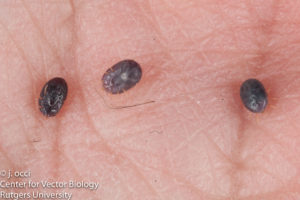
‘Carios kelleyi’ on hand (Photo Credit: J. Occi, Center for Vector Biology, Rutgers Univ.)
“First Record of Carios kelleyi (Acari: Ixodida: Argasidae) in New Jersey, United States and Implications for Public Health,”J Med Entomol., March 2021. Carios kelleyi is a soft tick that is almost exclusively a parasite of bats and had been found in at least 29 states, Canada, Mexico, Costa Rica, Cuba, and now in New Jersey. The nymphs and adults take several short blood meals (min. to hrs.), while the larvae remain attached for several days. Relapsing fever Borrelia is known to come from soft ticks that feed on small rodents, and when bats are removed, ticks begin to seek blood meals from humans.
C. kelleyi has been found infected with a novel spotted fever Rickettsia; a novel relapsing fever-related Borrelia; Bartonella henselae; and a novel relapsing fever spirochete, identified as Borrelia johnsonii.
Although C. kelleyi is not thought to be an important vector of pathogens, its prevalence in bats in New Jersey is increasing. This creates the possibility for transmission to humans, animals, and livestock. New Jersey bats and the pathogens they carry should be monitored to assess the risk to the public. (Click here for published article)
“Ixodes scapularis (Ixodida: Ixodidae) Parasitizing an Unlikely Host: Big Brown Bats, Eptesicus fuscus (Chiroptera: Vespertilionidae), in New York State, USA,” was published in J Med Entomol, Jan. 2022. I. scapularis is a three-host tick found throughout the Northeast, Southeast, and Upper Midwest in the U.S and is the most common vector of tick-borne diseases to humans in North America. It feeds on over 150 species of terrestrial vertebrates, yet it had not previously been reported to feed on bats. During 2019 and 2020, injured big brown bats in four locations in rural NY had larvae and nymphs attached to them. Bats are known to carry a large number of pathogens and these ticks could go from hosting on a bat to hosting on a human. This poses a significant epidemiological risk and should be investigated further. It also threatens bat species that are at risk. (Click here for published article)
We have published many rigorous and trustworthy high-quality evidence pieces across the last two years to show that the COVID lockdowns, school closures, face masks, and mask mandates were ineffective and even harmful in terms of curbing infection and deaths (see here, here, here). A very recent Johns Hopkins review by Herby et al. did an exemplary job at reviewing the evidence and declaring what we have always stated, this being that lockdowns had no impact on mortality.
“Lockdowns in the spring of 2020 had little to no effect on COVID-19 mortality…lockdowns during the initial phase of the COVID-19 pandemic have had devastating effects. They have contributed to reducing economic activity, raising unemployment, reducing schooling, causing political unrest, contributing to domestic violence, loss of life quality, and the undermining of liberal democracy. These costs to society must be compared to the benefits of lockdowns, which our meta-analysis has shown are little to none.”
Jeffrey Tucker’s piece on the loss of moral clarity is stunningly brilliant in sensitizing us to what could happen when already vulnerable persons are further isolated and dehumanized and all decision-making ripped from them, as was done to us during the heights of the COVID lockdown lunacy. We even wrote about the corruption of public health agencies such as the World Health Organization and their role in the COVID disasters globally.
Now I challenge the CDC directly and its Director Dr. Rochelle Walensky to do the right thing by publishing new research by Chandra and Høeg (LANCET) that debunks their (CDC’s) recent mask study that is being used as a key study driving mask policy today. They have a unique moment to show some leadership and to understand much better research methods than the pseudoscience the CDC puts out on a routine basis.
(See link for article)
______________________
**Comment**
Don’t hold your breath.
A few points about the flawed but heavily used and cited CDC mask study:
Causation can not be concluded from an ecological mask study
Children up to age 18 were classified as pediatric
The research methods were poor
Data was not parsed out by age-bands as 17 & 18 year olds are not the same as 5-10 year olds
It was an observational study
It was plagued by selection bias
It could not control for all the key potential confounding factors
There was no mention of statistical adjustment for “vaccine” status or prior infection
The CDC doesn’t update or change anythingunless it suits their vested interests. Every time they up Lyme numbers there’s a new “vaccine” in the works. Every. Single. Time. It’s getting old. Rather than focus efforts on early diagnostics and effective treatments, the efforts remain, per usual, on a “magic bullet” cure-all vaccine which historically has only further served to maim patients. The reason? “Vaccines” are the cash-cow every researcher hopes to land. They know that researching tests and effective treatments are not big money-makers, and will certainly not give them the power and prestige they desire in the cut-throat world of competitive research vying for government grants doled out by none other than Dr. Fauci, aka Dr. Evil.
While Twitter has suspended and permanently blocked numerous individuals for posting so-called “misinformation” concerning COVID-19 vaccines, it has not done so to “health” authorities – those who arguably should be held to an even higher standard – when they blatantly share inaccurate information.
On June 18, 2022, CDC Director Rochelle Walensky posted a tweet with a video of herself discussing the CDC’s recent recommendation of the COVID-19 shots for children under 5. In the video, Dr. Walensky made the following two claims:
“We now know based on rigorous scientific review that the vaccines available here in the United States can be used safely and effectively in children under 5.”
“We have taken another important step together on our fight against COVID-19 by making safe and effective vaccines available for our little ones.”
But as Dr. Walensky should certainly be aware, in issuing Emergency Use Authorizations (EUAs), the FDA has not (under its ridiculously low standards) made a finding that these vaccines are “safe and effective.” Instead, the grant of an EUA means only that the FDA has determined
“it is reasonable to believe that [each vaccine] may be effective” and that “it is reasonable to conclude, based on the totality of scientific evidence available, that the known and potential benefits of [each vaccine] outweigh the known and potential risks of the vaccine.”
By claiming – two separate times – that these vaccines are “safe and effective,” Dr. Walensky is misleading the public by suggesting these vaccines have met the legal standard required for licensure.
Worse yet, because her tweet is “descriptive printed matter” that is both advertising and promoting Pfizer’s and Moderna’s vaccines, the tweet itself is in violation of both EUAs issued to these companies because it does not “clearly and conspicuously” contain the required disclaimer that these products have not yet been licensed as safe and effective by the FDA.
ICAN, through its attorneys, has sent Dr. Walensky a formal letter demanding that she immediately remove the misleading tweet and we will keep you posted on the CDC’s response.
Research shows the oft-misdiagnosed tick-borne disease can lead to serious mental health problems that can erode a person’s quality of life, especially if left untreated. Psychologists are among those working to improve care for these patients.
Long before the SARS-CoV-2 virus was linked to a syndrome we now call long COVID, researchers and clinicians were already debating over how to best assist patients experiencing lingering symptoms from Lyme disease. For reasons that are unclear, 10% to 20% of people who contract Lyme disease report ongoing or intermittent symptoms at least a year after completing antibiotic treatment, including fatigue, muscle aches, difficulties with memory, irritability, and other symptoms, according to a review of the research (Marques, A., Infectious Disease Clinics of North America, Vol. 22, No. 2, 2008).
For patients, these ongoing and sometimes debilitating symptoms can erode their quality of life, potentially leading to depression, anxiety, and other mental health issues. But over the past few decades, researchers have also determined that the tick-borne infection itself, along with related inflammatory and other physiological effects, may directly cause mental health disorders.
One recent study, conducted by researchers from the Columbia University Irving Medical Center and the Copenhagen Research Centre for Mental Health, found that patients who received a hospital diagnosis of Lyme disease had a 28% higher rate of mental disorders and were twice as likely to have attempted suicide post infection than individuals without a Lyme diagnosis (Fallon, B. A., The American Journal of Psychiatry, Vol. 178, No. 10, 2021).
Patients diagnosed with Lyme report a range of mental health-related symptoms. Some experience panic attacks for the first time, which can sometimes extend for hours at a stretch, said Sheila M. Statlender, PhD, a clinical psychologist in Newton, Massachusetts, who has been working with patients with Lyme disease for more than 15 years. Some report frustrations with “brain fog,” cognitive difficulties that can include impaired concentration or trouble with tracking words on a page. In rarer instances, they develop auditory hallucinations. “They hear music, or they hear a radio that’s not playing,” she said.
(See link for article)
____________________
A few points:
The article falsely regurgitates that only 10-20% experience lingering symptoms when this only includes those diagnosed and treated early. A far larger group of 30-40% are diagnosed and treated late. By combining the two groups, a whopping 60% suffer lingering symptoms. Numbers matter.
The article falsely regurgitates that at least 70% of adults and children will develop some type of skin irritation around the bite including the EM rash when this is highly variable and in the first patient group was only 25%. While having the rash is diagnostic for Lyme (no testing required – start treatment asap) not having the rash means nothing. You can still be infected without a rash.
Dr. Fallon states that antibody blood testing is required for those with late stage Lyme to help “clarify” the diagnosis. The testing he speaks of misses 70 – 86% of cases. That is hardly clarifying. Lyme/MSIDS has been and always will be a “clinical diagnosis” that demands proper understanding and education of tick-borne diseases, something that is sorely lacking in medical training.
The article points out one of the problems with CDC testing – if it’s done too soon, antibodies may not have had time to develop. Taking a “wait and see” approach (waiting for testing or waiting for symptoms, or both) has doomed patients to a life-time of suffering.
The CDC’s statement that “most people recover after treatment” is complete and utter propaganda. They are so hopelessly lost in their own corruption and hubris they wouldn’t know facts if they were hit squarely in the face with them.
Please note one of the doctors got involved treating Lyme patients due to having to go through the gauntlet with her three children becoming ill with tick-borne illness (TBI). This is a common refrain. Our best doctors and researchers have “been there, done that.”
Further complicating things are misdiagnoses, such as in Lorraine Johnson’s case where she was misdiagnosed with psychiatric illness and was put on psychotropic drugs, which didn’t work. She lost 5 years of her life essentially due to doctor bias. Please note that the “proof is in the pudding” because when she was properly treated for Lyme her symptoms cleared – including psychiatric illness. But mainstream medicine/research only sniffs at case studies with clinical outcomes like Johnson’s.
One of the psychologists in the article recommends they should refer any patient they are concerned about to a physician for testing to rule out Lyme but there are three problems with this advice: 1) testing sucks 2) other organisms besides Lyme are at play and a test only can pick out what it is designed to look for 3) mainstream medicine is is the Dark Ages regarding all things TBI. The only true help will come from an ILADS-trained doctor who understands that TBI diagnosis is a clinical diagnosis.Testing is essentially futile.
The point made about a potential “red flag” when a patient’s symptoms change while they are taking antibiotics for another medical reason, such as treating an infection, is an important, crucial point that mainstream medicine has denied for far too long.
Some excellent psychiatric observations are made and I highly recommend reading the article for these nuances that show some differences between ordinary mental health issues and those caused by Lyme/MSIDS. (Lyme/MSIDS tends to cause intense, prolonged, nonstop, very high anxiety without any underlying triggers and gives the patient sensitivities to light, sound, touch, and smell. I would add food and environmental issues as well.) This explains my husband to a T.
I’m thankful for the Lyme researcher’s advice to psychologists on the importance of reading up on Lyme controversies since patients struggle with abuse from doctors, family, and co-workers and often suffer from isolation, depression, and demoralization on top of the effects of the infections.
This researcher teamed up with psychologists who treat Lyme and came up with a screening tool.
They also discovered that cognitive behavior therapy’s (CBT) homework-intensive approach overwhelms these patients due to their brain fog, fatigue, and cognitive issues
CBT’s identifying and changing dysfunctional and distorted thought processes also doesn’t work as well on these patients as many of their thoughts are not distorted (they truly lost their job, they are really sick, they can’t do the things they used to do, they actually are isolated, etc.)
Acceptance and commitment therapy (ACT); however, which relies less on restructuring one’s thought patterns and more on adapting to current reality, has helped these patients. The patient still identifies and notices thoughts but they focus more on learning to coexist with or accept those thoughts.
Important quote:
“There is no question, it is a very, very challenging population to work with,” Trunzo said. “It also can be very rewarding. You can have an immeasurably profound impact on someone’s life by doing this work. Because you may very well be the only person who is listening to them.”