Where:The Sparrow’s Nest at the Abbey:https://sparrowsnest-abbey.com/, 17304 Havenwood Road, Sparta, Wisconsin. Questions about accommodations: Call Lori or Tom Graber: (661) 400-2318 or (661) 406-1721 (Map for directions is on the website). Once you get off the interstate, and are on highway 16, you turn onto Havenwood and just keep driving (maybe 2 miles?) until Havenwood ends. Park your car, enter the building, and turn left into the hallway. Going down about half way, on the right is a room connected to the kitchen where we will meet. There are circular tables and chairs and a restroom close by.
What: Bring your questions, frustrations, and anything you want to share with the group. Can’t wait to catch up and see how you are all doing!
Analysis of Alzheimer’s disease in hospital, conceptual image
Unlike diseases that impair the body in a myriad of physical ways, dementia can rob mental faculties and identity, as patients struggle to remember memories from previous days. As the disease progresses, victims may also forget friends or relatives and the functional skills to perform a daily routine.
The most common form of dementia, Alzheimer’s disease, is a disorder in which brain cells shrink and die. There is no cure, although some medicines, support groups and other programs may help patients manage the disease.
Considering this void, the search for better treatments presses on. More than $3 billion in National Institutes of Health funding is dedicated to Alzheimer’s research, although progress seems painfully slow for the roughly 5.8 million Americans currently suffering from the disease. Some existing drugs are controversial, such as Aduhelm, which was recently approved by the Food and Drug Administration for patients with mild cognitive impairment or early onset Alzheimer’s. Among the many questions about the drug is whether it is worth its $56,000 a year cost and side effects risk.
The glaring limitations of available therapeutics led one College of Medicine professor to consider whether the solution is not an expensive drug, but one that has been around since World War II. This is the question posited by Herbert B. Allen, MD a professor and chair emeritus in the College of Medicine, who offers a bold challenge to colleagues: consider whether penicillin could help prevent Alzheimer’s, and when combined with a disperser, whether penicillin may slow progression of the disease — or maybe even stop it altogether.
Allen’s hypothesis paper, recently published in the Journal of Alzheimer’s Disease, expands beyond penicillin’s current role in treatment of infections, like syphilis and gonorrhea, and introduces the possibility that there could be similar effectiveness when applied to Alzheimer’s.
Two regimens proposed by the hypothesis: prevention using penicillin via a once a year shot, or pills for two weeks, or treatment of early-onset Alzheimer’s using penicillin and a drug such as rifampin to break the biofilms so the penicillin can break through into the body.
Allen says the path of Alzheimer’s in the tissues of patients starts with two types of spiral-shaped bacteria, known as spirochetes, known as Borrelia burgdorferi (which also causes Lyme disease) and Treponema denticola. These dangerous bacteria enter the brain via nerve cells and brain circuits and create biofilms that are responsible for the tangles and the attack on brain cells that cause Alzheimer’s, Allen said.
“Alzheimer’s disease is a chronic infection,” said Allen. “Up until to this point in time, no one has been able to find these biofilms that cause disease hidden in live tissue.”
After reading that a colleague at the International Alzheimer Research Center in Switzerland, Judith Miklossy, MD, PhD, grew Lyme organisms from the brains of Alzheimer’s patients, Allen got an idea.
“I thought maybe there’s something to this, because Lyme is a skin disease first, so I put the same staining procedure together for tissue samples from our tissue bank here and it showed that the organisms made biofilms and the hypothesis grew from there.”
Allen explains that it’s these spiral-shaped bacteria that make the biofilms and make the beta-amyloid located inside and outside of cells and attack normal, healthy Tau protein and cause the breakdown of nerve cells.
Miklossy is credited with the discovery that the pathology of syphilis and Alzheimer’s are the same, Allen said.
Allen points to penicillin’s success in preventing syphilis and psoriasis as possible reason why it may have success in Alzheimer’s and possibly other neurodegenerative diseases. Despite this, Allen says research funding prioritizes new drug development over study of existing drugs like penicillin. Following the money to see part of the reason why, Allen points to billions of dollars in revenue for drugs like Humira, with billions of dollars in sales each year to psoriasis and rheumatoid arthritis patients.
The first data showing that spiral-shaped bacteria played a role in Alzheimer’s was discovered by Alan MacDonald, MD, back in the 1980s when MacDonald was working as a pathologist at Southhampton Hospital in New York. This latest hypothesis from Allen follows his decades of research in dermatology, including a 2014 JAMA Dermatology paper showing that eczema is also an infection.
Those over age 65 and/or with a family history of Alzheimer’s, are at greater risk of the disease. There are also specific genes implicated in Alzheimer’s risk, such as the risk gene APOE-e4. Estimates suggest that roughly 40 to 65 percent of those diagnosed with the disease have this gene. There are very rare deterministic genes in about one out of every hundred cases that guarantee an individual with the gene will develop Alzheimer’s.
Leukemias are cancers that involve certain cells of the body’s blood, bone marrow, or immune system. Lyme disease is a bacterial infection that people can catch from tick bites. Although these conditions are very different, certain connections may exist between them.
As a 2021 reviewTrusted Source explains, leukemias are cancers that develop from certain cells called leukocytes. When someone has leukemia, some of their leukocytes grow and divide in an uncontrolled fashion. Doctors can classify such cancers according to whether they affect myeloid or lymphoid cells. These cells are kinds of leukocytes.
As the review notes, there are many possible genetic and environmental causes of leukemia.
Lyme disease is the resultTrusted Source of Borrelia burgdorferi bacteria. These bacteria can make their way into a person’s body via tick bites. Ticks are small arachnids that feed on blood, and that can carry B. burgdorferi bacteria.
This article will look into the possibility that Lyme disease is a risk factor of leukemia. It will also look into what it is like to have both conditions at the same time, and at whether Lyme disease could mask or be mistaken for leukemia. (See link for article)
_____________
Summary:
some evidence showsTrusted Source that Lyme disease may increase a person’s risk for another type of blood cancer called lymphoma. This may be because of the inflammation that Lyme disease causes in the body.
evidenceTrusted Source that Lyme disease is a risk factor of lymphomas. But this risk is small, and the link is not clear.
American Cancer Society (ACS)Trusted Source notes that some people with a B. burgdorferi infection, which causes Lyme disease, developed skin lymphomas in Europe. But the ACS emphasizes that most individuals with Lyme disease will not develop skin lymphomas.
ScientistsTrusted Source believe that bacterial infections such as Lyme disease could increase a person’s cancer risk by causing inflammation in the body. Up to 25%Trusted Source of cancer causes may include infections and inflammation.
The article erroneously states that those with the EM rash are more likely to have a more “developed” form of Lyme. In fact, I would state it’s probably just the opposite.
The article further erroneously states 10-14 days of doxycycline is the treatment, which case after case and study after study has proven this to be insufficient.
The article also erroneously states 70-80% get the EM rash when in fact the percentages are highly variable and many never get a rash at all.
Some with leukemia develop a skin rash that is different than the EM rash. See top link for pictures of both.
REMINDER: Please mark your calendars for the upcoming November Madison Lyme Support Group Meeting.
**Note the new location**
For future reference, anytime you want to know upcoming meeting times, go to the upper right hand corner on the website and click on the “meetings” tab.
TOUCHED BY LYME: Helping families with Lyme re-capture their joy
Nov. 4, 2021
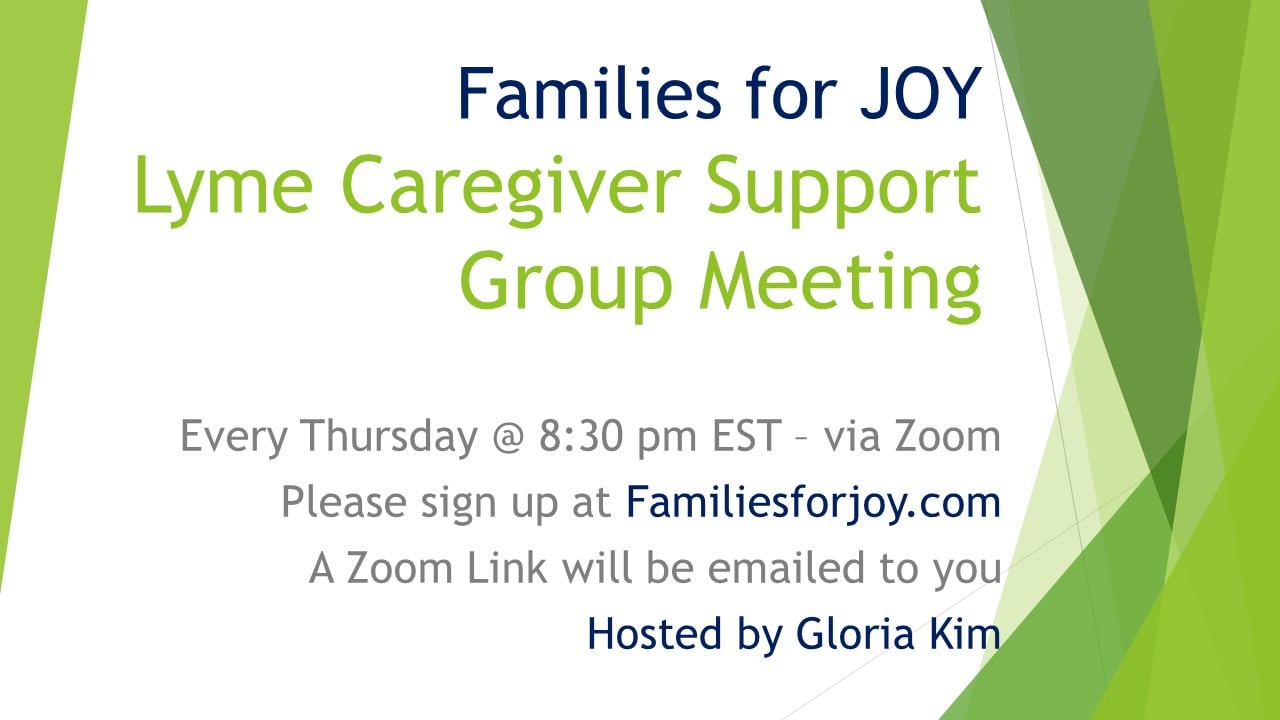
Gloria Kim, a mother of three from New Jersey, fell into the Lyme world when her son was bitten by a tick at a young age.
As a result, her family has been dealing with chronic Lyme and co-infections for the last 14 years. And as she learned early on, Lyme disease affects the whole family—not just the ones who are sick.
“As a caretaker, I worked tirelessly to keep my son alive and was constantly in a state of despair, isolation and survival,” she recalls.
“As much as I wanted to be there for my other two healthy children and husband, the struggle of saving my son overwhelmed me and I lost myself.”
She understands the “difficulty, frustration, sadness and anger” of being a Lyme caregiver, she says.
To help others, she has created a weekly online support group to help bring connection and community to people in this situation–and to help them rediscover joy.
One of the things that Gloria said really helped her and her family was to find ways to laugh together. Here’s something she recently posted on her Facebook page.
Add this to your toolbox to help you heal from Lyme.
Worldwide Walkouts will demand a return to freedom and democratic principles. Citizens around the globe are protesting loss of liberty, illegal mandates and tyrannical government overreach. Every man, woman and child is important to this movement!
Robert F. Kennedy, Jr., CHD Board Chair and Lead Counsel: “No government in history has ever surrendered power in the absence of a demand. We need to tell these governments and their friends in the technocracy, the Silicon Valley billionaire boys club, the mainstream media, and the pharmaceutical industry that we will no longer tolerate their trampling of citizens’ rights.”
Upcoming WWW Event dates:
November 3rd November 8-11th November 19-20th November 26th (Black Friday)
CHD launches “Hold the Line” medical freedom song to kick-off Worldwide Walkouts Nov. 3, 2021
Artist: Ito da Truth featuring Ac Da Kid Editor – Deana Vincuillo Photo Credit: Souls of a Movement (IG: @soulsofamovement) Producer: Aimee Villella McBride
Overview
Why?
People have been battered during the epidemic for the last 1.5 years. And now their jobs, livelihoods, education for their children and way of life is being threatened because they refuse to take a government and employer mandated injection.
Religious and medical exemptions are being rejected but that is a false choice anyway. Since when does anyone need an exemption to exercise their personal right to reject a foreign substance being injected into their body by the government?
Americans and the world need to stand up, walk out and just say NO. CHD will encourage recurring walkouts where citizens target specific industries and solidify our grassroots movement as a powerful voting block in elections to apply political pressure.
Who?
Children’s Health Defense and our State and International Chapters are joining citizens and organizations from all over the world as they come together for “WORLDWIDE WALKOUTS!”
What?
“WORLDWIDE WALKOUTS!” is a call for a global shut down to stop business as usual and celebrate human rights. Citizens around the world will be asked to unify for freedom and commit acts of civil disobedience to make their point. No masks, no vaccines, no testing. No coercion. The potential headlines: “500 towns in America and around the world have nurses, teachers etc. walk out for freedom,” “French and Italian Voters in acts of civil disobedience…”
Where?
Any mass gathering of people in peaceful noncompliance engaging in acts of civil disobedience. People can gather at local town halls, court houses, their department of education or state capitols or any high-profile, high-traffic area. Any location works and no event is too small or too large. They will only grow with time.
How?
Make it a celebration of unity. Create a unified voice with signage, posters, singing of popular songs, the national anthem, chants and more. Ask veterans, first responders, educators and children to speak. Create a community by asking the crowd to introduce themselves to their neighbor, encouraging hugs and holding hands to resist the mainstream narrative of social distancing and fearing close contact with others. Choose for everyone to wear a consistent color to unify the crowd visually. If you’re expecting larger crowds, or use of amplified sound you may need to consider securing permits with local municipal, precincts or community affairs offices, but people also have the right to peaceably assemble in public areas as long as they’re not obstructing vehicle or foot traffic.
Come back to this page for helpful planning information on this and future rallies including best practices (i.e., press releases, getting local media) and ways to order posters, flyers, T-shirts and more.