Part 2 of the Lyme and Nutrition Series, sponsored by RxSugar®
Learn how to manage Lyme disease by improving gut health, reducing inflammation, and incorporating specific dietary changes, as well as the five actionable diet tips for a healthier Lyme journey.
Lyme disease might be the diagnosis, but it’s not always the name of the game. It is an addition to a trifecta between immune function, inflammation and gut health. These three pieces have a direct influence on each other, but now, Lyme disease makes it into a “quadrifecta”.
There is an interdependent link between the health of our gut, where the majority of our immune system lives, and inflammation; this is amplified by Lyme disease. Treatment can also play a role in this as well if antibiotics are used, which also affect the health of our gut. This diagram shows the interconnected relationship between the four pieces, the “Lyme Quadrifecta:”

A disruption of our gut’s bacterial balance, known as gut dysbiosis, intensifies inflammation, weakening our immune system and complicating recovery from Lyme disease. Since a significant portion of our immune system resides in our gut, maintaining its health becomes paramount when combating Lyme disease.
I promised to share five diet tips to help with your Lyme diagnosis, but it’s not just about the list itself. Making sure you understand why I’m suggesting things is just as important. I want you to grasp why these tips are helpful. When we know the “why”, we can take charge of our own health better. Knowing the reasons behind these suggestions gives you the power to make smart decisions about what you eat and how you take care of yourself. It will help you follow through on the changes you’re looking to make.
My Lyme journey began in April 2014, following a tick bite. It all started with exhaustion, a sore throat, and knee pain. Within a few months, it spread to my joints and tendons. Despite seeing a rheumatologist for several months, my symptoms didn’t fit neatly into any diagnosis.
By spring 2015, the joint and muscle pain, along with swelling, were overwhelming. With no answers from doctors, I decided to take matters into my own hands. I switched gears, putting on my dietitian hat and becoming my own patient zero. After days of researching science journals, I presented my findings to my family doctor. It wasn’t about the supplements or the lack of diagnosis; it boiled down to focusing on my gut health. This was something I could do. And something I had full decision power over. It was empowering to take control back.
I embarked on a strict elimination diet, fine-tuning it over time to be able to share a more practical approach. I was my own experiment. I learned a lot about my body; gluten turned out to be a big trigger for joint pain and inflammation – that was the first step. Cutting out sugar was next, and I noticed of the inflammation easing up.
I incorporated more plant-based foods, ancient grains, and fermented foods. These changes naturally led to steps four and five, which I’ll discuss below. By taking these steps, I was strengthening my gut. When it was time for treatment, this turned out to be the most beneficial thing I could have done. In my other blog about Lyme, the gut microbiome and inflammation, I discussed the results of testing I had done on my gut health immediately after I had been on pulsed antibiotics for 1.5 years; I did it right. I unlocked key pieces to this puzzle when I started all of that work with my own diet in 2015. And this is the exact system I am passionate about sharing with others.
Imagine the pyramid below as a game of Jenga. As you begin to remove or weaken a piece (symbolizing a decline in that particular bodily function), the stability of the entire structure becomes compromised, eventually leading to its possible collapse. Gut health has been a buzz word for a number of years now, so first, let’s have a look at why it matters for our overall health.
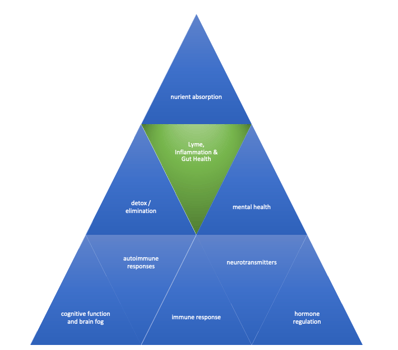
What does the gut do?
- Digestion and Nutrient Absorption: The gut is responsible for breaking down food, absorbing nutrients, and eliminating waste products.
- Immune System Support: A balanced gut microbiota helps regulate the immune response.
- Mental Health and Brain Function: The gut and brain communicate through the gut-brain axis. Neurotransmitters and other signaling molecules are produced in the gut and they can affect mood, cognition, and behavior. Imbalances in gut bacteria have been linked to undesirable mental health outcomes.
- Inflammation: An imbalance in gut microbiota can lead to chronic inflammation, which is associated with various diseases, including Lyme disease, inflammatory bowel disease, autoimmune conditions, and metabolic disorders.
Now that you understand how these building blocks stack together, let’s look at five ways you can support your Lyme diagnosis with food and nutrition, giving you actionable steps to strengthen your gut health, manage inflammation, and enhance your journey towards managing and healing from Lyme disease:
1. Remove gluten
When you have Lyme disease, you may have more inflammation in your body, and gluten can trigger an inflammatory response, potentially worsening symptoms such as joint pain, fatigue, and neurological issues associated with Lyme disease.
Gluten can contribute to gut inflammation and hyper-permeability of the intestinal barrier, commonly known as “leaky gut”, allowing large particles into the blood stream that shouldn’t have been able to pass through. This can further heighten inflammation and immune dysregulation, which are already intensified in Lyme disease.
The relationship between gluten and Lyme disease symptoms is unique to everyone, but minimizing or eliminating gluten intake may be beneficial for individuals with Lyme disease, particularly those who experience heightened inflammation, gut issues, or gluten sensitivities.
2. Remove added sugar
The average daily intake of sugar is reported to be around 68 grams (17 teaspoons), but this figure may underestimate reality. Consider the sugar content in some common food and drink options:
- A 16oz bottle of Cola contains 44 grams (11 tsp) of sugar.
- A 12oz bottle of Gatorade contains 21 grams (5.25 tsp).
- One cup of oat milk contains about 6 grams (1.5 tsp).
- A tall lavender oat latte from Starbucks has 15 grams (3.75 tsp).
- Honey Nut Cheerios, a popular gluten-free cereal, contains 9 grams (2.25 tsp) in ¾ cup.
- Silk Vanilla Non-Dairy yogurt has 11 grams (2.75 tsp) in ¾ cup.
- One tablespoon of Silk Vanilla Coffee Cream contains 4 grams (1 tsp).
While cola and Gatorade aren’t likely staples, the other items are typical common treats or pantry staples. It’s crucial to recognize how quickly added sugar can accumulate throughout your day, especially since it’s often concealed in packaged foods like condiments, salad dressings, frozen meals, crackers, cereals, and more. But why should you aim to cut back on added sugar?
Eating too much sugar can contribute to inflammation in your body in several ways:
- First, it can lead to oxidative stress and inflammation in the body by reacting with proteins in a process called glycation, forming advanced glycation end products (AGEs). AGEs contribute to inflammation.
- Second, it can activate inflammatory signals. High amounts of sugar can turn on inflammation pathways in the body that lead to inflammatory molecules called cytokines, causing your body to produce more substances that make it swell and hurt, and well… stay inflamed.
- Third, it can contribute to an imbalance in the microbes living in the gut. Too much sugar can tip the balance of good bacteria in your gut, leading to what we call “dysbiosis” and inflammation of the gut which can contribute to “leaky gut” and immune dysregulation, and it can also contribute to inflammation throughout the whole body.
- Fourth, eating lots of sugar can make your body less sensitive to insulin (aka “insulin resistance”) and that can trigger pro-inflammatory cytokines, contributing to systemic, whole-body inflammation. This can also lead to more metabolic effects that we would rather avoid.
Hopefully, you can now see how there is an overlap between why gluten and sugar can be harmful when you’re trying to eat to support your Lyme diagnosis.
If you would like to learn more about how to identify sugar on food labels and quickly know exactly how many teaspoons are in a serving? Grab my Lyme Friendly Recipe Book and I’ll send you a few emails to help you learn how to do this yourself in the simplest way possible.
3. Aim for 30+ plant foods per week
Our gut has trillions of tiny living microorganisms that make up our own unique internal ecosystem. These microorganisms can affect our health and cause diseases or help prevent it and improve disease states.
Each person’s gut has its own unique mix of these microorganisms, which usually stays pretty consistent over time, but can change from day to day. What we eat can have a big impact on the types of microorganisms living in our gut, this affects the composition of our gut microbiota, and suggests that dietary changes could alter microbial diversity, composition, and stability.
Eating a diverse range of plant-based foods offers numerous benefits for improving gut microbiome health. The greater the variety of plant foods in our diet, the wider array of benefits we can experience:
Fiber: Plant foods contain several types of fiber, which serve as “prebiotics” – these feed the beneficial bacteria in the gut. By fermenting the fiber we eat, gut bacteria produce short-chain fatty acids (SCFAs) such as acetate, propionate, and butyrate. SCFAs play essential roles in gut health, including nourishing colon cells, reducing inflammation, and regulating metabolism.
Polyphenols: These are antioxidants that are found in fruits, vegetables, nuts, seeds, and whole grains and they also have prebiotic effects on the gut microbiota. They can help the growth of beneficial bacteria and inhibit the growth of harmful pathogens, contributing to a healthier gut environment.
Resistant Starch: You’ll find this in foods like legumes, whole grains, and green bananas. These starches escape digestion in the small intestine and reach the colon intact, where they serve as fuel for beneficial gut bacteria. Fermentation of resistant starch produces SCFAs, promoting gut health.
You can actually boost the amount of resistant starch in your diet a technique called “retrogradation” in starchy foods like rice and potatoes. This happens when these foods are cooked, cooled and reheated. The starch undergoes structural changes: they gelatinize, and upon cooling, some of the starches retrograde, forming resistant starches.
The process of cooking, cooling, and reheating foods to increase resistant starch content is particularly beneficial for individuals looking to support gut health and optimize the nutritional benefits of their diet. Including a variety of foods rich in resistant starches, both cooked and cooled, can contribute to a healthier gut microbiome and overall well-being.
Diverse Nutrients: Plant foods provide a wide range of vitamins, minerals, and phytonutrients that support overall health and microbial diversity in the gut. A diverse diet rich in different types of plant foods ensures that the gut microbiota receives a variety of nutrients needed for optimal function.
Overall, consuming a diverse array of plant foods ensures a rich and varied supply of nutrients and compounds that promote the growth of beneficial gut bacteria, enhance SCFA production, and support overall gut microbiome health. Adding in a variety of plant foods doesn’t need to be complicated.
Go for colorful fruits and vegetables, and consider adding nuts and seeds to your meals – sprinkle them onto salads or blend them into smoothies. If you can tolerate grains, they make a great alternative to store-bought bread and pasta (yes, even those gluten-free options). Quinoa, rice, millet, and amaranth are all excellent choices. Don’t forget about herbs and spices! Adding parsley or cilantro to your dishes or salads can boost flavor and nutritional impact. Experiment with seasonings like turmeric, ginger, and cinnamon, they can add a variety of health benefits to your meals too.
If you’re curious for more about this, you can check out this post on my Instagram where I list out 30 different plant foods you can incorporate in a week. It’s not as overwhelming as it sounds, I promise!
4. Incorporate More Anti-Inflammatory Foods
Certain foods possess anti-inflammatory properties due to their rich content of nutrients and compounds that fight inflammation. These foods can hinder inflammatory pathways, regulate the immune system, and scavenge free radicals, neutralizing and removing highly reactive molecules that can cause cellular damage and contribute to oxidative stress.
Choose foods high in antioxidants like vitamins A, C, and E, selenium, anthocyanins, beta-carotene, and flavonoids. Antioxidants play a crucial role in neutralizing free radicals. To add more of these beneficial nutrients into your diet, include foods such as berries, leafy greens, nuts, seeds, colorful vegetables, spices, beans, lentils, and chickpeas.
Prioritize foods rich in omega-3 fatty acids such as salmon, mackerel, sardines, flaxseeds, chia seeds, and walnuts. These foods can reduce the production of pro-inflammatory compounds such as certain prostaglandins and cytokines while promoting the production of anti-inflammatory compounds.
Polyphenols, another class of antioxidant plant compounds, are abundant in foods like berries, green tea, matcha, dark chocolate, and olive oil. They contain flavonoids which can help neutralize harmful free radicals and reduce oxidative stress and inflammation.
As discussed previously, fiber plays a significant role in lowering inflammation by promoting a healthy gut microbiome. By nourishing beneficial gut bacteria, fiber facilitates the production of short-chain fatty acids (SCFAs), which have anti-inflammatory effects in the body.
Additionally, incorporating herbs and spices such as turmeric, ginger, cinnamon, and garlic can be beneficial due to their compounds with anti-inflammatory properties. In summary, including a diverse array of whole, nutrient-rich foods in your diet can fight inflammation and support overall health and well-being throughout your journey with Lyme and beyond.
Considering points three and four, it becomes obvious that many foods overlap between the two categories. The benefits of a diet focused on whole foods that are minimally processed and rich in nutrients can simultaneously improve gut health and reduce inflammation.
If diving into the intricacies of gut health and inflammation isn’t your priority and you prefer a straightforward approach, the next point may resonate with you. Follow this next approach, and you’ll naturally be supporting yourself in a simplified way.
5. Focus on lots of different whole foods
Emphasizing whole foods simplifies the steps mentioned above. By reducing packaged foods (even gluten free ones), you naturally gravitate towards gluten-free options and foods without added sugars. Opting for whole foods, in their natural state, also helps you to achieve your goal of consuming 30 plant-based foods per week. You’ll naturally eat more fiber that will help function as a prebiotic in your body. And lastly, as you incorporate a variety of colorful whole foods into your diet, you’re not only increasing nutrient density but also benefiting from their inherent antioxidant and anti-inflammatory properties.
Lyme is complicated, but nutrition doesn’t have to be.
***
Thank you to RxSugar® for being the Official Sponsor of our Lyme and Nutrition Series. RxSugar® Certified Allulose products are a great natural sugar alternative to refined sugar. Allulose is the only natural sugar with metabolic benefits and supports the body’s production of GLP-1 and GLP-2 (which helps to mitigate the impact of leaky gut). RxSugar®‘s Plant-based Certified Sugar, Syrup and Chocolate Snacks are USDA Organic, Keto Certified, Grain & Gluten-free, FODMAP Friendly Certified, Vegan with zero blood sugar impact. Use discount code GLA20 at checkout at https://rxsugar.com/
*GLA Contributor and Author not compensated by brand for this post

GLA Contributor
Opinions expressed by contributors are their own. Sara Brunner is a Registered Dietitian (RD) hailing from Canada. In 2014, Sara experienced a significant health challenge after being bitten, initially diagnosed as a spider bite. Despite seeking medical advice, she remained untreated and eventually found herself bed-bound within two years. Throughout this period of undiagnosed illness and escalating symptoms, Sara took proactive measures to manage her health, drawing upon her expertise as a Registered Dietitian. In 2016, Sara received a Lyme+ diagnosis, marking the beginning of her journey towards recovery. It wasn’t until 2022 that she began to witness significant improvements. Despite the prolonged and challenging nature of her journey, Sara remained determined. During this time, she focused on developing The Universal Lyme Diet (ULD), a self-paced online course designed to empower individuals with Lyme disease to create personalized nutrition management plans. Scheduled for release in late 2024, the ULD offers a systematic framework tailored to each individual’s needs. In the interim, you can join the waitlist for the ULD by visiting: https://training.sarabrunner.com/uldwaitlist For more insights and practical tips on navigating your Lyme journey, follow Sara on Instagram: @thelymedietitian
________________
For part 1: https://www.globallymealliance.org/blog/lyme-disease-the-gut-microbiome-and-inflammation-the-dos-and-donts






 Madison Area Lyme Support Group