https://danielcameronmd.com/lyme-disease-inflammation-hindbrain/

Lyme disease triggers inflammation in “hindbrain”

lyme-disease-inflammation-brain

A 52-year-old woman was hospitalized with rhombencephalitis (inflammation of the rhombencephalon, also known as the hindbrain). The condition was found to be triggered by an infection with Borrelia burgdorferi, the causative agent of Lyme disease.

In their article, “Neuroborreliosis with involvement of rhombencephalon: A case report,” ¹ Svingen and colleagues describe a unique presentation in which Lyme disease triggered inflammation of the rhombencephalon, a region of the brain also referred to as the hindbrain.

Over an 8-month period, the patient experienced intermittent fevers, dry cough, fatigue, headaches, night sweats, unintentional weight loss of about 15 lbs., double vision, a tremor in the neck, paresthesia and tremor in the extremities, an unsteady gait, and memory loss.

Approximately 4 weeks prior to symptom onset, the woman had been vacationing in a Lyme-endemic region of Norway. However, she did not recall a tick bite or rash.

“An MRI scan demonstrated pathology in rhombencephalon with quite symmetric T2 hyperintensity involving capsula interna bilaterally, extending through mesencephalon to pons,” the authors wrote.

Borrelia burgdorferi-specific IgM and IgG antibodies were identified using Chemiluminescence Immunoassay (CLIA).

An MRI scan revealed inflammation in rhombencephalon (also referred to as the hindbrain) that are extremely rare in patients with Lyme disease, the authors wrote.

The patient was treated successfully for 4 weeks with intravenous ceftriaxone.

“The MRI findings in rhombencephalon had almost disappeared,” according to the authors. Seven months later, a follow-up MRI “was completely normal, and she had further improvement of her symptoms.”

The authors suggest, “Significant improvement of neurological symptoms and resolution of the MRI findings after proper treatment confirmed the diagnosis neuroborreliosis with rhombencephalitis.”

Furthermore, “we recommend that neuroborreliosis should be considered among the differential diagnoses in patients where neurological symptoms and findings suggesting inflammation in the CNS, despite unusual or normal neuroimaging findings.”

Rhombencephalitis can be caused by infections with Listeria monocytogenes as the most common agent followed by Enterovirus 71 and Herpes simplex virus, the authors wrote. However, it is “exceedingly rare” to find Borrelia burgdorferi as an infectious cause of rhombencephalitis.
References:
  1. Svingen H, Orrem J, Nørgaard Eskesen A. Neuroborreliosis with involvement of rhombencephalon: A case report. IDCases. 2022;28:e01472. Published 2022 Mar 8. doi:10.1016/j.idcr.2022.e01472

___________________

**Comment**

Please remember everything is considered “rare” regarding Lyme, even though many may have the symptoms.  They are rarely recorded.  Big difference.

For more:

https://thevaccinereaction.org/2022/04/another-two-boys-died-in-their-sleep-days-after-receiving-second-covid-19-vaccine/  News Video Here (Approx. 2 Min)

Another Two Boys Died in Their Sleep Days After Receiving Second COVID-19 Vaccine

Just days after getting their second COVID-19 vaccine, two teenage boys died in their sleep. Medical experts have been investigating what happened and have now released their report. An epidemiologist says it adds to a body of evidence that confirms Pfizer’s vaccine can lead to death in children.
This sad news after the CDC admits 50% of the population has had COVID.  This percentage increases to 75% in children and adolescents, making anyone with a functioning brain question the need for a gene therapy injection for children that doesn’t stop infection or transmission, is filled with frighteningly toxic ingredients, and hasn’t shown any measurable impact upon mortality.

FDA Approves Remesivir For Babies

Despite the fact COVID poses little risk to children as well as a FOIA request showing the CDC can not provide a single confirmed COVID death in a child younger than 16, the FDA just approved toxic remdesivir for patients as young as 28 days and weighing 7 pounds.

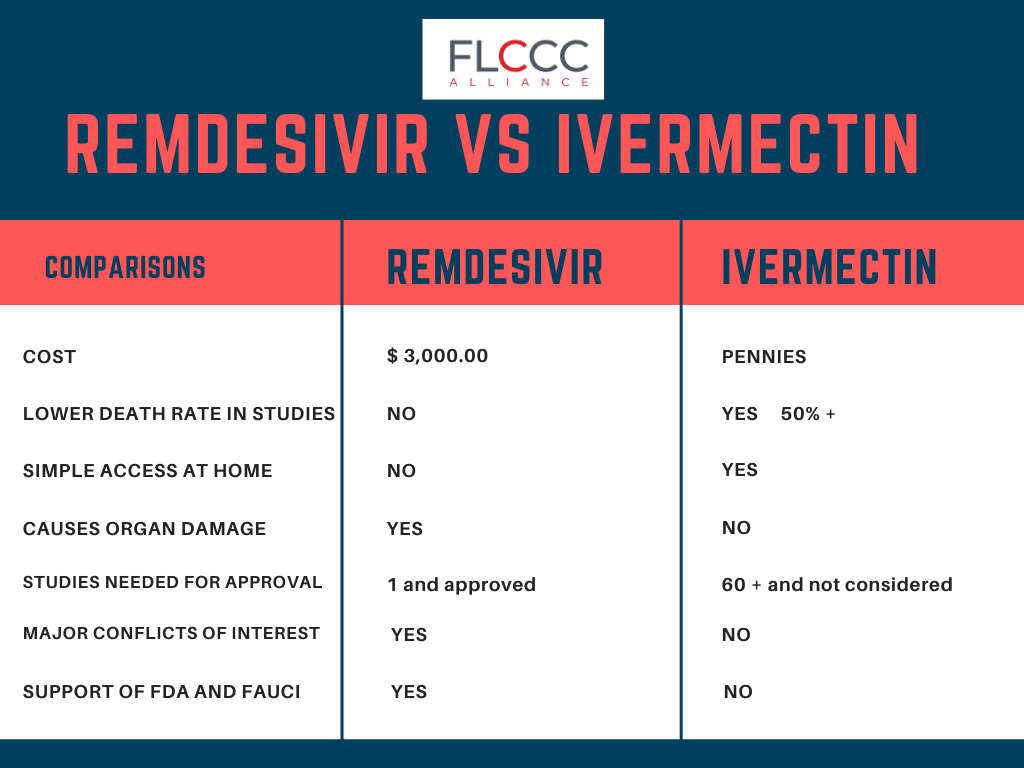
Please see this powerful FLCCC graphic of remdesivir vs ivermectin.

Gilead, the manufacturer of remdsivir, announced by press release, (which appears to be the way science is now done in the ‘new normal) that there was clinical improvement at day 10. The study conveniently has no control group, making it impossible to compare effectiveness against standard of care and only included 53 children – three of whom died.  Adverse events were reported in 72% of the children, with 21% experiencing serious adverse events.
Possible adverse events:

  • elevated levels of liver enzymes
  • allergic reactions
  • fever
  • shortness of breath
  • rash
  • nausea
  • sweating
  • shivering

The drug is marketed under the name Veklury, but the clincher is that similarly to the COVID injections which are in a current clinical study with those receiving the injections being test subjects, a clinical study on infants using Veklury is also underway and also will not be completed until 2023.

This article goes through 5 studies the FDA uses to support remdesivir.  All of them show little if any benefit to hospitalized patients with moderate or severe disease.  It’s important to note that none of these studies looked at children or infants and only 8 subjects were under 18 – which means the FDA has ZERO data to support the drug in children.

So why is it approved?

Royalties go to Gilead, but a portion go NIAID, Tony Fauci’s agency and the US Army, which assisted with its development. I originally omitted the fact (appreciate the reminder) that Ralph Baric, UNC professor and the US’ premier coronavirus scientist, is not only a creator of ACE-2 humanized mice and chimeric SARS coronaviruses, he is also an inventor of Remdesivir and worked with the Moderna COVID vaccine beginning in December 2019 through NIAID, even before anyone knew there would be a pandemic.

Nearly everyone who is hospitalized in the US with COVID receives Remdesivir, because:

  1. hospitals get a financial bonus from the government for using it

  2. it is the top treatment recommended by the NIH Guidelines

    1. The Guidelines were created by a group that originally had 16 members with current or past financial ties to Gilead. The members of the guidelines group were handpicked by the 3 co-chairs. Clifford Lane, one of the co-chairs, is a Fauci deputy.  Source

This article states that nine on the panel of 65 have disclosed financial conflicts with Gilead.

Evidently some nurses refer to remdesivir as “Run, death is near.”

If you are new to the toxic world of remdesivir, that even the WHO admits is ineffective for COVID, please read the following articles:

https://thehighwire.com/videos/new-data-shows-troubling-trend-in-vaccinated/  Video Here (Approx. 15 Min)

COVID Test Positivity By “Vaccination” Status

Covid case data now comes without the politics from a surprising source…Walgreens. Check out this shocking data which again proves COVID shots are ineffective and are setting people up for infection.

POSTED: April 22, 2022

The video explains the following article which has numerous graphs showing that not only do the COVID shots not stop the spread, boosters make you more likely to contract COVID.

__________________

https://boriquagato.substack.com/p/us-covid-test-positivity-rates

US covid test positivity rates by vaccination status

Yet another set of evidence that vaccines are not working to stop covid spread and that boosters wind up making you more likely to contract covid in the long run

It has been notably difficult to get covid data by vaxx status in the US. the epic records are a mess and deeply undercount the vaccinated and the health agencies have been playing all manner of games. However, it appears that private industry may be coming to the rescue here (and once more shedding doubt on why we need the CDC to aggregate anything). Walgreens, who perform large amounts of both testing and vaccination are now publishing data conveniently assessable through a power BI interface. It’s got quite a lot of useful information. Huzzah.

Spoiler alert: it does not make the case for vaccines preventing infection.

It’s clearly associated with much higher infection rates and boosters are faring worst of all.

As can be seen, unvaxxed is outperforming every other category in the overall standings. Vaccine fade from the <5 month category to the >5 month is also clearly visible.  (See link for article and graphs)

_________________

**Comment**

The article points out that the findings are also consistent with Swedish data which show the COVID shots drop below ZERO efficacy on spread by 200 days.

While “vaccine” manufacturers are VERY good at clinical trials and don’t make mistakes – they make choices. They purposely chose to run short trials and eliminate control groups after 90 days. They also only tested those reporting COVID symptoms to assess efficacy. These choices were made to give the shots as high of a chance of success as possible while avoiding negative outcomes.  But, even with all these handicaps it is abundantly clear COVID shots:

Despite claims of safety and efficacy made by “vaccine” manufacturers and corrupt public health ‘authorities’, the article also points out that natural immunity is FAR superior to “vaccinated” immunity.  There is also an argument that leaky vaccines are causing superspread while at the same time actually making the virus worse by inverting its evolutionary gradient. Due to this, the author states boosters need to end so hotter strains will stop spreading.

But none of this matters in the maddening world of “the new normal” where up is down and black is white.  The end-game is quite clear to those paying attention.

https://www.globallymealliance.org/blog/where-am-i-disorientation-and-lyme-disease

Do you know what it’s like to have Lyme disease and suffer from disorientation? It can result in confusion or forgetfulness.

The other night while making dinner, I thought of something I needed to add to my to-do list. I walked a few feet into my home office, got to the center of the room, and stopped in my tracks. “What am I doing here?” I said aloud, looking around in confusion.

It’s a feeling many of you have probably experienced: walking into a room to get something and forgetting what you came for; or being in the middle of one task, starting another, and forgetting the first (luckily, I did not leave dinner burning on the stove). Sometimes we can chalk these moments up to the forgetfulness that comes with aging. Sometimes we’re just tired at the end of a busy day. In some cases, these incidents may be early indications of serious conditions like dementia.

And for many, forgetfulness and confusion, particularly as they relate to disorientation, are due to Lyme disease. In their book Conquering Lyme Disease: Science Bridges the Great Divide, Brian A. Fallon, MD and Jennifer Sotsky, MD note that the most typical cognitive effects of Lyme disease are “short-term memory problems (especially working memory), word-finding problems, dyslexic changes, executive problems (difficulties with planning and organization, difficulties with multitasking), and mental slowing.” For some patients, these effects can lead to “spatial disorientation such that familiar routes become suddenly difficult to navigate or appear unfamiliar.”[1]

Luckily for me, even at my lowest points of illness, I never got so disoriented that I didn’t actually know where I was. In those days it might take hours to remember why I walked into a room—I might wake up in the middle of the night and jot down that all-important item on my to-do list—but now, years into remission, I usually remember my task within a few minutes. Drs. Fallon and Sotsky write, “Such errors are readily recognized soon after the fact, but may be sources of alarm or perplexity to the patient and to his or her family.”[i]

For some Lyme patients, alarm bells indeed ring, because the disorientation becomes severe. They may suddenly get lost driving home from work, or go for a walk and not recognize their own neighborhood. They may have to call a family member or neighbor for help. Some stop driving altogether, or won’t go places without company. Disorientation can leave Lyme patients feeling frustrated, angry, confused, and ashamed. It can be yet another blow to their independence.

The good news is that with adequate treatment, disorientation usually gets better or goes away. Neurological symptoms of Lyme disease occur when the Lyme disease bacteria (spirochetes) cross the blood-brain barrier and enter the central nervous system. The infection causes inflammation in the brain, which can manifest in a host of neurological and psychiatric symptoms. Once the infection gets treated, symptoms often subside (though due to Jarisch-Herxheimer reactions, they may get worse before they get better). In other words, though you may literally get lost, with the help of a good Lyme Literate Medical Doctor (LLMD) you can  eventually find your way.

Sources

[1] Fallon, Brian A., MD and Sotsky, Jennifer, MD. Conquering Lyme Disease: Science Bridges the Great Divide. New York: Columbia University Press, 2018 (314-15).

[i] Fallon, Brian A., MD and Sotsky, Jennifer, MD. Conquering Lyme Disease: Science Bridges the Great Divide. New York: Columbia University Press, 2018 (314-15).

Writer

Jennifer Crystal

Opinions expressed by contributors are their own. Jennifer Crystal is a writer and educator in Boston. Her work has appeared in local and national publications including Harvard Health Publishing and The Boston Globe. As a GLA columnist for over six years, her work on GLA.org has received mention in publications such as The New Yorker, weatherchannel.com, CQ Researcher, and ProHealth.com. Jennifer is a patient advocate who has dealt with chronic illness, including Lyme and other tick-borne infections. Her memoir about her medical journey is forthcoming. Contact her via email below.

Email: lymewarriorjennifercrystal@gmail.com

https://www.medicalnewstoday.com/articles/multiple-sclerosis-ms-drug-targeting-epstein-barr-virus-shows-promise

Multiple sclerosis (MS): Drug targeting Epstein-Barr virus shows promise

  • Researchers are investigating the effects of a drug that targets the Epstein-Barr virus in people with multiple sclerosis (MS) in an ongoing phase 1 clinical trial.
  • The drug improves MS symptoms and may even reverse the condition.
  • The researchers are now recruiting for a Phase 2 clinical trial to further study the drug’s effects.

Multiple sclerosis (MS) is a chronic condition that affects the central nervous system (CNS). It is characterized by the immune system attacking myelin sheaths — fatty layers that surround nerve fibers and enable them to communicate.

A study published in early 2022 found that contracting the Epstein-Barr virus (EBV), a herpes virus, significantly increases a person’s risk of MS. Multiple studies have also found EBV-infected immune B cells in patients with MS.

Researchers still don’t know how EBV may increase MS risk. However, one study suggests that EBV proteins may mimic human myelin proteins and induce an immune reaction against myelin by CNS antigens.   (See link for article)

__________________

SUMMARY:

  • Atara Biotherapeutics, Inc. is in the middle of a Phase 1 clinical trial utilizing ATA118 that targets EBV-infected cells in people with MS.
  • Of 24 volunteers receiving varying doses, 20 showed improvement or halt in progression after 1 year.
  • Of 18 volunteers who took the drug for up to 39 months, half achieved sustained disability improvement with 7 showing signs of remyelination
  • Results will be presented at a conference by Atara on October 13th, 2022.
  • A188 might:
    • Interrupt cell-mediated autoimmune cascade driven by EBV-infected B cells.
    • Reduce the production of myelin-targeted antibodies made by EBV-infected plasma cells.
  • No serious or fatal side-effects were experienced, although one volunteer suffered a relapse.
  • Higher doses led to greater clinical responses.
  • The small sample size requires further research.
  • Atara is actively recruiting for a randomized, Phase 2, double-blind, placebo-controlled trial.

Important quote:

“A majority of persons with MS appear to have been exposed to EBV. There is a protein on the EBV that is the same as a protein in myelin. When the body’s immune system attacks the virus, it also ends up attacking the myelin. Clearing the virus would decrease the stimulus for the immune cells to attack the myelin.” ~ Barbara Giesser, MD, neurologist and MS specialist