Archive for the ‘research’ Category

NIH Scientists Deliberately Infect Mammals With Deadly Pandemic H5N1 in Montana – 66% Death Rate

https://jonfleetwood.substack.com/p/nih-scientists-deliberately-infect?publication

NIH Scientists Deliberately Infect Mammals With Deadly Pandemic H5N1 Bird Flu in Montana—66% Death Rate: Journal ‘Nature Communications’

Taxpayer-funded Rocky Mountain lab study cause severe respiratory disease and high mortality in mammals.

U.S. government scientists funded by the National Institutes of Health claim they have deliberately infected mammals with contemporary H5N1 bird flu viruses—experiments that produced severe respiratory disease and high death rates among the animals, according to a newly published study in Nature Communications.

The research was funded through the Intramural Research Program of the National Institute of Allergy and Infectious Diseases (NIAID)—a division of the National Institutes of Health (NIH)—meaning the project was conducted using U.S. federal government funding inside government laboratories.

The experiments were carried out by NIAID scientists at the Rocky Mountain Laboratories in Hamilton, Montana, a U.S. government high-containment bioresearch facility.

U.S. government researchers deliberately infected mammals with one of the world’s most feared pandemic pathogens.

NIAID is led by Dr. Jeffery Taubenberger, while the NIH is led by Dr. Jay Bhattacharya(See link for article)

_____________

For more:

Antibodies to Bb & Bartonella in Serum and Synovial Fluid in Those With Rheumatic Diseases & Synovectomy for Lyme Arthritis

https://pmc.ncbi.nlm.nih.gov/articles/PMC10986562/

. 2024 Mar 14;12(4):e01653-23. doi: 10.1128/spectrum.01653-23

Antibodies to Borrelia burgdorferi and Bartonella  species in serum and synovial fluid from people with rheumatic diseases

Editor: Anna Moniuszko-Malinowska5
PMCID: PMC10986562  PMID: 38483477
ABSTRACT

Vector-borne infections may underlie some rheumatic diseases, particularly in people with joint effusions. This study aimed to compare serum and synovial fluid antibodies to B. burgdorferi and Bartonella spp. in patients with rheumatic diseases. This observational, cross-sectional study examined paired synovial fluid and serum specimens collected from 110 patients with joint effusion between October 2017 and January 2022. Testing for antibodies to B. burgdorferi (using CDC criteria) and Bartonella spp. via two indirect fluorescent antibody (IFA) assays was performed as part of routine patient care at the Institute for Specialized Medicine (San Diego, CA, USA). There were 30 participants (27%) with positive two-tier B. burgdorferi serology and 26 participants (24%) with IFA seroreactivity (≥1:256) to B. henselae and/or B. quintana. Both B. burgdorferi IgM and IgG were detected more frequently in synovial fluid than serum: 27% of patients were either IgM or IgG positive in synovial fluid, compared to 15.5% in serum (P = 0.048). Conversely, B. henselae and B. quintana antibodies were detected more frequently in serum than synovial fluid; overall only 2% of patients had positive IFA titers in synovial fluid, compared to 24% who had positive IFA titers in serum (P < 0.001). There were no significant associations between B. burgdorferi or Bartonella spp. seroreactivity with any of the clinical rheumatological diagnoses. This study provides preliminary support for the importance of synovial fluid antibody testing for documenting exposure to B. burgdorferi but not for documenting exposure to Bartonella spp.

https://danielcameronmd.com/what-do-i-do-when-specialists-disagree/

Synovectomy for Lyme Arthritis

She had been ill for nearly two years when synovectomy for Lyme arthritis was recommended.

Her knee remained swollen, painful, and limiting despite treatment for Lyme arthritis. She had completed antibiotic therapy. When the swelling persisted, she was told the infection had been treated and what remained was inflammation.

Surgery was presented as the next step.

What was not discussed was how limited the supporting evidence actually is.


What Synovectomy Does—and Does Not Do

A synovectomy removes inflamed synovial tissue, most commonly from the knee. In some inflammatory arthritides, this can reduce swelling and improve joint function.

In synovectomy for Lyme arthritis, the procedure addresses local joint inflammation only. It does not treat Lyme disease systemically and has not been shown to prevent persistent or recurrent tick-borne infection in other organs.


The Evidence Supporting Synovectomy for Lyme Arthritis

The evidence supporting synovectomy for Lyme arthritis is narrow.

It rests primarily on a small case series published more than three decades ago involving patients with persistent knee effusions after antibiotic therapy. There are no large contemporary trials and no studies demonstrating that synovectomy alters the overall course of Lyme disease or prevents disease persistence outside the joint.

This context should be part of informed consent—but often isn’t.


Symptoms Beyond the Joint

Although the treatment plan focused on her knee, her illness extended beyond a single joint.

She experienced fatigue, cognitive slowing, and generalized symptoms that did not fit neatly into a surgical framework. These symptoms were not addressed in surgical discussions, despite their impact on daily function.


What Happened After Delay

After a period of delay, she was retreated medically.

Her improvement was gradual but meaningful. Over time, systemic symptoms eased and function improved—despite the prolonged course and delayed intervention.


Clinical Experience with Complex Lyme Arthritis Cases

In my practice, I see patients who have been told their joint inflammation is purely post-infectious, even when systemic symptoms suggest a broader process. Synovectomy may help select patients with truly isolated, refractory synovitis. But when symptoms extend beyond the joint, a careful re-evaluation—and, in some cases, medical retreatment—can be more clinically meaningful than focusing solely on tissue removal.

The decision should be based on the whole patient, not just the inflamed joint.


What Was Missing

A complete discussion would have made clear that synovectomy is a procedure aimed at reducing local joint inflammation, not at treating Lyme disease itself. It would have acknowledged that surgery has not been shown to prevent persistent or recurrent tick-borne infection elsewhere in the body, including the nervous system or other organs.

It also would have explained that the evidence supporting synovectomy in Lyme arthritis is limited, based largely on a small, decades-old case series rather than modern comparative trials. Importantly, it would have emphasized that even after prolonged symptoms, other medical options may still be appropriate, particularly when the clinical picture extends beyond a single joint.

Without this context—without an honest discussion of what is known, what is uncertain, and what alternatives remain—patients cannot fully understand their choices. And without that understanding, consent cannot truly be considered informed.


❓ Common Questions Patients Ask About Synovectomy for Lyme Arthritis

Does synovectomy cure Lyme disease?
No. Synovectomy does not cure Lyme disease. It removes inflamed tissue from a joint but does not treat infection elsewhere in the body.

Is there strong scientific evidence supporting synovectomy for Lyme arthritis?
No. The evidence is limited and largely based on a small case series published in the early 1990s. There are no modern randomized trials.

Can synovectomy prevent persistent Lyme infection in other organs?
No studies have shown that synovectomy prevents persistent or recurrent tick-borne infection in the nervous system, heart, or other tissues.


🩺 Clinician Perspective

Most patients with Lyme arthritis improve with antibiotics. A smaller subset develops persistent joint inflammation. In carefully selected cases, synovectomy may reduce localized synovitis.

However, the evidence remains limited, and the procedure has not been shown to alter systemic Lyme disease or prevent persistent infection in other tissues. Ethical care requires that these limits be disclosed as part of informed consent.

Resources
  1. Lochhead RB, et al. Post-infectious Lyme arthritis and immune-mediated synovitis. Clin Rev Allergy Immunol.
  2. Schoen RT, et al. Arthroscopic synovectomy in antibiotic-refractory Lyme arthritis. Arthritis Rheum. 1991.
  3. CDC. Signs and Symptoms of Untreated Lyme Disease
  4. Dr. Daniel Cameron: Lyme Science Blog. Signs and symptoms of Lyme disease
  5. Dr. Daniel Cameron: Lyme Science Blog. Lyme Disease Symptoms

______________

For more:

Bartonella and Borrelia-Related Disease Presenting as a Neurological Condition Revealing the Need for Better Diagnostics

https://www.mdpi.com/2076-2607/12/1/209

Bartonella and Borrelia-Related Disease Presenting as a Neurological Condition Revealing the Need for Better Diagnostics

by Marna E. Ericson1, B. Robert Mozayeni1, Laurie Radovsky2 and Lynne T. Bemis3,*
1T Lab Inc., Gaithersburg, MD 20878, USA
2Laurie Radovsky, M.D. LLC., St. Paul, MN 55102, USA
3Department of Biomedical Sciences, Medical School Duluth Campus, University of Minnesota, Duluth, MN 55812, USA
*Author to whom correspondence should be addressed.
Microorganisms 202412(1), 209; https://doi.org/10.3390/microorganisms12010209
Submission received: 21 December 2023 / Revised: 16 January 2024 / Accepted: 18 January 2024 / Published: 19 January 2024
(This article belongs to the Special Issue Bartonella and Bartonellosis: New Advances and Further Challenges)

Abstract

The diagnostic tests available to identify vector-borne pathogens have major limitations. Clinicians must consider an assortment of often diverse symptoms to decide what pathogen or pathogens to suspect and test for. Even then, there are limitations to the currently available indirect detection methods, such as serology, or direct detection methods such as molecular tests with or without culture enrichment. Bartonella spp., which are considered stealth pathogens, are particularly difficult to detect and diagnose. We present a case report of a patient who experienced a spider bite followed by myalgia, lymphadenopathy, and trouble sleeping. She did not test positive for Bartonella spp. through clinically available testing. Her symptoms progressed and she was told she needed a double hip replacement. Prior to the surgery, her blood was submitted for novel molecular testing, where Bartonella spp. was confirmed, and a spirochete was also detected. Additional testing using novel methods over a period of five years found Bartonella henselae and Borrelia burgdorferi in her blood.
This patient’s case is an example of why new diagnostic methods for vector-borne pathogens are urgently needed and why new knowledge of the variable manifestations of Bartonellosis need to be provided to the medical community to inform and heighten their index of suspicion.
_____________
**Comment**
You will recognize Marna Ericson’s name as her son had a severe bartonella infection.  She managed to take advanced imaging techniques on samples and found Bartonella alive and well in tissues surrounding where a PIC line had been removed.  She has teamed up with other researchers investigating Bartonella.  We can be extremely thankful for their work.
For more:

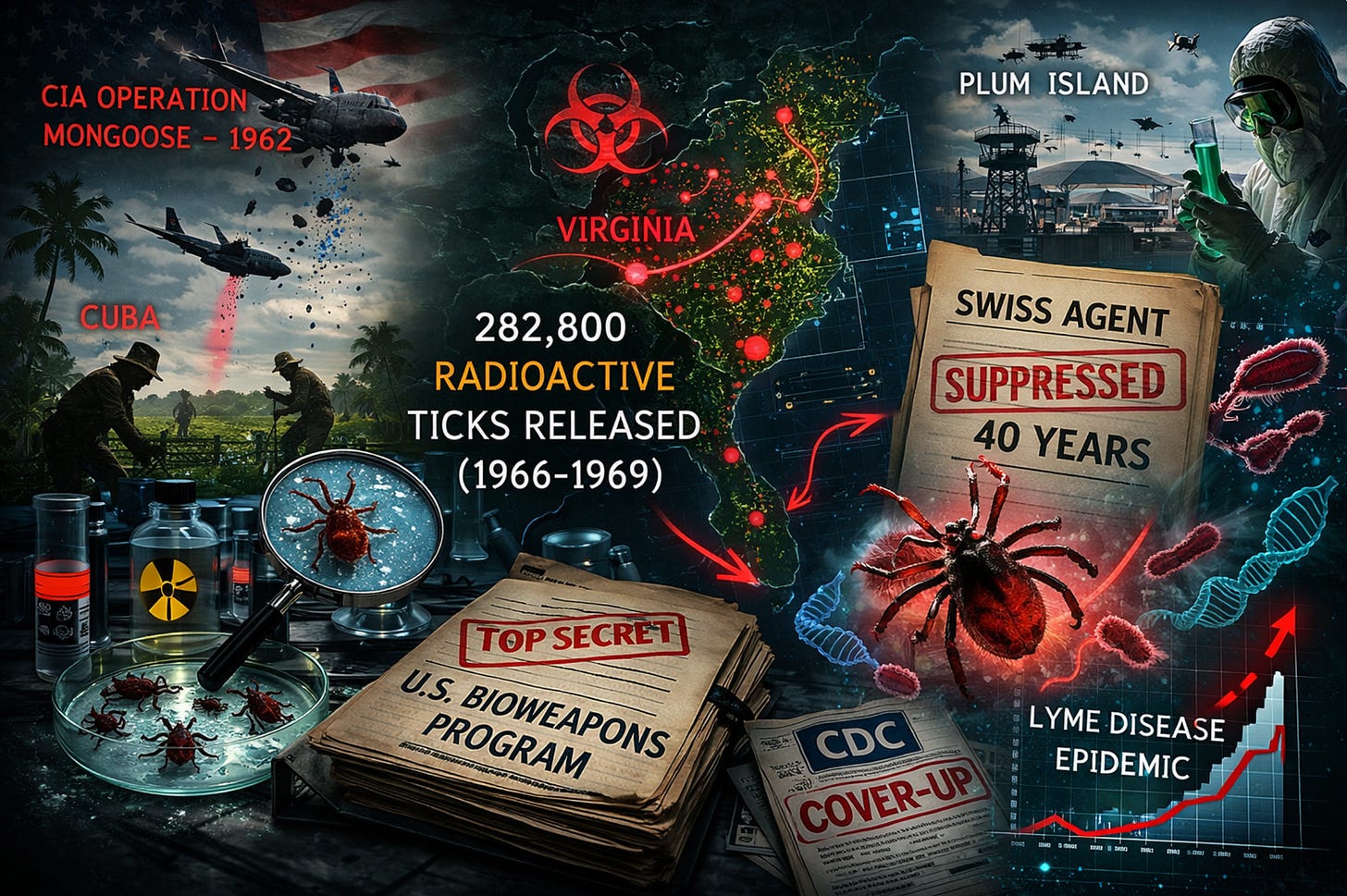
Declassified Docs Link Bioweapon Program to Lyme Disease

http://

Radioactive Ticks

Dr. Robert Malone

March 5, 2026

Important point: Malone states that the Lone Star Tick has spread due to purposely deployed radio active ticks in Virginia by our government.  (It ain’t climate change!  Please hear me)

https://www.malone.news/p/declassified-documents-link-us-bioweapons

Declassified Documents Link U.S. Bioweapons Program to Lyme Disease Outbreak

Exclusive: Military released 282,800 radioactive ticks, suppressed co-infection research for 40 years

An extensive investigation based on declassified government documents and previously suppressed scientific research has uncovered compelling evidence that U.S. biological weapons programs contributed to the emergence of Lyme disease, which now affects hundreds of thousands of Americans annually.

The investigation reveals a pattern of concealment spanning six decades, including the systematic suppression of critical medical research and the release of nearly 300,000 radioactive ticks across Virginia to study how the disease-carrying insects would spread.

CIA Deployed Infected Ticks Against Cuba

Declassified documents and testimony from a CIA operative describe the 1962 deployment of infected ticks against Cuban sugarcane workers as part of Operation Mongoose, the Kennedy administration’s effort to destabilize Fidel Castro’s regime.

The operative, now in his seventies, told researchers that the “strangest thing he ever did was drop infected ticks on Cuban sugarcane workers” using C-123 transport aircraft flying nighttime missions “almost skimming the surface of the Caribbean to avoid Cuban radar.”

After returning from Cuba, the operative’s four-month-old son developed life-threatening fever requiring emergency surgery. His CIA commander advised him to “burn all the clothes you took to Cuba. Burn everything,” indicating contamination concerns.

The deployment was canceled when “Cuba’s shifting winds made accurate payload delivery difficult,” according to the operative’s account.

Massive Domestic Tick Experiments

Between 1966 and 1969, the U.S. military released 282,800 lone star ticks made radioactive with Carbon-14 across Virginia sites along bird migration routes. The radioactive marking allowed researchers to track the ticks’ spread using Geiger counters over several years.

Before these experiments, lone star ticks were not found above the Mason-Dixon Line. Within years of the Virginia releases, they had established populations on Long Island for the first time. Two tick experts consulted about these releases said they “were aghast” and “you’d never be able to do that now.”

The Swiss Agent Cover-Up

In 2014, researchers discovered extensive unpublished materials in the garage of deceased scientist Willy Burgdorfer, who identified the bacterium that causes Lyme disease. The materials revealed that Burgdorfer had found a second pathogen called “Swiss Agent” in Lyme patient blood samples from Connecticut and Long Island in the late 1970s.

Blood from Lyme patients showed “very strong reactions” to Swiss Agent testing, but this finding was completely omitted from Burgdorfer’s landmark 1982 study that identified the Lyme disease bacterium. The suppression of this research for over 40 years may have contributed to treatment failures in chronic Lyme patients.

Dr. Jorge Benach and Dr. Allen Steere, co-authors of the 1982 study, now acknowledge that Swiss Agent research “should be done” because “public health concerns warrant a closer look.”

Project 112: The Hidden Bioweapons Expansion

Defense Secretary Robert McNamara authorized Project 112 in 1962, creating what researchers describe as a bioweapons program “almost as large and secretive as the Manhattan Project.” The program involved 134 scheduled tests from 1962-1974 with production facilities capable of breeding 100 million infected mosquitoes monthly and 50 million fleas weekly.

The program’s existence was “categorically denied by the military” until 2000, when a CBS News investigation forced acknowledgment. Documents show the program involved “every branch of the U.S. armed services and intelligence agencies” with testing sites spanning multiple countries.

Operation Big Itch in 1954 successfully deployed 670,000 fleas from cluster bombs, proving arthropods could survive aerial deployment and “soon attached themselves to hosts.” The test validated bioweapons capable of covering “a battalion-sized target area and disrupt operations for up to one day.”

The Plum Island Connection

Plum Island Animal Disease Center sits just 13 miles from Lyme, Connecticut, where the disease was first identified. From 1952-1969, the facility was managed by the Army Chemical Corps for biological warfare research before transfer to the Department of Agriculture.

The facility “frequently conducted its experiments out of doors” with acknowledged containment failures where “test animals mingled with wild deer, test birds with wild birds.” Richard Endris maintained “over 200,000 soft and hard ticks of varying species in tick nurseries on Plum Island, personally collected from locations as far away as Cameroon, Africa.”

Wildlife regularly moved between Plum Island and the mainland. “Deer from Lyme regularly swam to Plum Island, and local birds flew there to feed on insects,” creating direct pathways for laboratory pathogens to reach wild populations.

Disease Emergence Timeline

The Long Island Sound region experienced an unprecedented outbreak of tick-borne diseases beginning in 1968:

  • 1968: First Eastern U.S. human babesiosis cases appear on Nantucket
  • 1968: Rocky Mountain spotted fever appears in Cape Cod region
  • 1970: Hundreds of Rocky Mountain spotted fever cases documented on Long Island
  • 1972: First 51 documented Lyme arthritis cases in Old Lyme, Connecticut

“By the 1990s, the eastern end of Long Island had by far the greatest concentration of Lyme disease,” according to one analysis. “If you drew a circle around the area of the world heavily impacted by Lyme disease, the center of that circle was Plum Island.”

Burgdorfer’s Cryptic Admissions

Willy Burgdorfer, who discovered the Lyme disease bacterium in 1982, spent most of his career developing tick-borne biological weapons before transitioning to civilian research. In 2013 video testimony, he confirmed participation in bioweapons research and “insinuated there had been an accidental release of some sort.”

After cameras stopped rolling, “Willy told us with a smile, ‘I didn’t tell you everything.’ But try as we might, we couldn’t get him to say more.” Before his death in 2014, he left a note stating “I wondered why somebody didn’t do something.”

In 2007, when documentary filmmakers attempted to interview Burgdorfer, a government scientist “pounded on the door” demanding to “sit in on this interview,” indicating ongoing official concern about his potential disclosures.

Pattern of Institutional Concealment

The investigation identified systematic concealment behaviors spanning multiple decades:

  • Project 112 denied for 50 years despite extensive documentation
  • Swiss Agent research suppressed despite public health relevance
  • Relevant documents kept classified long after security justifications expired
  • Congressional investigation requirements resisted
  • Laboratory origin questions characterized as “conspiracy theories”

(See link for article & comprehensive integrated multi-layered analysis of the issue)

_____________

**Comment**

An AI-enhanced retrospective analysis found:

  • phylogenetic gaps between ancient strains and the strains that emerged in the 60’s & 70’s (in other words, what we are infected with isn’t found in nature – it’s been tweaked in a lab)
  • co-infection clustering of three distinct diseases in the same geographical area and timeframe (but are never even considered, discussed or treated)
  • GMO signatures
  • distribution anomalies inconsistent with natural tick migration patterns (And it ain’t from climate change! It’s from man-made tick redistribution out of airplanes & migrating birds & animals)
  • suppression of the Swiss Agent indicating systematic research concealment

In short, it’s wide-spread systemic fraud perpetrated upon an unsuspecting public, yet the answer always presented is to have the very agencies behind this fraud do an investigation on themselvesIt will never happen.  ‘Dog and pony show’ comes to mind.

We’re on our own and the quicker we embrace this salient fact, the quicker we will get better.

For more:

Cancer Link to COVID Shots Can No Longer Be Denied but 15 States Sue HHS For Reducing Recommended Shots

In a head scratching move, 15 states are suing HHS (Wisconsin is one of them) for reducing the number of ‘vaccines’ on the childhood immunization schedule from 17 to 11.  I wonder if they have bothered personally studying the issue at all.

I will answer my rhetorical question: no. They simply click their heels together and recite, ‘vaccines are safe and effective,’  because they are in a ‘vaccine’ religion where no one is allowed to think or question, and truth and facts don’t matter.

https://www.conservativewoman.co.uk/causal-links-between-covid-jabs-and-cancer-are-starting-to-look-irrefutable/

Links between covid jabs and cancer can no longer be denied

EPIDEMIOLOGIST Nicolas Hulscher, a researcher with the Peter McCullough Foundation, has just completed another review of mRNA vaccine damages, this time focusing on cancer. He has looked at 100 papers that link the incidence or the cause of cancer with the mRNA covid vaccines, has described mRNA jabs as ‘one of the largest carcinogenic exposures in history’, listing 20 increased cancer risk factors that studies have linked to the jabs.

Disturbingly, the other covid vaccines based on the spike protein delivered without mRNA technology (Novavax protein subunit vaccine and the now discontinued Johnson and Johnson/Janssen and AstraZeneca vaccines) he reports are not without association here too, due to features of the encoded spike protein of the Sars-2 viruses. Hence mRNA spike-based vaccines such as Pfizer and Moderna are delivering a double cancer ‘hit’.

When I first called out the fact that I was seeing an excess of cancer relapses in my melanoma patients in 2022 (see here and here) I suggested that this was likely to be because of the observed T cell suppression that was caused by the booster vaccine.

A Spanish team led by Benitez Fuentes and colleagues documented this beautifully in a study associating T cell exhaustion after booster vaccines in cancer patients. We therefore expected this to be a major problem in those cancers where T cell surveillance was known to be paramount in management, such as melanoma, lymphoma, renal and colorectal cancers.

However, it would appear that many other cancers not thought to be heavily dependent on T cell control have started to appear such as breast, prostate, pancreatic, thyroid and bladder cancer. Hulscher reviews epidemiological studies since the famous Gibo et al paper from Japan which showed such a clear link with each booster vaccine and cancer that it received an avalanche of attack demanding its withdrawal. Since then other studies from South Korea and Italy have confirmed this trend, with many other studies not necessarily highlighted in overall agreement.*

The main message here is that the cancers that have increased most are not necessarily the same in every study and cannot be blamed on immune compromise. The Gibo paper suggested a number of mechanisms whereby mRNA and the spike protein could induce cancers. It is worth highlighting some of them here.

T cell suppression is also associated with class switching of the immunoglobulins so that neutralising anti bodies (IgG1 and 3) become tolerogenic enhancers (IgG4).

The mRNA vaccines themselves have been shown to have unacceptable DNA capsid levels, with many containing SV40, a known carcinogen.

The mRNA has been shown to integrate into host DNA and a case where it has been shown to be integrated into a grade 4 bladder cancer is highlighted. Once integrated it causes disruption of thousands of genes at random and can activate oncogenes and interfere with many known oncogenic signalling pathways such as the RAS pathway. Of extreme concern is that it is capable of interfering with the major cancer suppression genes such as p53 and BRCA among others. This is a potential time bomb as mutations in these genes are known to be associated with cancers occurring at early ages.

There are other reasons as to why non-mRNA vaccines may also contribute as the spike protein causes chronic activation and inflammation which leads to micro-clotting and metastatic spread of any already developing cancer.

I have been working with colleagues on reviews of many ways that mRNA can induce cancer and can confirm that there are several hundred publications that are in agreement with the observations here. As a clinician I can confirm that I have seen many rare cancers occurring after covid vaccines, including ones not mentioned here such as gliomas and gall bladder cancers. The pattern is in younger people with cancers occurring at a more advanced stageas first reported by the UK surgeon James Royle.

What is incredible is that the regulators and authorities have been so brainwashed or are in such denial that they have not reacted to what is probably the worst preventable cause of malignancy in human history. Criminal negligence does not even start to describe it. (See link for article)

_____________

Sadly, that isn’t all.

Israel FOIA shows a 500X increase in heart attacks in teens on the day of their COVID shot.
True to form, no investigation is called for and the records no longer exist.  POOF!

For an indepth article on the COVID shots that includes the lates VAERS report and mounting list of adverse reactions and death:   https://madisonarealymesupportgroup.com/2020/12/21/warning-3150-injuries-in-1st-week-of-covid-vaccines-among-american-healthcare-workers-pregnant-women-included/

For more:

For Hope: