Archive for the ‘research’ Category

Neuropsychiatric Lyme Borreliosis: An Overview With a Focus on a Specialty Psychiatrist’s Clinical Practice

http://www.mdpi.com/2227-9032/6/3/104

Neuropsychiatric Lyme Borreliosis: An Overview with a Focus on a Specialty Psychiatrist’s Clinical Practice

Department of Psychiatry, Rutgers-Robert Wood Johnson Medical School, Piscataway, NJ 08854, USA
Received: 10 July 2018 / Revised: 22 August 2018 / Accepted: 23 August 2018 / Published: 25 August 2018
View Full-Text   |   Download PDF [316 KB, uploaded 25 August 2018]

Abstract

There is increasing evidence and recognition that Lyme borreliosis (LB) causes mental symptoms. This article draws from databases, search engines and clinical experience to review current information on LB. LB causes immune and metabolic effects that result in a gradually developing spectrum of neuropsychiatric symptoms, usually presenting with significant comorbidity which may include:

  • developmental disorders
  • autism spectrum disorders
  • schizoaffective disorders
  • bipolar disorder, depression
  • anxiety disorders (panic disorder, social anxiety disorder, generalized anxiety disorder, posttraumatic stress disorder, intrusive symptoms)
  • eating disorders
  • decreased libido
  • sleep disorders
  • addiction
  • opioid addiction
  • cognitive impairments
  • dementia
  • seizure disorders
  • suicide
  • violence
  • anhedonia
  • depersonalization
  • dissociative episodes
  • derealization
  • other impairments
Screening assessment followed by a thorough history, comprehensive psychiatric clinical exam, review of systems, mental status exam, neurological exam and physical exam relevant to the patient’s complaints and findings with clinical judgment, pattern recognition and knowledgeable interpretation of laboratory findings facilitates diagnosis.
Psychotropics and antibiotics may help improve functioning and prevent further disease progression. Awareness of the association between LB and neuropsychiatric impairments and studies of their prevalence in neuropsychiatric conditions can improve understanding of the causes of mental illness and violence and result in more effective prevention, diagnosis and treatment. View Full-Text
This is an open access article distributed under the Creative Commons Attribution License which permits unrestricted use, distribution, and reproduction in any medium, provided the original work is properly cited. (CC BY 4.0).
Bransfield, R.C. Neuropsychiatric Lyme Borreliosis: An Overview with a Focus on a Specialty Psychiatrist’s Clinical Practice. Healthcare2018, 6, 104.
_____________________


Identifying Vancomycin as an Effective Antibiotic for Killing Bb

https://aac.asm.org/content/early/2018/08/14/AAC.01201-18

Identifying vancomycin as an effective antibiotic for killing Borrelia burgdorferi

Xiaoqian Wu, Bijaya Sharma, Samantha Niles, Kathleen O’Connor, Rebecca Schilling, Nicole Matluck, Anthony D’Onofrio, Linden T. Hu, Kim Lewis
DOI: 10.1128/AAC.01201-18

ABSTRACT

Borrelia burgdorferi is the causative agent of Lyme borreliosis. Antibiotic therapy of early acute infection is effective for most patients, but 10-20% go on to develop Post-Treatment Lyme Disease Syndrome. The nature of PTLDS remains unknown, but currently approved antibiotics for treatment of Lyme disease do not appear to impact these symptoms after they have developed.

We reason that minimizing the time the pathogen interacts with the host will diminish the probability of developing PTLDS, irrespective of its nature. This calls for an efficient eradication of the pathogen during acute infection. In search of a superior killing antibiotic, we examined approved antibiotics for their ability to kill B. burgdorferi.

Vancomycin proved more effective in killing the pathogen in vitro than ceftriaxone, the standard of care for disseminated B. burgdorferi infection. Both compounds were also the most effective in killing stationary phase cells. This is surprising, given that inhibitors of cell wall biosynthesis are known to only kill growing bacteria. We found that peptidoglycan synthesis continues in stationary cells of B. burgdorferi, explaining this paradox. A combination of vancomycin and gemifloxacin sterilized a stationary phase culture of B. burgdorferi. Examination of the action of antibiotics in immune-deficient SCID mice showed that doxycycline, a standard of care for uncomplicated acute infection, did not clear the pathogen. By contrast, both ceftriaxone and vancomycin cleared the infection. A trial examining early use of more potent antibiotics on development of PTLDS may be warranted.

_____________

**Comment**

I like the initial thinking of the researchers regarding the need to treat acute infections thoroughly to hopefully prohibit later symptoms; however, vancomycin is often used IV which is more expensive and has its own risks.  The oral route does not result in significant levels in the body which seems unwise since Bb can go anywhere in the body and typically does.  https://www.medicinenet.com/vancomycin-oral/article.htm

It’s also active only on gram positive bacteria.  While many claim Bb is gram-negative, it’s actually neither type and appears to be a monster complete with its own category:  http://web.uconn.edu/mcbstaff/graf/Student%20presentations/Bburgdorferi/bburgdorferi.html

Doxycycline is far from a perfect drug but it’s a great front-line drug for many tick borne pathogens.  The problem is it isn’t enough.  Eva Sapi has shown it only works on two forms of Bb, the cell wall and spirochetal forms but actually increases the non cell wall form (she calls them round/cyst forms):  https://www.dovepress.com/evaluation-of-in-vitro-antibiotic-susceptibility-of-different-morpholo-peer-reviewed-article-IDR

However, both metronidazole and tinidazole had far superior action:

Metronidazole led to reduction of spirochetal structures by ~90% and round body forms by ~80%. Tigecycline and tinidazole treatment reduced both spirochetal and round body forms by ~80%–90%.

In terms of qualitative effects, only tinidazole reduced viable organisms by ~90%. Following treatment with the other antibiotics, viable organisms were detected in 70%–85% of the biofilm-like colonies.

LLMD’s almost all use drug combinations due to the complexity of the organism as well as to ward off any potential resistance, and the fact coinfections are often involved.  For examples:  https://madisonarealymesupportgroup.com/2016/02/13/lyme-disease-treatment/

Things done in vitro (the lab) often do not play out in vivo (the body).  It will be interesting to watch this develop.

Take Back Your Power – Smart Meter Documentary

Take Back Your Power – Smart Meter Documentary

Published 8/23/18

This must see documentary reveals how smart meters emit dirty electricity causing health problems, are a fire hazard, allow in-home spying, including the ability to be hacked https://www.politico.com/story/2015/01/energy-electricity-data-use-113901, and actually increase your utility bills.  

Under the auspice of climate action, President Obama in 2008 asked for $100B to fund a smart grid which incentivized utilities with grants up to $200M each to install new digitized wireless meters for electricity, water and gas.  This plan now is in 60-65% U.S. homes.  Other nations have followed.  These smart meters were created to be integrated with big telecom’s 5G plans.

The executive summary is:

  • Over 6,000 published studies since the 30’s show negative health effects.
  • Smart meters emit pulsed microwave radiation – as much as 190,000 times/day.
  • The strength of each pulse is hundreds of times higher than radiation from cell phones.
  • 42:42 does a great job of quickly explaining what the definition of a smart grid is.  (A wireless system which turns every appliance in your home into a transmitting cell phone which in turn will be sent to aggregate meters where all data from your neighborhood is collected/transmitted collectively bouncing from house to house that will be sent to the utility company. An RF signal will be firing at many many times a second, increasing radio frequency exposure exponentially.  
  • 44:00 shows aphids on the leaf of an orange tree after radar equipment was installed at an airport.  You can visually see them pulsing every few seconds in tandem with the radar rotation device.  The airport was 14 miles away.
  • The switch mode power supply emits dirty electricity. (Go to 51:20 for more)
  • At 55:00 using dark field microscopy, Dr. Springob shows how smart meters in only 2 min and only 1 foot away from the meter cause cell degradation including bottle cap formation, as well as red blood cells stacking up prohibiting oxygen from being delivered to the body.  Many complain of headaches around the meters.
  • 44:44 shows a graph of peer-reviewed published science on radiation testing results/public standards.
  • At 57:30 Dr. Klinghardt discusses how fetuses are affected with a correlation between Autism and increased electromagnetic fields.
  • 48:46 in 1972 the U.S. Navy produces an unclassified report of the health effects on the human body observed from microwave radiation.  There were five pages of human health effects. (headaches, insomnia, restlessness, EEG changes, seizures, convulsions, erratic heart palpitations, anxiety, chest pains, and changes in pace-makers – among many others)
  • 58:51 Jerry L. Phillips, PhD describes smart meter research funded by Motorola that started out amicable but went sour when negative results came back.  The two pie-charts given demonstrate the polarization between non-industry studies showing a 70% harmful effect of smart meters vs only a 32% harmful effect in industry led studies.  Motorola urged him NOT to publish his findings.  (Sound familiar?)
  • 1:05 shows a frightening story of a young man who died from brain cancer due to a cell tower at San Diego State.  There was a cluster of brain cancer deaths and all of them lived next to that tower.
  • 1:08 shows the city police trespassing onto peoples’ property to allow the electric companies to trespass to install smart meters – kicking in doors and cutting locks.  A housewife was handcuffed and taken to jail for “interfering.”

I won’t go into the invasion of privacy issue which is glaring, but if you can turn your oven on with your phone, so can someone living in Shanghai if they hack into your system.  I’m also not going to touch the utility company employees kicking down doors and breaking locks to enter peoples’ homes.  Wow.  All I can say is stand up and speak in your sphere of influence.  This is not acceptable.

And lastly, at around 31:50 the author zooms out and considers how all of this can happen – essentially bringing people to a place where they willingly give up basic human rights.  In a nutshell he suggests that some are playing on fear (terrorist threats, energy crisis/scarcity, disease and yes, Martha, even global warming/climate change. etc) to get people to accept a false paradigm.  It isn’t wrong to be concerned about issues, but when the bully-fear tactic causes people to hastily give up human rights, a corner has been turned.

The older I get the more I see this play out from the fear of disease (mandatory vaccines despite the lack of safety studies and damage they cause) to a supposed climate issue and fear of scarcity of natural resources pushing people to accept smart meters despite the fact at 32:05, Joel L. Bellenson, solar expert, states we do not live in a condition of scarcity and that there is no shortage of energy.  The sun produces far more energy than we could ever need or use.  Listen in around 32:45 if you are interested in solar energy.

All in all a fascinating yet frightening film about smart meters that only solidifies the fact they will never grace my residence.

The solution to the smart meter problem:

https://inpowermovement.com/wp-content/uploads/2017/08/InPower-liability-action-overview.pdf

Note:  anyone can do the NOL process, no matter if they have an analog meter, a “smart” meter, or anything in between.  Documents, templates, videos, guides:  www.inpowermovement.com


Aluminum in the Brain in Multiple Sclerosis: Regulatory and Funding Agencies Silent, Complicit

https://jameslyonsweiler.com/2018/08/18/aluminum-in-the-brain-in-multiple-sclerosis-regulatory-and-funding-agencies-silent-complicit/

By James Lyons Weiler in Cures August 18, 2018

https://jameslyonsweiler.com

MEDICAL SCIENCE proceeds along a hierarchy of evidence; often, patients are studied individually (case studies), or a small collection of patients are examined and characterized together (case series studies). Case series studies typically have smallish sample sizes and it is generally understood that larger studies will be necessary to determine more accurately the characteristics being studied.

In a new case series study, brain tissue from 14 donors with a diagnosis of MS was studied in a case series by Mold et al (2018) using transversely heated graphite furnace atomic absorption spectrometry. The study found high aluminum content (>10 ug/g dry weight) in all areas of the brain studied, with some areas exceeding 50 ug/g. They found aluminum both with cells and in the interstitium between cells. They found aluminum co-localised with structures known to be present in Secondary Progressive Multiple Sclerosis (SPMS) in the frontal cortex of one donor with SPMS.

There are a number of critical lines of evidence that make this fundamental finding critically important. Patients with MS have lower amounts of aluminum in their hair, suggesting depressed detoxification, and higher amounts are found in urine on chelation challenge testing (Fulgenzi et al., 2014). Chelation with EDTA is known to significantly reduce aluminum intoxication (Fulgenzi et al. 2014), and consumption of silica-rich mineral waters also increase urinary excretion of aluminum from patients with SPMS (Jones et al., 2017).

Extremely plausible direct mechanisms of the cause of MS from aluminum are known and animal studies routinely induced MS using aluminum hydroxide injections. So much evidence exists that points to aluminum as a source of strange new conditions of unknown causes, such as MMF and Gulf War Syndrome, one would think that calls to reconsider the use of aluminum in vaccines would be answered. The same team had previously found high amounts of aluminum in the brains of people with autism, and and in patients with Alzheimer’s disease. The latter result, while also important, is not surprising, as it has long been known that amyloid is part protein and part aluminum. Finally, when France brought on HepB vaccination, cases of MS following vaccination increased; when they stopped recommending the HepB vaccine, which contains aluminum hydroxide, the rate of HepB vaccine-associated MS cases dropped to near zero.
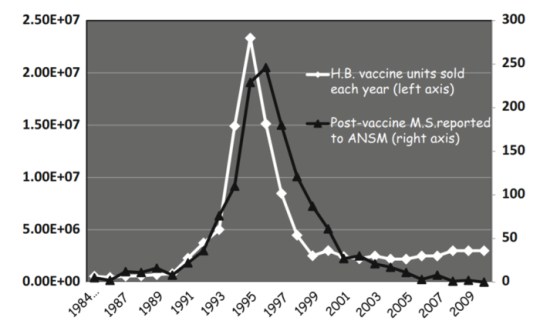
francems

Complicity

What is surprising is the lack of action on the part of the US FDA to put an end to the use of this dangerous metal in vaccines, and that the NIH is not funding more studies like this. NIH should fund studies to determine how to most safely remove aluminum from anyone exposed via vaccines; brain stem amyloidosis is a non-trivial concern. Approaches like ketogenic diet, silica-rich mineral waters, hyperbaric oxygen, EDTA, intranasal insulin and intranasal deferoxamine (to prevent brain stem amyloidosis) should all be tested in randomized clinical trails in clinical populations known to be afflicted with aluminum intoxication (autism, Alzheimer’s, MS).

What is also surprising is that the CDC and ACIP remain blithe to the morbidity and mortality their continued approval of vaccines that contain metals like aluminum and mercury. They make decisions on behalf of us all, and yet every member of ACIP with the exception of one military member has conflicts of interest with vaccine manufacturers. ACIP should review all of the literature on aluminum and make recommendations on how to phase it, and thimerosal, out of vaccines completely.

Further inaction on the part of these regulatory and funding agencies, and active denialism at this point will surely be seen by future generations as both callous disregard, and where conflicts of interest reside, complicity.

The study, conducted at the Keele University, was funded in part by the Children’s Medical Safety Research Institute.

References

Jones K et al. EBioMedicine. 2017 Urinary Excretion of Aluminium and Silicon in Secondary Progressive Multiple Sclerosis. 26:60-67. doi: 10.1016/j.ebiom.2017.10.028.

Fulgenzi A, Vietti D1, Ferrero ME. Aluminium involvement in neurotoxicity. Biomed Res Int. 2014;2014:758323. doi: 10.1155/2014/758323.

_______________

**Comment**

https://www.nationalmssociety.org/Symptoms-Diagnosis/Other-Conditions-to-Rule-Out/Lyme-Disease

Lyme disease can cause delayed neurologic symptoms similar to those seen in multiple sclerosis (MS) such as weakness, blurred vision caused by optic neuritis, dysesthesias (sensations of itching, burning, stabbing pain, or “pins and needles”), confusion and cognitive dysfunction, and fatigue. Lyme disease symptoms may also have a relapsing-remitting course. In addition, Lyme disease occasionally produces other abnormalities that are similar to those seen in MS, including positive findings on magnetic resonance imaging (MRI) scans of the brain and analysis of cerebrospinal fluid (CSF).

These similarities in symptoms and test results have led some people with MS to seek testing for the presence of antibodies to Borrelia, to determine if their neurologic symptoms are the result of Lyme disease or truly MS. The distinction is important because Lyme disease, especially when treated early, often responds to antibiotic therapy, whereas MS does not.

Studies examining Lyme disease & MS
Two studies have examined the overlap in diagnosis of MS and Lyme disease. The studies were conducted in parts of Long Island, New York, an area where Lyme disease is endemic, or regularly found.

In the first study, people who had Borrelia antibodies in their blood as well as a variety of neurologic symptoms considered to be “MS-like,” were evaluated with MRI, evoked potentials (EP) and CSF analysis, including a test for the presence of Borrelia antibodies in the spinal fluid.

While those with the MS-like illness had the highest incidence of abnormal MRIs and were the only ones among those studied to have abnormal EP and oligoclonal bands in their spinal fluid (indicating an abnormal immune response), they did not prove to have any Borrelia antibody in their spinal fluid.

The researchers concluded that the few patients with the MS-like symptoms probably had these symptoms due to MS and had also been exposed to the Borrelia bacterium.
A companion study looked for the presence of Borrelia antibodies in the blood of 100 people with the diagnosis of possible MS. Of 89 people who in fact turned out to have definite MS, only one had Borrelia antibodies. The researcher concluded that “…infection with Borrelia is infrequent in MS patients who live in an endemic area. Lyme disease is unlikely to be a significant factor in the differential diagnosis of MS.” Furthermore, the presence or antibodies to Borrelia does not prove that Borrelia is causing the neurological symptoms, only that there has been previous infection with the organism.

Just remember, “rare” is only “rare” if it isn’t you.


Our Battle Ongoing: Lyme Disease in Australia

 Approx 1 hour 30 min.

Our Battle Ongoing: Lyme Disease in Australia | Full Documentary

Directed by Andy Smith
Published on May 25, 2017

Our Battle Ongoing takes a look into the lives of Australians across the nation currently suffering from Lyme disease or a Lyme-like illness. Every individual has their own unique story as symptoms differ from person to person, but they are all united in a common cause of seeing recognition come to those suffering now and for the generations to come. With little to no help currently available, some have to take drastic measures in order to receive treatment. Our Battle Ongoing brings to light the tragedy of living with an invisible illness in Australia.

www.ourbattleongoing.com

_________________

**Comment**

The number of afflicted Australians is growing yearly just as it is worldwide.  To deny this pandemic is truly an “Emperor has no clothes” story.  You’ve got thousands of people with Lyme-like symptoms, most of who improve with appropriate treatment, but denial from the establishment.  For every patient who can high-tail it to Germany for treatment, you have 1,000 who can’t afford to.

Devastating.

While it is bad here in the U.S., it is truly abysmal in Australia.

Recently I posted this:  https://madisonarealymesupportgroup.com/2018/08/20/tick-borne-diseases-causing-autonomic-dysfunction/ and declared it a literal rap sheet for Lyme.  Please compare this article to the patients you see in this documentary.  They are identical.  

While I agree that Australia is a unique area with its own flora and fauna and pathogens, don’t kid yourself – migrating birds have no problem transiting ticks to and from Australia or anywhere else on the planet.  To say otherwise is burying your head in the sand.  Time to wake up and quit blaming the climate and look around at the integrated world in which we live with animals and humans moving in and out of areas with ticks on them on a daily basis.  For more on why the climate is NOT responsible for this pandemic:  https://madisonarealymesupportgroup.com/2018/08/13/study-shows-lyme-not-propelled-by-climate-change/

More on Lyme in Australia:  https://madisonarealymesupportgroup.com/2016/11/03/ld-not-in-australia-here-we-go-again/

https://madisonarealymesupportgroup.com/2017/09/19/tbis-in-australia/

https://madisonarealymesupportgroup.com/2018/08/08/an-invasive-new-tick-is-spreading-in-the-u-s/  Known in Australia as bush ticks and in New Zealand as cattle ticks, long-horned ticks can multiply rapidly and suck so much blood from a young animal that it dies. The ticks bloat up like fat raisins until their tiny legs are barely able to support them.  After a blood meal, females can lay hundreds of fertile eggs without mating.

https://madisonarealymesupportgroup.com/2018/08/02/12-scary-diseases-you-can-catch-at-the-beach-lyme-is-one-of-them/  Ticks have been found on the beach, in caves, underneath picnic benches, on rocks, have blown from trees into swimming pools, have blown onto my house by a lawn mower and ended up crawling up the interior basement walls.  Can we just say ticks can be virtually everywhere with the need for extreme diligence?

https://madisonarealymesupportgroup.com/2018/03/23/australian-lyme-disease-research-pilot-funded/  The study utilises a proprietary capture methodology that has not previously been employed in the detection of tickborne pathogens in Australia.

While the authorities don’t believe you, we do.