
https://sayerji.substack.com/p/the-methylene-blue-mistake-how-a?
The Methylene Blue Mistake: How a 19th-Century Textile Dye Became a “Mitochondrial Medicine”
And why nature has been outperforming synthetic chemistry since long before Heinrich Caro picked up a dye vat
May 26, 2026
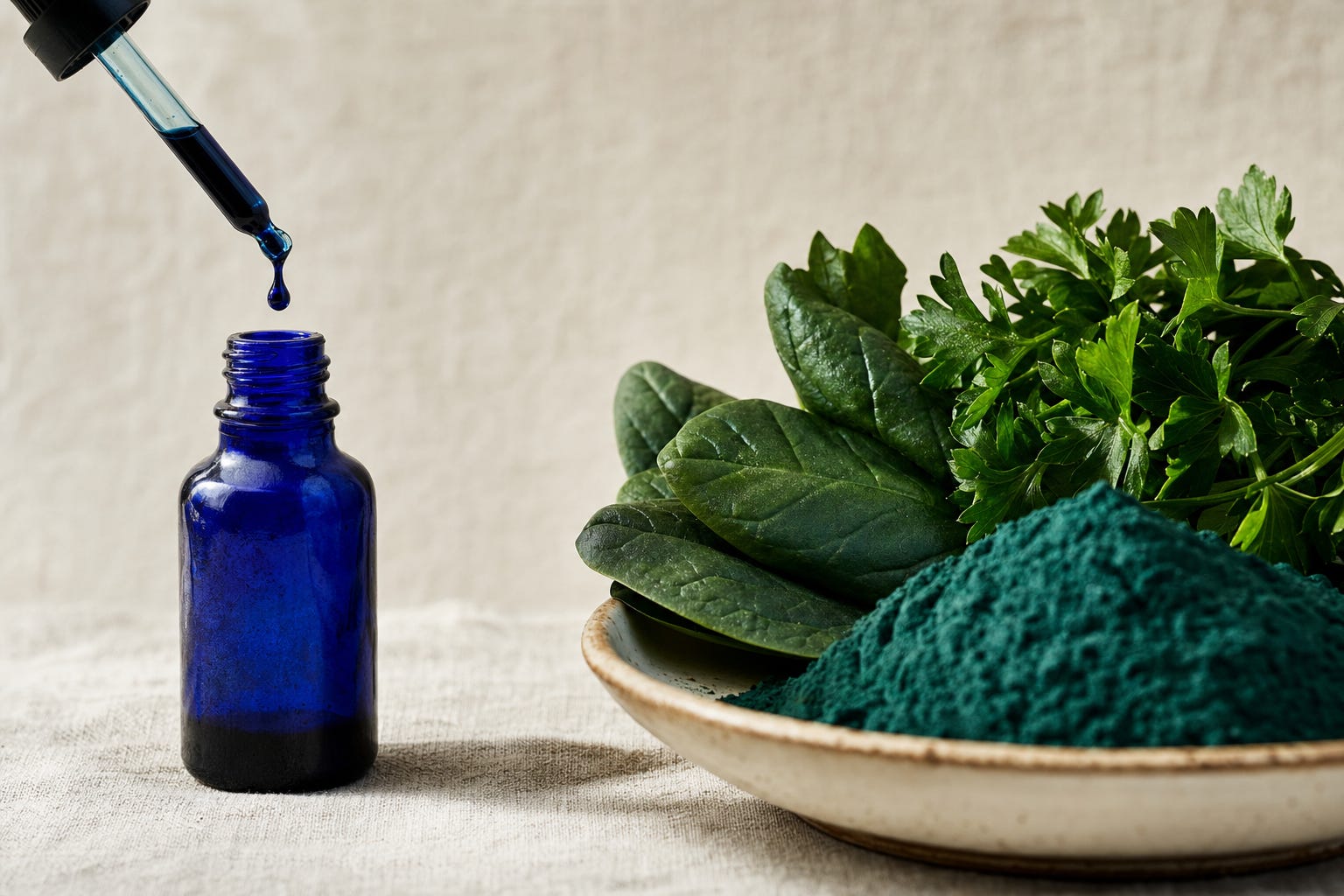
It is being sold across the wellness world as a daily brain booster. Meanwhile, the green pigment in your salad and the blue pigment in spirulina do the same thing — safer, with better evidence, and as the way your body was designed to harvest sunlight in the first place.
Scroll through wellness Substacks, biohacker podcasts, or longevity posts on X in 2026 and you cannot miss methylene blue. A tiny dropper bottle of deep navy liquid. A blue-tongued grin. Claims that it “supercharges mitochondria,” “uncloggs neurons,” and turns aging brains young again.
It is one of the strangest stories in the modern wellness movement.
Because methylene blue is not a botanical, not a peptide, not a mushroom extract. It is a synthetic phenothiazine dye, invented in 1876 by a German chemist named Heinrich Caro to color cotton and wool. It has been used to stain microscope slides, to disinfect aquariums, to treat malaria when nothing else was available in the 19th century, and — in modern emergency rooms — as an acute antidote for a rare blood disorder called methemoglobinemia.
It was never designed as a daily supplement. And once you look at what the toxicology literature actually says — the kind of literature that the FDA’s own regulators read before approving a new drug — the case for taking methylene blue as a nootropic falls apart.
Worse, it falls apart precisely because there is a better, safer, evolutionarily older molecule doing the same job in your mitochondria — and it is sitting in your refrigerator.
This is the story of how a textile dye got mistaken for a mitochondrial medicine, and why the chlorophyll in your spinach and the phycocyanin in spirulina are doing what methylene blue claims to do, without the genotoxicity.
(See link for article)
__________________
**Comment**
Many are promoting MB, including LLMDs for Lyme/MSIDS. This is another take on it to consider. The article also lists other substances that do similar things but are completely safe.
For more:
- https://madisonarealymesupportgroup.com/2025/05/27/seminar-toxicity-risks-of-methylene-blue-you-cant-afford-to-ignore/
- https://gingerbreggin.substack.com/p/emergency-notification-methylene methylene blue is a Monoamine Oxidase Inhibitor (MAOI). As such, it is one of the most toxic agents ever used in medicine and psychiatry, and the mother of the most dangerous drugs used in psychiatry.
- Methylene blue is not a miraculous new discovery. It’s the opposite. Created in 1876 in a lab, it is the oldest manmade chemical to be used in medicine. But for well over a century, methylene blue has never been FDA-approved for psychiatric purposes. Later, its chemical structure was modified in labs to create many of the earliest, most neurotoxic psychiatric drugs. (See link for the in-depth article by psychiatrist Peter Breggin who has decades of experience and who has written many scientific papers and books showing how human beings who take psychiatric drugs sometimes are initially stimulated when the drug over-activates the monoamine neurotransmitters, including epinephrine, norepinephrine, serotonin, and dopamine; but eventually, similar to the animals, the human drug recipients typically become more subdued, apathetic, or disengaged from their own feelings, those around them, and with life itself. Breggin does not prescribe psychiatric drugs as a treatment as he feels they do more harm than good. Instead he offers therapy, and education on more effective and healthier principles of living. He is the author of the only medical textbook on the subject, called “Psychiatric Drug Withdrawal: A Guide for Prescribers, Therapists, Patients and Their Families.”)
- https://amandhavollmer.substack.com/p/methylene-blue-colour-me-concerned A critical analysis of its pharmacology, risks, and incompatibility with holistic methods.
- https://madisonarealymesupportgroup.com/2022/07/11/methylene-blue-magic-bullet/
- https://madisonarealymesupportgroup.com/2023/12/12/methylene-blue-for-tick-borne-infections-more/
- https://madisonarealymesupportgroup.com/2024/02/02/methylene-blue-for-lyme-dr-jemsek/

