Remember, I told you not to expect anything to come out of the CDC and FDA admitting an early “safety” signal of clot shots and strokes. Well, I hate to say I was right:
About That CDC Stroke “Safety” Signal We All Detected Last Year: America Suffered the Cost of Vaccine Risk, Injury & Death Denialism.
First of all, it’s a signal of risk, not safety. Second, we detected the signal over a year ago, long before the CDC. They appear now to have lost the signal. How many strokes could have been averted?
This is a compendium of useful resources – evidence – that proves that the signal of stroke was present early on and persisted through the process to “pharmacovigilance”.
May 2021
Dr. Gregory Michael
From Seneff et al (May, 2021): “Dr. Gregory Michael, an obstetrician in Miami Beach, died of a cerebral hemorrhage 16 days after receiving the first dose of the Pfizer/BioNTech COVID-19 vaccine. Within three days of the vaccine, he developed idiopathic thrombocytopenic purpura (ITP), an autoimmune disorder in which the immune cells attack and destroy the platelets. His platelet count dropped precipitously, and this caused an inability to stop internal bleeding, leading to the stroke, as described in an article in the New York Times (Grady and Mazzei, 2021). The New York Times followed up with a second article that discussed several other cases of ITP following SARS-CoV-2 vaccination (Grady, 2021), and several other incidences of precipitous drop of platelets and thrombocytopenia following SARSCoV-2 vaccination have been reported in the Vaccine Adverse Event Reporting System (VAERS).”
October 2021
Dr. Blaylock, October 2021 – Covid-19 pandemic: What is the truth? Surg Neurol. In 2021 doi: 10.25259/SNI_1008_2021. eCollection 2021.
“These vaccines can also trigger seizures, strokes, and even neuropsychiatric disorders. Keep in mind that in some cases these disorders do not appear for years or even decades. Dr. Peter McCullough, a professor of internal medicine and cardiology, cited a case in which a woman lost all memory after receiving the first vaccine dose.[26] He also told of a fully vaccinated woman who lost her baby after breastfeeding. The child died of a thrombotic/hemorrhagic episode.”
A comment on Steve Kirsch’s newsletter, Dec, 2021:
“Ancedotally (sic), I was in the ER a couple of weeks ago. Hospital beds in the area were full of stroke, heart attack, and clotting patients. This nurse offered this when I asked. I was, under protest, being worked up for heart attack and clotting because I casually mentioned chest pain in a telehealth appointment. I had a cold. I tried to walk it back and they wouldn’t let me. D-dimer, ekg, traponin (sic) test. I am 41, low bmi, exercise 5 times a week, take no medications, no history of heart issues. I was like, uh, you guys seeing a lot of heart attacks? They were like, OMG SO MANY. And strokes too, and blood clots. They just the last two, I did not prompy(sic) them.”
(See link for article)
_______________
**Comment**
Weiler’s Substack presents example after example of blood clots, hemorrhages, strokes, heart attacks, pathogenic priming, deep vein thrombosis, myocardial infarctions, pulmonary embolisms, and deaths. Further, a postmortem study of patients “vaccinated” for COVID in Colombia showed that nearly60% of deaths were classified as sudden cardiac death.
“Despite the author’s claim of “no association,” its my interpretation of the data that 78% of the deaths could be directly attributed to a known mechanism of COVID-19 vaccination. This is very consistent with the recent report from Schwab et al from Germany whose data revealed 71% of deaths within 20 days of vaccination occurred in the context of acute problems known to be caused by the vaccines….when autopsies done by separate teams in different countries arrive at similar findings, we have external consistency.” ~ Dr. Peter McCullough
But, the CDC and FDA suddenly find no increased risk of strokes for the elderly who got the Pfizer bivalent booster, just like the DOD didn’t find a massive increase in sickness and injury diagnoses in 2021 over previous years, particularly in the neurological, cardiovascular, oncological, and reproductive health categories, after whistleblowers came forward. Why’s this, you ask? They simply “recalibrated” their health surveillance data to make it all disappear, kind of like when the CDC ‘disappeared’ nearly 13,000 VAERS reports, and kind of like when the FAA helped airlines cover up “vaccine” injuries by loosening the cut-off for cardiac damage in medical clearance for aviation.
Lyme disease misinformation has physicians searching for guidance
Carl Tuttle
Hudson, NH, United States
JAN 20, 2023 —
It appears that the CDC has partnered with Mathematica to start working on the “disinformation campaign” for the upcoming Lyme vaccine brought to you by Pfizer who paid the the largest health care fraud settlement in history for fraudulent marketing. $2.3 Billion!
Why not start an email campaign and tell these folks how Lyme disease has impacted your life?
Email addresses:
Arnold Chen achen@mathematica-mpr.com Frederick Chen frederick.chen@ama-assn.org Grace Marx gmarx@cdc.gov Sara Berg sara.berg@ama-assn.org
Email to Arnold Chen, Senior Researcher at Mathematica…
———- Original Message ———-
From: CARL TUTTLE <runagain@comcast.net>
To: “achen@mathematica-mpr.com” <achen@mathematica-mpr.com>, “info@mathematica-mpr.com” <info@mathematica-mpr.com>
Cc: “grace.marx@cuanschutz.edu” <grace.marx@cuanschutz.edu>, “lwx1@cdc.gov” <lwx1@cdc.gov>, “frederick.chen@ama-assn.org” <frederick.chen@ama-assn.org>
Date: 01/19/2023 5:53 PM
Subject: Lyme disease misinformation has physicians searching for guidance
“False and misleading information about the diagnosis and treatment of Lyme disease is spreading and creating confusion for both physicians and patients,”Dr. Chen added. The report conducted with the CDC and Mathematica Policy Research is just the start and “will highlight some of the disinformation that patients with persistent, medically unexplained symptoms attributed to Lyme disease have been exposed to and how some physicians respond to that,” he said.
Mathematica
Princeton, NJ
Attn: Arnold Chen, Senior Researcher
Dear Dr. Chen,
Could you please answer the following questions:
1. Will the CDC and Mathematica report include the following reference:
We report an unusual patient with evidence of Borrelia burgdorferi infection who experienced repeated neurologic relapses despite aggressive antibiotic therapy. Each course of therapy was associated with a Jarisch-Herxheimer-like reaction. Although the patient never had detectable free antibodies to B. burgdorferi in serum or spinal fluid, the CSF was positive on multiple occasions for complexed anti-B. burgdorferi antibodies, B. burgdorferi nucleic acids and free antigen.
____________________________________________
2. Will your report include the following references of seronegative Lyme disease:
4. Were you aware that the Western blot reporting criteria was manipulated in 1995 to facilitate vaccine development? (Dearborn Conference)
That manipulation led to a reduction in diagnostic success rate to 31% as reported by Dr. Paul Fawcett during the 1995 Rheumatology Symposia: 1995 Rheumatology Symposia Abstract# 1254 Dr. Paul Fawcett et al.
Faulty misleading FDA approved antibody tests cannot be used to gauge treatment failure or success and are absolutely essential for hiding an antibiotic resistant/tolerant superbug.
What we have been dealing with here Dr. Chen (based on all the suppressed evidence I have shared with you) is deliberate mismanagement of a disease. A chronic relapsing seronegative disease does not fit the vaccine model and that is the root of the disinformation perpetuated by the CDC for three decades. Now you have been informed. What will you do with this information?
A response to this inquiry is requested.
Carl Tuttle
Independent Researcher
Hudson, NH
“It is difficult to get a man to understand something when his salary depends upon his not understanding it” -Upton Sinclair, American novelist and social reformer
Cc:
-Frederick Chen, MD, chief health and science officer at the AMA
-Grace Marx, MD, MPH, medical epidemiologist with the Bacterial Diseases Branch at CDC’s Division of Vector-Borne diseases
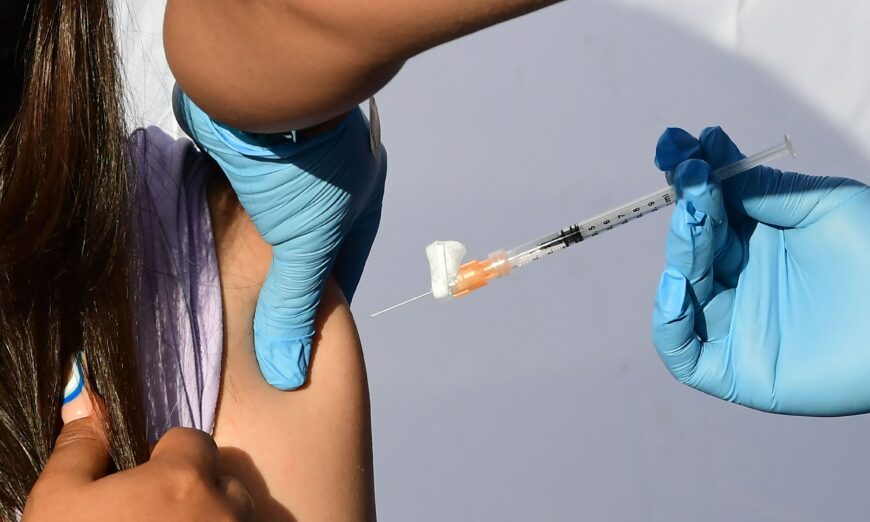
A child receives a dose of Pfizer’s COVID-19 vaccine in Los Angeles, Calif., on Nov. 5, 2021. (Frederic J. Brown/AFP via Getty Images)
More than 1,600 children aged 5 to 11 experienced a systemic reaction such as fever or diarrhea after receiving one of the new COVID-19 vaccines, according to a study from the U.S. Centers for Disease Control and Prevention (CDC).
Of 3,259 children in the age group who received an updated Pfizer or Moderna vaccine and were registered in the v-safe system, nearly half experienced a systemic reaction, CDC researchers found.
Systemic reactions, defined as “usually mild” and lasting for multiple days, include fatigue, chills, nausea, abdominal pain, vomiting, joint pain, and diarrhea. On a severity scale, the category of reactions is between local reactions and severe reactions.
According to responses to v-safe, a smartphone survey system started by the CDC during the COVID-19 pandemic to monitor vaccine safety, 48.9 percent, or 1,594 children, in the 5 to 11 population who got a new booster between Oct. 12, 2022, and Jan. 1, 2023, experienced one or more systemic reactions. (See link for article)
________________
Important points:
CDC did not report the events that happened on the day of vaccination and only published data for one through seven days.
That time period “is not nearly long enough to characterize safety,” Dr. Harvey Risch, professor emeritus of epidemiology at the Yale School of Public Health, told The Epoch Times via email.
“The present study is of 5-11 year olds, who have an infection fatality risk of well less than 3 per million, whereas the cited reference is of all ages, mostly adults, who have increasingly greater risks with age. The stated comparison of children with adults is thus invalid,” Risch said.
While the study “is being represented by CDC as showing vaccine safety in this age group, no comparison to actual quantitative risks of Omicron infection serious adverse events has been performed,” he added.
A recent study found the infection fatality rate (IFR) —the ratio of mortality for confirmed and inferred infections—was just 0.0003% for ages 0 to 19.
This study found 436 BILLION copies of spike protein circulating freely in the blood of children after COVID shots.
The clot shots continue despite experts statingmRNA products are unstable and circulate systemically via the blood, causing cells to take up messenger RNA which is expressing a foreign new antigen throughout the body. The body sees this foreign new antigen as aninvader – like an autoimmunedisease.
It has never been proven that mRNA genetic therapy injections are any better than previous vaccines.
The amount of antigen can not be controlled in the mRNA platform.
Due to reverse transcriptase(an enzyme within our cells), the implications are unknown if the mRNA platform could produce a potential cancerrisk or transgenerational expression.
mRNA vaccines, besides the current diabolical experiment with the COVID shot, have:
“NEVER been effectively been put into humans before, except one or two where it didn’t work very well. This is a massive experiment. The vaccines are actually registered as experimental vaccines.“ ~ Professor Robert Clancy
There’s a new peer-reviewed research paper out regarding the COVID Vax. It’s bad. How bad? I’ve shown it to two physicians so far. One said he “had a seizure” reading it. The other said something worse.
Long story short: 436 BILLION copies of spike protein are found circulating freely in blood plasma, a month after the COVID (Gene therapy) vaccine.
In kids.
Their hearts, screeching in pain with Myocarditis, will never fully recover.
You knew that, didn’t you? But there is more than that . . .
(See link for article with damning information and graphs)
_______________
Important excerpt:
First, this study was done and submitted for “peer-review” on May 26, 2022. It was ACCEPTED for publication (after peer-review) on November 23, 2022. So the world has known, as a matter of scientific research, these details, since May of last year. Yet no one called for Vaccines to be HALTED.
They had scientific proof the vaccines were causing heart damage . . . myocarditis . . . which, incidentally, has a FIFTY PERCENT mortality rate within five years, and they said . . . nothing.
Want to know why? MONEY.
They can’t admit it’s potentially harmful and deadly.
They can’t suddenly stop the shots; To do so would be an admission of guilt.
______________
**Comment**
Others sat on crucial information which could have saved thousands of lives as well. Recently, Dr. Joseph Fraiman, lead author of the peer-reviewed research reanalyzing the Pfizer and Moderna trials knew back in August that the clot shot increases serious adverse events at a rate of 1 in 800, but did nothing.
ALERT! International Medical Billing Codes Used by the U.S. Government and Private Insurance Now Track Your COVID-19 Vaccination Status
Comments by Brian Shilhavy Editor, Health Impact News
1/18/23
Leo Hohmann has just published a special report about how the International Classification of Disease (ICD) codes used by the medical industry for billing purposes under Medicare-Medicaid and the private insurance companies, now include a code for COVID-19 “vaccination status.”
This means that if you visit a medical doctor, or are admitted to a hospital, they will ask you whether or not you are up-to-date on your COVID shots, and enter that into your medical records.
Hohmann’s report confirms that this code is now being implemented and has started.
This is yet another reason why it is imperative to STOP using the medical system.If you don’t use their services, they cannot track you.
I know this seems like an impossibility to many people, as we have been brainwashed our whole lives to believe that we cannot survive without medicine and hospitals, but I assure you that it is possible. I have been doing it for years, and I raised my three children, now all adults and one of them with “special needs,” all without using the medical system.
Start looking for other healers in your community, or even online, if you have not done so yet. Many older systems of healthcare do still exist in the U.S., even though the FDA and Big Pharma have worked hard to outlaw them. Homeopathy, Traditional Chinese Medicine (TCM), aromatherapy and the use of essential oils, are a few of the many options you have available.
For those who simply cannot go cold turkey and immediately stop using the medical system, then the next best option is for you to drop your health insurance, and start paying out of pocket for your medical services from private medical practices.
If you are someone who is conscientious about your health, and takes responsibility for your own health rather than running to a doctor or the ER every time you get sick, as most readers of Health Impact News would be, then you are a cash cow for the health insurance industry, because they make money off of you and your healthy lifestyle.
I decided decades ago I was not going to keep funding the health insurance industry with my good health, and invested in myself instead, trusting God that if a major crisis arose where I needed emergency services, that God would supply the funds needed to pay for them directly.
And God has honored that faith throughout the years. The few times our family had to use ER services (all years ago and pre-COVID), we were able to afford to pay for it out of pocket, and over the years we saved a LOT of money by not paying expensive health insurance premiums every month.
If you are paying out of pocket for medical services and do not use insurance, in most cases you can get by without surrendering so much private information, including your vaccination status (don’t even offer your social security number if you are paying out of pocket).
Look for private practices that allow you to do that. There are many out there, and many of these providers even choose not to accept Medicare and Medicaid insurance, to avoid Government over-reach.
The one organization I have recommended over the years to search for such private medical providers, is The Association of American Physicians and Surgeons (AAPS). Even before COVID was launched upon the world in 2020, AAPS was providing a platform for private providers and patients who wanted to avoid government over-reach in healthcare.
They have a provider list where you can search for private practices that will serve patients without insurance that you can search for here. Just do your own due diligence to make sure they will respect your privacy, because simply being listed on the AAPS site does not guarantee that.
Also, look for providers who have been offering these kind of private services for some time now, before COVID started. Because there are a lot of these whistleblower doctors that are now jumping onto this bandwagon but have not operated like that in the past, and many of them still promote the COVID shot for certain people, and other vaccines as well, as we have frequently reported.
Be especially aware if they require any kind of technology registration, such as the use of apps and other things, as a requirement to use their services, and of course verify that you can pay out of pocket without insurance.
EXCLUSIVE Special Report: Medical profession implements WHO digital diagnosis code for the unvaxxed
Doctors will be ‘incentivized’ by the government to start asking more questions about your vax status
A set of international codes are used by the medical industry for billing purposes under Medicare-Medicaid and the private insurance companies, but it’s not just about billing.
These codes are part of the International Classification of Disease (ICD) system set forth by the United Nations World Health Organization and they’re about to get far more invasive.
This system was originally created after World War II for the purpose of tracking the diagnosis of major diseases within a population. But over the years, there have been 11 major revisions, and with each revision the data being collected on each individual has become more precise and all-inclusive.
More than 1.6 million clinical situations can now be coded, according to the WHO website.
And it’s also become more coercive, to the point where it’s become impossible for doctors to get reimbursed by insurance companies if they don’t upload all the requested data points.
According to an April 2016 article in the American Journal of Neuroradiology, “Across the years, it has become an integral part of the payment infrastructure of the U.S. healthcare system along with the Current Procedural Terminology (CPT) coding system for medical procedures.”
The ICD system really grew into an electronic data-mining beast with the passage by Congress of the Affordable Care Act (Obamacare) in 2012. The digitization of healthcare records was fully implemented with the upgrade to ICD-10 after two congressional delays in 2016.
Since then, there has literally been a numeric code created for almost any diagnosis you can think of, and some you would never think of (Search “crazy ICD-10 codes” and you will see what I’m talking about).
Fast forward now to April 2022. This is when the federal Centers for Medicare and Medicaid (CMS) announced a new code that anyone who is awake and aware of the growing medical tyranny should be concerned about. After some delays, the new code was rolled out in October 2022 and became available to nearly every medical clinic and hospital in January 2023.
What is this new code? It’s Code Number Z28.310. This is the code for a very peculiar “diagnosis” since it’s not a diagnosis at all, but an invasion of privacy and likely to be used against many people in the future. This is the code your doctor will log into the computer system that is accessed by government and private health insurers informing them of your Covid vaccine status.
These are internationally recognized codes for very specific medical conditions for insurance and government purposes. They are accessible worldwide should you be overseas and have a health issue that needs to be treated.
I recently interviewed a fully licensed M.D., a physician who practices in a Midwestern state and has full hospital privileges. This doctor’s name will remain anonymous because if it were to get out, he could end up losing his job. On January 12, he informed me that Code Z28.310 went live in his state.
“Yesterday (January 11) it showed up for the first time in any kind of hospital paperwork I’d seen,” the doctor told me.
If diagnostics aren’t entered properly, a doctor may not get reimbursed. Now that this new code is officially required by government and private insurance providers, doctors will likely now be “incentivized” to ask about your vax status, he said. That means they get financial payouts whenever the government decides there’s a “meaningful use” for this data.
I had no idea that doctors were being bought off in this way.
This system appears to be the way the military-industrial-biomedical complex will identify and separate out those who have submitted to their digital identification system, which starts with being “up to date” on your shots — endless shots. As the late Dr. Zev Zelenko and others have said, these continuous boosters will become a “gateway to transhumanism.”
The powers that be at the United Nations and World Economic Forum have a “need to know” when it comes to those who reject this demonic transitioning of the human race, which the transhumanists refer to as an “upgrade” to “humanity 2.0.”
“I’ve never used this diagnosis code, never would for any patient,” the doctor told me in a follow-up interview this week. “I never even knew it existed until last week.”
He explained that Z28.3 is the diagnostic code for being under-vaccinated generally, but it gets more specific from there.
“It’s non-specific,” the doctor explained. “But with Covid they added the 1 after the 3 (Z28.31), so Covid is the only vaccine they’re specific for. Then they added a second digit if you’re partially vaccinated and didn’t get any of the boosters.”
These codes could continue to get more specific to the point that they also log in codes for why you refuse Big Pharma’s ineffective and unsafe — but very profitable — injections.
The doctor told me he saw one patient’s diagnosis code that was specific for refusing the vaccine due to his schizophrenia.
“A lot of people with schizophrenia are paranoid of shots and different treatments, so his doctors were attributing him (as unvaxxed) on that basis,” the doctor said.
So it doesn’t take too much of an imagination to see how this system could be abused.
What about if you continually refuse your doctor-recommended vaccines? Could you end up being diagnosed with mental illness? The doctor I spoke with agreed that this is not far-fetched. And once you get diagnosed with a mental disorder, you can lose many of your constitutional rights. You essentially become a second-class citizen.
“You could technically get a diagnosis of schizophrenia from any medical doctor, but usually they will refer you to a psychiatrist to make that diagnosis,” he said.
And that’s not the only thing to be concerned about with regard to this new diagnostic code.
Here’s where it gets interesting. At the G20 Summit held a couple of months ago in Indonesia in November 2022, the leaders of the world’s 20 largest economies issued a joint statement that called on the nations of the world to implement a global digital vaccine passport system, based on standards set by the WHO, which would force international travelers to have a digital vaccine passport ID on their mobile phone.
Without it, you would not be “allowed” to travel outside your home country, unless of course you’re an illegal migrant trying to get to the U.S. or Europe from an “undeveloped” or “under developed” country.
We also know, from a Forbes magazine article published in February 2022, that nearly half of the states in America had already at that point signed the contracts and laid the infrastructure to implement digital vaccine passports, so this same system could eventually be used to control, or at least monitor, the travel of Americans outside of their states.
Then we have the World Economic Forum’s push toward Smart Cities, recently rebranded as “15-Minute Cities,” which would monitor and restrict travel outside of one’s city. Are you following me here?
A digital system is being put in place that would have the capability of essentially locking down entire populations at any given time. All that would be needed is a declaration of a “public health emergency of international concern,” or of “regional concern” and the U.S and E.U. are trying their hardest to turn that authority over to the WHO in the form of a new pandemic treaty.
Eventually, as we have been informed by Yuval Noah Harari, a top adviser to Klaus Schwab and the World Economic Forum, the plan is to put this digital surveillance technology not just on your mobile phone but “under the skin.”
Surveillance Under the Skin ~ Dr. Yuval Noah Harari
The doctor in the Midwestern state explained a medical terminology called “meaningful use” and how it’s used to log personally identifiable data on medical patients.
“If you ever wondered why they try to get your blood pressure and your weight every time you go to the doctor’s office, it’s because hospitals and physicians get reimbursed if they provide ‘meaningful use’ data. They get reimbursed better. They get bonuses. Doctors have monthly meetings with staff and administrators and this is how they get reimbursed higher, they get more money, if they provide that meaningful use data.”
He further explained that if the ICD-10 coding system requires doctors to find out their patients’ Covid vax status as part of the “meaningful use” data, then they will add that to their office charts and they will get reimbursed handsomely for providing this information to the government.
“Every time you go to the doctor’s, they will try to get this information out of you,” he said.
The U.S. expanded its ICD system under the presidency of Barack Obama and the adoption of the Affordable Care Act. Previously, the U.S. used the ICD-9 system, which required less specific and less invasive information on patients,
“but then with the ICD-10 system all of a sudden, they got real specified. Instead of just high blood pressure it became, is this high blood pressure caused by spending too much time with your mother-in-law or is it because of this other thing, whatever it may be. It became very specific.”
“ICD-10 also includes significant improvements over ICD-9 in coding primary care encounters, external causes of injury, mental disorders, and preventive health. The ICD-10 code sets’ breadth and granularity reflect advances in medicine and medical technology, as well as capture added detail on socioeconomics, ambulatory care conditions, problems related to lifestyle, and the results of screening tests.”
In other words, ICD-10 coding became a tool for extraordinary data mining of Americans’ personal life histories.
When ICD-10 was implemented, that’s when the AARP got the contract to administer the program in the U.S.
It also got more rigid.
“As a doctor, you have to use the ICD-10 system to get reimbursed,” my doctor source told me.
Even if you do not have government or private insurance and pay strictly out of pocket, each and every diagnosis is still logged into the system.
“If you have an interaction with the healthcare system, you will have an ICD-10 code logged and assigned to your condition,” he said. “And all that data goes into a central database that was created under Obama so that the Electronic Medical Record systems (EMR), can talk to each other.”
“Nobody else is talking about this,” he told me.
Obamacare forced all doctors to use the EMR system in order to get reimbursed.
“Because up until eight or ten years ago, a lot of doctors were still using paper charts. It’s all digitized now.”
In fact, according to the WHO website, that U.N. body has already rolled out an “upgraded” ICD-11 systemand is working to get nations to adopt it.
When the U.S. federal government adopted ICD-10, it subsidized the transition, offering interest-free loans and grants that many doctors’ offices used to pay for the upgraded EMR software systems.
“There were hundreds of millions of dollars allocated, but then you had to allow the government to come in and access your books whenever they want,” the doctor said. “But now you can’t get reimbursed unless you go through this system. Virtually every doctor is a part of this system now.”
Bottom line:Be aware of what information you hand over to your doctor, because they essentially all work for the government now. That’s who they are beholden to for reimbursement. And if your doctor asks too many questions that seem unrelated to the health issue you’re being treated for, you may want to fire them and find a new one.
This news is particularly troubling for Lyme/MSIDS patients who are already misunderstood and abused by the medical system. Those suffering with life-altering brain infections are misdiagnosed and labeled with mental illness far too often already. Now, those who are choosing not to be an experimental pin cushion by foregoing the clot shots are now at even greater risk of being labeled with mental illness, which in turn will put them at risk of losing their individual rights.
If you think this “over the top,” please know that in Ontario, doctors are encouraged to consider psychiatric drugs for “vaccine” refusers. It doesn’t take a brain surgeon to see where this is headed.
Just today, prison staff and inmates in Illinois have been exposed to an “unknown substance.”While “officials” haven’t stated exactly what this substance is, “local sources” state it is fentanyl, which can only cause symptoms if it gets into the blood stream. This of course begs the question of how this outbreak happened. The reason I bring up prisons and prison staff is because of the Mycoplasma fermentans outbreak in a Texas prison which served as the backstory to Garth Nicolson’s book, “Project Daylily.” Nicolson states Mycoplasma is the #1 coinfection with Lyme/MSIDS and is virtually undetectable but can cause all manner of chronic diseases. It’s also important to note that genes part of the HIV-1 envelope were found in these Mycoplasmas, which in a nutshell means that a person may not get HIV but they may get some of the symptoms.This should sound familiar because part of the HIV envelope has also been found in the clot shots. Who is behind the HIV debacle?Fauci, of course.
Why prisons? Prisoners serve as a perfect example of a population with virtually no rights – which is exactly what could happen to those deemed with “mental illness,” the new norm for “vaccine” refuseniks. Please be aware that virtually anyone can be called a “prisoner,” and have their rights taken away.
There has been work done to get Lyme recognized in the ICD codes. While this appears at first blush to be a good thing, we can now see how the entire system can be used against patients in a diabolical way.Perhaps the very barriers for Lyme/MSIDS patients (having to find independent doctors who typically won’t except insurance, requiring us to pay out of pocket)may benefit and protect us in the long run. Lyme literate doctors (LLMD) have been forced to go outside the system for a very long time. They’ve had to restructure their entire business model to be able to treat us as its the insurance companies turning them in for treating outside the CDC guidelines which function as mandates. These doctors take the necessary time with patients and treat the body holistically unlike typical allopathic medicine being used in hospitals and most “managed care.”
Unscientific and unlawful “vaccine” mandates don’t take individual health or beliefs into account (WI Governor Tony Evers has vetoed every bill for “vaccine” freedoms)
Biden blames the unvaccinated for the economic downturn