Archive for the ‘Treatment’ Category

A Comprehensive & Practical Review of Mold Toxicity & Its Complications

https://www.betterhealthguy.com/nathancrista2021

I had the opportunity to attend “A Comprehensive & Practical Review of Mold Toxicity and its Complications” held online on April 24-25, 2021.  This event was a wonderful collaboration between Neil Nathan, MD and Jill Crista, ND.

Disclaimer: Nothing in this text is intended to serve as medical advice. All medical decisions should be made only with the guidance of your own personal licensed medical authority.

Disclaimer: This information was taken as notes during the training course and may not represent the exact statements of the speakers. Errors and/or omissions may be present.

Note: As this information may be updated as any errors are found, I kindly request that you link to this single source of information rather than copying the content below. If any updates or corrections are made, this will help to ensure that anyone reading this is getting the most current and accurate information available.

Go to top link for article and notes

____________________

For more:

Mold toxicity is a big deal and needs to be addressed before some Lyme/MSIDS patients experience improvement.  Again, Lyme literate doctors are educated in these issues.

Awaited Ivermectin Review is Out

https://www.medpagetoday.com/special-reports/exclusives/93485?xid=nl_mpt_DHE_2021-07-

Awaited Ivermectin Review Is Out

— Findings are positive, but critics still want a randomized controlled trial
Boxes and blister pack of Ivermectin Tablets USP Boxes and blister pack of Ivermectin Tablets USP and a prescription bottle.a

Proponents of ivermectin for COVID-19 have long been talking about an expected review and meta-analysis led by Andrew Hill, PhD, of the University of Liverpool.

These results were finally published this week in Open Forum Infectious Diseases, and they’re positive — but they haven’t escaped criticism, and most researchers still want results from a randomized controlled trial.  (See link for article)

___________________

**Comment**

The following was found from the review:

  • There was a 56% reduction in mortality (relative risk [RR] 0.44, 95% CI 0.25-0.77, P=0.004), with 3% of patients on ivermectin dying compared with 9% of controls
  • A 70% improvement in survival (RR 0.30, 95% CI 0.15-0.58, P=0.0004)
  • A reduction in time to recovery of 1.58 days compared with controls (95% CI -2.8 to -0.35, P=0.01) 
  • A shorter duration of hospitalization (-4.27 days, 95% CI -8.6 to -0.06, P=0.05).
But this still wasn’t good enough for critics.

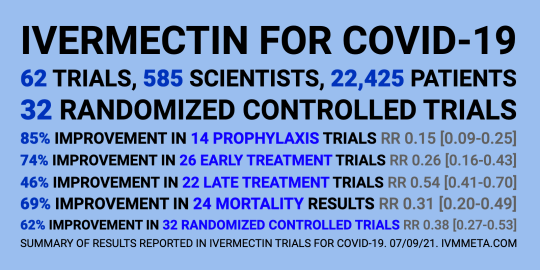
And there’s been 32 randomized controlled trials done to date, but that still isn’t good enough for critics.

The key for this is found in the following quote:

“Of course, rolling out vaccination as quickly and widespread as possible would negate the need to use ivermectin as a treatment,” he added. “So big picture, vaccines are the better solution.”

This is completely backwards.

Rolling out effective treatments as quickly and widespread as possible negates the need for a vaccine!  But history is being rewritten to state natural immunity will only be achieved through vaccines – the magic bullet for mankind.

Despite what mainstream news and medical rag journals like Medscape state, current research shows:

isummarySource: Database of all ivermectin COVID-19 studies – www.c19ivermectin.com – (constantly updated)

For the backstory on how Remdesivir obtained EUA status despite lack of effectiveness, while Ivermectin languished on shelves see this article for the sordid history.

In what can only be described as “shennanigans,” researchers changed the primary outcome measures in the study for Remdesivir to make it appear more successful.  Go here for more info.

For more on Ivermectin:

“We now have four large randomized control trials totaling over 1,500 patients each trial showing that as a prophylaxis agent [against COVID-19] it is immensely effective,” Kory said. “You will not get sick. You will be protected from getting ill if you take it in early outpatient treatment.”

Please see FLCCC’s COVID-19 treatment protocols for every stage of illness: https://covid19criticalcare.com/covid-19-protocols/  as well as the research on it:   https://covid19criticalcare.com/ivermectin-in-covid-19/

Lastly, the following was written about the Medscape piece:

I have years of experience with Ivermectin in the Brazilian Amazon. The drug in general, has acceptable safety profile. Ivermectin has few established mechanisms of action; chief among them are its immunomodulatory and antiinflammatory properties. Recently, Australian scientists conducted an in vitro study of the MOA of Ivermectin with respect to SARS-CoV-2 replication. The Australian study showed it interferes with a specific protein product which is essential in the viral replication cycle. Considering the benefit of this drug outweighs the risk, Ivermectin is a reliable and practical solution in resource-limited countries where access to COVID-19 meds is scarce. It is commonly understood that in the western countries, the Big Pharma resists prescription of Ivermectin for COVID19 cases.  – Prof. Dr. Nassiri, July 9, 2021

BINGO!

What is Powassan Virus?

https://danielcameronmd.com/what-is-powassan-virus/

WHAT IS POWASSAN VIRUS?

what is powassan virus
The Powassan virus is a tick-borne illness transmitted by the same tick that harbors the Lyme disease bacterium. Although it is still considered rare, the number of cases is growing and if contracted the virus can have devastating and long-lasting effects.

In their article “Underrecognized Tickborne Illnesses: Borrelia Miyamotoi and Powassan Virus,”  Della-Giustina et al. explain what is the Powassan virus and why it’s raising concerns.  

“We chose to review the Powassan virus because it only requires 15 min. of tick attachment for transmission, and the sequelae of the neurologic disease are devastating, in addition to a 10% mortality rate.”¹

What is Powassan virus?

The Powassan virus (POW) is a tick-borne flavivirus that is related to other viruses including: dengue, yellow fever, West Nile encephalitis, and tick-borne encephalitis (primarily found in Europe). “Flaviviruses are a group of single stranded RNA viruses that cause severe endemic infection and epidemics on a global scale.”²

In recent years, other viruses transmitted by ticks have been identified including the Heartland virus (phlebovirus) and the Bourbon virus (thogotovirus).

POW is very similar genetically to the deer tick virus and the clinical presentations are identical.
How was it discovered?

Powassan was first discovered in the brain of a young child.

“Powassan virus is named for the Ontario, Canada, town where it was first isolated from the brain of a 5-year-old boy who died of severe encephalitis in 1958,” the authors write.

Where is it?

The second case was reported in New Jersey (1970) and then another in eastern Russia (1978). Although, there have been no reported cases in other countries, the virus has been identified in a growing number of states.

In 2019, 13 U.S. states reported cases: Connecticut, Indiana, Massachusetts, Maine, Minnesota, North Carolina, North Dakota, New Hampshire, New Jersey, New York, Pennsylvania, Rhode Island, and Wisconsin.

Ticks infected with Powassan virus can transmit the disease in only 15 minutes, causing long-lasting neurologic problems in some individuals, in addition to a 10% mortality rate.

How is the virus transmitted?

The Powassan virus is carried and transmitted by Ixodes scapularis ticks, also known as deer ticks or blacklegged ticks. These ticks can also transmit Borrelia burgdorferi, the bacteria which causes Lyme disease.

“Although many flaviviruses have mosquitos as competent vectors, there is no evidence of human POW virus disease transmitted by mosquitos,” the authors point out.

How fast can Powassan virus be transmitted?

Very fast. “Transmission in mice has been shown to occur within 15 min. of I. scapularis attachment,” the authors write.

This rapid transmission occurs because the virus is already present in the salivary glands, compared to other non-viral tick-borne diseases where the pathogen is typically harbored in the tick’s mid-gut.

What is the typical clinical presentation?

“Few people who become infected with the POW virus have clinically significant disease,” the authors write.

However, in some cases, “a Powassan infection can lead to disorientation, headache, neck stiffness, fever up to 40°C, clonus, ocular, and other motor palsies, obtundation and convulsions, and can mimic herpes simplex encephalitis.”

Can Powassan virus be serious?

Yes.  

“Approximately 50% of cases result in lasting hemiplegia, memory problems, and muscle wasting,” the authors explain.

“Ten percent of cases are fatal.”

Are there tests for it?

A PCR test is only positive in early stages of a Powassan infection. “IgG by enzyme-linked immunosorbent assay is the mainstay of diagnosis, but confirmation requires specialized testing,” write the authors.

Why are co-infections important?

Treatable tick-borne co-infections may be present. The authors describe a patient with a combination of Powassan encephalitis, Lyme carditis, and Babesia.

Yoon and colleagues described the case of a 17-year-old young man who died waiting for a Powassan virus test.³  He was not treated for a co-infection with Lyme disease. His autopsy showed Borrelia spirochetes, which cause Lyme disease, in his heart and liver. He also had PCR evidence of spirochetes in his brain and lungs.

What is the treatment for a Powassan infection?

There is no treatment for a Powassan virus infection other than supportive care.

References:
  1. Della-Giustina D, Duke C, Goldflam K. Underrecognized Tickborne Illnesses: Borrelia Miyamotoi and Powassan Virus. Wilderness Environ Med. Jun 2021;32(2):240-246. doi:10.1016/j.wem.2021.01.005
  2. Chong HY, Leow CY, Abdul Majeed AB, Leow CH. Flavivirus infection-A review of immunopathogenesis, immunological response, and immunodiagnosis. Virus Res. 2019 Dec;274:197770. doi: 10.1016/j.virusres.2019.197770. Epub 2019 Oct 15. PMID: 31626874.
  3. Yoon EC, Vail E, Kleinman G, et al. Lyme disease: a case report of a 17-year-old male with fatal Lyme carditis. Cardiovasc Pathol. Sep-Oct 2015;24(5):317-21. doi:10.1016/j.carpath.2015.03.003

____________________

**Comment**

Regarding transmission time – ALL pathogens can reside in the salivary glands of ticks due to partial feeding, which will result in quicker transmission times, but this fact is continually downplayed:  https://madisonarealymesupportgroup.com/2019/04/26/three-strains-of-borrelia-other-pathogens-found-in-salivary-glands-of-ixodes-ticks-suggesting-quicker-transmission-time/

It’s also important to note that minimum transmission times have NEVER been established:   https://madisonarealymesupportgroup.com/2017/04/14/transmission-time-for-lymemsids-infection/

https://madisonarealymesupportgroup.com/2021/06/01/cdc-lying-again-tuttle-drops-the-mic/  Within this important letter, Lyme advocate Carl Tuttle shows rapid transmission has occurred in under 4 hours:

  1. Clinical evidence for rapid transmission of Lyme disease following a tick bite:  https://www.sciencedirect.com/science/article/abs/pii/S0732889311004159?via%3Dihub
  2. B. Patmas, MA, Remora, C. Disseminated Lyme Disease After Short-Duration Tick Bite. JSTD 1994; 1:77-78: https://www.lymedisease.org/hard-science-on-lyme-ticks-can-transmit-infection-the-first-day/
  3. Lyme borreliosis: a review of data on transmission time after tick attachment:  https://www.ncbi.nlm.nih.gov/pmc/articles/PMC4278789/  The claims that removal of ticks within 24 hours or 48 hours of attachment will effectively prevent LB are not supported by the published data, and the minimum tick attachment time for transmission of LB in humans has never been established.
  4. Regarding Tick Attachment Times –  https://history.nih.gov/display/history/Burgdorfer%2C+Willy+1986
There are about 5 to 10 percent of infected ticks that have a generalized infection, including salivary glands and saliva at the time of attachment. In such cases, transmission of spirochetes would and does occur immediately at time of attachment.” —Willy Burgdorfer

According to this study by Coppe Labs, right here in Wisconsin, 85% of Powassan infected ticks come from Northern Wisconsin. Another study by Coppe showed that when 95 patients were tested for suspected tick-borne disease, 66% showed evidence of current or prior Lyme infection.  Of those patients, 17% had serologic evidence of acute POWV infection, demonstrating that POWV may affect more patients than we know.

For more on Powassan:

“Healing Can’t Happen in a Bubble of Fear”

https://www.lymedisease.org/amy-scher-bubble-of-fear/

Amy Scher: “Healing can’t happen in a bubble of fear”

By Amy B. Scher

In order to fully heal, you are going to have to let go and lighten up (mostly on yourself).

That’s what I tell people when they are trying to micro-manage every itty bit of themselves and their protocols in order to heal. It may seem like an easy suggestion to follow after all they’ve been through. However it was personally one of the most difficult parts of healing for me to embrace.

I lived in a bubble of fear, worried that everything I did or didn’t do would make or break my healing. But  eventually, it became clear to me that healing will not (and cannot) happen in a bubble of fear. Fear is contradictory to the environment that is needed for wellbeing.

While much went into my ultimate recovery from Lyme, the act of lightening up and letting go had one of the most profound impacts on my journey.

When we suppress ourselves, we can end up feeling anxious, depressed, and sick. If healing is all about getting free to experience a full life again, we must also pay attention to freeing ourselves from the patterns and behaviors that no longer serve us.

Lightening up does not always come easy, but it’s so worth it, and it does come if we let it.

The tyranny of perfectionism

My parents raised me with all the love and silliness you’d expect from the hippies that they were. They always praised me as smart, sweet, artistic, and kind.

But instead of taking these compliments as truth, the part of me that analyzed and internalized everything contorted them into a rule: I must be perfect.

With no one else requiring this of me, I took perfection on as my calling, my purpose. As I grew older, the pressure of this piled on me like a thousand pounds. I strived to be the one who made everyone happy and was celebrated for great things, but I also longed to be one whose faults went unnoticed.

When I strayed from the person I thought I should be—by not getting perfect grades, not being the perfect friend, or making a mistake—my insides would clench. I spent a lot of time rehearsing in my head what things I could have done differently, better. Even though my parents didn’t seem  bothered by any of my imperfections, I worried I might somehow be less of a shining star to them.

By the time I’d been suffering with chronic illness and my body had been falling apart for a good long while, I had assigned much of the blame to myself. Somehow, I must have not done this life thing good enough, perfect enough. Now, perfection was something I owed to the people around me as an apology for being the glaring burden I felt myself to be. I tried hard to convince myself I deserved mercy in this new small life, yet still, even on my near-deathbed, I felt I wasn’t doing sick perfect enough.

The truth is this: I was unloved by myself long before my physical body went astray. And it had become painfully obvious that this pattern was crushing my being and assaulting my immune system. At some point, I decided that if I didn’t lighten the f**k up, this pattern of perfection was going to kill me. I sensed that maybe it had already started to in some way.

The self-criticism trap

You cannot bully yourself into doing enough good or being good enough to feel good—and good enough to be loved, especially by yourself. That’s just not how it works.

Thanks to Stanford University’s Center for Compassion and Altruism Research and Education, we now have scientific data that shows us how and why self-criticism isn’t healthy. (Although we probably didn’t need scientific proof on this one). Self-criticism “makes us weaker in the face of failure, more emotional, and less likely to assimilate lessons from our failures.”

In fact, in a 2012 study published in the US National Library of Medicine, a link between self-compassion and negative states such as depression and anxiety was apparent across 20 studies. Because self-compassion is associated with lower levels of self- criticism, and self-criticism is known to be an important predictor of anxiety and depression, this is where we’re going to start our work.

Even outside of these examples, there has been much information that’s emerged over the years on how positive emotions, including love and acceptance, have a direct impact on your physiology, particularly your nervous system. If you beat yourself up all the time about what you are or aren’t doing, it makes sense that your system would read that self-criticism as danger and stress and react to it in just that way.

The practice of self-compassion is learning to lighten up on yourself just as you would with someone close to you who you loved and cared for. You’ve probably been criticizing yourself for a long time. If this hasn’t worked yet, it’s probably time to try something new

Release attachment to symptoms

During my experience with illness, I spent a lot of time obsessing over every new sensation in my body. I was in a state of constant overdrive, trying to figure out what each symptom was from or how to make it go away. I always alerted my doctors, who also seemed perplexed by what they meant, which of course made me feel even more worried.

Ultimately, I started to approach my body and its symptoms as not warning signs of something severe (as long as my doctor had already been notified), but as just something my body was doing that may not have a clear-cut explanation. I learned how, sometimes, to just let my symptoms be, releasing the massive amounts of energy I spent consumed by trying to solve them.

This is what I learned: sometimes they mean nothing.

We spend so much time analyzing our symptoms, guessing what they could mean, and obsessing over when they’ll go. And sometimes, we need to do that. But other times, we need a break. The truth is that despite all of our incessant “figuring out,” sometimes we just won’t know what our body is doing. We also won’t always know what healing might be taking place despite the raging symptoms. I had my worst month of symptoms came just before I turned a corner toward healing.

Give yourself permission to live a little

I spent most of my life in California, where I ate organic food, held my breath when I walked by a smoker, and focused on controlling my environment to control my health. After I was diagnosed with chronic Lyme, I became even more attuned to my lifestyle and surroundings—afraid that every misstep would kill me.

The turning point for me happened when I was in India in 2007, where I had traveled for stem cell treatment. That was my first hint that I needed to learn to let go. I had to. No choice. No time to get used to an entirely different world and medical system.

At the request of one of the nurses, I had given the staff at the hospital a list of foods I could and could not eat. On the could list: protein and veggies. On the could not list: everything else. Over the years, my brain had been programmed with messages like dairy is bad because it causes inflammationsugar feeds the Lyme bacteria, and carbs are evil. And while maybe some of that has truth to it, being ridiculously strict about my diet only caused me more intense stress.

When the doctor saw the list, she came to my room with it and asked, “But what about your healthy cells? They need some sugar. Dairy is not bad for them. Carbs are okay in moderation! Each night, you can have a small amount of red wine and chocolate. You need some pleasure too.” All I could think was, Are you trying to kill me?

An epiphany

It wasn’t until I was squatting on a mud-smudged grocery store floor that what she said began to sink in. My whole existence for years had been dedicated to “killing” Lyme. I had built my entire life around Lyme disease, the one thing that I didn’t want. What about the rest of me?

“Mom! Look!” I had found a packaged chocolate lava cake, the kind where you add hot water to the plastic tray full of batter and it magically puffs up into dessert. It was inflatable chocolate cake, and it was a miracle in a country that was hard for me to find food I enjoyed.

This is when I had an epiphany that informed the rest of my healing journey:

What if, in my furious effort to find the cure, I had been missing something critically important all along? What if I loosened the death grip I had on my own life? What if healing is beyond what you eat and how perfectly you take your supplements? What if enjoying life and lightening up didn’t look like healing, but was a tiny step toward it?

Chocolate cake, just like the other lessons I learned, would become part of my protocol; one that brought me joy and helped to teach me that the healing journey doesn’t always look like perfection. Sometimes it looks like lightening and loosening up.

Amy B. Scher, an energy therapist, has written several books on healing, including: This Is How I Save My Life: Searching the World for a Cure – A Lyme Disease Memoir (When doctors have all but given up, when a diagnosis eludes you, and when every test result raises more questions than answers, how do you save yourself?); How To Heal Yourself From Depression When No One Else Can (Scher’s accessible approach to helping anyone struggling with depression to reclaim a joyful life). How To Heal Yourself From Anxiety When No One Else Can (A unique, go-at-your-own-pace book, full of hands-on techniques and guidance that illustrate one profound truth: healing from anxiety is possible). She can be found online at amybscher.com.

__________________

**Comment**

Some great advice in here.  I couldn’t help considering the COVID debacle that’s been thrust upon us.  The same advice about being unable to heal while in a ‘bubble of fear’ is also true for a virus.  Fear is an emotion that will zap your strength and lower your immune system by putting you in hyper-drive, yet this is precisely what our corrupt public health ‘authorities’ have foisted upon an unsuspecting public.

Firstly, accepting death is #1 on the list toward living fully while on planet earth.  Secondly, (despite the denial by public health authorities and a complicit main stream media) there are effective treatments for both COVID and Lyme/MSIDS.  Obtaining good medical help is crucial, and in my experience Lyme literate doctors (LLMD’s) are probably your best bet for both illnesses as they are open-minded, up to date on the science, and willing to go outside the box.  When I felt like I was on death’s door from COVID, my LLMD utilized his knowledge once again and squared me away.  I write about the treatment that worked here. Within 1-2 doses I felt like a new person – demonstrating the importance of effective treatment.

These attributes are what make a good doctor, yet for both diseases we are clearly seeing the monopolization of medicine where doctors not following the narrative are censored, bullied, maligned, and persecuted.

It’s an old, old tactic that continues to be deployed.

The FDA is Broken. Its Controversial Approval of an Ineffective New Alzheimer’s Drug Proves the Agency Puts Profit Over Public Health & ‘Project Onyx’

https://www.yahoo.com/news/fda-broken-controversial-approval-ineffective

The FDA is broken. It’s controversial approval of an ineffective new Alzheimer’s drug proves the agency puts profit over public health.

alzheimers research 4x3
The way medicinal science is funded and rubber-stamped in this country has less to do with public health than it does with profit. Skye Gould/Insider
  • The agency’s approval of a new Alzheimer’s drug rightly caused an uproar.
  • But the problems extend far beyond the drug, and far beyond the FDA: Drug science has been corrupted by the pharmaceutical industry.
  • We must get money out of science to have safe and effective drugs.
  • P.E. Moskowitz is an author and runs Mental Hellth, a newsletter about capitalism and psychology.
  • This is an opinion article. The thoughts expressed are those of the author.

Earlier this month, three scientists on an independent panel at the Food and Drug Administration (FDA) resigned after the agency green-lit a drug that the scientists had recommended against approving. The drug, aducanumab, brand name Aduhelm, is designed to help Alzheimer’s patients, but there’s little evidence that it actually works, and monthly infusions of it cost $56,000 a year.  (See link for article)

_________________

https://www.statnews.com/2021/06/29/biogen-fda-alzheimers-drug-approval-aduhelm-project-onyx/

Inside ‘Project Onyx’: How Biogen used an FDA back channel to win approval of its polarizing Alzheimer’s drug

By Adam Feuerstein , Matthew Herper , and Damian Garde

June 29, 2021

It was perhaps the most contentious drug approval in decades, shocking drug company executives, insurance companies, and politicians alike: The Food and Drug Administration, over the objections of its scientific advisers, backed the first new Alzheimer’s medication since 2003, one that could finally give millions of dementia patients a reason for optimism — and reap billions of dollars for its manufacturer, Biogen. (See link for article)

___________________

**Comment**

According to this, Biogen had discussed the possibility of accelerated approval of aducanumab (Aduhelm) with the FDA long before internal agency documents suggest, an investigation by STAT News found, as well as the fact the company made a powerful alliance with a top FDA official that likely contributed to its success.

Alzheimer’s, similarly to Lyme/MSIDS has been trapped in dogma led by a Cabal.

Yet numerous researchers have doggedly fought against the myopic focus and have found spirochetes in the brains of Alzheimer’s patients:   https://madisonarealymesupportgroup.com/2016/06/09/alzheimers-byproduct-of-infection/, and actor/musician Kris Kristofferson was diagnosed with Alzheimer’s but actually had Lyme disease:  https://madisonarealymesupportgroup.com/2017/01/04/aluminum-alzheimers-ld/  A white paper was written in 2018 with the clarion call to “Find the Alzheimer’s Germ.”

Just another example in a mounting list of under the table shenanigans and severe conflicts of interest by the FDA.  For more: