Archive for the ‘Transmission’ Category

[#MeAgain] New Beginnings: How Nicole Williams Overcame Lyme and Began a Journey to Start a Family

https://rawlsmd.com/health-articles/new-beginnings-how-nicole-williams-overcame-lyme-and-began-a-journey-to-start-a-family-meagain

View Larger New Beginnings: How Nicole Williams Overcame Lyme and Began a Journey to Start a Family [#MeAgain]

Interview by Jenny Lelwica Buttaccio
Posted 1/6/22

Born and raised in Southern California, ticks weren’t on Nicole Williams’ radar while growing up. Though she was an adventurous person — traveling, exploring, and studying abroad when she could — she didn’t spend much time in wooded areas, so tick-borne diseases like Lyme disease weren’t a cause for concern.

In 2014, Nicole decided to move to Nashville, Tennessee, excited about the new possibilities and opportunities that awaited her. But eight months into her stay, she began to experience a range of unusual symptoms: brain fog, joint and nerve pain, and memory problems were just some of the issues she dealt with. As a travel writer and editor, she also noticed her ability to articulate words began to diminish, and she was having trouble getting out of bed some days.

Nicole at pumpkin harvest farm, smiling

In search of answers, Nicole saw doctor after doctor, but they didn’t know what was wrong with her. With the ongoing, supportive help of her mother and the suggestion of a family friend, she was tested for Lyme disease and received a positive result.

Over the next several years, Nicole embarked on an epic journey to regain her health and her life. Here, she shares the healing story of hope and perseverance, her road to natural and herbal therapies, and finally, to marriage, pregnancy, and beginning her family.

I was trying to find an answer, and my mom had a friend back in California who lived in the neighborhood that she would often run into on walks. They struck up a kind of friendship and would have conversations. This woman suffered for many years with Lyme disease, and every time my mom would tell her about me, she said to my mom, “I think she should get tested for Lyme.” And so, it was my mom who was really championing this, “I think you need to get tested for Lyme disease.”

I struggled with it because I thought, “No, I don’t have Lyme. I’ve never been bitten by a tick. I’ve never really been a woodsy person.” I like adventure, but I don’t go camping. I didn’t think that I had it. But my mom had heard this woman’s story and told me that she’d had it her whole life.

For me, that was the kiss of death — if I got diagnosed with Lyme disease, and it’s a lifelong battle. I didn’t want to hear that. I was hoping for some other diagnosis.

I asked an orthopedic doctor I was seeing in Tennessee if I should have [a Lyme test], and he said, “You know that there’s no Lyme disease here.” But we finally did it, and that test came back negative.

Then, I was in California, and I had a doctor agree to run the test again, and that one came back positive — and this was just the standard lab test. With the positive test, we said, “Okay, now we know what we’re dealing with.” We assumed, based on that positive test result and my clinical symptoms, that I had Lyme disease. That doctor put me on the standard course of doxycycline and said, “Alright, here’s 30 days of antibiotics, and you’ll be fine.” Then, we started researching Lyme-literate doctors in my area.

zoomed out view of Nicole in woods, walking on wooden bridge

I found an LLMD near Nashville and started going to him, and he had me on a cocktail of different antibiotics. I did intravenous UV light therapy because I also had Epstein-Barr. I was on a whole course of all these different meds, and at the time, I thought I was tolerating it all pretty well. He was a proponent of diet as well; I didn’t really believe that the diet would be the answer.

But when I was on all the antibiotics, I cut back on alcohol; I cut back on sugar because I had read that the microbes feed off sugar; I cut out dairy because dairy could counteract some of the antibiotics. So in my head, I had justified a couple of dietary changes to try to increase my chances of treatment working.

But one night, I got up in the middle of the night and had to use the bathroom, and I passed out. I had a display of all the meds I was on, and I had my little pill organizer, and I actually passed out on them. I took that as a sign to say, “I’m done. This is too much. I’m taking too much. I’m overwhelming my body.” I felt some improvement, so I decided to stop the meds.

When I stopped treatment, I added all the stuff back into my diet that I had cut out. I thought, “Well, it doesn’t matter now — I’ll have a little bit of sugar,” and everything came back with a vengeance. My symptoms worsened, and I realized there was more to this — how I eat and what I put in my body — than I wanted to admit initially. One day, I woke up and thought, “Alright. No sugar. No dairy. No soy, corn, or gluten.” I went on a full anti-inflammatory diet, which was really hard.

Through this whole experience, my mom was my biggest advocate, but she also took the brunt of a lot of my pain because I was never ready to hear, “Okay, what’s next? What you’re doing has stopped working. You need to take it to the next level.”

It was actually my mom who stumbled on Dr. Rawls on Facebook. Something came up about one of his webinars. We watched one, and we both ended up reading his book (Unlocking Lyme), but I still waited a long time before starting the herbal protocol. I wasn’t ready to commit to that next thing financially. I just wasn’t there yet.

Then, my now husband proposed, and we were planning our wedding. I wanted to see if herbs could take me to my wedding day feeling more like myself. I was already doing well with the diet, and I was completely homeopathic at that point. I felt good about it because I was giving my body what it needed to be healthy.

Nicole and her husband outdoors, holding baby

I did a consult in January of 2018, and I jumped right in. I did one pill of each for a week and then two pills of each for the next week, and then I was on the full dose and tolerating them well. I started seeing improvements pretty quickly. My wedding was in April of 2018, and I did reach my goal of feeling good on my wedding day. For almost three years, I took full doses of the herbs and knew they were working.

Now, we’ve been married three years. About the two-year mark, we knew things with us were good — and of course, the pandemic happened. But we were both working from home, and we were spending more time together. It felt like the right time for us as a family to talk about having kids. It was a fear of mine that I could pass [Lyme] onto my child. How would I feel if my child was sick because of me?

In November of 2020, I did a consult with Dr. Rawls, and with his history of being an OB, I was curious to hear what he had to say. He gave me a lot of confidence in where I had come in my journey. If you truly believe that chronic illness is an immune dysfunction, there’s not one thing that makes you ill. It’s multiple things: toxins in your environment, toxins in your food, stress, lack of sleep. Why not find harmony with the microbes and find a way to feel better because you’re not going to get rid of them completely?

That was sort of my thought process with procreating: I’ve learned so much about my body and about wellness, well-being, health, food, toxins in my environment and the products I use, and I thought, “If I can take that and apply that to a major life event like a pregnancy or how I raise my child, I’ll feel more equipped to handle whatever comes up in the future.”

In December of 2020, I conceived our son. I decided I was going to stop the herbs and see how my body does, and worst-case scenario, if I need to add them back in postpartum, I will. But I’ve made sure to keep a very clean diet. The pregnancy hormones were wonderful, and I was just really conscious of how I managed my health through the pregnancy.

photo of 4 week old baby boy

In September of 2021, I gave birth to our son Jacob. I wanted to be as natural as I could, so I ended up doing an unmedicated birth. That was a true test of my strength, and I had a really smooth birth. I’m still feeling good to this day — minus a flareup at 10 weeks postpartum. I haven’t added the herbs back yet since I’m breastfeeding, but I take Epsom salts baths and detox as much as possible, but I don’t want to do too much because of breastfeeding.

For me, the takeaway with all of this is that [Lyme] doesn’t go away. I struggled with that for years while I was sick, thinking that this would be my forever, but I’ve found peace with it. I have bad days, but they do pass, and I learned from them and appreciate the good days more.

Looking back, I’m thankful for what I went through because I learned so much in the process. I learned how to be an advocate for myself. I know how to be an advocate for a child. One of my fears was, what if I feel terrible those nine months of pregnancy? How am I going to get through it? But I feel like I learned much more about my body and how to stay healthy in ways that I’m appreciative of now. As a new mom, I now have the tools to get better if a relapse were to happen to me. I know what works. I know what to do, and it’s a constant journey.

__________________

For more:

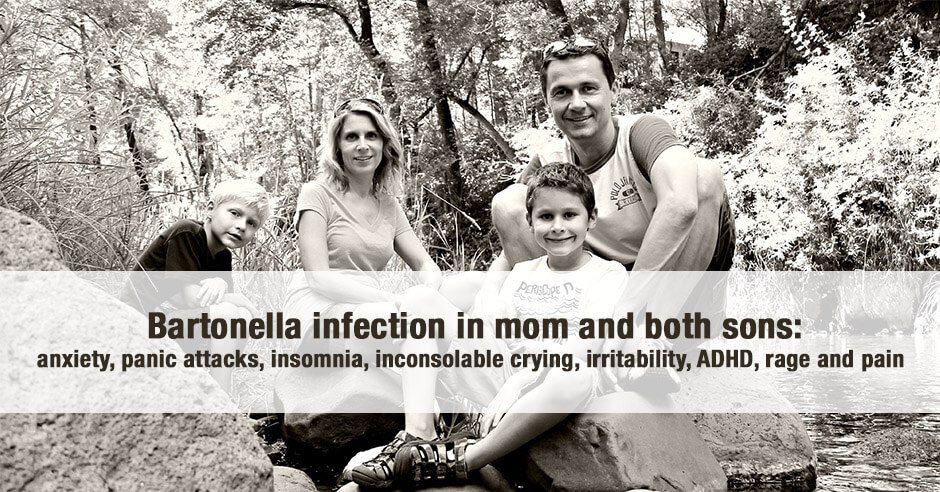
Bartonella Infection in Mom and Both Sons: Anxiety, Panic Attacks, Insomnia, Inconsolable Crying, Irritability, ADHD, Rage, and of Course Pain

https://www.everywomanover29.com/blog/bartonella-infection-in-mom-and-both-sons-anxiety-panic-attacks-insomnia-inconsolable-crying-irritability-adhd-rage-and-pain/

Bartonella infection in mom and both sons: anxiety, panic attacks, insomnia, inconsolable crying, irritability, ADHD, rage and pain

bartonella infection

A mom and both her sons experienced a variety of emotional/mood and pain symptoms between them as a result of a Bartonella infection: anxiety, panic attacks, insomnia, irritability, inconsolable crying, ADHD, rage, eye pain, joint pain and pain in the legs. This family case study was published in Parasites and Vectors in 2013. I would love to see individual amino acids being used to ease some of these symptoms while the infection is being treated (more on this below).

Here are some of the emotional and mood-related symptoms they experienced:

  • the mother and both sons developed recurrent rash-like skin lesions, disruptive sleep patterns and both boys developed anxiety accompanied by episodes of inconsolable crying, irritability, and panic attacks
  • subsequent to the spider infestation of the apartment, [the mother] developed fatigue, memory difficulties, headaches, irritability, eye pain, insomnia, chest pain, blurred vision, shortness of breath, rash and skin lesions and anxiety attacks.
  • The youngest son… awakened at night crying and complaining of pain in his legs
  • The older son experienced increased irritability and rage episodes. In addition, the boy’s teacher indicated a lack of attention during class, and suggested that the child might have an Attention Deficit Hyperactivity Disorder (ADHD).

The youngest son also developed severe neurological symptoms and was diagnosed with Guillain-Barre syndrome and Chronic Inflammatory Demyelinating Polyradiculoneuropathy.

You can read the full investigation, timing, sequence of events and all the symptoms in the paper: Bartonella henselae infection in a family experiencing neurological and neurocognitive abnormalities after woodlouse hunter spider bites  (For more see link)

___________________

**Comment**

Fantastic article that needs to be shared widely.  I believe Bartonella is much more common than doctors believe, and as in these cases, quite severe and debilitating.

A few points:

  • Please note the spider infestation. See this article for more on transmission.
  • The author mentions Chinese herbs, which in my experience aren’t strong enough to fight this alone.  This is just my experience, and my husband’s and numerous other patients, but and I realize perhaps there are others with a different experience than ours.
  • For us, when we relapse, it’s clearly Bartonella that immediately responds to the combination of rifampin and clarithromycin.  Within 2-3 months of treatment we push the symptoms away.
  • The author also gets into amino acids to address symptoms – of which I have little experience.  When in the midst of the battle, I hear Dr. Hoffman telling me that if I address the infection(s), the symptoms will either disappear entirely or lessen considerably.  I have proven this dictum repeatedly with each successive, treated relapse.  When money is an issue, you must decide the best course of action as many things are needed to successfully fight MSIDS.  As with everything else; however, each case is individual and for those suffering with severe psychiatric, sleep, and other issues, learning about amino acids may be a key part of treatment.
  • My husband has definitely found relief with 5-HTP & Gabapentin for sleep issues.  Strong CBD and melatonin has helped as well as LDN.  Lyme/MSIDS related insomnia is very real.

Please read the article in its entirety, but here’s a highlight on the various amino acids:

Deer Ticks Parasitizing Big Brown Bats in NY

https://academic.oup.com/jme/advance-article-abstract/doi/10.1093/jme/tjab174/6425286?redirectedFrom=fulltext

Ixodes scapularis (Ixodida: Ixodidae) Parasitizing an Unlikely Host: Big Brown Bats, Eptesicus fuscus (Chiroptera: Vespertilionidae), in New York State, USA

Journal of Medical Entomology, tjab174, https://doi.org/10.1093/jme/tjab174
Published:  11 November 2021

Abstract

Ixodes scapularis Say is a three-host tick that has been recorded feeding on over 150 different species of terrestrial vertebrates (mammals, birds, and reptiles). This tick is found throughout the northeastern, coastal southeastern, and upper midwestern United States and is considered the most significant vector of tick-borne pathogens to humans in North America. Despite its ubiquity and broad host range, I. scapularis previously has not been reported feeding on bats (Chiroptera). However, during 2019 and 2020, larvae and nymphs of I. scapularis were recovered from big brown bats, Eptesicus fuscus (Palisot de Beauvois), at four locations in rural New York State, USA. All Ixodes infested bats were injured and found on the ground; therefore, parasitism by I. scapularis was likely opportunistic. Nonetheless, the large number of pathogens known to be associated with bats and the frequency with which I. scapularis bites people suggest that this host–tick relationship is of at least potential epidemiological significance.

Advocates Call on IDSA to Retract False Information on Congenital Lyme

https://www.lymedisease.org/advocates-call-for-idsa-retraction/

Advocates call on IDSA to retract false information on congenital Lyme

Nov. 9, 2021

Mothers Against Lyme, a group of advocates concerned about the impact of Lyme disease and its co-infections on pregnant women, children and families, is calling for retraction of a statement in the Infectious Diseases Society of America (IDSA), American Academy of Neurology (AAN), American College of Rheumatology (ACR) 2020 Clinical Practice Guidelines for the Prevention, Diagnosis and Treatment of Lyme Disease that contributes to misdiagnosis and harm to pregnant women and children who are congenitally infected.

On October 20, Mothers Against Lyme sent a retraction request letter to the editors of the journals that published the guidelines and the leadership of the sponsoring organizations. Copies were sent to the clinical practice guidelines committees of the sponsoring organizations and the co-authors of the guidelines. The guidelines were published in Clinical Infectious Diseases, Neurology, Arthritis Care & Research, and Arthritis & Rheumatology.

Page e12 of the guidelines “Treatment of Lyme Disease” section states:

“To date, Lyme disease in pregnancy has not been found to result in congenital infection or a syndrome of congenital abnormalities, and no additional treatment or monitoring of the mother or infant is recommended beyond the standard of care.”

According to the letter, the statement “To date, Lyme disease in pregnancy has not been found to result in congenital infection” is not true.

40 peer-reviewed articles

The letter cites more than 40 peer-reviewed articles, including a systematic review co-authored by a CDC epidemiologist, that provide evidence of congenital infection with Lyme disease.

The letter also cites studies and review articles that show adverse birth outcomes are common for both treated and untreated pregnant women with Lyme disease.

Adverse outcomes include fetal death, newborn death, and newborns with an abnormal outcome (e.g. birth defects, hyperbilirubinemia, respiratory distress).

According to Mothers Against Lyme Chair Isabel Rose:

“Correction of this error is vital and warrants an expedited review and notice of correction. The potential harm to mothers, children, and families from the inaccurate information in the IDSA, AAN, ACR Guidelines is significant. Providers who rely on the guidelines will fail to diagnose and treat Lyme disease in pregnancy and fail to recognize the offspring of women with Lyme disease as infants and children at risk. Countless tragic births and fetal losses will result, with a lifetime of harm to the children and their families.”

Authors contradict their own work

The letter also cites eight articles co-authored by IDSA, AAN, ACR Guidelines authors that “clearly contradict what they’ve written in the guidelines, and which address the issue of intrauterine transmission and fetal abnormalities head-on.”

Following are examples.

“It is clear that B. burgdorferi can be transmitted in the blood of infected pregnant women across the placenta into the fetus. This has now been documented with resultant congenital infections and fetal demise.”

“The precise risk to the developing fetus of maternal Lyme disease during pregnancy is unknown, although it is well documented that fetal infection can occur and may have deleterious outcomes, including malformations and death.”

“The aim of treatment of early Lyme disease during pregnancy is not only to treat the infection and prevent long-term sequelae but to eliminate the infection as quickly as possible so as to prevent congenital transmission to the fetus.”

Ignoring their own research

According to Rose:

“It is disheartening and alarming that the authors of medical guidelines that direct the care of pregnant women with Lyme disease are ignoring their own research to put forward guidelines based on ‘expert opinion’ rather than their own discoveries. Their own work conclusively proves that perinatal transmission of B. burgdorferi during pregnancy does occur and may have dire consequences for the pregnant mother and her fetus.”

The IDSA, AAN, ACR Guidelines say that “no additional treatment or monitoring of the mother or infant is recommended beyond the standard of care.”

Instead of denying the existence of congenital Lyme, the letter says “the Guidelines should acknowledge that Lyme bacteria can cross the placenta, both infecting and causing harm to unborn children, and describe the manifestations of Lyme in pregnancy that the research has uncovered and advise screening and treatment according to the knowledge we have to date.”

Research funding

Rose points out that researchers who depend on the IDSA, AAN, ACR Guidelines for information will be less likely to submit grant applications for much needed research if they rely on the statement that congenital Lyme disease does not exist.

She notes that this is especially important since more than $29 million in new annual funding for NIH has been appropriated that could support this type of research. NIH has also issued several notices of special interest to encourage research on Lyme and other tick-borne diseases. A recent notice includes a section that calls for research on “gestational Lyme disease” and the impact on pregnancy on immune response.

Rose says, “Correcting this error does not undo the harm. In addition to making this correction in a timely manner, the sponsoring organizations should encourage their members to conduct research on congenital Lyme that will improve health outcomes for pregnant women with Lyme disease and children who are congenitally infected.”

About Mothers Against Lyme

We’re a group of mothers and mother-advocates who are concerned about the impact of Lyme disease and its co-infections on pregnant women, children and families. Our focus includes awareness, education, advocacy and community building, as we promote research that advances diagnosis, treatment and prevention.

SOURCE OF PRESS RELEASE: Mothers Against Lyme

Sexual Transmission of Lyme Borreliosis? The Question That Calls For An Answer

tropicalmed-06-00087-v2 (1)

Sexual Transmission of Lyme Borreliosis? The Question That Calls for an Answer

Natalie Rudenko * and Maryna Golovchenko

Citation: Rudenko, N.; Golovchenko, M. Sexual Transmission of LymeBorreliosis? The Question That Calls for an Answer. Trop. Med. Infect. Dis. 2021, 6, 87. https://doi.org/10.3390/ tropicalmed6020087

Copyright: © 2021 by the authors.
Licensee MDPI, Basel, Switzerland.

This article is an open access article distributed under the terms and conditions of the Creative Commons Attribution (CC BY) license (https://creativecommons.org/licenses/by/4.0/).

Biology Centre Czech Academy of Sciences, Institute of Parasitology, Branisovska 31, 37005 Ceske Budejovice, Czech Republic; marina@paru.cas.cz
* Correspondence: natasha@paru.cas.cz; Tel.: +420-387775468

Abstract:

Transmission of the causative agents of numerous infectious diseases might be potentially conducted by various routes if this is supported by the genetics of the pathogen. Various transmission modes occur in related pathogens, reflecting a complex process that is specific for each particular host–pathogen system that relies on and is affected by pathogen and host genetics and ecology,
ensuring the epidemiological spread of the pathogen. The recent dramatic rise in diagnosed cases of Lyme borreliosis might be due to several factors: the shifting of the distributional range of tick vectors caused by climate change; dispersal of infected ticks due to host animal migration; recent urbanization; an increasing overlap of humans’ habitat with wildlife reservoirs and the environment of tick vectors of Borrelia; improvements in disease diagnosis; or establishment of adequate surveillance. The involvement of other bloodsucking arthropod vectors and/or other routes of transmission (human-to-human) of the causative agent of Lyme borreliosis, the spirochetes from the Borrelia burgdorferi sensu lato complex, has been speculated to be contributing to increased disease burden. It does not matter how controversial the idea of vector-free spirochete transmission might seem in the beginning. As long as evidence of sexual transmission of Borrelia burgdorferi both between vertebrate hosts and between tick vectors exists, this question must be addressed. In order to confirm or refute the existence of this phenomenon, which could have important implications for Lyme borreliosis epidemiology, the need of extensive research is obvious and required.

_________________

**Comment**

SO DO IT ALREADY!

How long must we wait?  I think 40 years is sufficient.

Reminder:  the climate has little to nothing to do with tick and disease proliferation.  Ticks are remarkably ecoadaptive according to independent researchMigrating birds and photo-period have a great hand in it and would explain why tropical ticks are found in Canada (and other Northern climates) and Canadian ticks are found in the topics. Climate change is a popular topic that fits into the current accepted narrative, which is why it is being pushed regarding ticks, despite evidence to the contrary (which is frankly ignored by mainstream research).  Researchers need grant money, and in order to obtain that, they must genuflect to corrupt, mafia overlord Dr. Anthony Fauci, which simply means they must tout the accepted narrative or miss out on funding.  According to a former French Health Minister, real science no longer exists due to the fact Big Pharma is also exerting pressure on scientific publications.

Sad but true.

http://

Symposium on Tick-borne Diseases

Nov. 6, 2014

At approx. 6:10, Dr. Burrascano delves into sexual transmission and discusses animal studies that show animal to animal transmission. Viable Lyme organisms have also been found in human secretions.

For more: