Archive for the ‘Lyme’ Category

Woman Develops Lyme Disease Symptoms After Giving Birth, But Baby Doesn’t – Yet

https://danielcameronmd.com/woman-develops-lyme-disease-symptoms-after-giving-birth/

WOMAN DEVELOPS LYME DISEASE SYMPTOMS AFTER GIVING BIRTH

In their article, “An Unusual Case of Serologically Confirmed Post-Partum Lyme Disease Following an Asymptomatic Borrelia burgdorferi Infection Acquired during Pregnancy and Lacking Vertical Transmission in Utero,” Pavia et al. describe the case of a young woman who developed symptoms of Lyme disease immediately following the birth of her child. [1]

A 23-year-old woman, who lived in Brooklyn, NY, had visited her primary care doctor complaining of bilateral knee swelling and pain. Three days prior, she had delivered a healthy baby girl.

The pain was reported as 8/10 in severity and was exacerbated by walking, according to the authors.

When the woman was 6 months pregnant, she experienced similar knee pain briefly but never sought treatment.

“Interestingly, except for a brief 2-day period where she experienced knee pain, she remained symptom-free for Lyme disease for the remainder of the pregnancy.”

During her pregnancy the woman had taken several trips to wooded areas in upstate New York.

She denied any known exposure to ticks or the development of any rash.

Testing for Lyme disease was positive by Western blot with several reactive bands including: 18, 23, 28, 33, 41,43, 58, 66, and 93 kDa.

The woman was treated successfully with a 3-week course of doxycycline.

Her newborn was symptom-free at birth and has never shown any of the usual signs or symptoms of active disease well into early childhood and beyond, the authors state.

According to the authors, “There was no evidence for congenital or perinatal transmission of this pathogen at any point pre-term or postnatally.”

References:
  1. Pavia CS, Plummer MM, Varantsova A. An Unusual Case of Serologically Confirmed Post-Partum Lyme Disease Following an Asymptomatic Borrelia burgdorferi Infection Acquired during Pregnancy and Lacking Vertical Transmission in Utero. Pathogens. 2024 Feb 20;13(3):186. doi: 10.3390/pathogens13030186. PMID: 38535530; PMCID: PMC10976031.

______________

**Comment**

This, of course, will be used ad nauseam to push the myth that congenital transmission is rare or doesn’t occur.  FALSE!  Further, it is widely known that the immune system often keeps the infection in check until a trigger sets it off.

For more:

Podcast: Medical Gaslighting, Human Rights, and Lyme Disease

https://www.lymedisease.org/podcast-gaslighting-lyme/

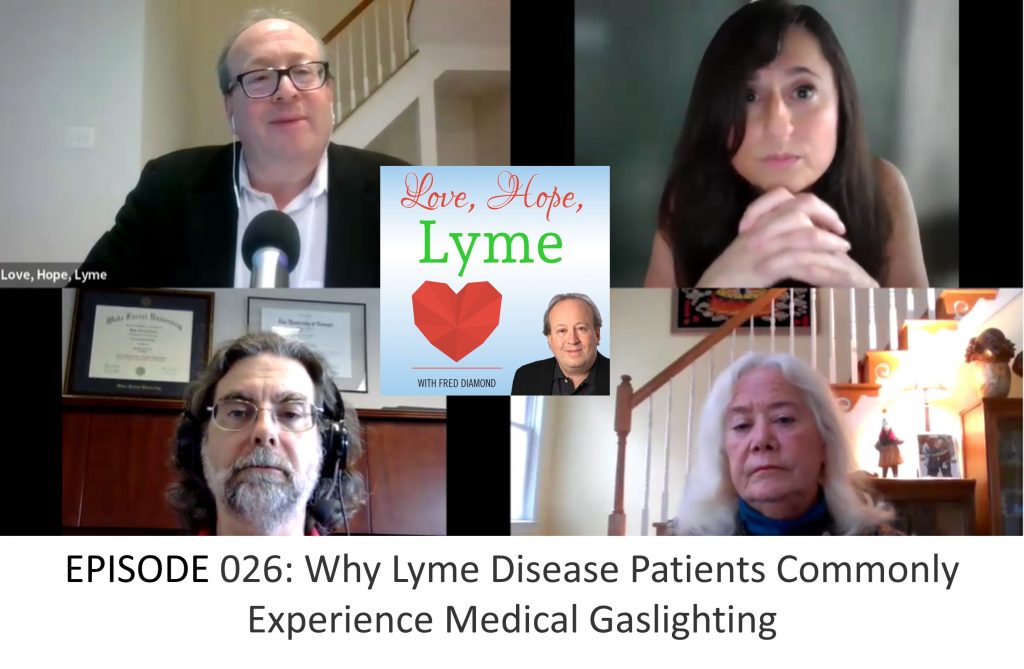
PODCAST: Medical gaslighting, human rights, and Lyme disease

By Fred Diamond

May 1, 2024

When I was researching my book “Love, Hope, Lyme: What Family Members, Partners, and Friends Who Love a Chronic Lyme Survivor Need to Know,” I had no idea that medical gaslighting was something that persistent Lyme survivors had to commonly deal with.

I also had no idea that gaslighting was emblematic of the human rights challenges Lyme survivors have historically dealt with when seeking medical treatment.

I met hundreds of Lyme survivors who shared stories about being dismissed, mocked, and disbelieved by dozens of doctors.

Unfortunately, this gaslighting led to family members disbelieving that their loved ones had the disease, which led to further detachment, alienation, and suffering.

The patient experience

A peer-reviewed, international medical article was published in the journal Healthcare in 2023 called Medical Gaslighting and Lyme Disease: The Patient Experience. I interviewed the authors of the report, Jennifer Fagen, PhD, and Jeremy Shelton, PhD, both from Lamar University in Texas, and Human Rights Advocate Jenna Luché-Thayer, on two episodes of the Love, Hope, Lyme podcast.

The article states “Lyme disease is a recognized public health threat and is a designated notifiable disease. As such, Lyme disease is mandated to be reported by the CDC. Despite this, both acute and chronic Lyme disease have been relegated to the category of ‘contested illnesses’ which can lead to medical gaslighting.

“By analyzing results from an online survey of respondents with Lyme disease, 986 people, we elucidate the lived experiences of people who have been pushed to the margins of the medical system by having their symptoms attributed to mental illness, anxiety, stress, and aging. Further respondents have had their blood tests and rashes discounted and were told that chronic Lyme disease simply does not exist. As a result, a series of fruitless consultations often result in the delay of a correct diagnosis, which has deleterious consequences.”
Challenges with contested illnesses

According to Dr. Fagen, “Contested illnesses are conditions that lack cultural legitimacy as their nature and even their existence is often questioned. Any physical manifestations or symptoms may be deemed purely subjective as they lack objective biological markers. The result is that patients are in the unfortunate position of having to convince medical practitioners that they’re in need of medical attention, often leading to seeing many doctors before receiving a proper diagnosis.

“People with contested illnesses might not qualify for disability, despite their inability to work. Insurance may not cover their treatments and they could be denied the social recognition of their condition.”

She continued, “Despite the fact that there is such a high incidence of them in the US and internationally, and because they often have objective biological markers, such as blood tests and the EM or bullseye rash, it’s really quite counterintuitive that they are considered contested illnesses.”

Ignoring symptoms

The article discussed the wide range of gaslighting techniques used by doctors.

“The most common one by far was doctors just telling their patients, ‘You’re just overreacting to these symptoms,’ which is unfortunate because it doesn’t really address those symptoms at all. It essentially ignores them. Other reactions that we found that were common were implying that the symptoms were psychosomatic,” said Dr. Shelton.

He continued, “Many patients were told there’s just no such thing as chronic Lyme disease. A few people were told that it was fairly common that their symptoms were due actually to mental illness. It’s one thing to say it’s psychosomatic, but it’s a whole other category to say that you actually are suffering from some sort of mental illness.”

“Others were commonly told that their symptoms were due to stress. The common theme that you can see here is that doctors were trying to argue either the symptoms were due to some other cause besides Lyme disease, or that the symptoms were entirely fictitious and just in the person’s head, or they should just learn to live with those symptoms. Of course, that’s not what you want to hear when you go to a medical professional,” Dr. Shelton continued.

Lyme disease and human rights violations

Jenna Luché-Thayer put the findings in the article in the context of the human rights framework. On a special follow up episode of the podcast, she discussed the role of the World Health Organization (WHO) in developing medical codes that are linked directly to how insurance recognizes and reimburses their medical care and how governments track diseases.

She said, “If there is not a [WHO] code for a particular illness or disease or medical condition, it’s very hard to get the recognition, research, financial support, insurance support, Medicare, and Medicaid support to take care of the illness.”

Luché-Thayer formed a voluntary, nonprofit international organization that petitioned the World Health Organization and documented the science as well as the human rights violations related to Lyme disease. WHO expanded the codes to include multiple medical conditions that are caused by Lyme disease, including dementia, demyelinating conditions, Lyme carditis, and the ophthalmic complications from it.

“This is now part of the medical system that’s being integrated across the United States and other countries. People understand the importance of knowing their codes and bringing these codes to the attention of their medical providers. That means that the medical providers understand these codes have been validated, and it greatly helps to validate the multiple complications and chronic conditions disabling and potentially fatal complications from Lyme disease,” said Luché-Thayer.

Lyme survivors had their human rights compromised for decades. On the podcast, we discussed the extremes this might lead to.

“One of the key human rights is the highest attainable standard of health. If you are denied diagnosis and you are being denied treatment, clearly your health human rights are being violated,” she said. “If you are being told, as in a gaslighting situation, that you are not sick, when in fact you are infected with a bacteria that’s going throughout your body, your right to information is being denied. If you are a Lyme patient who has been told that not only are you not sick, but we think you need to go into psychiatric care, and you’re forced into a psychiatric care, then your personal security, which is also another human right, is being violated.”

Using the article for self-advocacy

Dr. Fagen said that one of the survey’s findings is that a patient’s positive blood test did not always influence how likely a doctor was to believe they have Lyme disease. On average, almost 14 doctors were seen prior to receiving a Lyme disease diagnosis. The article can be used as a tool for self-advocacy. (Download the article here.)

“It is important for patients to bring research with them to doctors’ appointments. This article not only contains a good deal of data from peer-reviewed medical journals that validate the existence of chronic Lyme disease, but it also provides data regarding the incidents and types of Lyme disease in our respondent pool. The latter can potentially encourage medical practitioners’ self-reflection if they are employing such techniques,” she said.

Dr. Fagen continued, “It’s also important for Lyme patients to know that these experiences are not uncommon, so they’d be less likely to doubt themselves. We’ve shared the research among medical doctors far and wide globally, including medical doctors who treat Lyme disease and other medical doctors who could perhaps benefit from some education about Lyme disease and Lyme patients’ experiences. We hope this accomplishes those goals.”

Click here to listen to all episodes of the Love, Hope, Lyme Podcast or on YouTube.

Fred Diamond is based in Fairfax, Virginia and can be contacted via Facebook. His popular book, “Love, Hope, Lyme: What Family Members, Partners, and Friends Who Love a Chronic Lyme Survivor Need to Know” is available on Amazon. The e-version of the book is always free to Lyme survivors. PM Fred on Facebook for your copy.

For more:

Letter From a Lyme Advocate

https://www.lymedisease.org/shirley-strong/

To my fellow Lyme fighters, I’m with you. Your pain is my pain.

By Shirley Strong

Dear Lyme Disease Doctors and Everyone Who Cares:

I’m reaching out to share something really important and close to my heart. This isn’t just about me. It’s about all of us who are fighting Lyme disease, and it’s about the friends I’ve lost along the way.

Yes, I’ve lost friends to this disease, and it hurts like nothing else. I’ve been fighting Lyme for over 13 years now, and it’s been tough. Not just the disease itself, but trying to get the help I need and seeing others struggle too.

The biggest problem we’re facing isn’t just the sickness. It’s how hard it is to get the right care without breaking the bank. I’ve been there, trying to make ends meet while knowing I need treatment I just can’t afford. It feels like if you don’t have the money, you don’t get the help. That’s not right. I’ve worked hard all my life, and when you need help the most, it should be there for you.

Not just about money

But here’s the thing – it’s not just about the money. It’s about losing people. Friends I’ve laughed with, cried with, and hoped with. They’re not just numbers; they were real people who had their lives cut short by Lyme disease. And every time we lose someone, it hits me hard because I know I could be next. That fear never goes away.

So, what am I asking for? I want us to do better. For doctors to really listen and help us. For everyone to understand that Lyme disease can destroy lives and families. And for some compassion from a system that seems to forget we’re human beings just trying to survive.

To my fellow Lyme fighters, I’m with you. Your pain is my pain. We’ve got to keep pushing for change, for better treatment, and for hope. We owe it to those we’ve lost to not give up. Let’s make sure our voices are heard. Let’s fight for a future where Lyme disease isn’t a death sentence or a financial ruin. We deserve better, and it’s time we get it.

Shirley Strong lives in Illinois. This blog was originally posted on her Facebook page.

________________

**Comment**

It is my educated opinion that this moving forward will NEVER happen via government-funded research.  I think 40 years has shown this statement to be true and not simply opinion.  This means that advocacy groups still working with the CDC/NIH/NIAD, etc. are barking up the wrong tree and simply wasting time and money.

This may sound harsh, especially if you are uneducated about the sordid back-story and biased research, and trust me when I say I wish this wasn’t so, but alas it simply is what it is.

The only forward progress we’ve made is by independent researchers, often infected themselves, who look harder because their very lives depend upon it.  

Still No Answers: Follow-Up to Advocate & CDC Vaccine Meeting

https://lymediseaseassociation.org/news/still-no-answers-follow-up-to-advocate-vaccine-meeting-hosted-by-cdc/

Still No Answers: Follow-up to Advocate Vaccine Meeting Hosted by CDC

Vaccine SyringeOn March 7, 2024 a meeting was hosted by the CDC that consisted of a small group of expert-advocates to develop the CDC’s understanding of the lived experience of Lyme disease. The goal of this meeting was to compile a list of individual questions to understand more about a future Lyme disease vaccine, and the VLA15 vaccine in particular, given it was the only vaccine candidate being evaluated in phase 3 clinical trials as of the date of this meeting. Pat Smith reported on this meeting in the President’s Blog – In-depth Synopsis of Advocate Vaccine Meeting Hosted by CDC. The following is a list of all the questions contributed by the participants of the meeting. These questions were shared with a Pfizer representative by the CDC on March 8, 2024. As of April 30, 2024, there has been no response by Pfizer. (See link for article)

_________________

**Comment**

Sadly, this is all too predictable for anyone who understands corrupt government public health agencies.

I mean, do you really expect the CDC to be transparent and answer probing questions?

If you are one of those who believes the CDC will come clean, please educate yourself:

I could literally go onto infinity with this.

To state I’m not a fan of the CDC would be the understatement of the year!

Lyme Disease Causes Diaphragm Paralysis, Resulting in Breathing Problems

https://danielcameronmd.com/lyme-disease-diaphragm-paralysis-breathing-problems/

LYME DISEASE CAUSES DIAPHRAGM PARALYSIS, RESULTING IN BREATHING PROBLEMS

lyme-disease-breathing-problems

In a letter to the editor, entitled “Atypical presentation of Lyme disease,” Jarosińska and colleagues describe a unique case of a diaphragm paralysis caused by Lyme disease. [1]

According to the authors, diaphragm paralysis as a complication of Lyme disease was first reported in 1986. Since then, there have only been 4 cases involving bilateral paralysis of the diaphragm, which can cause breathing problems in patients.  “… the presented case will be the fifth described case of bilateral diaphragmatic paralysis in the course of probable Lyme neuroborreliosis.”

Patients with this condition experience weakness of the diaphragm and “have reduced breathing capabilities or are unable to control their voluntary breathing. They also have difficulty maintaining adequate gas exchange, as the lungs are not able to inhale and exhale outside air as efficiently.”²

Lyme disease causes breathing problems

A 64-year-old man exhibited symptoms of acute respiratory failure when lying on his back and complained of dyspnea, breathing difficult during sleep, and pain in the cervical spine, which had been ongoing for about one month.

“Upon admission, physical examination revealed tachypnea, a thoracic breathing pattern, and increased respiratory effort with the activation of accessory respiratory muscles, without any signs of an acute respiratory infection,” the authors state.

A cardiac exam revealed bilateral phrenic nerve palsy and the patient was transferred to the neurology department for further testing, which revealed no significant abnormalities.

Infectious Disease Testing

“The diagnostic process was broadened and serological analysis was carried out to test for a number of antibodies,” including those specific to Lyme disease, the authors state.

Test results were positive for Lyme disease. However, there was no history of a tick bite.

“Hence, the patient was diagnosed with bilateral phrenic nerve palsy in the course of probable Lyme neuroborreliosis,” the authors state.

The patient was treated with IV ceftriaxone, followed by oral doxycycline.

“During the hospitalization, partial clinical improvement was achieved and the patient was discharged home in a stable condition without any respiratory support.”

According to the authors, “palsy of the phrenic nerve in the course of [Lyme neuroborreliosis] is a rare and unique symptom.”

However, “it seems reasonable to consider serological diagnostics for Lyme disease in patients with diaphragmatic paralysis of undetermined etiology.”

References:
  1. Jarosińska A, Pilśniak A, Cieśla-Fuławka A, Dziubak W, Siuda J, Holecki MT. Atypical presentation of Lyme disease. Arch Med Sci. 2024 Jan 18;20(1):344-347. doi: 10.5114/aoms/175494. PMID: 38414461; PMCID: PMC10895935.
  2. Columbia University, Department of Surgery. https://columbiasurgery.org/conditions-and-treatments/diaphragmatic-weakness-paralysis