Archive for the ‘Activism’ Category

Lyme Warrior Q & A

https://globallymealliance.org/dear-lyme-warriorhelp-13/

lyme warrior

by Jennifer Crystal

Every few months, Jennifer Crystal devotes a column to answering your questions. Do you have a question for Jennifer? If so, email her at lymewarriorjennifercrystal@gmail.com.

I have tried several different medications for Lyme and am not getting any better. Do you think I just need to own up to the possibility that this is simply my reality and I should resign myself to it?

No! Treating tick-borne illness is complicated. It often takes a lot of trial and error to find the right treatment protocol, especially since what works for one patient might not work for another. When you’re not feeling well, it’s especially hard to be patient with the process. You just want to get better, and you don’t have the energy to keep waiting and trying things. I understand that. But difficult as it is, if you give up now, you will make your current situation your longterm reality. There were so many moments in my journey with Lyme disease and two other tick-borne illnesses—babesia and Ehrlichia—that I wanted to just throw in the towel. Thank goodness I didn’t, though. After many different medications over many years, I have been in remission for over a decade, and my life is better than I ever thought it could be.

I suggest keeping a daily log of your symptoms so that you can chart any small change, good or bad, and so you can also give a detailed report to your Lyme Literate Medical Doctor (LLMD), who may be able to tweak to your protocol to address any new issues. So many times my LLMD would say something like, “Oh, now that I’m hearing how brain fog is bothering you, I think we actually need to switch to an antibiotic that is better for neurological symptoms.” Or, “The symptoms you’re telling me about indicate inflammation, so I think we need to add an anti-inflammatory medication.” If this fine-tuning isn’t working, it may be time to seek a second opinionfrom a different LLMD. Sometimes it helps to have someone evaluate your case with fresh eyes. Be sure that you have been checked for all tick-borne diseases and are being adequately treated for any co-infections since a single tick bite can give you multiple infections.

Finally, it’s important to remember that medication is only part of the equation when treating tick-borne illnesses. Other factors like diet, sleep hygiene, and stress play a role in your body’s ability to heal. You may want to try complementary therapies such as integrative manual therapy or neurofeedback to help your medication work more effectively. There is always something new to try; never, ever settle!

What does the future look like for you?

This is a great follow-up to the last question. The answer is, I don’t really know, and that’s a good thing. When I was completely bedridden over a decade ago, the future looked bleak. I never thought I’d regain my independence. I wasn’t even sure if I’d ever be able to walk around the block again. But now I am living on my own, working, socializing, and exercising, and enjoying a full life.

My path to health wasn’t linear. After regaining some independence, I relapsed all the way back to the starting line. If the future looked bleak before, relapsemade me feel downright desperate. But I made it through, and have been in remission for over a decade, now that I know how to really manage my life in the context of these chronic illnesses.

Each year of this decade has been better than the last. There have been dips, of course: flare-ups of Lyme or babesia, acute illnesses like COVID-19 (link: https://globallymealliance.org/corona-with-a-twist-of-lyme/). But overall, I’ve made incredible strides since moving to Boston and starting graduate school in 2011. I can teach more classes now than I could after earning my M.F.A. in 2014. I can read for longer periods of time without getting neurologically overwhelmed. I bounce back faster when I push my body too far. I can ski more runs, swim more laps, paddle for more hours than I could a few years ago.

So, who knows how much more progress I will make in the next few years. Maybe I’ll be able to juggle even more work projects. Maybe I’ll be on a book tour. Maybe I’ll reduce some of my medications. Maybe I won’t need an afternoon nap. I can’t say for sure what the future holds, but I’m confident that more will be possible than I can currently imagine.

You mentioned that you can’t work a traditional full-time job, so you work a few part-time jobs that fit your schedule. How did you find those?

One of the hardest parts of living with chronic illnesses was accepting that I wasn’t going to be able to go back to the rigorous schedule I kept before I became ill. In order to maintain my health, I have to pace myself physically and neurologically. I also need to do adjunct therapies every week, which eat up time in my schedule, and I need to nap every afternoon. These needs—which I had to learn to see as just that, needs and not restrictions make it impossible for me to work a 9 to 5 job.

So I had to think outside of the box. What did I love to do, and how could I do that work on a flexible schedule? Instead of my old full-time high school teaching position, I now teach as an adjunct, at a creative writing center, and at colleges. My classes are scheduled in the mornings or the evenings, and class prep time is on my own. I was able to combine my passions for Lyme awareness/advocacy and writing into these weekly blog posts. I do one-on-one consulting work with writers, reviewing their work at home and then setting convenient meeting times (that’s even easier now, with meetings happening virtually).

The current climate is difficult because the economy was closed for so long, but it’s also a good time for patients like myself with unique scheduling needs because so many jobs have shifted to work-from-home. Therefore, you may now be able to find part-time work that offers a more flexible schedule than it previously did.

Moreover, I recently learned about Chronically Capable, an employment platform that aims to connect chronically ill patients with remote work-from-home jobs. I have no personal connection to or experience with this platform, but you might want to check it out. It’s important to think about what you can do and what skills you have to offer, instead of worrying about what you can’t do.

That said, working while chronically ill is not easy. You may not be able to cover all of your expenses. To address that Global Lyme Alliance has put together afinancial resource pagewhere you can find information on federal and state assistance programs and other resources.


jennifer crystal_2

Opinions expressed by contributors are their own.

Jennifer Crystal is a writer and educator in Boston. Her memoir about her medical journey is forthcoming. Contact her at lymewarriorjennifercrystal@gmail.com.


____________________

**Comment**

Fantastically practical post.

From experience I can also attest to the importance of persistence with treatment.  NEVER, EVER QUIT!  You need to be as, if not more persistent than the organisms who have invaded your body.

While it’s true that there can be blow-back that causes issues that you may not be able to change, by and large, treatment ameliorates most if not all symptoms.  Sometimes it’s as simple as finding the right drug.  Other times it’s as simple as finding the right adjunctive therapies and supplements that take away the remaining symptoms after treatment.

For me personally those things include:

Many of these supplements were determined after blood tests showed I was deficient; however, some were just found through trial and error.  One word of warning: be careful you don’t try too many things simultaneously as you won’t be able to determine if a singular thing is helping you or not.  Supplements cost money and you want to make sure it’s something you need because it’s an investment.



Join United Medical Freedom SuperPAC Today

https://medicalfreedompac.com

united-medical-freedom-super-PAC-logo-box-min

Mission_Statement-2

“Unless we put Medical Freedom into the Constitution, the time will come when medicine will organize into an undercover dictatorship. To restrict the art of healing to one class of men and deny equal privileges to others will constitute the bastille of medical science. All such laws are un-American and despotic…

The Constitution of the Republic should make special provisions for Medical Freedom as well as Religious Freedom.” —DR. BENJAMIN RUSH, George Washington’s personal doctor and a signer of the Declaration of Independence

____________________

**Comment**

To join for FREE, go to top link.

You will receive a FREE ebook with a lot of great information.  You can also go to the website and read uncensored breaking health news.  If ever there was a time to fight for medical freedom, it’s now.  

Science has been hijacked by the highest bidder and has become little more than propaganda.  Our health “authorities” have severe conflicts of interest and can not be trusted.

Lyme/MSIDS patients typically understand these issues as they have to navigate through them to find help.  Doctors who treat tick-borne illness are singled out and persecuted on the crucible of Lyme:  http://www.dailykos.com/story/2012/01/29/1059800/-Wisconsin-Lyme-doctor-gets-reprieve?  This has happened across the United States and worldwide.  

You Know Your Body Best

https://globallymealliance.org/you-know-your-body-best/

by Jennifer Crystal

…we grow up thinking of doctors as all-knowing. Whatever ‘the doctor’ said—be it the Primary Care Physician, the family doctor, or the ER doctor—was once deemed absolute.

This doesn’t have to be the case.

When I was originally diagnosed with Lyme disease and two co-infections—babesia and Ehrlichia—I took oral antibiotics for six weeks. They didn’t work as effectively as my doctor had hoped, so he suggested I switch to intravenous antibiotics through a PICC line. I had been on the PICC line successfully for about seven months when one afternoon I was suddenly gripped with searing abdominal pain.

I was eating a banana with peanut butter when I felt a stabbing, wrenching ache just under my right rib cage. Dropping my snack, I clutched my side, grew dizzy, and started to sweat. Trying to escape the pain, I ran into the next room, where I collapsed on the floor, writhing and screaming. 

Maybe it’s from the PICC line,” exclaimed my worried mother. 

I shook my head. The attack felt too localized to be related to the PICC line, which was in my left arm.

Maybe it’s appendicitis,” she suggested.

Again, I shook my head. The appendix is lower,” I gasped. This pain is right under the rib cage.”

We drove to the ER. I screamed the whole way, feeling like someone was stabbing me with a knife over and over. 

The ER doctor did a scan, read it, and diagnosed constipation.

I looked at him quizzically. I have a lot of medical issues,” I said, “but constipation isn’t one of them. This pain is far more severe than constipation.”

He shrugged. Well, your scan shows a lot of stool in your colon, so that’s what it is.”

Turns out, what this doctor saw wasn’t stool, it was gallstones. He had read the scan backward, mixing up the colon with the gallbladder. Thankfully, my Lyme Literate Medical Doctor (LLMD) realized what was really going on. The intravenous antibiotics had caused gallstones, a rare side effect of the particular medication I was taking. I was having a gallbladder attack, brought on by eating a fatty snack. I went to another hospital, where I had emergency gallbladder removal.

My LLMD and my surgeon knew the original ER doctor was wrong. So did I. I didn’t know I had gallstones, but I knew I wasn’t suffering from constipation. I knew that what was going on in my body was different—more severe—than what the ER doctor was telling me, and I spoke up.

Patients with tick-borne diseases often need to do this. It can take years for some patients even to get diagnosed, because the doctors they’re seeing aren’t well-versed in tick-borne illnesses and don’t put together what are often nebulous symptoms. Moreover, because diagnostic tests are so faulty, some patients get negative results and are told they are fine. Even once diagnosed, other doctors treating patients for acute issues may not understand the complexities of underlying tick-borne infections, and may dismiss them as irrelevant.

This is when Lyme patients need to advocate for themselves. Those suffering from Lyme and other tick-borne illnesses need to explain their symptoms or diagnoses, push for tests, and reject any doctor who doesn’t have an answer for them and move on to one who does. This last action can be the hardest of all, because we grow up thinking of doctors as all-knowing. Whatever “the doctor” said—be it the Primary Care Physician, the family doctor, or the ER doctor—was once deemed absolute.

This doesn’t have to be the case.

There are many good doctors, and often what they say is correct. But when you feel unheard or invalidated, or simply have a gut feeling that something more is going on with your body, you have a responsibility to find a different doctor. This isn’t always easy to do when you’re sick and tired and have to deal with insurance. But it’s worth it. Had I listened to the ER doctor and accepted his diagnosis of constipation, I might have eventually suffered a fatal gallbladder attack. Had I stopped with the first doctor I saw with flu-like symptoms back in 1997, I might still be bedridden, never accurately diagnosed with tick-borne illnesses. 

No one knows your body better than you. When you’re a patient, you become so in tune with every little change in your body, and that’s a good thing. I can tell when my temperature is 98.4 and I can tell when it’s 99.1; the thermometer just confirms what I already know. I know the difference between what it feels like when I’m getting sick, and what it feels like when I’m just run down. You likely do, too. It can be easy to be swayed by other people’s opinions. They’re well-meaning when they say, Maybe you have the flu,” or maybe it’s the weather.” But only you know because you can feel exactly what’s going on in your body. 

Being thus attuned puts Lyme patients and those with chronic illnesses ahead of the learning curve during the current COVID-19 pandemic. Suddenly everyone is aware of every cough, sniffle, or temperature fluctuation. Lyme patients already know what’s typical for them—what signifies baseline health, what signifies a Lyme flare, and what signifies a different acute illness—and that is especially helpful at a time when medical facilities are overwhelmed as they are now and many appointments are being conducted via telehealth. We can notice important changes in our bodies and explain them to our doctors.

So trust your instincts. It’s okay to speak up for what you believe you need. It’s okay to seek a second, third, or even twelfth opinion. Your body is counting on you to give it the best possible care, and only you know what that feels like. 


jennifer crystal_2

Opinions expressed by contributors are their own.

Jennifer Crystal is a writer and educator in Boston. Her memoir about her medical journey is forthcoming. Contact her at lymewarriorjennifercrystal@gmail.com

1986 The Act

http://1986theact.com

JULY 2020

For thousands of parents with vaccine-injured children, the 1986 National Childhood Vaccine Injury Act (NCVIA) conjures up sadness, betrayal of trust, disappointment and anger. But what does the rest of the public think? Most people don’t even realize the NCVIA exists! They are still under the rosy misconception that vaccines are safe and effective and that our legislators and public health officials would never do anything that would knowingly hurt America’s children.

We need to educate them. That is where 1986: The Act comes in.

Dr. Andy Wakefield, the filmmaker who brought us Vaxxed, now brings us 1986: The Act, a story of how the powerful force of a mother’s intuition leads down the rabbit hole of lies and corruption surrounding the NCVIA. 1986: The Act forges head on into the important conversation and controversy surrounding this one-sided health policy that gave vaccine makers a multi-billion-dollar gift (so far) and immunity from prosecution.

Viewers will learn how “The Act” turned fairness and the US court system on its head. Touted at the time as a helpful, non-adversarial alternative to long, protracted court battles, it actually turned into anything but; where the vaccine- injured linger without help, parents rack up medical bills and wait years for monetary relief which seldom comes, and government lawyers take home fat paychecks for their efforts against families.

This corrupt system ensures that consumers pay the tab and vaccine manufacturers laugh all the way to the bank.

Watch 1986: The Act now! Buy tickets and share with those you love. The film is available to stream on demand.

Sincerely,  The Children’s Health Defense Team

AJW3

1986: The Act

Man and microbe, from Polio to COVID19… a never more relevant forensic examination of the 1986 National Childhood Vaccine Injury Act and its consequences.

What happens when an ancient wisdom – a mother’s intuition – is pitted against powerful interests in a race against time?

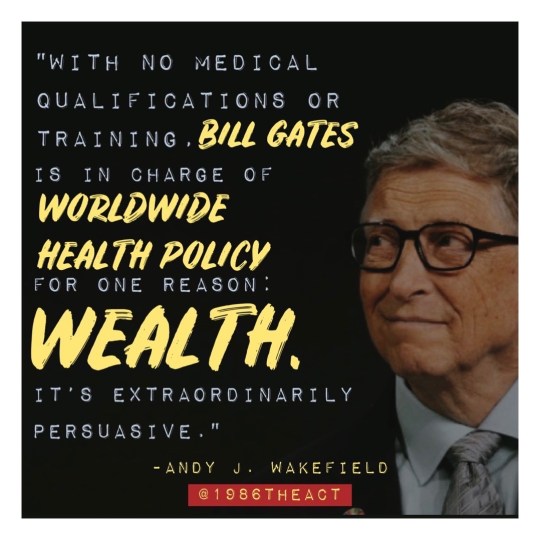
Gates-Wealth

Watch Trailer here (In numerous languages):  https://7thchakrafilms.com/film-info/social-assets

More on Gates:  https://madisonarealymesupportgroup.com/2019/01/22/bill-gates-former-doctor-says-billionaire-refused-to-vaccinate-his-children/

Fauci 1

More on Fauci:  https://madisonarealymesupportgroup.com/2020/05/12/shedding-light-on-the-dishonorable-record-of-dr-fauci-a-real-mengele/

Regarding COVID-19 vaccines:  

Excerpt:

The World Health Organization (WHO) acknowledges there are gaps in scientific knowledge about DNA vaccines and states:22

Many aspects of the immune response generated by DNA vaccines are not understood.However, this has not impeded significant progress towards the use of this type of vaccine in humans, and clinical trials have begun.

Some of the outstanding questions about DNA vaccine safety include:23

  • chronic inflammationbecause the vaccine continually stimulates the immune system to produce antibodies;
  • possible integration of plasmid DNA into the body’s host genome resulting in mutations;
  • problems with DNA replication;
  • triggering of autoimmune responses, and
  • activation of cancer-causing genes.


Follow The Money: Who Is Getting Rich Off Coronavirus Pandemic?

You know what they say…..”Follow the Money.”  Well, COVID-19 is no different.

https://articles.mercola.com/sites/articles/archive/2020/07/07/billionaires-getting-rich-off-coronavirus-pandemic.aspx?

Who Is Getting Rich Off Coronavirus Pandemic?

Analysis by Dr. Joseph MercolaFact Checked

STORY AT-A-GLANCE

  • Forbes compiled a list of 10 health care billionaires who collectively raked in more than $7 billion since March 11, 2020 — the day the World Health Organization (WHO) declared COVID-19 a global pandemic
  • Topping the list is Stéphane Bancel, CEO of Moderna, the biotech firm that’s seen as the frontrunner for developing a COVID-19 vaccine
  • As of June 18, 2020, U.S. billionaire wealth increased $584 billion, or 20%, since the start of the pandemic
  • Since March 18, the number of U.S. billionaires increased from 614 to 643; during the same period, more than 45.5 million Americans filed for unemployment
  • CNBC’s Jim Cramer said the pandemic and resulting lockdown paved the way for “one of the greatest wealth transfers in history”
  • While many big businesses are coming out unscathed or even in a better position financially, small businesses are closing their doors

In May 2020, the U.S. unemployment rate was 13.3%,1 which means 21 million Americans were unemployed. Not surprisingly, financial stress is a major concern, with 88% of Americans surveyed by the National Endowment for Financial Education (NEFE) saying that the COVID-19 pandemic is creating stress for their personal financial situation.2

Fifty-four percent were particularly worried about having enough money saved for emergency savings or retirement, while another 48% were worried about paying bills.

A report by the Well Being Trust (WBT) and the Robert Graham Center for Policy Studies in Family Medicine and Primary Care that up to 75,000 people may die during the COVID-19 pandemic from drug or alcohol misuse and suicide, which they deemed “deaths of despair” caused, in part, by unprecedented economic failure paired with massive unemployment.3

This experience of scarcity and financial uncertainty is not being felt by all, however. In stark contrast, many of the richest among us — particularly health care and biotech billionaires — have gotten even richer due to COVID-19, profiting handsomely off the pandemic that’s left the general public financially reeling.

Pandemic Propels Moderna CEO to the Billionaire’s Club

Forbes compiled a list of 10 health care billionaires who collectively raked in more than $7 billion since March 11, 2020 — the day the World Health Organization (WHO) declared COVID-19 a global pandemic.4 Topping the list is Stéphane Bancel, CEO of Moderna, the biotech firm that’s seen as the frontrunner for developing a COVID-19 vaccine. According to Forbes:5

“When the WHO declared a pandemic, Bancel’s estimated net worth was some $720 million. Since then, Moderna’s stock has rallied more than 103%, lifting his fortune to an estimated $1.5 billion. A French citizen, Bancel first joined the billionaire ranks on April 2, when Moderna’s stock rose on the news that the firm was planning to begin phase two trials of its vaccine.”

Moderna partnered with the National Institute of Allergy and Infectious Diseases (NIAID) headed by Dr. Anthony Fauci to create the vaccine. In February 2020, its stock price increased 78.1% when it announced that its messenger RNA vaccine was ready for clinical trials.6 “The company’s CEO has become a new billionaire overnight,” wrote Barbara Loe Fisher, co-founder and president of the National Vaccine Information Center (NVIC).7

Moderna began human trials of its experimental mRNA vaccine in March 2020, and its stock soared again in May, hitting $29 billion, even though the company currently doesn’t sell any products,8when it released early results from its Phase 1 study of 45 healthy volunteers between the ages of 18 and 55 — the first released from a study involving human volunteers.

Moderna’s press release9 stated that 25 participants who received two doses of its low or medium dose vaccine had levels of binding antibodies — the type that are used by the immune system to fight the virus but do not prevent viral infections — at levels approximating or exceeding those found in the blood of patients who recovered from COVID-19.10

Data for the more significant neutralizing antibodies, which stop viruses from entering cells, was reported for only eight people, with Moderna stating that levels in each of these initial participants met or exceeded antibody levels seen in recovered COVID-19 patients.

Four study subjects experienced a “Grade 3” adverse event, which is described by the U.S. Department of Health and Human Services as “severe or medically significant but not immediately life-threatening; hospitalization or prolongation of hospitalization indicated; limiting self-care” such as “bathing, dressing and undressing, feeding self, using the toilet, taking medications.”11

During Phase 2 trials, 600 people will receive the vaccine, while a Phase 3 trial is expected to start in July 2020 — an unprecedented move in terms of typical vaccine development timelines. Bancel owns a 9% stake in the company, which received a grant of up to $483 million from the U.S. Department of Health and Human Services to accelerate its COVID-19 vaccine development.12


Nine More COVID-19 Billionaires

Making up the rest of Forbes’ list is a mix of entrepreneurs, biotech executives and diagnostic test makers, which come from seven different countries:13

1. Gustavo Denegri — With a net worth of $4.5 billion, which is up 32% since the beginning of the pandemic, Denegri has a 45% stake in DiaSorin, a biotech company based in Italy. DiaSorin makes swab-based diagnostic tests for COVID-19 as well as antibody blood testing kits for the virus.

2. Seo Jung-Jin — Jung-Jin co-founded Celltrion, a biopharma company in Seoul. Jung-Jin’s net worth is $8.4 billion, up 22% thanks to the company’s experimental antiviral treatment for COVID-19, along with a self-administered diagnostic test that gives results in 15 minutes, which is expected to come to the market this summer.

3. Alain Mérieux — Mérieux’s $7.6 billion net worth is tied to BioMérieux, the diagnostic testing company he founded in 1963. It’s a branch of Institut Mérieux, a medical company founded by his grandfather in 1897. BioMérieux developed a faster version of a COVID-19 diagnostic test kit that was released in March 2020.

4. Maja Oeri — Oeri is a descendent of Fritz Hoffmann-La Roche, the founder of pharmaceutical giant Roche. She owns about 5% of Roche’s shares, with a net worth of $3.2 billion; Roche has clinical trials ongoing for its arthritis drug tocilizumab, which it is hoping to transition to a COVID-19 treatment, as well as a serology test to detect antibodies in people who have had COVID-19.

5. Leonard Schleifer — His net worth is $2.2 billion, a rise of 11% due to the pandemic. He founded Regeneron Pharmaceuticals, which is conducting clinical trials of its rheumatoid arthritis drug sarilumab on COVID-19 patients.

6. George Yancopoulos — Yancopoulos is Regeneron‘s chief scientific officer; his net worth is $1.2 billion (up 14% since the beginning of the pandemic).

7. and 8. Thomas and Andreas Struengmann — The Struengmann twins have a net worth of $6.9 billion. They first made their fortune by selling generic drug company Hexal to Novartis in 2005, and they invest in biotech and health care companies. One of their investments is BioNTech, which partnered with Pfizer and Fosun Pharmaceuticals on a COVID-19 vaccine that’s currently in human trials.

9. Li Xiting — Xiting cofounded Mindray Medical International, China’s largest medical equipment producer. It tripled its production capacity of ventilators since the start of the pandemic. Xiting’s net worth is $12.6 billion, which is up 1% due to COVID-19.

US Billionaires $584 Billion Richer Thanks to COVID-19

The Institute for Policy Studies (IPS), in partnership with Americans for Tax Fairness (ATF), published a report highlighting what they call America’s “pre-existing condition”: extreme wealth inequality.14 IPS is regularly updating U.S. unemployment and billionaire wealth during the pandemic, which shows the great divide among the wealthy and the majority of Americans.

As of June 18, 2020, U.S. billionaire wealth increased $584 billion, or 20%, since the start of the pandemic.15 Meanwhile, since March 18, the number of U.S. billionaires increased from 614 to 643; during the same period, more than 45.5 million Americans filed for unemployment. Other striking inequalities revealed by the report include:16

  • Jeff Bezos‘s fortune increased by $25 billion from January 1, 2020, to April 15, 2020; the wealth surge alone is greater than Honduras’ Gross Domestic Product, which was $23.9 billion in 2018
  • From January 1, 2020 to April 10, 2020, the wealth of 34 of the richest U.S. billionaires increased tens of millions of dollars; eight of them had their net worth rise by more than $1 billion
  • From March 18 to April 10, 2020, U.S. billionaire wealth surged by nearly 10%, rising $282 billion; during the same period, more than 22 million Americans lost their jobs
  • U.S. billionaire wealth increased 1,130% from 1990 to 2020; U.S. median wealth grew by 5.37% during the same period
  • The tax obligations of U.S. billionaires decreased 79% between 1980 and 2018, when measured as a percentage of wealth

As noted by Inequality.org, IPS’ sister site:

“The top five billionaires — Jeff Bezos, Bill Gates, Mark Zuckerberg, Warren Buffett and Larry Ellison — saw their wealth grow by a total of $101.7 billion, or 26%. They captured 17.4% of the total wealth growth of all 600-plus billionaires in the last three months. The fortunes of Bezos and Zuckerberg together grew by nearly $76 billion, or 13% of the $584 billion total.

‘This orgy of wealth shows how fundamentally flawed our economic system is,’ said Frank Clemente, ATF’s executive director. ‘In three months about 600 billionaires increased their wealth by far more than the nation’s governors say their states need in fiscal assistance to keep delivering services to 330 million residents.

Their wealth increased twice as much as the federal government paid out in one-time checks to more than 150 million Americans. If this pandemic reveals anything, it’s how unequal our society has become and how drastically it must change.”17

‘One of the Greatest Wealth Transfers of History’

CNBC’s Jim Cramer, host of CNBC’s Mad Money and a former hedge fund manager, said the pandemic and resulting lockdown paved the way for “one of the greatest wealth transfers in history.“18 While many experts are predicting a V-shaped recovery for the stock market, which has been quickly rebounding, “that has almost nothing to do with a V-shaped recovery in the economy,” Cramer said.

While most big businesses are coming out of the state-ordered lockdowns largely unscathed, many small businesses have closed their doors. Already, Chapter 11 bankruptcies are up 48% compared to 2019, and the worst may be yet to come. Even as businesses are increasingly allowed to open for business, lower occupancy limits will continue financial hardships, despite relief funds provided by the government.

“… [I]n the end, the stimulus package probably won’t be enough, for one simple reason,” Cramer said. “It’s not going to work because of social distancing.”19 Meanwhile, big business will continue to thrive. “The bigger the business, the more it moves the major averages, and that matters because this is the first recession where big business … is coming through virtually unscathed, if not going for the gold.”20

The transfer of wealth from average people to the richest through a planned economic collapse is ongoing, and something that’s slated to get even more severe if a COVID-19 vaccine is released. In an article positing the question, “Is It Too Late to Buy Moderna Stock?” The Motley Fool suggested:21

“Let’s assume that Moderna’s COVID-19 vaccine proves to be successful and wins regulatory approvals in the U.S. and other major markets. If the company was able to price its coronavirus vaccine similarly to flu vaccines currently on the market, its list price would probably be in the ballpark of at least $40.

If we also assume at least 2 billion doses of the vaccine would be given per year, Moderna could be looking at annual revenue of $80 billion.”