**UPDATE March 2022**

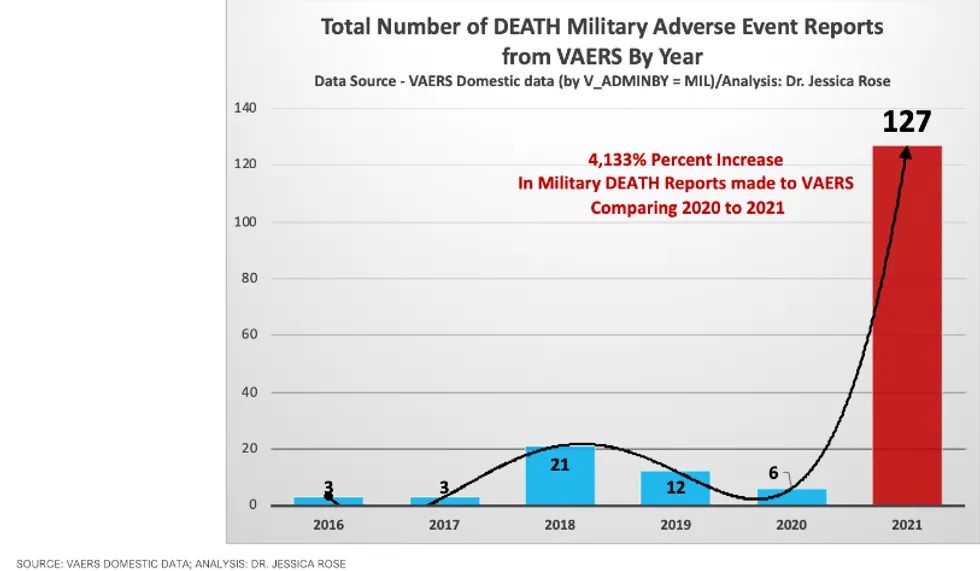
More reported military DEATH from COVID shots than from COVID.

U.S. attorney: 1,100% increase in military deaths following COVID shots. 
HIV protein added to shots to disable autoimmunity (disarm your immune system) so lipid nanoparticles can get through your cellular defense.  Those getting COVID shots are testing positive for HIV and those getting three shots have destroyed their immune systems.

**Update, Aug. 21, 2021**

Despite documented adverse reactions, deaths, and heart inflammation, COVID jabs are now mandated for the military as of Sept. 15, despite being experimental, fast-tracked injections approved under mysterious circumstances. Soldiers with natural immunity are now fighting back by filing a lawsuit against the Pentagon, the DOD, FDA, and HHS. Also, America’s Frontline Doctors have filed a Temporary Restraining Order (TRO) against mandating these dangerous injections for military members with existing immunity.  The military in fact has existing laws and regulations providing exemption from vaccination for those with natural immunity, however commanders have already told servicemen and women that religious, medical, and serological exemptions will be denied.

Guess how many soldiers have died from COVID?  Would you believe only 26 (as of Jun 25, 2021)?  According to U.S. Army Dr. Theresa Long, only 12 were in active duty.

And yet, they are now mandated to get injections that have caused more injuries and death than all injuries and death combined in a 30 year history of VAERS, which is known to only capture about 1% of adverse events.  According to a doctor who served 9 years as a Navy physician and surgeon and who also studied bioweapons:

… the “vaccine” program has ostensibly killed more of our young active duty people than COVID did.  Dr. Lee Merritt

https://childrenshealthdefense.org/defender/heart-inflammation-linked-covid-pfizer-moderna-vaccines-u-s-military/

Heart Inflammation Linked to COVID Vaccines in Study of U.S. Military, Department of Defense Confirms

In a study published June 29 in JAMA Cardiology, researchers described 23 cases of myocarditis in healthy military members who developed the condition within four days of receiving the Pfizer or Moderna COVID vaccines.

By Megan Redshaw

A new study of U.S. service members found higher than expected rates of heart inflammation following a COVID vaccine.

A new study of U.S. service members found higher than expected rates of heart inflammation following receipt of a COVID vaccine. It’s a finding Defense Department researchers say should call attention to the condition, known as myocarditis, as a potential side effect of vaccinations.

In a study published June 29 in JAMA Cardiology, U.S. military physicians described 23 cases of myocarditis in previously healthy males who developed the condition within four days of receiving a COVID vaccine.

A total of 23 male patients (22 currently serving in the military and 1 retiree) with a median age range of 25 years were evaluated between January and April 2021 for acute-onset chest pain following vaccination with an mRNA COVID vaccine.

All military members were previously healthy with a high level of fitness. They were physically fit by military standards and lacked any known history of cardiac disease, significant cardiac risk factors or exposure to cardiotoxic agents.

Seven military members received Pfizer’s COVID vaccine and 16 received the Moderna vaccine. Each patient had a final diagnosis of myocarditis without infectious, ischemic or autoimmune etiologies identified. Diagnoses were reviewed and met the U.S. Centers for Disease Control and Prevention’s (CDC) case definition criteria for probable myocarditis.

All patients presented with acute chest pain and significantly elevated cardiac troponin levels (10-fold to 400-fold the upper limits of their respective reference ranges) with symptom onset within 12 to 96 hours following COVID vaccination.CHD Calls on FDA to Take COVID Vaccines Off the Market – Submit a Comment

According to the study, physicians expected to find eight or fewer cases of myocarditis among the 436,000 male military members who received two mRNA doses. But 20 military members developed inflammation after their second dose, including 14 after the Moderna shot and six after the Pfizer shot. Three developed myocarditis after their first vaccine.

Cardiac symptoms resolved within a week of onset for 16 patients, but seven continued to have chest pain at the time of publication.

The researchers stated that while the true incidence of myocarditis is unknown at this time, the presentation pattern and clinical course suggest an association with an inflammatory response to vaccination.

The team concluded that increased attention to myocarditis as a potential adverse event following vaccination is warranted.

New study supports link between mRNA COVID vaccines and heart inflammation

A separate study published in JAMA Cardiology on June 29 investigated seven cases of acute myocarditis. Four cases occurred within five days of COVID vaccination between Feb. 1 and April 30.

All four patients had received the second dose of an mRNA vaccine and presented with severe chest pain, had biomarker evidence of myocardial injury, were hospitalized and had test results consistent with myocarditis.

“It is possible that these four cases of acute myocarditis represent a rare, potential adverse event linked to mRNA COVID-19 vaccination,” researchers wrote. “The findings from the present report raise the possibility of an association between mRNA COVID-19 vaccination and acute myocarditis.”

An association between COVID vaccines and myocarditis was first reported in Israel with a case study in February involving a 19-year-old male.

On April 26, details leaked from an Israeli Health Ministry report raising concerns among experts about a possible link between the Pfizer-BioNTech COVID vaccine and myocarditis.

A preliminary report by an Israeli committee tasked with monitoring vaccine side effects found 62 cases of myocarditis, including two deaths, in people who received the Pfizer vaccine. Fifty-six cases occurred after the second dose of the vaccine, and 55 cases occurred in men — most between the ages of 18 and 30.

The two patients who died were reportedly healthy until receiving the vaccine and had no pre-existing conditions.

On April 27, Reuters reported the U.S. Department of Defense was investigating 14 cases of heart inflammation among people who were vaccinated through the military’s health services.

On June 2, Israeli health officials confirmed a probable link between the Pfizer’s COVID vaccine and dozens of cases of heart inflammation in young men following the second dose.

As The Defender reported June 10, the CDC’s advisory committee acknowledged a higher-than-expected number of cases of heart inflammation among 16- to 24-year-olds who recently received a second dose of the Pfizer and Moderna COVID vaccines.

Based on a May 24 report from the CDC’s Advisory Committee on Immunization Practices (ACIP) COVID-19 Vaccine Safety Technical Work Group (VaST), the CDC on June 1 updated its website with the following language:

“Data from VAERS [Vaccine Adverse Events Reporting System] show that in the 30-day window following dose 2 mRNA COVID-19 vaccination, there was a higher number of observed than expected myocarditis/pericarditis cases in 16–24-year-olds.”

On June 23, the ACIP said there was a “likely association” of “mild” heart inflammation in adolescents and young adults after vaccination with an mRNA COVID vaccine and a warning statement was warranted.

The safety panel acknowledged more than 1,200 cases of myocarditis or pericarditis in 16- to-24-year-olds who received an mRNA COVID vaccine, mostly occurring in males after the second dose.

As The Defender reported June 28, the U.S. Food and Drug Administration added a warning to Pfizer and Moderna’s fact sheets indicating an increased risk of myocarditis and pericarditis following vaccination.https://platform.twitter.com/embed/Tweet.html?dnt=false&embedId=twitter-widget-0&features=eyJ0ZndfZXhwZXJpbWVudHNfY29va2llX2V4cGlyYXRpb24iOnsiYnVja2V0IjoxMjA5NjAwLCJ2ZXJzaW9uIjpudWxsfSwidGZ3X2hvcml6b25fdHdlZXRfZW1iZWRfOTU1NSI6eyJidWNrZXQiOiJodGUiLCJ2ZXJzaW9uIjpudWxsfSwidGZ3X3R3ZWV0X2VtYmVkX2NsaWNrYWJpbGl0eV8xMjEwMiI6eyJidWNrZXQiOiJjb250cm9sIiwidmVyc2lvbiI6bnVsbH19&frame=false&hideCard=false&hideThread=false&id=1409604910971297795&lang=en&origin=https%3A%2F%2Fchildrenshealthdefense.org%2Fdefender%2Fheart-inflammation-linked-covid-pfizer-moderna-vaccines-u-s-military%2F&sessionId=585e2914ed5412234524c7067130bcbd183a1c9d&siteScreenName=ChildrensHD&theme=light&widgetsVersion=82e1070%3A1619632193066&width=550px

According to the latest data from VAERS, there were 1,342  cases of myocarditis and pericarditis (heart inflammation) in all age groups reported in the U.S. following COVID vaccination between Dec.14, 2020 and June 18, 2021.

Of the 1,342 cases reported, 835 cases were attributed to Pfizer, 458 cases to Moderna and 45 cases to Johnson & Johnson’s COVID vaccine.

Megan Redshaw is a freelance reporter for The Defender. She has a background in political science, a law degree and extensive training in natural health.

© [6/30/21] Children’s Health Defense, Inc. This work is reproduced and distributed with the permission of Children’s Health Defense, Inc. Want to learn more from Children’s Health Defense? Sign up for free news and updates from Robert F. Kennedy, Jr. and the Children’s Health Defense. Your donation will help to support us in our efforts.

https://www.liebertpub.com/doi/full/10.1089/vbz.2020.2724#utm_source=ETOC&utm_medium=email&utm_campaign=vbz

Statewide Passive Surveillance of Ixodes scapularis and Associated Pathogens in Maine

Published Online:https://doi.org/10.1089/vbz.2020.2724

Abstract

The blacklegged tick, Ixodes scapularis, is the primary vector of multiple human pathogens, including the causative agents of Lyme disease, anaplasmosis, and babesiosis. Both I. scapularis and its associated pathogens have expanded their geographic range throughout the northeastern Unites States and into northern New England. Through this study, we present an updated distribution of I. scapularis in Maine and report the first statewide passive surveillance infection and coinfection prevalence of Borrelia burgdorferi, Anaplasma phagocytophilum, and Babesia microti within the state’s I. scapularis population. In 2019, we collected 2016 ticks through a passive surveillance program, in which Maine residents submitted tick samples for identification and/or pathogen testing. We used a single multiplex quantitative PCR assay to detect tickborne pathogens in 1901 tick samples. At the state level, we found:

  • Bo. burgdorferi and A. phagocytophilum infection rates of adults (42.4%, 11.1%) were nearly double that of nymphs (26.9%, 6.7%)
  • B. microti prevalence was similar for both adults (6.5%) and nymphs (5.2%).
  • Spatially, we found an uneven distribution of both tick activity and pathogen prevalence, with both increasing on a north to south gradient.
  • We also noted a potential association between the ratio of adult to nymphal ticks and the incidence of tickborne disease in human populations, with counties that exhibit high rates of human disease also maintaining low adult to nymph ratios.
  • We detected Bo. burgdorferi in ticks from all counties, except Aroostook, although we only tested five samples from this county.
  • Excluding Aroostook, the county-level Bo. burgdorferi prevalence ranged from 30.0% (Piscataquis) to 50.0% (Franklin and Waldo) in adults and 0% (Piscataquis and Somerset) to 43.8% (Knox) in nymphs.
  • High disease incidence counties did not necessarily have higher prevalence rates within submitted ticks.
  • Knowledge of anaplasmosis is not as widespread as Lyme disease, which may lead to the underdiagnosis of this disease.
  • The sporadic distribution of B. microti is consistent with a pathogen that is colonizing a new location and has not yet reached an even spatial distribution (Diuk-Wasser et al. 2016).
  • B. microti is also thought to spread more quickly in areas where Bo. burgdorferi is prevalent due to an immune interaction in reservoir hosts such as white-footed mice (Peromyscus leucopus) or deer mice (P. maniculatus) (Dunn et al. 2014).
  • B. microti is likely to continue spreading throughout Maine.

____________________

**Comment**

It is interesting that researchers acknowledge that multiple infections occur due to an immune interaction yet severely ill patients are still viewed myopically to only have Lyme disease.  Our conflict-riddled public health ‘authorities’ continue to promote ancient mythology, deny persistent infection, and treat patients with a mono-therapy that has never been adequate.  Treating co-infections isn’t even on their radar.

https://www.mdpi.com/2227-9032/9/6/771/htm

Tick-Borne Surveillance Patterns in Perceived Non-Endemic Geographic Areas: Human Tick Encounters and Disease Outcomes

*Author to whom correspondence should be addressed.
Academic Editor: Raphael B. Stricker
Healthcare 2021, 9(6), 771; https://doi.org/10.3390/healthcare9060771
Received: 12 May 2021 / Revised: 15 June 2021 / Accepted: 16 June 2021 / Published: 21 June 2021
Abstract
Recent scholarship supports the use of tick bite encounters as a proxy for human disease risk. Extending entomological monitoring, this study was designed to provide geographically salient information on self-reported tick bite encounters by survey respondents who concomitantly reported a Lyme disease (LD) diagnosis in a state perceived as non-endemic to tick-borne illness. Focusing on Texas, a mixed-methods approach was used to compare data on tick bite encounters from self-reported LD patients with county-level confirmed cases of LD from the U.S. Centers for Disease Control and Prevention (CDC), as well as serological canine reports.
A greater proportion of respondents reported not recalling a tick bite in the study population, but a binomial test indicated that this difference was not statistically significant. A secondary analysis compared neighboring county-level data and ecological regions.
Using multi-layer thematic mapping, our findings indicated that tick bite reports accurately overlapped with the geographic patterns of those patients previously known to be CDC-positive for serological LD and with canine-positive tests for Borrelia burgdorferi, anaplasmosis, and ehrlichiosis, as well as within neighboring counties and ecological regions. LD patient-reported tick bite encounters, corrected for population density, also accurately aligned with official CDC county hot-spots. Given the large number of counties in Texas, these findings are notable.
Overall, the study demonstrates that direct, clinically diagnosed patient reports with county-level tick bite encounter data offer important public health surveillance measures, particularly as it pertains to difficult-to-diagnose diseases where testing protocols may not be well established. Further integration of geo-ecological and socio-demographic factors with existing national epidemiological data, as well as increasingly accessible self-report methods such as online surveys, will contribute to the contextual information needed to organize and implement a coordinated public health response to LD.
______________________
Important excerpts:
  • Primary care physicians may under-diagnose LD in areas perceived as non-endemic [33].
  • Misdiagnosis was reported in seventy-two percent of respondents in a large survey [34], indicating the need for improved surveillance beyond entomology that links tick encounters with human disease risk, which can inform diagnostic approaches.
  • The need for expanded and improved LD research and knowledge is highly apparent for the benefit of both patients and health practitioners.
  • Given that LD is often labeled a “contested illness,” TTS respondents who may be perceived as “faking it” could easily report any random county if their tick bites were indeed a false entry in the TTS survey. In other words, it would be highly unlikely that the totality of respondents’ tick bite reports would map directly to confirmed official CDC cases or canine serological findings through attempted deception. TTS-reported tick bites overlap almost exactly with CDC-confirmed LD cases in county-level and eco-region analyses. In one case, in a county in which TTS respondents did not overlap with human cases, tick encounter reports did overlap with a positive canine county.
You know it’s bad when researchers have to deal with the myth that patients are considered deceivers.

**UPDATE**

Please see this informative video by journalist Greg Reese on how the UN, which has been orchestrating the open boarders in the US, has openly announced plans to clear the lands of people and move them into 15 minute Smart Cities. 

Enter Directed Energy Weapons.

A map from the UN’s Agenda 21 shows designated areas that are ‘off limits’ to people which just happen to line up with the 2008 California fires. Nine years ago planning was announced for Smart Cities to be built on Maui, but the most coveted land was owned by natives whose families have lived there for generations. Then August, 2023 Maui was devastated by highly suspicious fires.  In April 2023, a conference was held in Viña del Mar Chile on how to prepare for Smart Cities. A year later Viña del Mar was also devastated by fires, blamed on ‘climate’ change, but local officials claim arson. Then in 2022, Amarillo, Texas was listed as #1 area ‘under the radar’ for the Texas housing market under the UN’s Vision 2045 Summit.  In Feb., 2024 the worst wildfire in Texas’ history broke out in the same area.

Vision 2045 is the latest iteration of the UN’s plan to seize control of 90% of the land and limit people to 15 minute cities.

The UN, along with our own government, has the means and motive to make this happen.

https://www.activistpost.com/2021/06/research-paper-exposes-cybersecurity-environmental-and-health-risks-associated-with-5g-iot-smart-buildings-and-cities.html

Research Paper Exposes Cybersecurity, Environmental, and Health Risks Associated with 5G, IoT, “Smart” Buildings and Cities

By B.N. Frank

Excerpts from article:

From Environmental Health Trust:


The Cost of “Smart” Cities Include Cybersecurity, E-waste, Environment and Pollution

A new meta-integrative qualitative research paper published in the journal Buildings presents the multi-level problems that could arise from the implementation of smart building structures, especially with 5G and IoT devices. Researchers found cybersecurity threats and radiation effects, “especially from 5G cells that can directly affect the individual, biologically and mentally.” The paper also focuses on e-waste and energy consumption.

The authors challenge the rhetoric that 5G is energy saving. The paper documents that because so many additional cell towers and antennas are required for 5G “the generic notion that wireless data transfer is energy-conserving or can act as a CO2 eliminator can be challenged.” The authors recommend a thorough analysis of the carbon emissions and environmental impacts of massive data centers and undersea optic cabling.

Read the full paper at https://www.mdpi.com/2075-5309/11/6/251/htm

“This new paper should be a call to action for our city planners and elected leaders worldwide. A cradle to grave analysis of so called “smart” cities should be a pre-requisite before we leap into 5G.  As this paper outlines, the true cost of 5G and the internet of things includes cyber-security threats,  electromagnetic pollution, E-waste, and environmental impacts from data centers and the proliferation of undersea cables. The word “smart” is being used to describe a tsunami of infrastructure and technology that is harming our environment and threatens human health,” stated Theodora Scarato, Executive Director of Environmental Health Trust co-author to the paper “Building Science and Radiofrequency Radiation: What Makes Smart and Healthy Buildings”  which documents why and how to reduce/eliminate radio frequency (wireless) electromagnetic radiation in buildings. “We must ensure safe and sustainable technology  to protect our children’s healthy future.”

Abstract

Smart buildings deploying 5G and the Internet of Things (IoT) are viewed as the next sustainable solution that can be seamlessly integrated in all sectors of the built environment. The benefits are well advertised and range from inducing wellness and monitoring health, amplifying productivity, to energy savings. Comparatively, potential negative risks are less known and mostly relate to cyber-security threats and radiation effects. This meta-integrative qualitative synthesis research sought to determine the possible underlying demerits from developing smart buildings, and whether they outweigh the possible benefits. The study identified five master themes as threats of smart buildings: a surfeit of data centers, the proliferation of undersea cables, the consternation of cyber-security threats, electromagnetic pollution, and E-waste accumulation. Further, the paper discusses the rebound impacts on humans and the environment as smart buildings’ actualization becomes a reality. The study reveals that, although some aspects of smart buildings do have their tangible benefits, the potential repercussions from these not-so-discussed threats could undermine the former when all perspectives and interactions are analyzed collectively rather than in isolation. View Full-Text

Generally, there is a belief that wireless connections decrease CO2 emissions. However, the wireless transfer of data can take place only for a short distance (distance being dependent on the frequency of operation of the smart devices), for example, for 4G, the wireless data transmission is around 1000 miles, while, for 5G, it is only 10 miles. As a result, additional relay cell towers and antennas are required for the operation of 5G devices [95]. As a result, the generic notion that wireless data transfer is energy-conserving or can act as a CO2 eliminator can be challenged. Therefore, the data from any sensor device would have to take a wired path for almost 99% of its travel time to reach back to the user’s mobile phone [96]. Thus, smart buildings that function with multiple smart devices that are connected to a network culminate with the installation of more undersea cables.

Raveendran R, Tabet Aoul KA. A Meta-Integrative Qualitative Study on the Hidden Threats of Smart Buildings/Cities and Their Associated Impacts on Humans and the Environment. Buildings. 2021; 11(6):251. https://doi.org/10.3390/buildings11060251


(See link for article and videos)

___________________

For more:

https://www.sciencedirect.com/science/article/pii/S1201971221003647

First case of postmortem study in a patient vaccinated against SARS-CoV-2

Under a Creative Commons license
open access

Highlights

•We report on a patient with a single dose of vaccine against SARS-CoV-2.
•He developed relevant serum titer levels but died 4 weeks later.
•By postmortem molecular mapping, we found viral RNA in nearly all organs examined.
•However, we did not observe any characteristic morphological features of COVID-19.

Immunogenicity might be elicited, while sterile immunity was not established.

Abstract

A previously symptomless 86-year-old man received the first dose of the BNT162b2 mRNA COVID-19 vaccine. He died 4 weeks later from acute renal and respiratory failure. Although he did not present with any COVID-19-specific symptoms, he tested positive for SARS-CoV-2 before he died. Spike protein (S1) antigen-binding showed significant levels for immunoglobulin (Ig) G, while nucleocapsid IgG/IgM was not elicited. Acute bronchopneumonia and tubular failure were assigned as the cause of death at autopsy; however, we did not observe any characteristic morphological features of COVID-19. Postmortem molecular mapping by real-time polymerase chain reaction revealed relevant SARS-CoV-2 cycle threshold values in all organs examined (oropharynx, olfactory mucosa, trachea, lungs, heart, kidney and cerebrum) except for the liver and olfactory bulb. These results might suggest that the first vaccination induces immunogenicity (provokes an immune response) but not sterile immunity (the ability of the immune system to stop the virus from replicating).

___________________

**Comment**

The spike protein is binding to Angiotensin-converting enzyme 2 (ACE2) receptors throughout the entire bodies of those getting COVID injections. This autopsy is also a good example of antibody dependent enhancement (ADE) and that the virus spreads faster in those getting the injections – sometimes with lethal results. 

Do not think for a minute that these injections protect you from getting COVID or from dying.

For more: