Since the recent death of a Wisconsin resident due to Rocky Mountain Spotted Fever (RMSF) it’s important we understand this pathogen as it’s in our neck of the woods:  https://madisonarealymesupportgroup.com/2018/07/10/first-rmsf-death-in-wisconsin/

The following article by doctors Lapenta (father & son) explains how devastating this particular tick borne illness is and what you need to know about it.

http://dermagicexpress.blogspot.com/2018/05/the-rocky-mountain-spotted-fever-and.html?m=1

THE ROCKY MOUNTAIN SPOTTED FEVER AND THE NEW PLAGUE OF THE 21ST CENTURY, THE TICKS
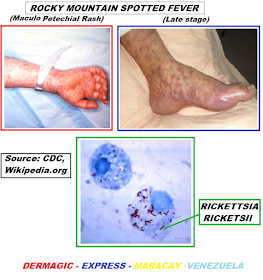
rocky

ABSTRACT

In this publication we bring you another disease caused by the bite of several TICKS; it is the ROCKY MOUNTAIN SPOTTED FEVER, which is caused by a bacterium called Rickettsia Rickettsii, and also another recently discovered the Rickettsia Parkeri. This disease, described since the 1900s, is disseminated in North America, from Canada to South America. The purpose of this publication is to know the main vectors of the disease, how it is transmitted, its symptoms, treatment and to give warning to the world once again that these parasites, ticks are the new plague of the 21st century.

Key words: Rocky Mountain Spotted Fever, spotted fever, Typhus by ticks, Black measles, Dermacentor Andersoni, Dermacentor Variabilis, Rhipicephalus Sanguineus, Rickettsia Rickettsii, Rickettsia Parkeri.

INTRODUCTION

Hello friends of the network, today DERMAGIC EXPRESS brings you another interesting topic about the TICKS and the diseases they transmit, in this case it is the ROCKY MOUNTAIN SPOTTED FEVER (RMSF), which as I said is transmitted by the a tick bite and disseminated not only in the United States, has also been described in the AMERICAS under the name of “Sao Paulo fever” or “Fever maculosa” in BRAZIL; In MEXICO “Spotted fever” and “tick Typhus” or “Tobia Fever” in COLOMBIA. Cases have also been described in Costa Rica and Panama. [1-5]

This disease is produced by the BACTERIA called Rickettsia Rickettsii; gram-negative intracellular cocobabicil considered the most pathogenic strain of the Western Hemisphere and a small part of the Eastern Hemisphere. It belongs to the Rickettsiaceae Family, Order: Rickettsiales, Class: Alphaproteobacteria, Domain: Bacteria, Genus: Rickettsia and species: Rickettsia rickettsii. The disease extends from CANADA to SOUTH AMERICA, and is the most frequent rickettisial disease in the United States. [6-11]
rocky4

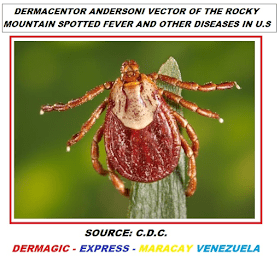
The main TICK transmitter of this bacterium are the ticks of the DERMACENTOR genus, Family Ixodidae, known as “HARD TICKS” which, in addition to transmit the Rickettsia rickettsii, are transmitters of other diseases such as: TICK PARALYSIS (neurotoxin); the POWASSAN virus (Powassan encephalitis); THE FEVER Q (Coxiella burnetii); ANAPLASMOSIS in cattle and humans (Anaplasma Marginale and Anaplasma spp.); TULAREMIA (Francisella tularensis) and the BABESIOSIS in  equine (piroplasmosis) and humans  (Babesia Caballi and Babesia spp.). [12-18]

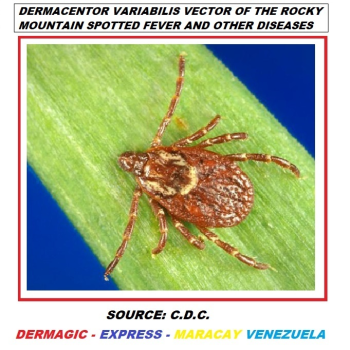
The DERMACENTOR genus of ticks belongs to the Ixodidae Family and has more than 34 described species and the most involved in the ROCKY MOUNTAIN SPOTTED FEVER are DERMACENTOR ANDERSONI (Rocky mountain tick) and DERMACENTOR VARIABILIS (American dog tick), second main vector causing this disease.
rocky1

Of this “hard tick” (DERMACENTOR VARIABILIS) I can say to you that in addition to transmit the ROCKY MOUNTAIN SPOTTED FEVER, it is transmitter of TULAREMIA (Francisella tularensis). They can also be carriers of the Anaplasma phagocytophilum that causes the HUMAN GRANULOCYTIC ANAPLASMOSIS, and Ehrlichia chaffeensis, causal agent of the HUMAN MONOCITIC EHRLICHIOSIS; and in addition they can produce TICK PARALYSIS when introduce a NEUROTOXIN when  are feeding with human blood.

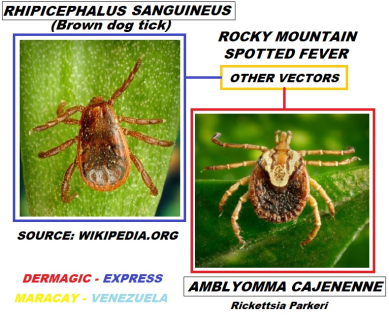
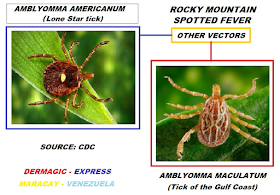
In addition to the DERMACENTOR VARIABILIS and ANDERSONI TICKS as vectors of the ROCKY MOUNTAIN SPOTTED FEVER (RMSF), other species have been described: RHIPICEPHALUS SANGUINEUS (brown tick of the dog), AMBLYOMMA CAJENNENSE (Cayena tick) which is disseminated in South and Central America, AMBLYOMMA AMERICANUM (Lone Star Tick) and AMBLYOMMA MACULATUM (Tick of the Gulf Coast) involved in the transmission of this disease. [1-22]
rocky2

On the other hand, it was discovered in the year 2002 and confirmed in 2013 another species of Rickettsia, the Rickettsia Parkeri in the tick AMBLYOMMA MACULATUM and recently in the tick AMBLYOMMA AMERICANUM capable also of transmit the ROCKY MOUNTAIN SPOTTED FEVER (RMSF).

In addition, it has been demonstrated in the tick DERMACENTOR VARIABILIS AND RETICULATUS antibodies against BORRELIA BURGORFERI which is the causal agent of the already described LYME DISEASE or ERITHEMA MIGRANS, but they are not considered vector of it.
rocky3
HISTORY

The disease ROCKY MOUNTAINS SPOTTED FEVER, is also known under the name “TYPHUS BY TICKS”, and “BLUE DISEASE” and was described in the years 1800 and 1900 in the Valleys of Montana United States, (US), known at that time as “Black measles” for its clinical characteristics. Later it was discovered that the ticks were the vector of the same one and it was in the year 1906, when the scientist Howard T. Ricketts discovered the causal agent, described as an agent “smaller than a bacterium and longer than a virus”; it was called RICKETTSIA RICKETSII in honor of its name. [22-30]

We must remember that Willy Burgdorfer is intimately linked to the ROCKY MOUNTAIN SPOTTED FEVER and study of the Rickettsias; In fact, between 1967 and 1978, he was investigating the Rickettisial Zoonoses in Egypt and then he was sent by the WHO (1976-1986 – World Health Organization) to Montana, United States, and in the course of his investigations he discovered the FEARED ESPIROCHETE BORRELIA, in the year 1981, which carries in its honor the surname BURGODERFERI.

These ticks are the NATURAL HOSTS and they serve as RESERVOIRS AND VECTORS, they transmit the RICKETTSIA through the bite to vertebrates mammals and man, and unlike other diseases they only need to be attached 2 hours to the skin to achieve the transmission of the disease, so that it is a ZOONOSIS, transmitted from animals to man. It can also be transmitted through fluids, tick feces and contaminated tissues of the same.

SYMPTOMS

Symptoms of the disease appear after an incubation period of 1 to 2 weeks, (can affect children and adults) and include threee stages:

1.) INITIAL phase: fever, headache, nausea, vomiting, loss of appetite, mumps,

2.) SECONDARY phase: characterized by maculous and petechial rash, abdominal pain, conjunctivitis and joint pain.

3.)  POSTERIOR or LATE stage: the  Rickettsia may invade the brain, heart, eyes, lungs, kidneys, gastrointestinal tract, and other organs causing definitive sequel such as: deafness, ataxia, blindness, and loss of bladder and bowel control; in extreme cases amputation of limbs by gangrene. Mortality in severe cases: 30-80%

The “CLASSICAL TRIAD” of this disease in terms of symptoms is: 1) FEVER, 2) MACULOUS AND PETECHIAL ERUPTION AND 3) THE PRECEDENT OF TICK BITE; it should be noted that only 35 to 60% of patients manifest the complete TRIAD, and 40% do not present the TYPICAL rash of the disease; it is presented in a centripetal form, from the extremities to the trunk. [1-32]

TREATMENT

The treatment of choice for THE ROCKY MOUNTAIN SPOTTED FEVER (RMSF) is the  DOXYCYCLINE (tetracycline antibiotic), the same used in the LYME disease and EHRLICHIOSIS, which is administered for a period of 10 to 14 days, and in some cases may be more longer. The other antibiotic that shows effectivity against Rickettsia is  the CHLORANPHENICOL, but this should be used with caution as it has many side effects.

With this I want to tell you in a simple way how seven (7) TICKS are capable of transmit nine (9) diseases:

Including the ticks of the Family ixodidae: IXODES SCAPULARIS or the black legged tick.

1) ROCKY MOUNTAIN SPOTTED FEVER (Rickettsia Rickettsii).

2) POWASSAN ENCEPHALITIS (Powassan virus, flavivirus).

3) TICK PARALYSIS (neurotoxin).

4) EHRLICHIOSIS (Ehrlichia chaffeensis, Ehrlichia ewingii).

5) HUMAN GRANULOCYTIC ANAPLASMOSIS (Anaplasma spp)

6) BABESIOSIS IN ANIMALS AND HUMANS (Babesia spp).

7) FEVER Q (Coxiella burnetti).

8) TULAREMIA (Francisella tularensis).

9) LYME DISEASE (Ixodes Scapularis). 1-32]

“… perhaps other diseases …. Today not well documented or simply man has not discovered yet.”

CONCLUSIONS

On the web you can find thousands of articles about the ROCKY MOUNTAIN SPOTTED FEVER, HISTORY AND SYMPTOMS, but for us the main objective of this publication is to make you UNDERSTAND the following:

1) These TIICKS are distributed practically in the entire PLANET.

2) Transmit parasitic diseases with risk of MORTALITY if the diagnosis and treatment is not made in time.

3) Some of the transmitted diseases are RESISTANT to treatment such as LYME disease, leaving permanent sequel in the body, being able to confine the patient to a wheelchair for life.

4) Apart from fighting for the human rights of the unassisted for diseases such as LYME, the final destination is to fight against the TICKS and their HOSTS.

5) THE CODES ICD-11 (International Classification of Diseases, year 2018) for this disease, Rocky Mountain Spotted Fever have been recognized by the World Health Organization (WHO) a long time ago, but  in some cases as the Lyme disease, the scientific society and affected population awaits its inclusion.

6) The new plague of the 21st century is not the mosquitoes (Dengue, Zika and Chikungunya), they are TICKS. [33-38]

“… Humanity is not going to be extinguished by atomic bombs thrown into the air, atomic bombs walk in the earth attached to animals, mice, rats, birds, coyotes, deer, dogs, cats, cattle, goats, camel sheep, rabbits, etc, or the humans, feeding on his blood, contaminating and spreading vertiginously, slowly creating a incapacitated society … “

Greetings to all.

Dr. José Lapenta R Dermatologist
Dr. José M. Lapenta MD.
__________________

For more on RMSF:  https://madisonarealymesupportgroup.com/2017/10/21/mom-got-rocky-mountain-spotted-fever-while-picking-pumpkins/

https://madisonarealymesupportgroup.com/2015/08/13/severe-case-of-rmsf-had-to-remove-patients-arms-and-legs/

https://madisonarealymesupportgroup.com/2018/08/16/new-tick-causes-epidemic-of-rmsf/

https://madisonarealymesupportgroup.com/2018/06/12/georgia-mom-warns-others-after-son-contracts-rocky-mountain-spotted-fever-after-tick-bite/

https://madisonarealymesupportgroup.com/2018/08/19/monster-ticks-found-in-germany-threaten-europe-with-deadly-disease-crimean-congo-fever/  Please note the last quote of the story – that they proved a tropical form of tick typhus in one of tropical ticks found in Germany. Typhus, a bacteria, is making a comeback, particularly in the South. Common in the U.S. in the 40’s, and normally attributed to lice, now it’s been proven to be in a tick. In other words, another disease and a tick found where they supposedly shouldn’t be.
Typus is a rickettsial infection with ticks carring numerous species including rickettsia, ehrlichia, and anaplasma. Rocky Mountain Spotted Fever is also considered a tick-borne typhus fever. https://www.health.ny.gov/diseases/communicable/rocky_mountain_spotted_fever/fact_sheet.htm  Divided into the typhus group and the spotted fever group, disease is transmitted through ectoparasites (fleas, lice, mites, and ticks). Inhalation and inoculating conjunctiva with infectious material can also cause disease. The good news for most is that doxycycline is a front-line drug for it. Broad-spectrum antibiotics aren’t helpful.


October Lyme Support Group Speaker:

Kathy Nodolf of TRUTHCURES

When:  October 13

Time:  2:30-4:30

Where:  East Madison Police Station, 809 S Thompson St. Madison, WI.  Parking info here: https://madisonarealymesupportgroup.com/wp-content/uploads/2017/03/east-dist-parking-visitor-parking.pdf No parking allowed in red areas. You may park in the dotted yellow areas, in-between the light poles and in the last row under the red, as well as on the road leading up to the station.


We are honored to hear and learn from Lyme Advocate Kathy Nodolf of TRUTHCURES, whom candidly admits to trusting the medical establishment for 20 years for her son who had severe neurological Lyme disease.  He unfortunately succumbed to the disease and passed.

With the heartbreaking loss of her son, she has vowed to make everyone aware of this disease tsunami by becoming politically active and speaking up for patients whom are too sick to speak for themselves.

She feels we are on the right track by exposing the correct definition of the disease with scientific discoveries continually validating what TRUTHCURES has maintained for 20 years.

Having been active with HHS prior to the selection of the Tick Borne Disease Working Group (TBDWG), she has given statements and has closely followed their actions.  She will discuss her concerns about the TBDWG and what we can do to be Pro-active.  More on the TBDWG:  https://madisonarealymesupportgroup.com/2018/02/11/anti-patient-bias-embedded-in-tickborne-disease-working-group-and-its-subcommittees/

https://madisonarealymesupportgroup.com/2018/05/18/conflicts-of-interest-in-tick-borne-disease-working-group/

https://madisonarealymesupportgroup.com/2018/08/31/the-runaway-plague/

Kathy with WI Senator Tammy Baldwin, whom she feels is on our side.

IMG_0335-2

I was also able to successfully able to convince WI Representative Mark Pocan to join the Lyme Caucus:  https://madisonarealymesupportgroup.com/2017/05/23/wi-representative-mark-pocan-joins-lyme-caucus/

Please, contact your reps and senators today, letting them know we need them to speak up for the Wisconsin residents who are debilitated due to tick borne disease.  It’s going to take all of us working together to move this mountain.  Never underestimate the power of one.  Just try sleeping with a mosquito!

For information to send them and/or adapt your own letter (personalization is always best), go here: Letter to WI Reps and Senators

Also, spread the word to willing medical practitioners to become properly trained:  

https://madisonarealymesupportgroup.com/2018/06/06/lyme-education-for-healthcare-professionals/

https://madisonarealymesupportgroup.com/2018/02/19/calling-all-doctors-please-become-educated-regarding-tick-borne-illness-heres-how/

More information on TRUTHCURES:  https://www.truthcures.org


iu

Join Dr. Bill Rawls on Tuesday, September 18th, at 8pm EDT for a new LIVE Q&A webinar about How to Overcome Roadblocks to Lyme Disease Recovery.

In this interactive webinar, Dr. Rawls will answer questions about your biggest obstacles to moving beyond Lyme disease and feeling like yourself again, including:

  • Herxheimer reactions
  • Common coinfections (Epstein-Barr, bartonella, parasites + more)
  • Gut dysfunction
  • Lack of social and medical support
  • Plus, more questions from the live audience

Submit your top questions after you register, and Dr. Rawls will answer as many as possible.

Reserve Your Seat Now:  https://rawlsmd.com/webinars/ask-dr-rawls/?utm_campaign=webinar+_hash_26+ask+dr.+rawls+9.18.18+-

If you have any questions about the webinar, call 800-951-2414.


https://www.ncbi.nlm.nih.gov/pubmed/30160650

Emerg Infect Dis. 2018 Nov 17;24(11). doi: 10.3201/eid2411.172033. [Epub ahead of print]

Detection of Tickborne Relapsing Fever Spirochete, Austin, Texas, USA.

Abstract

In March 2017, a patient became febrile within 4 days after visiting a rustic conference center in Austin, Texas, USA, where Austin Public Health suspected an outbreak of tickborne relapsing fever a month earlier. Evaluation of a patient blood smear and molecular diagnostic assays identified Borrelia turicatae as the causative agent. We could not gain access to the property to collect ticks. Thus, we focused efforts at a nearby public park, <1 mile from the suspected exposure site. We trapped Ornithodoros turicata ticks from 2 locations in the park, and laboratory evaluation resulted in cultivation of 3 B. turicatae isolates. Multilocus sequencing of 3 chromosomal loci (flaB, rrs, and gyrB) indicated that the isolates were identical to those of B. turicatae 91E135 (a tick isolate) and BTE5EL (a human isolate). We identified the endemicity of O. turicata ticks and likely emergence of B. turicatae in this city.

_______________

**Comment**

For decades there has been complete denial of Lyme in the South.  Dr. Masters fought this tooth and nail:  https://madisonarealymesupportgroup.com/2017/10/06/remembering-dr-masters-the-rebel-for-lyme-patients-who-took-on-the-cdc-single-handedly/

https://madisonarealymesupportgroup.com/2018/05/31/no-lyme-in-the-south-guess-again/

https://madisonarealymesupportgroup.com/2016/10/25/hope-for-southerners/

https://madisonarealymesupportgroup.com/2018/08/18/lyme-found-in-all-50-states/

TBRF has been found in Austin, TX caves:  https://madisonarealymesupportgroup.com/2018/04/23/tick-borne-relapsing-fever-found-in-austin-texas-caves/

Thankfully more and more is coming out revealing that in fact these poor patients and the doctors who dare to treat them are not delusional but are in fact dealing with tick borne illness.  The Lyme-like illness that for all intents and purposes looks, smells, and acts just like Lyme, is caused by something that needs to be identified.  We need to quit focusing on the red herring of climate change and start identifying these bugs so people can get better.

Bartonella isn’t even on the radar yet it is a HUGE player:  https://madisonarealymesupportgroup.com/2016/12/29/cardinal-state-bartonella/

https://madisonarealymesupportgroup.com/2018/05/07/fox-news-bartonella-is-the-new-lyme-disease/

https://madisonarealymesupportgroup.com/2016/01/03/bartonella-treatment/  Various strains have been found in eye fluid, the heart (myocarditis and endocarditis), and cysts, and can infect by nearly anything puncturing the skin and exchanging bodily fluids – including needles. Evidence also suggests congenital transmission.…. Symptoms are largely associated with where the blood flow is compromised. The reason many have pain in the soles of their feet is due to inflammation caused by microvascular trauma. It has been known to cause cysts around dental roots leading to chronic and hard to diagnose head and face pain as well as root canals. This microvascular trauma is also to blame for brain issues causing psychological issues such as anxiety, anger, and suicidal thoughts, since the small vessel disease affects executive function. A cog is literally caught in the wheel. As neurotransmitters become depleted due to overstimulation, depression rears its ugly head. A vicious cycle ensues.  Due to the cyclical nature of Bartonella and that it exists in very low amounts in human blood, blood tests are unreliable. It also has a long division time between 22-24 hours and requires a special growth environment. There is a Triple Draw through Galaxy which collects blood over 8 days to maximize the test, stating a 90% reduction in false negatives.


https://shoutout.wix.com/so/87MNE-P__?cid=3be50b05-a5b9-47a1-a8f8-c12174cf82c1&region=cb36eb27-d7d9-4cca-8fce-c3400909d73a#/main

CIC Tick-borne Illness Preliminary Survey Results

Initial data from the Climate Impact Census contains some striking numbers on the personal costs of Lyme disease to Americans.

Some preliminary findings from our tick-borne illness survey include:

  • More than half reported having spent at least $30,000, and one-third at least $75,000, on medical-related expenditures over the course of their illness. A little over 10% reported spending more than $200,000


  • In addition to these high out-of-pocket medical expenses, the most common hardships from tick-borne illnesses reported were debt (credit card, friends, family or others); liquidated assets (e.g. homes, retirement savings); terminated or interrupted careers; lost relationships; and reliance on public assistance (e.g. disability, unemployment)


  • 60% reported suffering at least two of these hardships; 40% at least three; and 15% at least four.


  • More than half reported becoming in debt as a result of their illness


  • 40% had sold off assets (e.g. homes), liquidated some or all of their retirement savings, or liquidated some or all of their children’s college funds.


  • 45% lost their careers, and over 60% experienced some form of career loss or interruption.


And the press is paying attention. A recent Op-ed in the science publication, Undark, recently used the Climate Impact Census to illustrate the depth of financial harm to individuals caused by Lyme disease, and called for more research funding. You can read the article here:  https://madisonarealymesupportgroup.com/2018/09/11/as-the-threat-of-lyme-disease-rises-why-hasnt-research-funding-followed-suit/

You can also hear the two directors of the Climate Cost Project interviewed about the project and the importance of getting more data on the personal costs of Lyme disease on WHMP radio here:  https://soundcloud.com/whmp/estimating-the-cost-of-lyme-disease

If you have any friends or family who have been affected by Lyme disease, please help spread the word by sending them the survey:

https://www.climatecostproject.org/cic-individual

_________________

**Comment**

This survey has revealed what all of us out here in Lyme land know – Lyme/MSIDS costs us nearly everything we have.  If you have not taken the time to fill out the survey, please do.  The more data, the more accurate the picture.

According to independent tick researcher, John Scott, ticks and Lyme are NOT propelled by climate.

For more on this:  https://madisonarealymesupportgroup.com/2018/08/13/study-shows-lyme-not-propelled-by-climate-change/

Scott and his wife Kit have been infected for decades and have everything to gain from getting to the bottom of this mess.  The article points out many other factors such as light (photo period) and migrating birds.

He also explains how the climate issue is not innocent.

https://madisonarealymesupportgroup.com/2017/08/14/canadian-tick-expert-climate-change-is-not-behind-lyme-disease/  John explains, “The climate change range expansion model is what the authorities have been using to rationalize how they have done nothing for more than thirty years. It’s a huge cover-up scheme that goes back to the 1980’s. The grandiose scheme was a nefarious plot to let doctors off the hook from having to deal with this debilitating disease. I caught onto it very quickly. Most people have been victims of it ever since.”

“This climate change ‘theory’ is all part of a well-planned scheme. Even the ticks are smarter than the people who’ve concocted this thing,” he says.

“Climate change has nothing to do with tick movement. Blacklegged ticks are ecoadaptive, and tolerate wide temperature fluctuations.