Archive for the ‘Transmission’ Category

HCQ Breakthrough: ICMR Finds It’s Effective in Preventing Coronavirus, Expands Its Use

https://theprint.in/health/hcq-breakthrough-icmr-finds-its-effective-in-preventing-coronavirus-expands-its-use

HCQ breakthrough: ICMR finds it’s effective in preventing coronavirus, expands its use

Three studies find that hydroxychloroquine reduces chances of contracting Covid, so ICMR allows more frontline workers to take it as a preventive drug.

22 May, 2020 

New Delhi: The Indian Council of Medical Research (ICMR), the country’s apex body in the field, has found that consuming the drug hydroxychloroquine reduces the chances of getting infected with Covid-19.

As a result, ICMR released an advisory Friday to expand the usage of HCQ — an anti-malarial drug — as a preventive treatment against the novel coronavirus.

The conclusion has been drawn on the basis of three studies conducted by the ICMR.

The advisory suggests surveillance workers, paramilitary and police personnel, as well as medical staff working in non-Covid hospitals and blocks to start consuming the pill as “preventive therapy”.  (See link for article)

____________________

For more:  https://madisonarealymesupportgroup.com/2020/06/06/fraudulent-hcq-covid-19-study-in-lancet-exposed/

https://madisonarealymesupportgroup.com/2020/06/01/rebuttal-on-huge-hcq-study-in-lancet/

https://madisonarealymesupportgroup.com/2020/05/22/new-study-hcq-zinc-greatly-reduces-covid-19-health-risk/

https://madisonarealymesupportgroup.com/2020/04/24/dr-oz-interviews-dr-didier-raoult-on-hydroxychloroquine-study-for-covid-19/

https://madisonarealymesupportgroup.com/2020/05/11/podcast-evidence-supporting-hcq-azithromycin-for-covid-19/

https://madisonarealymesupportgroup.com/2020/03/27/the-truth-about-hydroxychloroquine-plaquenil-in-the-treatment-of-covid-19/

Emerging Tick-Borne Diseases & Blood Safety: Summary of a Public Workshop

https://pubmed.ncbi.nlm.nih.gov/32208532/

. 2020 Mar 24.

doi: 10.1111/trf.15752. Online ahead of print.

Emerging Tick-Borne Diseases and Blood Safety: Summary of a Public Workshop

Affiliations expand

Abstract

Tick-borne agents of disease continue to emerge and subsequently expand their geographic distribution. The threat to blood safety by tick-borne agents is ever increasing and requires constant surveillance concomitant with implementation of appropriate intervention methods. In April 2017, the Food and Drug Administration organized a public workshop on emerging tick-borne pathogens (excluding Babesia microti and Lyme disease) designed to provide updates on the current understanding of emerging tick-borne diseases, thereby allowing for extended discussions to determine if decisions regarding mitigation strategies need to be made proactively. Subject matter experts and other stakeholders participated in this workshop to discuss issues of biology, epidemiology, and clinical burden of tick-borne agents, risk of transfusion-transmission, surveillance, and considerations for decision making in implementing safety interventions. Herein, we summarize the scientific presentations, panel discussions, and considerations going forward.

____________________

**Comment**

I only had access to the abstract, but Dr. Cameron writes more fully on the workshop here:  https://danielcameronmd.com/babesia-infection-transmitted-blood-supply/

Interestingly, according to the abstract, they excluded Babesia and Lyme, which are arguably two of the largest problems. It was pointed out that 200 cases of Babesia were transmitted through blood transfusions at the time of the workshop and that Anaplasma is next with increasing clinical cases.

Evidently there have been no reported cases of Lyme transmitted through the blood supply.


Other tick-borne pathogens have been transmitted through donated blood, but these occurrences are rare. (Or rarely reported)

  • 11 cases: A. phagocytophilum, responsible for Anaplasmosis (transmitted by the Ixodes ticks)
  • 2 cases: Tick-borne encephalitis virus complex (TBEV, Powassan virus, DTV), (transmitted by the Ixodes ticks)
  • 1 case: Colorado tick-fever virus (transmitted by Rocky Mountain wood ticks)
  • 1 case: Rickettsia rickettsii, the agent of Rocky Mountain Spotted Fever (transmitted by the Lone Star tick)
  • 1 case: Ehrlichia ewingii (transmitted by the Lone Star tick)

In addition, “two emerging [tick-borne agents] − B. miyamotoi and Powassan virus were discussed − for B. miyamotoi,cases have steadily increased since 2014.”

For more:  https://madisonarealymesupportgroup.com/2019/07/28/tick-borne-infection-risk-in-blood-transfusion/

https://madisonarealymesupportgroup.com/2018/10/11/transfusion-transmitted-babesiosis-one-states-experience/

https://madisonarealymesupportgroup.com/2017/08/08/transfusion-transmitted-babesiosis-in-nonendemic-areas/

https://madisonarealymesupportgroup.com/2019/05/26/fda-recommends-testing-for-tick-borne-illness-in-donated-blood-a-big-duh/

https://madisonarealymesupportgroup.com/2016/06/02/study-showing-results-testing-babesia-microti/


Asian Longhorned Tick Able to Transmit RMSF in Lab Setting (Also Transmitted Within Ticks Through Ova)

https://pubmed.ncbi.nlm.nih.gov/32338290/

The Ability of the Invasive Asian Longhorned Tick Haemaphysalis Longicornis (Acari: Ixodidae) to Acquire and Transmit Rickettsia Rickettsii (Rickettsiales: Rickettsiaceae), the Agent of Rocky Mountain Spotted Fever, Under Laboratory Conditions

2020 Apr 27;tjaa076.
doi: 10.1093/jme/tjaa076. Online ahead of print.
  • PMID: 32338290

Abstract

The invasive Asian longhorned tick, Haemaphysalis longicornis Neumann, was first detected in the United States in 2017. It has since been found in 12 states, and there is concern that the tick’s parthenogenetic ability and wide variety of host species may allow for broader dissemination. Of the tick-borne diseases endemic to the United States, Rocky Mountain spotted fever (RMSF), a rapidly progressive and potentially fatal disease caused by Rickettsia rickettsii, is the most severe. There is considerable geographical overlap between spotted fever rickettsioses cases, which include RMSF, and the currently known distribution of H. longicornis, providing the potential for this tick to encounter this pathogen.

We have evaluated the ability of H. longicornis to acquire and transmit R. rickettsii under laboratory conditions. Haemaphysalis longicornis as larvae and nymphs acquired the pathogen while feeding on infected guinea pigs. The infection persisted through every life stage, all of which were able to transmit R. rickettsii to naïve hosts. The pathogen was also transmitted at a low frequency between generations of H. longicornis through the ova. While H. longicornis was demonstrated to be a competent vector for R. rickettsii under laboratory conditions, the probability of its involvement in the maintenance and transmission of this pathogen in nature, as well as its potential impact on human health, requires further study.

___________________

**Comment**

The Asian Long-horned tick used to be known as pretty much just a livestock pest.  Obviously, researchers are changing their tune.  What makes this tick particularly unique and equally terrifying is its ability to reproduce through cloning – making a literal infestation very quickly. It is traipsing through the entire U.S. – having been found in at least 12 states.

Here we see it can also transmit Lyme (although they say “minimally” – whatever that means)  https://madisonarealymesupportgroup.com/2019/10/26/researchers-conclude-asian-longhorned-tick-contributes-minimally-to-lyme-disease-in-the-u-s/

The pressing question is what all do they transmit?  We know this so far:  

It spreads SFTS (sever fever with thrombocytopenia syndrome), “an emerging hemorrhagic fever,” causing fever, fatigue, headache, nausea, muscle pain, diarrhea, vomiting, abdominal pain, disease of the lymph nodes, and conjunctival congestion, but the potential impact of this tick on tickborne illness is not yet known. In other parts of the world, this Longhorned tick, also called the East Asian or bush tick, has been associated with several tickborne diseases, such as spotted fever rickettsioses, Anaplasma, Ehrlichia, and Borrelia, the causative agent of Lyme Disease.  https://madisonarealymesupportgroup.com/2018/06/12/first-longhorned-tick-confirmed-in-arkansas/

For a 2016 literature review on SFTS: http://infectious-diseases-and-treatment.imedpub.com/research-advances-on-epidemiology-of-severefever-with-thrombocytopenia-syndrome-asystematic-review-of-the-literature.php?aid=17986
Although the clinical symptoms of SFTS and HGA are similar to each other, but the treatment methods of the two diseases are totally different. Doctors notice that the biggest difference between the clinical symptom of SFTS and HGA is that SFTS patients generally without skin rash, the dermorrhagia is also not seriously, and few massive hemorrhage cases were reported [23]. It is also reported that SFTS patients had gastrointestinal symptoms, such as nausea, vomiting, and diarrhea, which are rarely observed in HGA patients [2]. So these differences can be used as the auxiliary basis of differential diagnosis.
At present, there is still no specific vaccine or antiviral therapy for SFTSV infection. Supportive treatment, including plasma, platelet, granulocyte colony stimulating factor (GCSF), recombinant human interleukin 11, and gamma globulin is the most essential part of case treatment [44]. Meanwhile, some measures were taken to maintain water, electrolyte balance and treat complications are also very important.
Ribavirin is reported to be effective for treating Crimean-Congo Hemorrhagic Fever (CCHF) infections and hemorrhagic fever with renal syndrome, but it is still inadequate to judge the effect of ribavirin on SFTS patients because of the study limitation without adequate parameters were investigated [45]. Host immune responses play an important role in determining the severity and clinical outcome in patients with infection by SFTSV.
For Viral treatment options:  https://madisonarealymesupportgroup.com/2016/03/28/combating-viruses/

And lastly, please know ticks parasitize one another, potentially spreading all manner of diseases to humans.  This fact also shoots holes in the regurgitated mantra that only certain ticks carry certain pathogens.  If they are feasting on one another, they can potentially infect each other and then us:  https://madisonarealymesupportgroup.com/2018/03/07/tick-bites-tick-hyperparasitism/

https://madisonarealymesupportgroup.com/2018/07/19/rutgers-racing-to-contain-asian-longhorned-tick/

And now it appears to have the ability at least in a lab setting to transmit RMSF.  For more:  https://madisonarealymesupportgroup.com/2018/09/14/rocky-mountain-spotted-fever-rmsf/

https://madisonarealymesupportgroup.com/2019/07/25/kentucky-more-than-two-dozen-rocky-mountain-spotted-fever-cases-reported-in-grayson-county/

https://madisonarealymesupportgroup.com/2017/10/21/mom-got-rocky-mountain-spotted-fever-while-picking-pumpkins/

https://madisonarealymesupportgroup.com/2015/08/13/severe-case-of-rmsf-had-to-remove-patients-arms-and-legs/

https://madisonarealymesupportgroup.com/2018/08/16/new-tick-causes-epidemic-of-rmsf/


Lyme in the South: 4 Kids Infected at 1 Camp

https://danielcameronmd.com/lyme-in-the-south-children-infected-camp/

LYME DISEASE IN THE SOUTH: 4 CHILDREN INFECTED AT ONE CAMP

lyme in the south

Some doctors have questioned the existence of Lyme disease in the south, but in their “Morbidity and Mortality Weekly Report,” published January 2020, the Centers for Disease Control and Prevention (CDC) describe 4 cases of Lyme disease in young children who attended a wilderness day camp in North Carolina. [1]

The number of tick-borne diseases, including Lyme, has been steadily rising in the South as tick populations expand into new territories. One study reports, “The trends in these data paint a clear picture of southward expansion of Lyme disease.” As a result, communities once considered non-endemic for Lyme disease will be at risk, including those in the south, the study warns. [2]

The CDC recently reported several children infected with Lyme disease at a single camp, located in the south. The children, who were between the ages of 6 and 8, attended the wilderness day camp at least 1 day a week in the Fall and Spring. Three of the four children were homeschooled but attended the camp. Three children had ticks removed.

“Further investigation identified an earlier camp participant who had received a diagnosis of Lyme disease in 2017,” the authors explain.

READ MORE: Culture Evidence of Lyme disease in antibiotic-treated patients living in the Southeast

Using a “flagging and dragging” method across 0.27 acres of the camp, investigators collected 37 Ixodes Scapularis ticks, commonly called deer ticks.

Study Results

Out of 35 ticks tested, 6 were positive for B. burgdorferi sensu stricto, the causative agent of Lyme disease.

“Results indicated that nymphal ticks collected at the campsite had a B. burgdorferi infection prevalence of 17%,” the authors write.

Additionally, 1 of the 6 ticks tested positive for Borrelia miyamotoi.

None of the ticks tested positive for the pathogens responsible for Anaplasmosis or Babesia microti.

In 3 of the 4 children, blood tests confirmed a Lyme disease diagnosis. Two of the children had an erythema migrans (bull’s eye) rash. One was considered probable because the test was positive by ELISA and IgM Western blot but not IgG Western blot.

Symptoms and Treatment

The clinical presentations included brief, recurrent attacks of joint swelling, arthralgia, fever, headaches, loss of appetite, and fatigue. One had radiculoneuropathy and Bell’s palsy.

All were treated with doxycycline. The authors did not indicate how long they treated the young children or the outcome of treatment.

Authors Conclude

“Clinicians should be aware of the risk for transmission of Lyme disease in North Carolina and consider recommended diagnostic testing and treatment.”

Other studies have also identified ticks infected with the causative agent of Lyme disease in the south. One study reports, “The trends in these data paint a clear picture of southward expansion of Lyme disease.” As a result, communities once considered non-endemic for Lyme disease will be at risk, including the southeastern United States, the study warns. [2]

Editor’s note: I hope this cluster of cases in children attending a single camp in North Carolina will remind doctors of the tick-borne problems in the Southeastern USA.
References:
  1. Barbarin AM, Seagle SW, Creede S. Notes from the Field: Four Cases of Lyme Disease at an Outdoor Wilderness Camp — North Carolina, 2017 and 2019. MMWR Morb Mortal Wkly Rep. 2020 Jan 31; 69(4): 114–115.
  2. Lantos PM, Nigrovic LE, Auwaerter PG, et al. Geographic Expansion of Lyme Disease in the Southeastern United States, 2000–2014. Open Forum Infectious Diseases. 2015;2(4):ofv143. doi:10.1093/ofid/ofv143. Available at https://www.ncbi.nlm.nih.gov/pmc/articles/PMC4629694/

_________________

**Comment**

Lyme disease still is not recognized for the pandemic it truly is. This study demonstrates how authorities are still hanging on to ancient data that never was accurate to begin with.

  1. It demonstrates a Southerly tick expansion.  We’ve been told ad nauseam that ticks are expanding Northward due to climate change. Well, it’s already hot in the South so there goes that theory.  Also, independent research has already blown that theory out of the water some time ago, yet it isn’t accepted because it doesn’t fit the narrative: https://madisonarealymesupportgroup.com/2018/11/07/ticks-on-the-move-due-to-migrating-birds-and-photoperiod-not-climate-change/ This researcher claims the narrative is widely held because researchers working at institutions need ‘accepted’ topics to receive funding for their work.  In essence, those with little research experience call the shots. Ticks laugh at the weather. They just don’t care. They will find a way to survive.  https://madisonarealymesupportgroup.com/2019/06/17/ontario-public-health-officials-called-out-on-shoddy-biased-research-utilizing-an-erroneous-climate-change-model-to-program-a-futuristic-tick-problem/
  2. Lyme disease STILL isn’t widely accepted and treated appropriately.  It’s even worse in the South: https://madisonarealymesupportgroup.com/2019/04/22/its-just-crazy-why-is-lyme-disease-treatment-so-difficult-to-find-in-mississippi/https://madisonarealymesupportgroup.com/2016/09/24/arkansas-kids-denied-lyme-treatment/https://madisonarealymesupportgroup.com/2018/05/31/no-lyme-in-the-south-guess-again/
  3. Even with a 17% tick infection rate with Bb, 4 kids got infected. It isn’t always a linear connection between tick infection rates and human infection rates. Trust me, if you’re the sorry sucker who gets infected – it matters!
  4. Notice not all found ticks, got the EM rash, and tested positive on serology – yet those parameters are still held like an iron curtain in mainstream medicine to prove infectivity.
  5. The symptoms these kids had are hallmark Lyme symptoms.

Man Develops Fever, Arthritis in Knee & Rash After Dog Licks Insect Bite

https://www.ncbi.nlm.nih.gov/pubmed/32087981

2020 Feb 19. pii: S0151-9638(20)30077-6. doi: 10.1016/j.annder.2020.01.016. [Epub ahead of print]

[Multiple erythema annulare centrifugum associated with knee monoarthritis revealing Capnocytophagacanimorsus infection].

[Article in French]

Abstract

INTRODUCTION:

Capnocytophagacanimorsus (C. canimorsus), a commensal Gram-negative bacillus found in the oral cavity of dogs and cats, is pathogenic for humans, with the most common clinical manifestations being septicemia, meningitis and endocarditis. Herein we report a case of CC bacteremia manifesting as multiple plaques of erythema annulare centrifugum associated with monoarthritis of the knee.

PATIENTS AND METHODS:

A 66-year-old man consulted for a skin rash and monoarthritis of the right knee with fever following an insect bite on his right hallux. Cutaneous examination revealed numerous erythematous annular plaques on the trunk and limbs with centrifugal extension. Analysis of synovial fluid from the right knee showed an inflammatory liquid with a sterile bacteriological culture and PCR was negative for Borrelia. C. canimorsus bacteria were isolated from blood cultures. 16S RNA PCR performed on the synovial fluid was positive for the same organism.

The patient’s history revealed that his hallux wound had been licked by his dog.

DISCUSSION:

C. canimorsus most frequently affects immunosuppressed subjects. Cutaneous signs are seen in half of all cases, most frequently presenting as cellulitis, pathological livedo or thrombotic purpura. We report herein a case of CC bacteremia in an immunocompetent patient manifesting as multiple plaques of erythema annulare centrifugum, an unusual sign, and monoarthritis of one knee.

_______________

**Comment**

I post this because many patients have pets.  Here we see the result of a man with an insect bite on his big toe being licked by his dog.  He was in good health but developed a skin rash, fever, and arthritis in the knee joint.  

This demonstrates that many organisms can cause pain & arthritis.

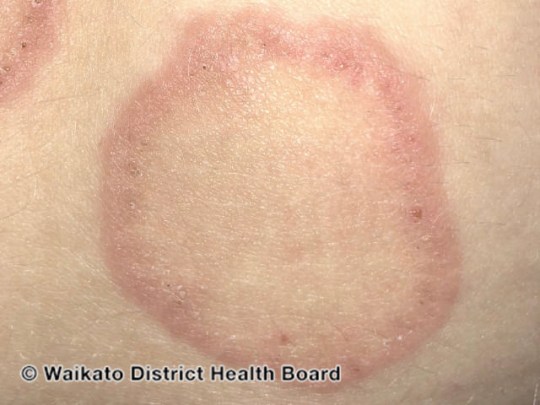
For more on erythematous annular plaques:  

annular-erythema-03__WatermarkedWyJXYXRlcm1hcmtlZCJdhttps://creativecommons.org/licenses/by-nc-nd/3.0/nz/legalcode

What are the clinical features of erythema annulare centrifugum?

Erythema annulare centrifugum typically affects the thighs, buttocks, and upper arms. However, any location on the body can be affected.

Erythema annulare centrifugum usually starts as a small pink papule that gradually enlarges over several weeks to form annular plaqueswith central clearing. These plaques can vary in size from a few millimetres to a few centimetres in size. Annular lesions can be partial (arciform) and coalesce to form polycyclic (ringed), serpiginous (wavy), and gyrate (revolving) patterns.

Classically, the annular or arciform lesions have an advancing outer erythematous edge with a trailing (inner) scaly edge. The rash may be itchy.

How is erythema annulare centrifugum diagnosed?

Erythema annulare centrifugum can sometimes be diagnosed on clinical features alone if the characteristic trailing scale is present. The diagnosis can be confirmed by skin biopsy in which the typical features of superficial or deep erythema annulare centrifugum are noted: a dense perivascular lymphocytic infiltrate involving either the superficial or deep vascular plexus, which is known as a ‘coat-sleeve’ appearance. Secondary changes to the epidermis may include spongiosis (inflammation of intercellular oedema), parakeratosis (disturbance in the keratinisation process), and hyperkeratosis (thickening of the outer layer of the epidermis) [2].  https://www.dermnetnz.org/topics/erythema-annulare-centrifugum/