Hello! Do you know what to do when you spot a tick?
When you spot a tick on a person or pet, remove it right away. If the tick has not attached itself to the host, you can simply pick it up and place it in a plastic bag. If the tick is attached, you’ll need to remove it carefully, following these simple steps listed here:
Using fine-point tweezers or a tick removal tool, grip the tick at the base of your skin, getting as close as you can to its head.
Steadily pull the tick straight up and out.
Place the tick in a plastic bag. Saving the tick will allow for you to have it tested for tick-borne pathogens by the Tick Research Lab of PA.
Clean the bite with an antiseptic such as isopropyl alcohol.
While some redness at the site is normal, this should subside. Watch for signs of infection. If you develop a rash, tenderness or pain, see your doctor right away.
Important:
Avoid burning the tick or coating it with any substances such as soap, alcohol, petroleum jelly or acetone. Covering the tick with any substance or applying heat will irritate the tick and place you at greater risk of contracting a tick-borne disease. It may also make it impossible to test the tick for diseases.
After you have removed the tick, monitor the area for several weeks. Check for signs of infection including rash or swelling. Keep an eye out for a bullseye-type rash, which may indicate the presence of Lyme disease and can occur anywhere on the body.
Laboratory testing is available through the Tick Research Lab of Pennsylvania. Testing can reveal the presence of tick-borne diseases such as Lyme Disease, Anaplasma and Rocky Mountain Spotted Fever even before symptoms appear.
Follow us on social media for more prevention and awareness tips!
Protect yourself, loved ones and pets from ticks. The Tick Research Lab of Pennsylvania is continuing to offer Free Basic Panel Tick Testing for PA residents through funds received from the PA Department of Health. If you find a tick attached, don’t panic.
The continued advice to sit around and “watch for signs of infection” is not helping patients. ILADS recommends consideration of prophylactic treatment for ALL black legged tick bites with a minimum of 20 days of doxycycline.
It’s also important to remember that Lyme is just the tip of the spear and ticks transmit 19+ pathogens, some of which can be transmitted within minutes. Also, other types of ticks transmit disease as well and need to be considered.
If you plan to be out in the woods or live next to woods, don’t be too quick to trade long pants and long sleeves for shorts and a tee shirt as the weather warms. You need to protect yourself from the ticks that are starting to emerge. Tick bites are possible year-round, but ticks are most active April through September.
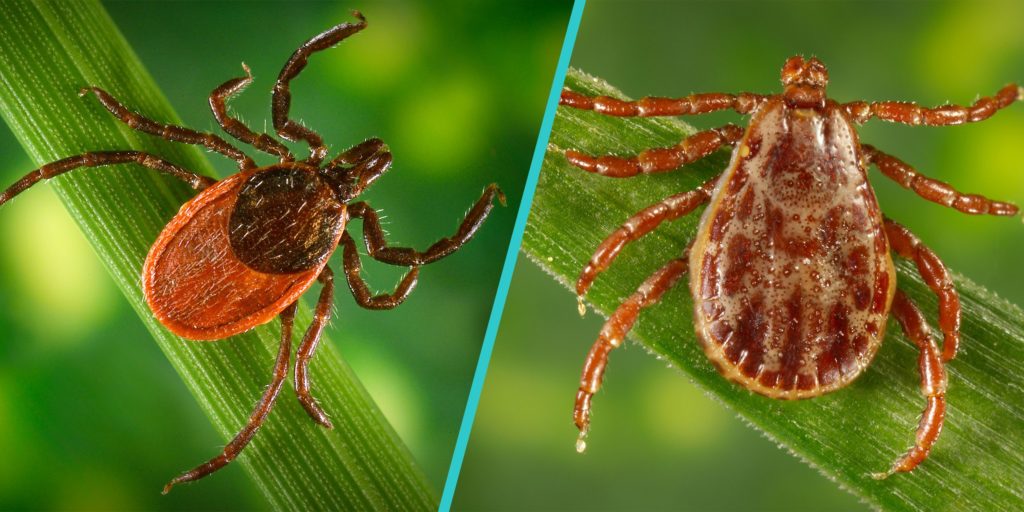
Many types of ticks never feed on people. In Wisconsin, the two most common ticks that do are the wood tick, which is not a health concern here, and the black-legged tick (Ixodes scapularis), commonly known as the deer tick, which can transmit several serious diseases including Lyme disease and, more recently, anaplasmosis, which can start with symptoms like fever and nausea and in some cases, progress to organ failure.
Deer tick (left) and Wood tick (right). Photo courtesy of prevention.com
Wisconsin is Tick Heaven
The Upper Midwest and the northeastern states are hardest hit by Lyme disease, and the numbers in Wisconsin are rising. According to the Wisconsin Department of Health Services, Wisconsin had 3,105 estimated cases in 2018.
Once considered to be a north woods hazard, deer ticks are now found in every county of the state. Deer are an important blood source for adult ticks, and in 2018 overwinter deer densities in the state varied from three to over 60 per square mile. The abundant woodlands interspersed with agriculture throughout much of central and southwestern Wisconsin creates high quality deer habitat.
“There’s been a change in the past 25 years,” says Dr. Susan Paskewitz, chair of the UW-Madison Department of Entomology. Ticks thrive in moist, shady forested environments, and love our increasingly mild winters. “We find them in pine forests, mixed forests and deciduous forests.”
Paskewitz has sampled along the woody edges and out into the yard in neighborhoods in Eau Claire and near Delton.
“Of 90 houses tested, by the end of June, 80 percent of them had at least one deer tick in the area we were sampling. Most were within three to six feet of the woods,” Paskewitz continued, “but a few were found in bright, open, mowed lawn. I don’t think they live long there, but they were making their way out there, so if you are walking out to get your mail without your shoes on, you might pick up that particular tick.” (See link for article)
____________________
**Comment**
They say a picture‘s worth a thousand words. The picture of this tick in the gum line in the mouth of a dog shows how durable and tenacious ticks are.
A few points for consideration:
Migrating birds, rodents, deer, lizards, and human movement are transporting ticks everywhere. For far too long doctors have been looking at maps to diagnose people. Trust me, ticks are virtually everywhere and adapt to weather conditions quite easily.
If I’ve written this once, I’ve written it 1,000 times – many people never see the tick or the rash and research shows the rash is highly variable – certainly not a sure thing.
Regarding the section on if you find a tick bite: while it’s true that removing the tick as soon as possible is step #1, step #2 is getting prompt treatment as the “wait and see” approach has doomed patients to decades of suffering. Demand immediate prophylactic treatment for each and every tick bite. Trust me – whatever mild side effects and inconvenience a month or two’s worth of doxycycline can cause is nothing compared to the pain and suffering of a chronic, relapsing infection.
Testing for all tick-borne illnesses is abysmal. Lyme is just the tip of the spear. Ticks are literal garbage cans full of numerous pathogens they can transmit in just one bite. The only infections listed in this article were Lyme disease, Anaplasmosis, and Babesia, when there are 19 and counting infections ticks can transmit. Research has shown being infected with more than one pathogen causes more severe illness for a longer duration. It is imperative that treatment includes medications that focus on each pathogen. For the mounting list of tick-borne pathogens:
Babesiosis
Bartonellosis
Borrelia miyamotoi
Bourbon Virus
Colorado Tick Fever
Crimean-Congo hemorrhagic Fever
Ehrlichiosis/Anaplasmosis
Heartland Virus
Meat Allergy/Alpha Gal
Pacific Coast Tick Fever: Richettsia philipii
Powassan Encephalitis
Q Fever
Rickettsia parkeri Richettsiosis
Rocky Mountain Spotted Fever (RMSF)
SFTS: Severe Fever with Thrombocytopenia Syndrome
STARI: Southern Tick-Associated Rash Illness
Tickborne meningoencephalitis
Tick Paralysis
Tularemia
While the wood tick and deer tick are the most common ticks in Wisconsin, they are hardly the only ticks we must be concerned about.Go here for more on the various types of ticks and the diseases they carry. The Lone Star tick has been found in Wisconsin and one allergist in MN states he diagnoses approximately 1 patient per month with Alpha-gal allergy – some patients hailing from WI. Wisconsin is a hot-spot for Powassan virus, and we recently had our first death due to Rocky Mountain Spotted Fever. It would be a huge mistake to believe you only have to worry about Lyme, Anaplasmosis, and Babesia in Wisconsin. Nearly every patient I work with also has Bartonella – a tenacious pathogen that isn’t even on most doctors’ radars, and Mycoplasma is very common.
Most articles such as these don’t tell you what to do once you’ve become infected. Optimally, you would be prepared before this ever happened by finding the Lyme literate doctors (LLMD) in your state. The best way to do this is to contact your local Lyme support group. There is also a tab on the right side of this website called, “Find a Lyme Support Group.” There is also another tab slightly down from that in which you can contact ILADS directly for doctors in your area. Read this if you don’t know what a LLMD is. LLMDs are specially trained in tick-borne illness and know how to diagnose patients clinically. This is crucial because current 2-tiered CDC testing misses anywhere from 70-85% of cases or more. You truly can not trust testing. They also know how to treat this complex illness that typically is far more than just Lyme.
According the the Centers for Disease Control and Prevention (CDC), the average number of Lyme disease cases has more than doubled over the last decade. In this presentation, Alicia Cashman from the Madison Lyme Support Group discusses tick-born illness, why it’s so difficult to obtain help, symptoms, prevention, and real life experience of patients. The program was made possible through funding from the Friends of the Oregon Library.
Slide 12: Lyme disease signs and symptoms explained by Dr. Aucott of Johns Hopkins
Patients can jump to stage 3 quickly and bypass the other stages. I give the example of the little girl who went out to play, got a tick bite above her eye and within 4-6 hours couldn’t walk or talk.
Slide 15: Willy Burgdorfer, the “discoverer” of Lyme
Investigative journalist, Kris Newby, interviewed Burgdorfer in the important documentary, “Under Our Skin.” She recently authored “Bitten, the Secret History of Lyme Disease and Biological Weapons.” Interview here:https://madisonarealymesupportgroup.com/2020/09/16/48473/
Burgdorfer states in the clip from “Under Our Skin” that the U.S. government knows Lyme can become chronic (patients have persistent symptoms despite treatment) and that patients can relapse years after an initial infection.
Burgdorfer was a U.S. government biological weapons researcher
He worked in the U.S. government’s Rocky Mountain Laboratories in Montana
In the 60’s he developed methods of “weaponizing” ticks to carry numerous diseases
Please remember that most patients are infected with numerous infections. Treatment should reflect this as research shows patients fighting numerous infections simultaneously have more severe symptoms for a much longer duration.
Mothers & Children Panel: 5th Annual LymeMIND Conference 2020
Nov. 2, 2020
Sue Faber, RN, BScN, President, LymeHope
Holly Ahern, MT(ASCP), Associate Professor of Microbiology, SUNY Adirondack
Charlotte Mao, MD, Pediatric infectious disease specialist, Spaulding Rehabilitation Hospital/Massachusetts General Hospital Congenital Lyme research has been on hold for 25 years.
CDC just updated and acknowledged the importance of this field of study. We are interested in exploring the paradigm shifting potential of this.
How can we detect and treat Lyme and TBD in children – especially infants?
What are the special considerations for children?
Children are most at-risk population in the US, so how do we prevent infection?
What should pregnant and new mothers do if they have (or suspect they have) Lyme or TBD?
Over recent years, a multitude of pathogens have been reported to be tick-borne. Given this, it is unsurprising that these might co-exist within the same tick, however our understanding of the interactions of these agents both within the tick and vertebrate host remains poorly defined. Despite the rich diversity of ticks, relatively few regularly feed on humans, 12 belonging to argasid and 20 ixodid species, and literature on co-infection is only available for a few of these species. The interplay of various pathogen combinations upon the vertebrate host and tick vector represents a current knowledge gap. The impact of co-infection in humans further extends into diagnostic challenges arising when multiple pathogens are encountered and we have little current data upon which to make therapeutic recommendations for those with multiple infections. Despite these short-comings, there is now increasing recognition of co-infections and current research efforts are providing valuable insights into dynamics of pathogen interactions whether they facilitate or antagonise each other. Much of this existing data is focussed upon simultaneous infection, however the consequences of sequential infection also need to be addressed. To this end, it is timely to review current understanding and highlight those areas still to address.
Key Quote: “Our findings recognize that microbial infections in patients suffering from TBDs do not follow the one microbe, one disease Germ Theory as 65% of the TBD patients produce immune responses to various microbes.”
It has also been discovered that many are infected with Borrelia miyamotoi which will also not be picked up with current CDC 2-tiered testing.
They found:
Among positive ticks, 60% were for B. miyamotoi.
Testing on over 2,000 humans (mainly late stage/chronic patients) showed 30% negative results and 70% positive, among which over 60% indicated the presence of specific Borrelia miyamotoi phages.