The Alongshan virus was discovered in China only five years ago. Now researchers have found the novel virus for the first time in Swiss ticks. It appears to be at least as widespread as the tickborne encephalitis virus and causes similar symptoms. The team is working on a diagnostic test to assess the epidemiological situation.
________________
**Comment**
There is no test for this virus.
This too is a problem. We don’t have accurate tests for the pathogens infecting people. Sick people continue to go to doctors for help, are given inaccurate, faulty tests, are told they are “fine,” or are gaslit, and are sent packing.
Climate-change researchers overlook and do not take into accountestablished populations of I. scapularis found in the late 1960’s in the upper Midwest, as well as at Manitoba in 1991, in their climate change model maps. Even game hunters remember ticks on the heads and necks of deer in the 1950’s and 1960’s in northwestern Ontario and southern Manitoba. The faulty climate change maps are devoid of any ticks in those areas – yet experience shows otherwise. This has been the experience of patients across the globe as well. Source
The bacteria that causes Lyme in humans doesn’t hurt ticks. In fact, it might help them survive.
Dec. 7, 2022
University of Rhode Island entomologist Jannelle Couret is tipping the way we understand the bacteria that causes Lyme disease.
Instead of looking at it from the human perspective, she and an interdisciplinary team of researchers are taking the view of the tick.
While the bacteria – Borrelia burgdorferi – is the pathogen that causes Lyme disease in humans, its presence is quite different in blacklegged ticks that pick up the bacteria from feeding on white-footed mice.
For the ticks, the bacteria doesn’t cause disease. It might even be beneficial.
For the next four years, Couret’s team will research the ecological factors driving the evolution of Borrelia burgdorferi in blacklegged ticks thanks to a $2.6 million grant from the National Institutes of Health.
The grant is part of the prestigious Ecology and Evolution of Infectious Disease (EEID) program, run by the NIH, National Science Foundation, and U.S. Department of Agriculture.
“I am really interested in the factors that are driving the tick populations,” said Couret, an assistant professor of biological studies and the principal investigator on the grant.
“Their populations vary year to year. Our preliminary data suggests that the survival of the ticks during some of their early life stages is improved based on whether they host these bacteria.”
All-female research team
For the four-year study, Couret is collaborating with Associate Professor Sukanya Narasimhan of Yale Medical School, Associate Professor Jean Tsao of Michigan State University, and Associate Professor Cynthia Lord of the University of Florida – along with postdoctoral, graduate and undergraduate trainees at each institution.
“One of my favorite aspects of this work is the research team. We are all women and three of us are women of color,” said Couret, who is part Indigenous, Afro-Cuban, and American. “I think that is – unfortunately – somewhat rare in science.”
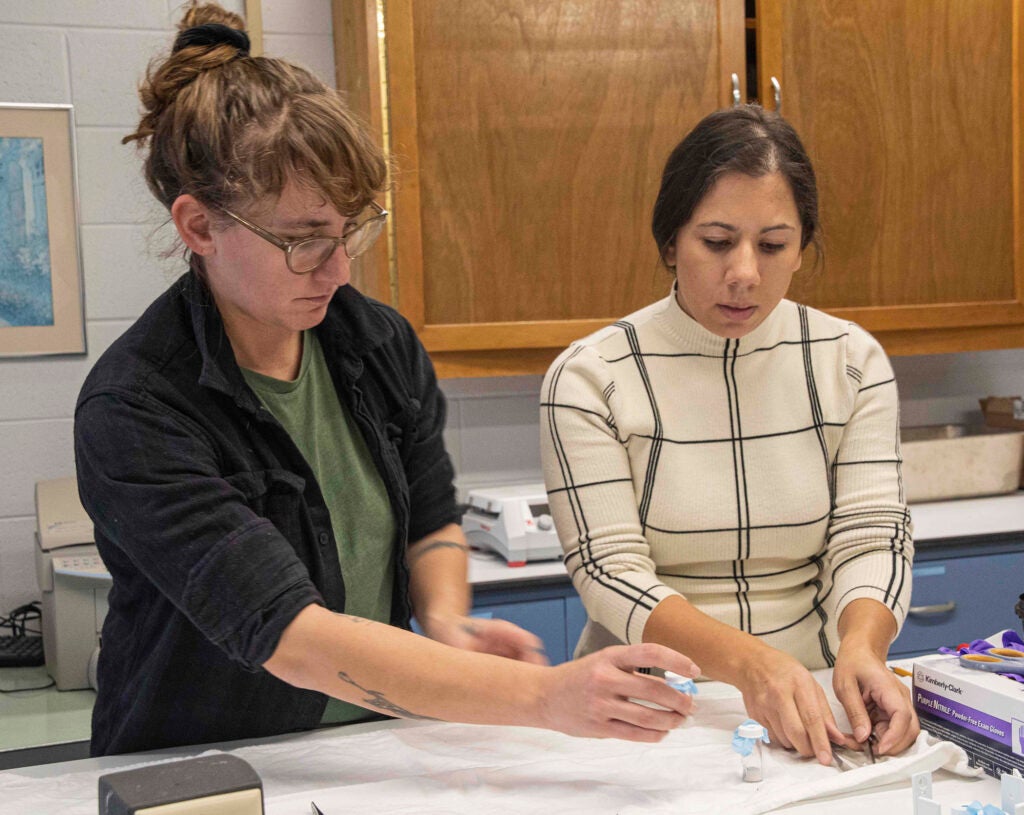
Couret (on the right) works with graduate student Samantha Schofield as they sort out tick samples. (URI photo/Nora Lewis)
Blacklegged ticks, also called deer ticks, carry seven known pathogens and are responsible for about 95% of the tick-borne diseases in the U.S., including about 30,000 cases of Lyme disease reported each year.
Deer ticks can acquire the bacteria that causes Lyme disease during any of its life stages – larvae, nymph or adult – during a blood meal from white-footed mice, the primary carriers of the Lyme disease bacterium.
(While the abundance of deer ticks is casually associated with deer, these hosts do not transmit Borrelia burgdorferi to ticks, and deer are not considered an important host for the maintenance of the bacteria in wildlife populations.)
Do ticks benefit from carrying infections?
But the bacteria doesn’t lead to Lyme disease in either the mice or the ticks. In pilot studies, Couret has seen changes in the ticks that acquire the bacteria – including behavior, metabolism, respiration, and survival. So there appears to be an advantage for those ticks, she said.
“That’s a shift in mindset,” said Couret, who joined URI in 2015 after earning her Ph.D. in the ecology of infectious diseases at Emory University.
“We mainly think of Borrelia burgdorferi as a pathogen because it causes Lyme disease in humans. We are studying the transmission cycle of the bacteria in nature between ticks and white-footed mice. It’s possible that it’s not acting as a pathogen, but rather as a beneficial symbiont of the tick, a partner. The bigger picture question is, if we view Borrelia burgdorferi with this lens, can we better understand its transmission dynamics?”
Environmental factors
In understanding the transmission cycle of Lyme disease, the researchers will explore the relationships of many influences on the bacteria in the tick, including environmental factors, such as temperature and humidity; ecological facets, such as the tick’s microbiome; and the bacteria’s interactions with other organisms in the tick.
“We’re studying the effects of the bacteria on ticks at different levels, from gene expression to behavior,’’ she said. “We’ll combine that information to look at the evolutionary fitness of ticks, and model the impacts of bacteria on annual tick populations. We also are considering the microbiome. We want a really comprehensive view of the ensemble of ecological interactions that influence ticks, Borrelia burgdorferi, and their partnership.”
For the study, Narasimhan, a molecular biologist, will look at gene expression to learn what is changing in the ticks that acquire the bacteria, along with what is changing in the bacteria.
Lord, a vector-borne disease modeler, will incorporate the experiment results in a model that can predict tick populations and rates of transmission of Borrelia burgdorferi.
Tsao, a tick ecologist, will study deer ticks in the Midwest, another hot spot of Lyme disease. Paralleling Couret’s work in Rhode Island, Tsao will study tick behavior and development in a semi-natural environment.
Tsao and Couret will also look at traits that may be affected by the presence of Borrelia burgdorferi, effects of environmental conditions, survival rates, and gene expression.
Learning ways to improve prevention
When it’s completed, the study will greatly expand our understanding of the factors driving the maintenance of Lyme disease in wildlife. Findings could eventually lead to ways to control the deer tick population or inform disease prevention measures, Couret said.
Also, by characterizing the role of the microbiome as it relates to tick-Borrelia interactions, the research could lead to novel methods of biological controls, such as finding competing bacteria within the tick that, when present, negatively impact Borrelia burgdorferi transmission.
A unique aspect of the grant is the heavy focus on providing comprehensive mentorship for trainees, centering the experiences of those who have been marginalized in science and supporting the team through professional development across all four institutions involved.
Called the Microbiome Integrated Tick Ecology Network – or MITEY Network, as in mites – the mentoring will send trainees to each partner university to sharpen science skills, promote sustainable and productive writing practices and science communication, support a growth mindset, and reduce imposter syndrome.
“We want to make sure it’s an inclusive research culture and environment for our trainees,” Couret said.
Unfortunately the wrong things are emphasized in this article. I don’t give a jot what gender, color, or beliefs researchers have and nobody else should either. What we desperately need are good, unbiased, well designed research studies that help patients by giving real answers to real problems. And true to form, this study, once again, while lining the pockets of researchers, most probably won’t help patients. I realize I’ve grown quite skeptical, but we need accurate tests, treatments, and transmission studies. Period.
We need mainstream medicine and public health to accept the fact this is a relapsing illness that persists and sequesters inside the body.
Until these foundational, fundamental issues are addressed and resolved, everything else is moot.
Quite a bit of research has already been done on this subject with regard to Ixodes ricinus – the European vector of Lyme and a species that is very closely related to the east coast U.S. tick Ixodes scapularis – the black-legged tick.
Important excerpts, showing this is not a new idea:
Survival rate of nymphal and adult I. ricinus was significantly enhanced by infection by B. burgdorferi s.l. (χ2: nymph, P = 0.008; adult, P = 0.021).
Moreover, ticks infected by B. afzelii survived better than other ticks (infected by other genospecies or not). The results here indicate that infection by B. burgdorferi s.l., and more specifically infection by B. afzelii, confers survival advantages to I. ricinus under challenging thermohygrometric conditions.
Important excerpt showing that Bb also relies upon the tick for survival:
The spirochaete relies heavily on its arthropod host for basic metabolic functions and has developed complex interactions with ticks to successfully colonize, persist and, at the optimal time, exit the tick. For example, proteins shield spirochaetes from immune factors in the bloodmeal and facilitate the transition between vertebrate and arthropod environments.
So we already know that the relationship between ticks and pathogens is beneficially symbiotic.
For the love of God, can we please move on to accurate testing, effective treatments, and transmission studies?
Molecular Detection of Anaplasma phagocytophilum, Babesia odocoilei, Babesia species and Borrelia burgdorferi Sensu Lato in Songbirds
John D Scott1 *, Elena McGoey2, Ana Morales3 and Risa R Pesapane2,4 1 Upper Grand Tick Centre, 365 St. David Street South, Fergus, Ontario, N1M 2L7, Canada 2 School of Environmental and Natural Resources, College of Food, Agricultural, and Environmental Sciences, The Ohio State University, Columbus, OH 43210, USA 3 McGill Bird Observatory, Ste Anne de Bellevue, QC, Canada H9X 0A6 4 Department of Veterinary Preventive Medicine, College of Veterinary Medicine, The Ohio State University, 1920 Coffey Rd., Columbus, OH 43210, USA
Abstract
The blacklegged tick, Ixodes scapularis, is known to carry various tick-borne zoonotic pathogens with the potential to cause debilitating human and animal diseases. Juvenile I. scapularis parasitize songbirds and, perhaps, these avifauna are competent hosts of common microbial pathogens. We extracted brachial venous blood from 18 groundforaging passerine birds that were parasitized by I. scapularis larvae and nymphs. Using molecular identification, namely PCR, DNA sequencing, and Basic Local Alignment Search Tool (BLAST), we targeted Anaplasma phagocytophilum, Babesia spp. and Borrelia burgdorferi sensu lato. Overall,
15 (83%) of 18 passerine birds were positive for 3 microbial zoonotic pathogens that comprised of A. phagocytophilum (n = 8), Babesia odocoilei (n = 6), Babesia spp. 20-5A74 (n = 1), and B. burgdorferi sensu lato (n = 9).
The pathogen load consisted of 8 singles, 5 doubles, and 2 triples.
One novel Babesia sp. (Babesia spp. 20-5A74) was found, and the remaining Babesia infections were B. odocoilei.
Our findings reveal that ground-foraging, passerine birds are avian hosts of zoonotic pathogens. We provide the first-ever documentation that songbirds are hosts of B. odocoilei. Based on our data, B. odocoilei outnumbered other Babesia spp., and elucidated the authentic fact that B. odocoilei is the predominant Babesia sp. in North America. As avian hosts, passerine birds play a significant role in the enzootic transmission cycle of B. burgdorferi sensu lato, A. phagocytophilum, and Babesia species.
Important excerpts:
In the USA, tick researchers have reported B. odocoilei in Indiana [41-43], Michigan [44] Maine [42,43], Massachusetts [41-43], New York [45], Oklahoma [46,47], Pennsylvania [48,49] Texas [50,51], Virginia [52], and Wisconsin [42,43]. As well, B. odocoilei has been detected in I. pacificus in California [53]. In Canada, B. odocoilei has been detected in Saskatchewan [54], Ontario [7,15,55-59], and Quebec [55,57,58]. And yet, acarologists and ecologists have not reported B. microti in these three provinces [7,15,21,55-59]. Babesia odocoilei, which is a sequestering Babesia sp., can be recalcitrant to treat in human patients [7].
Not only do groundfrequenting songbirds transport ticks, they may also be hosts for tick-borne, zoonotic pathogens. Migratory songbirds widely disperse zoonotic pathogens across North America and, therefore, one does not have to frequent or live in an endemic area to contract human babesiosis caused by B. odocoilei.
https://madisonarealymesupportgroup.com/2021/05/28/study-shows-babesia-odocoilei-is-pathogenic-to-humans/ Study found B. odocoilei in two of 19 participants. DNA amplicons from these two patients are almost identical matches with the type strains of B. odocoilei in GenBank. In addition, the same two human subjects had the hallmark symptoms of human babesiosis, including night sweats, chills, fevers, and profound fatigue. Based on symptoms and molecular identification, we provide substantive evidence that B. odocoilei is pathogenic to humans. Dataset reveals that B. odocoilei serologically cross-reacts with Babesia duncani.
https://www.ncbi.nlm.nih.gov/pmc/articles/PMC3998201/InAustria and Italy patients experienced a severe illness caused by EU1, a species closely related to B. odocoilei. InTaiwan it was (TW1) and in Korea (KO1). Human babesiosis is now reported from around the world. The study in this link states that reported human cases of babesiosis have been attributed, without strong molecular evidence to B. divergans: https://www.ncbi.nlm.nih.gov/pmc/articles/PMC3020600/
Study shows expanding tick populations in Colorado
A new study published in the peer-reviewed journal Ticks and Tick-borne Diseases shows that ticks capable of carrying diseases pose an emerging threat in Colorado.
The results demonstrate that American dog ticks are present in 16 Colorado counties where they had not been previously identified by the CDC.
Furthermore, Rocky Mountain wood ticks are found in 38 of the 64 Colorado counties, whereas they had only been identified in 33 previously.
The study leveraged several sources for the study, including ticks collected by citizen scientists as part of a free tick testing program offered by the Bay Area Lyme Foundation.
“The critical takeaway from this study is that Coloradans need to take preventative measures against ticks when outdoors, such as tick checks, and doctors should be more vigilant for symptoms of tick-borne diseases including those carried by Rocky Mountain wood ticks and American dog ticks,” said Linda Giampa, executive director, Bay Area Lyme Foundation.
Citizen science
“This ecology study illustrates the power of leveraging citizen science, and we are grateful for the more than 20,000 ticks that were submitted to our national program and made this study possible.”
Conducted by researchers from Colorado State University and funded by the Bay Area Lyme Foundation, the study aimed to quantify the current county-level distribution of Rocky Mountain wood ticks, Dermacentor andersoni, and American dog ticks, Dermacentor variabilis.
The study evaluated data from ticks collected by citizen scientists and evaluated at Northern Arizona University as part of Bay Area Lyme Foundation’s Free Tick Testing program, distribution data from the Colorado Department of Public Health and the Environment, veterinary surveillance at Oklahoma State University, and literature data.
“It was interesting to us to see American dog ticks in unexpected counties in Colorado which appear to be invading from nearby states or traveling with people and pets. And also to show that Rocky Mountain wood ticks appear, for the most part, to inhabit counties at higher elevations than American dog ticks,” said co-author Daniel Salkeld, PhD, Colorado State University.
A red flag
“This study is a red flag that, on the county-level, it is necessary to increase tick surveillance locally, and, on an individual level, to take precautions and know the symptoms of tick-borne diseases.”
Rocky Mountain wood ticks and American dog ticks are both known carriers of Rickettsia rickettsii, which causes Rocky Mountain spotted fever, a disease that is on the rise in the US. They also carry Francisella tularensis which causestularemia, a potentially life-threatening disease that has seen a spike in incidence in recent data.
According to this study, both species of tick were found on humans and dogs. Rocky Mountain wood ticks appear to be more attracted to humans, with this tick representing 58% of ticks attached to humans, compared to the American dog tick, which represented 92% of ticks attached to dogs.
“The citizen science approach has been critical to supporting our efforts as widespread active surveillance programs in Colorado have had difficulty due to the state’s diverse terrain and no Colorado counties regularly conduct these,” said lead author Elizabeth Freeman, MPH, Colorado State University.
More surveillance needed
“With the knowledge that there is a risk of encountering both the Rocky Mountain wood tick and American dog tick in Colorado, there should be more motivation to further enhance surveillance studies to fully understand the public’s risk of disease.”
Citizen scientists collected and provided the ticks evaluated in the study as part of Bay Area Lyme Foundation’s Free Tick Testing program, which collected more than 20,400 ticks, of which 8,954 are Ixodes ticks capable of carrying the most common tick-borne pathogens.
Some of the new county reports are likely due to travel-associated exposures (e.g., Montana), but many counties, such as those in Colorado, are in close proximity to previously known locations, illustrating either spreading range of ticks or the need for expanded on-the-ground surveillance.
The research was conducted through a partnership between Bay Area Lyme Foundation, Northern Arizona University, Colorado State University and the Translational Genomics Research Institute (TGen).
Interactive mapsshow the distribution by county of the tick species collected, including western blacklegged tick, blacklegged tick, American dog tick, lone star tick. Prevalence of Rocky Mountain wood ticks in this study were not previously evaluated and reported.
Ticks sent to the initiative from January 2016 through August 2019 were tested free of charge. These data were categorized, mapped, and recorded, as well as provided to the submitter. Ticks were submitted from every state except Alaska. The program received a six-fold increase in tick submissions over initial estimates, representing unprecedented national coordination of a ‘citizen science’ effort and diagnostic investigation.
I am ever grateful they did not blame the climate. Independent research has shown the climate is a nothing burger when it comes to tick and disease proliferation despite the continued narrative by corrupt science,politics, and climate alarmists.
Dr. Henry Lindner got involved with tick-borne illness after removing two ticks from his 10 year old daughter. After a delayed diagnosis and under prescribed prophylactic treatment, his daughter now suffers with a chronic infection that has physically and mentally disabled her.