Archive for the ‘Ticks’ Category

Kentucky: More Than Two Dozen Rocky Mountain Spotted Fever Cases Reported in Grayson County

http://outbreaknewstoday.com/kentucky-more-than-two-dozen-rocky-mountain-spotted-fever-cases-reported-in-grayson-county-89113/

Kentucky: More than two dozen Rocky Mountain spotted fever cases reported in Grayson County

July 22, 2019

By NewsDesk  @infectiousdiseasenews

Health officials in Grayson County, Kentucky are reporting a recent increase in cases of the tickborne disease, Rocky Mountain spotted fever (RMSF).
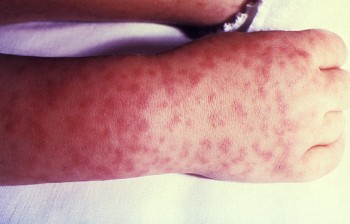
Characteristic spotted rash of Rocky Mountain spotted fever/CDC


They report receiving 26 cases of RMSF since July 7, 2019.

Dr. Bryce Meredith made the following statement, “We are seeing an increase in tick-borne illnesses in Grayson and the surrounding counties. Individuals should have heightened awareness regarding ticks in our area. The most common illnesses are Ehrlichiosis and Rocky Mountain Spotted Fever.”

RMSF is a tick borne disease caused by the organism, Rickettsia rickettsii. Typically, the progress of the disease is a sudden onset of high fever, deep muscle pain, severe headache and chills. A rash usually appears on the extremities within 5 days then soon spreads to palms and soles and then rapidly to the trunk.

Fatalities can be seen in greater than 20% of untreated cases. Death is uncommon with prompt recognition and treatment. Still approximately 3-5% of cases seen in the U.S. are fatal. The absence or delayed appearance of the typical rash or the failure to recognize it, especially in dark-skinned people cause a delay in diagnosis and increased fatalities.

Early stages of RMSF can be confused with erlichiosis, meningococcal meningitis and enteroviral infection.

They are asking residents to ensure they are protecting their family, pets, and yourselves properly while outdoors.

If you find a tick, please remove it appropriately. Also, if you feel fatigued (tired) or having a headache that will not go away, consider seeing your family healthcare provider for tick borne illness testing.

Dr Meredith said, “Ticks are commonly in woods, grassy, or bushy areas. If individuals are planning on being in these areas, they should plan accordingly and wear long sleeves, long pants tucked into your socks, and use an EPA approved insect and tick repellent. Once an individual has returned inside, they should check their clothes and body for ticks. Early awareness and early tick removal is particularly important. Typically, if an individual removes a tick within 24-48 hours, this decreases the rate of disease transmission. I encourage individuals to contact their physician if a tick has been attached for an undetermined time or if they develop fever, rash, chills, or vague symptoms such as new onset unexplained dizziness or excessive fatigue.”

RMSF & the importance of timely treatment: Outbreak News Interviews
DO NOT WAIT FOR LABORATORY CONFIRMATION FOR TREATMENT IF RMSF IS SUSPECTED. This is deadly.
Do not hesitate to use doxycycline in children. New research demonstrates it will NOT hurt children’s teeth.

_________________

For more: https://madisonarealymesupportgroup.com/2018/09/14/rocky-mountain-spotted-fever-rmsf/

https://madisonarealymesupportgroup.com/2017/10/21/mom-got-rocky-mountain-spotted-fever-while-picking-pumpkins/

https://madisonarealymesupportgroup.com/2015/08/13/severe-case-of-rmsf-had-to-remove-patients-arms-and-legs/

https://madisonarealymesupportgroup.com/2018/08/16/new-tick-causes-epidemic-of-rmsf/

https://madisonarealymesupportgroup.com/2018/06/12/georgia-mom-warns-others-after-son-contracts-rocky-mountain-spotted-fever-after-tick-bite/

https://madisonarealymesupportgroup.com/2018/08/19/monster-ticks-found-in-germany-threaten-europe-with-deadly-disease-crimean-congo-fever/  Please note the last quote of the story – that they proved a tropical form of tick typhus in one of tropical ticks found in Germany. Typhus, a bacteria, is making a comeback, particularly in the South. Common in the U.S. in the 40’s, and normally attributed to lice, now it’s been proven to be in a tick. In other words, another disease and a tick found where they supposedly shouldn’t be.
Typus is a rickettsial infection with ticks carring numerous species including rickettsia, ehrlichia, and anaplasma. Rocky Mountain Spotted Fever is also considered a tick-borne typhus fever.  

https://www.health.ny.gov/diseases/communicable/rocky_mountain_spotted_fever/fact_sheet.htm Divided into the typhus group and the spotted fever group, disease is transmitted through ectoparasites (fleas, lice, mites, and ticks). Inhalation and inoculating conjunctiva with infectious material can also cause disease. The good news for most is that doxycycline is a front-line drug for it. Broad-spectrum antibiotics aren’t helpful.

https://madisonarealymesupportgroup.com/2019/05/22/cdc-creates-interactive-training-for-diagnosis-management-of-rocky-mountain-spotted-fever/

https://madisonarealymesupportgroup.com/2018/10/21/all-his-symptoms-pointed-toward-the-flu-but-the-test-was-negative-rmsf-in-connecticut/

AGAIN, TESTING IS ABYSMAL.  DOCTORS NEED EDUCATION.

If interested:  https://madisonarealymesupportgroup.com/2018/02/19/calling-all-doctors-please-become-educated-regarding-tick-borne-illness-heres-how/

https://madisonarealymesupportgroup.com/2018/06/06/lyme-education-for-healthcare-professionals/

https://madisonarealymesupportgroup.com/2019/03/15/global-lyme-alliance-announces-new-partnership-with-delaware-lyme-board-to-help-educate-physicians-about-lyme-disease/


Lyme Disease Expert Champions Investigation into Pentagon Weaponizing Ticks: ‘It’s a Courageous Move’

https://www.foxnews.com/media/fox-friends-lyme-disease-weaponization?

Lyme disease expert champions investigation into Pentagon weaponizing ticks: ‘It’s a courageous move’

Kris Newby, author of “Bitten: The Secret History of Lyme Disease and Biological Weapons,” discussed how ticks can be weaponized during an interview with “Fox & Friends Sunday” and supported an investigation into whether or not the Pentagon attempted this feat during the Cold War.

She was responding to a call from House lawmakers for an investigation into the Pentagon to find out if it contributed to the outbreak of Lyme disease that’s currently ravaging the country.

“I think it’s a courageous move and I’m really excited about it because a lot of those Cold War experiments … right out of Dr. Strangelove, are classified,” she said.

Newby, who works as a science writer for the Stanford University School of Medicine, said much of the government’s information on the subject is being kept hidden, but expressed optimism about getting to the truth now that Congress is involved.

HOUSE ORDERS PENTAGON TO REVEAL WHETHER IT TURNED TICKS INTO BIOLOGICAL WEAPONS

Rep. Chris Smith, R-N.J., is leading the charge and claimed, “bioweapons specialists stuffed ticks with pathogens to cause severe stability, disease, even death to potential enemies.”

“When I wrote the book I researched it for five years, and a lot of documents I can’t get to, but with his congressional power, he can do it, and shed some light on this crazy set of tick-borne diseases that appeared around Long Island Sound in the late ’60s,” Newby said.

Host Pete Hegseth asked if the government’s release of ticks into the public was intentional or accidental, and she said it’s difficult to know for sure.

“Well, Willie Burgdorfer, who is the discoverer of the Lyme disease bacteria, he didn’t give away all the details but he implied it wasn’t the bacterium … but it was another organism that was genetically modified for warfare,” Newby replied.

“It’s not 100 percent clear, but Willie did say, ‘accidents happen.’ There was a lot of trials and pilot programs to try and get the perfect combination of ticks and diseases in them. There was open-air tests. I mean, I found one test on the Virginia coastline where they released over 100,000 Lone Star ticks. They’re the really aggressive ticks that caused that meat allergy.”

The Centers for Disease Control and Prevention has come out publicly and said Lyme disease and other tick-borne related illnesses are on the rise and called for “urgently needed” tangible “tools” to fight the growing epidemic.

The CDC has also identified seven new tick-borne germs found in the United States and claimed there’s now a record number of official tick-borne illnesses. The numbers have increased from a total of 48,610 reported cases in 2016 to a total of 59,349 reported cases in 2017.

The agency didn’t reference the Pentagon’s alleged experiments in their explanation and said the cause of the spike is still “unclear,” claiming “a number of factors” could contribute to such an anomaly.

“The spread of Lyme disease over the past several decades has been linked to changes in land-use patterns, including reforestation in the northeastern United States. Suburban development in these areas has increased the spread of these germs because people, ticks, deer, and tick hosts such as mice and chipmunks are in close contact,” their website reads.

“Changing climate patterns can alter the natural environment and longstanding ecological relationships. Since vector-borne diseases have strong environmental links, we expect that changes in seasonality and location may occur.  We don’t know what those changes will be, but we know that climate is only one of several very important factors that influence the distribution and occurrence of vector-borne diseases.”

________________

**Comment**

Notice the CDC wants to do the old bait and switch. Divert all attention away from any tweaking of ticks in a lab making them more pathogenic by blaming the climate.

The climate has nothing to do with ticks being spread by birds, reptiles, and mammals worldwide.

https://madisonarealymesupportgroup.com/2018/08/13/study-shows-lyme-not-propelled-by-climate-change/

https://madisonarealymesupportgroup.com/2018/08/13/study-shows-lyme-not-propelled-by-climate-change/

https://madisonarealymesupportgroup.com/2019/06/17/ontario-public-health-officials-called-out-on-shoddy-biased-research-utilizing-an-erroneous-climate-change-model-to-program-a-futuristic-tick-problem/

https://madisonarealymesupportgroup.com/2018/11/17/uw-madison-phd-in-ecological-climatology-climate-change-computer-models-fudged-except-russian-model/  Dr. Patrick Michaels, director of the Center for the Study of Science at the Cato Institute, provides insight into the debate over climate change and the political games played to create policy.

Political games surrounding Lyme/MSIDS have gone on long enough. Do research on important issues that will help patients.

For more on the bioweaponization issue:   https://madisonarealymesupportgroup.com/2019/07/19/biological-warfare-experiment-on-american-citizens-results-in-spreading-pandemic/

https://madisonarealymesupportgroup.com/2019/07/21/got-15-minutes-the-officially-ignored-link-between-lyme-plum-island/

https://madisonarealymesupportgroup.com/2019/05/01/interview-with-kris-newby-bitten-the-secret-history-of-lyme-disease-biological-weapons/

Did Pentagon Turn Ticks into Bioweapons That Spread Lyme Disease? N.J. Congressman Wants Answers

Did Pentagon turn ticks into bioweapons that spread Lyme Disease? N.J. congressman wants answers.

Rep. Chris Smith speaks in Middletown at a 9/11 memorial ceremony. ( Tom Haydon | NJ Advance Media for NJ.com)

Tom Haydon | NJ Advance Media

Rep. Chris Smith speaks in Middletown at a 9/11 memorial ceremony. ( Tom Haydon | NJ Advance Media for NJ.com)

WASHINGTON

It sounds like the plot for a science fiction movie: A government agency decides to use ticks and other insects to spread disease and kill its enemies, only the ticks got out and infected the country’s residents itself.

New Jersey Rep. Chris Smith says that may not be too far-fetched.

He’s won approval from the House to have the Defense Department’s inspector general investigate whether the Pentagon actually looked at using ticks stuffed with pathogens as bioweapons during the height of the Cold War beginning in the 1950s.

He said several books and articles pinned the blame on the Pentagon, and perhaps some of the ticks and insects got out and helped to spread illnesses, most notably Lyme disease.

“If this isn’t true, let’s put it to rest,” said Smith, R-4th Dist. “For the sake of public health we should demand these answers.”

The provision is part of the National Defense Authorization Act, which sets defense policy for the 12 months beginning Oct. 1. That’s the same bill that includes Pentagon projects at Joint Base McGuire-Dix-Lakehurst and the Picatinny Arsenal, as well as prevents President Donald Trump from launching an attack on Iran without first receiving congressional approval.

House Democrats allowed Smith to bring up an amendment to begin the study, and then joined with Republicans in unanimously adding it to the legislation.

“With Lyme disease and other tick-borne diseases exploding in the United States — with an estimated 300,000 to 437,000 new cases diagnosed each year and 10-20 percent of all patients suffering from chronic Lyme disease — Americans have a right to know whether any of this is true,” Smith said. “And have these experiments caused Lyme disease and other tick-borne disease to mutate and to spread?”

Since a similar provision is not in the Senate version of the bill, it will be up to congressional negotiators to make sure it makes the final defense legislation. Smith said he’s talking to Senate leaders to gain their ascent.

The Lyme Disease Association is pushing senators to agree to the study.

“We know that the government was doing other kinds of experiments during that time,” said Pat Smith, president of the Jackson, N.J.-based group. “Absolutely it needs to be looked at. The public needs to know if this has occurred.”

And if it turns to be true?

“Maybe there is something in the research that would lead to helping patients get better or constrain the spread of ticks across the country,” Smith said.

Human Seroprevalence of Tick-Borne Anaplasma, Lyme, and Rickettsia Species in Northern California

https://www.ncbi.nlm.nih.gov/pubmed/31295054/

2019 Jul 11. doi: 10.1089/vbz.2019.2489. [Epub ahead of print]

Human Seroprevalence of Tick-Borne Anaplasma phagocytophilum, Borrelia burgdorferi, and Rickettsia Species in Northern California.

Abstract

There is a paucity of data on human exposure to tick-borne pathogens in the western United States. This study reports prevalence of antibodies against three clinically important tick-borne pathogens (Borrelia burgdorferi, Anaplasma phagocytophilum, and Rickettsia spp.) among 249 people in five counties in northern California. Individuals from Humboldt County were recruited and answered a questionnaire to assess risk of exposure to tick-borne pathogens. Samples from other counties were obtained from a blood bank and were anonymized. Seventeen (6.8%) samples were seropositive for antibodies against at least one pathogen: five for A. phagocytophilum, eight for B. burgdorferi, and four for Rickettsia spp. Women and people aged 26-35 had higher seroprevalence compared to other demographic groups. Santa Cruz County had no seropositive individuals, northern Central Valley counties had three seropositive individuals (all against A. phagocytophilum), and Humboldt County had 14 (all three pathogens), a significant, four-fold elevated risk of exposure. The Humboldt County questionnaire revealed that a bird feeder in the yard was statistically associated with exposure to ticks, and lifetime number of tick bites was associated with increasing age, time watching wildlife, and time hiking. Three-quarters of respondents were concerned about tick-associated disease, 81.0% reported experiencing tick bites, and 39.0% of those bitten reported a tick-borne disease symptom, including skin lesions (76.4%), muscle aches (49.1%), joint pain (25.5%), or fever (23.6%).

Despite high levels of concern, many individuals who had been bitten by a tick were not tested for a tick-borne pathogen, including those with consistent symptoms.

We highlight the need for further research and dissemination of information to residents and physicians in Northern California regarding tick-associated disease, so that appropriate medical attention can be rapidly sought and administered.

________________

**Comment**

Again, the numbers are going to be much higher as they used the abysmal serology testing which tests for antibodies – not the organisms.

More on California:  https://madisonarealymesupportgroup.com/2018/05/24/lyme-in-california-what-you-need-to-know/

https://madisonarealymesupportgroup.com/2018/05/19/infected-ticks-in-california-its-complicated/

https://madisonarealymesupportgroup.com/2017/08/07/california-lyme-cases-get-no-respect/

https://madisonarealymesupportgroup.com/2018/06/23/say-what-california-fifth-in-nation-for-lyme-insurance-claims/

https://madisonarealymesupportgroup.com/2018/02/02/miyamotoi-in-ixodes-pacificus-in-california/

https://madisonarealymesupportgroup.com/2018/02/15/b-miyamotoi-in-ca-ticks-for-a-long-time/

https://madisonarealymesupportgroup.com/2018/02/14/borrelia-miyamotoi-in-ca-serodiagnosis-is-complicated-by-multiple-endemic-borrelia-species/

https://madisonarealymesupportgroup.com/2017/10/09/bb-in-california-chipmunk-and-squirrels/

https://madisonarealymesupportgroup.com/2019/05/26/educating-california-about-lyme-disease/

Folate Pathway Modulation in Brown Dog Tick in Response to Infection

https://www.ncbi.nlm.nih.gov/pubmed/31231926

2019 Jun 24. doi: 10.1111/tbed.13231. [Epub ahead of print]

Folate pathway modulation in Rhipicephalus ticks in response to infection.

Abstract

Folate pathways components were demonstrated to be present in RNA-sequencing data obtained from uninfected and pathogen-infected Rhipicephalus ticks. Here, PCR and qPCR allowed the identification of folate-related genes in Rhipicephalus spp. ticks and in the tick cell line IDE8. Genes coding for GTP cyclohydrolase I (gch-I), thymidylate synthase (ts) and 6-pyrovoyltetrahydropterin (ptps) were identified. Differential gene expression was evaluated by qPCR between uninfected and infected samples of four biological systems, showing significant upregulation and largest fold-change for the gch-I gene in the majority of the biological systems, supporting the selection for functional analysis by RNAi silencing. Efficient knockdown of the gch-I gene in uninfected and Ehrlichia canis-infected IDE8 cells showed no detectable impact on the capacity of the bacteria to invade or replicate in the tick cells. Overall, this work demonstrated an increase in the expression of some folate-related genes, though not always statistically significantly, in the presence of infection, suggesting gene expression modulation of these pathways, either as a tick response to an invader or manipulation of the tick cell machinery by the pathogens to their advantage. This discovery points to folate pathways as interesting targets for further studies.