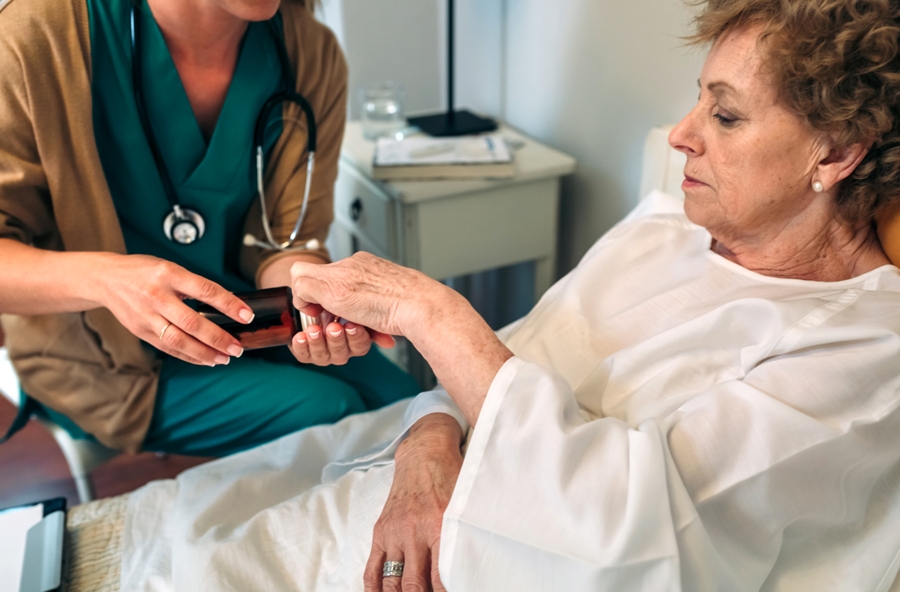
The number of Babesia cases among the elderly in the U.S. appears to be growing. According to a study by Menis and colleagues, published in the journal Open Forum Infectious Diseases, 19,469 Medicare beneficiaries had a Babesia diagnosis recorded between 2006 – 2017, with the highest rates occurring in babesiosis-endemic states. [1]
Overall, the number of individuals contracting Babesia is rising, as well. The annual number of cases per year climbed from 4 per 100,000 to 9 per 100,000 in the U.S. between 2006 and 2017. The annual number of cases of Babesia per year for individuals over the age of 85 was 4 out of 100,000. In comparison, the number of Lyme disease cases among the elderly was 15.98 per 100,000.
Most of the cases of Babesia occurred in the Lyme-endemic states of Massachusetts, Rhode Island, Connecticut, New York, and New Jersey, according to the authors. Other states recording Babesia cases included Florida, Pennsylvania, California, Maryland, and Virginia. Some cases of Babesia were also reported in New Hampshire, Maine, Vermont, Minnesota, Wisconsin, Texas, North Carolina, and Illinois.
The most common test used to diagnose Babesia was a blood smear in the institutional setting, wrote Menis in a related paper. [2] The intracellular parasite in the red blood cell clears after a few days. The most common tests used in a physician’s office involved antibody or PCR testing. [2]
Co-infections can be deadly
A Babesia infection can be serious for patients.
“Patients co-infected with Lyme disease experienced more symptoms and a more persistent episode of illness than did those (n=10) experiencing babesial infection alone,” wrote Krause and colleagues [3]. In another paper, the authors explain, “Immunocompromised people who are infected by B. microti are at risk of persistent relapsing illness.” [4]
For some patients, including the elderly, a Babesia infection can be more serious. “Babesiosis can be life threatening, particularly for persons who are asplenic, immunocompromised, or elderly,” wrote Krause et al. [4]
85-year-old dies from Babesia and Ehrlichia
Javed and colleagues describe the case of an 85-year-old man who died of a concurrent Babesiosis and Ehrlichiosis infection. [5]
He was an avid gardener and golfer in good health except for hypertension. He did not have a tick bite or rash. The man was hospitalized with weakness and jaundice. He had mild anemia, a very low platelet count, a mildly elevated bilirubin, and mildly reduced renal function.
The doctors diagnosed Babesia based on a bone marrow biopsy revealing intraerythrocytic inclusions (tetrads), typical of babesiosis. In retrospective, his admitting bloods from admission revealed parasitemia in 8% of the red blood cells. The Babesia antibody IgM and IgG were positive for Babesia.
READ MORE: Elderly Lyme disease patients more likely to have unfavorable treatment outcomes
The elderly man was treated with IV clindamycin and IV quinine. His anemia worsened despite transfusion of two units of blood and he was transferred to a tertiary hospital for possible exchange transfusion. The doctor added azithromycin but not Atovaquone.
His condition worsened. His oxygen saturation dropped to 84% and he subsequently developed bilateral pneumonia, renal failure, hepatic failure, and a coma. He was too ill to tolerate exchange transfusion.
He died within 60 hours of admission to the tertiary care center.
Post-mortem tests were positive for Human Monocytic Ehrlichiosis, the cause of Ehrlichia. He was never treated with doxycycline, the most commonly prescribed medication for Ehrlichia.
Treatment of Babesia
Krause and colleagues reported that a 10-day course of Mepron and Zithromax would be as effective as clindamycin and quinine and have less side effects. [3] The Medicare beneficiaries were far more likely to be prescribed Mepron with Zithromax than clindamycin and quinine. [1]
Some patients with Babesia require longer treatment. Krause and colleagues reported immunocompromised and elderly patients were more likely to need longer term therapy.” [4]
In another paper, the authors point out that,
“Such patients generally require antibabesial treatment for >or=6 weeks to achieve cure, including 2 weeks after parasites are no longer detected on blood smear.” [4]
More than one-third of elderly Babesia patients were not treated with anti-Babesia treatment during their evaluation. The study was not designed to determine if the elderly were subsequently treated.
IDSA position
The 2020 Infectious Diseases Society of America (IDSA) guidelines for Babesia highlighted concerns regarding severe Babesia in the elderly.
“Numerous immunodeficiencies and comorbidities have been associated with severe babesiosis, including asplenia and hyposplenism, cancer, congestive heart failure, HIV infection, immunosuppressive drugs, and advanced age.” [6]
For immunocompromised patients, we suggest monitoring Babesia parasitemia using peripheral blood smears even after they become asymptomatic and until blood smears are negative. PCR testing should be considered if blood smears have become negative but symptoms persist (weak recommendation, moderate-quality evidence).
In addition, the IDSA guidelines advised longer treatment for immunocompromised Babesia patients.
“A subgroup of highly immunocompromised patients reported in a case control study required at least 6 consecutive weeks of antibiotic therapy, including 2 final weeks during which parasites were no longer detected on peripheral blood smear.” [6]
However, some patients can relapse.
“A few cases of relapse despite at least 6 consecutive weeks of atovaquone plus azithromycin demonstrate that resistance to atovaquone and/or azithromycin can emerge in highly immunocompromised patients during an extended course of this antibiotic combination,” wrote Krause et al. [6]
Editor’s note: I share the same concerns regarding Babesia in the elderly, and I base the length of antibiotics on the patient’s response to treatment.
References:
- Menis M, Whitaker BI, Wernecke M, et al. Babesiosis Occurrence among the U.S. Medicare Beneficiaries Ages 65 and Older, During 2006-2017: Overall, and by State and County of Residence. Open Forum Infectious Diseases. 2020
- Menis M, Forshee RA, Kumar S, McKean S, Warnock R, Izurieta HS, Gondalia R, Johnson C, Mintz PD, Walderhaug MO, Worrall CM, Kelman JA, Anderson SA. Babesiosis Occurrence among the Elderly in the United States, as Recorded in Large Medicare Databases during 2006-2013. PLoS One. 2015 Oct 15;10(10)
- Krause PJ, Telford SR, 3rd, Spielman A, et al. Concurrent Lyme disease and babesiosis. Evidence for increased severity and duration of illness. JAMA. Jun 5 1996;275(21):1657-60.
- Krause PJ, Gewurz BE, Hill D, et al. Persistent and relapsing babesiosis in immunocompromised patients. Clin Infect Dis. Feb 1 2008;46(3):370-6. doi:10.1086/525852
- Javed MZ, Srivastava M, Zhang S, Kandathil M. Concurrent babesiosis and ehrlichiosis in an elderly host. Mayo Clin Proc. May 2001;76(5):563-5. doi:10.4065/76.5.563
- Krause PJ, Auwaerter PG, Bannuru RR, et al. Clinical Practice Guidelines by the Infectious Diseases Society of America (IDSA): 2020 Guideline on Diagnosis and Management of Babesiosis. Clin Infect Dis. Nov 30 2020;doi:10.1093/cid/ciaa1216
_____________________
For more: https://madisonarealymesupportgroup.com/2016/01/16/babesia-treatment/
Mainstream medicine still does not believe the seriousness of this complex illness that thousands upon thousands are suffering from. The interaction of confections make cases extremely difficult to treat. Do not mess around with this, get to a Lyme literate doctor asap: https://madisonarealymesupportgroup.com/2020/11/25/what-makes-a-doctor-lyme-literate/ These doctors typically layer treatment to reduce any potential of resistance to treatment. We often took 4 things simultaneously.



 Madison Area Lyme Support Group
Rapid Response:
Re: Tick bite
Dear Editor
Razai et al, in their consultation on tick bite, missed an important message to learners (1).
The most common infectious agents transmitted by Ixodes species ticks in North America that have the potential for co-infection with B burgdorferi are Anaplasma phagocytophilum, Babesia species, deer tick (Powassan) virus, Borrelia miyamotoi, and the Ehrlichia muris–like agent (2).
A phagocytophilum is transmitted by the same Ixodes ticks as B burgdorferi in the United States and causes fever, chills, headache, myalgia, and fatigue arising 1 to 3 weeks following tick exposure. Most cases are mild and self-limited. However, severe manifestations may include respiratory failure, adult respiratory distress syndrome, peripheral neuropathy, rhabdomyolysis, acute renal failure, pancreatitis, and coagulopathies.
It has been found that in Wisconsin, approximately 3% of I scapularis ticks examined were co-infected with B burgdorferi and A phagocytophilum (3). A similar study in 11,000 ticks in public parks of New York State’s Hudson Valley Region found that co-infection rates of nymphs and adults were 0.5% and 6.3%, respectively (4).
The frequency of humans with Lyme disease simultaneously co-infected with A phagocytophilum from various studies ranges from 2% to 10% (5,6). Similirly, Babesiosis is transmitted through the bite of infected I scapularis and I pacificus ticks. Most patients are asymptomatic or have mild, self-limited disease but may be complicated by renal failure, acute respiratory distress, and shock.
In a study of patients with Lyme disease from southern New England, approximately 10% were co-infected with babesiosis (7).
Unlike Lyme disease and Anaplasmosis, doxycycline is not an effective treatment of babesiosis and requires atovaquone and azithromycin or combination of clindamycin with quinine, making it imperitive to consider this diagnosis in mind in patients with tick bite.
Of the 3 species of Ehrlichia in United States, only E muris–like (EML) agent is transmitted by I scapularis is the vector of this emerging pathogen(8).
Possible co-infections should be considered in any patients who are diagnosed with tick bite or Lyme disease, especially those who have unexplained leukopenia, thrombocytopenia, or anemia, or who fail to respond to treatment for Lyme’s disease.
References:
1- Razai MS, Doerholt K, Galiza E, Oakeshott P. Tick bite. BMJ 2020;370:m3029
2- Caulfield AJ, Pritt BS. Lyme disease Coinfections in the United States. Clin Lab Med 2015;35:827–846.
3- Lee, X, Coyle DR, Johnson DK, et al. Prevalence of Borrelia burgdorferi and Anaplasma phagocytophilum in Ixodes scapularis (Acari: Ixodidae) nymphs collected in managed red pine forests in Wisconsin. J Med Entomol 2014;51:694-701.
4- Prusinski MA, Kokas JE, Hukey KT, et al. Prevalence of Borrelia burgdorferi (Spoirochets: Spirochaetaceae), Anaplasma phagocytophilum (Rickettsiales: Anaplasmataceae), and Babesia microti (Piroplasmida: Babesiidae) in Ixodes scapularis (Acari: Ixodidae) collected from recreational lands in the Hudson Valley Region, New York State. J Med Entomol 2014;51:226-36.
5- Horowitz HW, Aguero-Rosenfeld ME, Holmgren D, et al. Lyme disease and human granulocytic anaplasmosis coinfection: impact of case definition on coinfection rates and illness severity. Clin Infect Dis 2013;56;93-9.
6- Steere AC, McHugh G, Suarez C, et al. Prospective study of coinfection in patients with erythema migrans. Clin Infect Dis 2003;36:1078-81.
7- Krause PJ, Telford SR, Spielman A, et al. Concurrent Lyme disease and babesiosis – evidence for increased severity and duration of illness. JAMA 1996;275:1657-60.
8- Pritt BS, McFadden JD, Stromdah E, et al. Emergence of a novel Ehrlichia sp. agent
pathogenic for humans in the Midwestern United States. 6th International Meeting
on Rickettsiae and Rickettsial Diseases. Heraklion (Greece), June 5–7, 2011.
_______________________
**Comment**
This important letter to the editor highlights many contentious issues Lyme/MSIDS patients have to muddle through. From where I sit, I disagree with the author’s statements that these infections are ‘mild and self-limited’, but I deal with sick people – not healthy. If there’s one thing I DO know, it’s that these infections have been downplayed for far too long, and it’s been a real problem. Patients haven’t been taken seriously for over 40 years!
The consideration of coinfections; unfortunately, is not common in mainstream medicine regarding Lyme/MSIDS. They still treat this as a one germ disease with doxycycline curing it, when nothing could be further from the truth: https://madisonarealymesupportgroup.com/2018/10/30/study-shows-lyme-msids-patients-infected-with-many-pathogens-and-explains-why-we-are-so-sick/