Archive for the ‘Alpha Gal Meat Allergy’ Category

Meat Allergies: Yes, It’s Ticks

https://childrenshealthdefense.org/defender/red-meat-allergies-tick-proteins-alpha-gal-syndrome/

Meat Allergies: Yes, It’s Ticks

Numerous studies indicate that it is not the free alpha-gal sugar that is responsible for alpha-gal syndrome, more commonly known as red meat allergy, but the attached tick proteins — and not just from the lone star tick.
Editor’s note: This is part 3 (read part 1 and part 2) of a three-part series on red meat allergy, a serious, lifestyle-limiting disorder that causes individuals to experience mild- to life-threatening allergic symptoms several hours after eating red meat. Also known as alpha-gal syndrome (AGS), meat allergy has no cure — the only “treatment” is to avoid certain meats and animal products.

Most popular articles on meat allergy identify the culprit as alpha-gal, a sugar, but this is misleading. Even popular health-oriented websites and peer-reviewed papers do this.

However, the alpha-gal sugar by itself does not cause AGS. The culprit is specific proteins in tick saliva attached to alpha-gal. Since none of the four “ingredients of concern” discussed in part 2 — gelatin, albumin, glycerin, and stearate — contain tick proteins, they cannot induce AGS.

More than 35 studies conducted in 19 countries have established the tick-AGS connection.

Additional studies strengthen the AGS-tick-protein connection. A 2015 Japanese paper reported that 24 of 30 patients with red meat allergies were sensitized to a specific alpha-gal-linked protein in tick saliva.

Similar alpha-gal-linked proteins were found in tick species known to transmit alpha-gal, but not in others.

Two drugs mentioned in part 1, heparin (a blood thinner) and cetuximab (a cancer drug), may cause serious reactions in individuals with AGS but these episodes are similar to reactions after eating meat: they are a manifestation of AGS, not the cause. If they caused AGS this effect would be widespread among people taking these drugs, and would certainly have been noticed decades ago.

We also noted in parts 1 and 2 the special case of gelatin, a common ingredient in drugs and vaccines, which also causes allergic reactions in individuals with AGS. Since the alpha-gal sugar can only cause AGS when it is attached to specific tick proteins, gelatin by itself is highly unlikely to cause the illness.

If gelatin in injected drugs caused meat allergy someone would have noticed decades before 2009, when AGS was first described.

Another clue that alpha-gal protein, and not sugar, causes AGS is the unusual hours-long delay in symptomatology after eating meat. In contrast, allergies to common foods usually occur within minutes of exposure.

According to one hypothesis, alpha-gal attached to fats, as opposed (or in addition) to proteins, may be responsible for the delayed allergic response because fats take longer to digest than proteins.

Another possible explanation for the delay is the time required to digest meat, remove alpha-gal, and attach it to another molecule that can carry it into and through the bloodstream.

Some evidence suggests that after digestion and release, alpha-gal enters the bloodstream either directly attached to or surrounded by fats.

How about injectable drugs, like vaccines?

We also know from parts 1 and 2 that many vaccines contain alpha-gal, so connecting AGS to vaccines seems reasonable.

But if vaccination caused AGS the association would have been apparent decades ago.

Meat allergy is still extremely rare, with only around 110,000 “suspected cases” reported in the U.S. in the 13 years between 2010 and 2022. This calculates to fewer than 8,000 cases per year, or an incidence of about 2.5 cases per 100,000 people per year (based on the average U.S. population of 310 million during that time period).

During those same 13 years, Americans received more than a billion vaccine doses, including 667 million COVID-19 shots.

There are approximately 50 million U.S. children ages 12 and under. The Centers for Disease Control and Prevention (CDC) vaccination schedule lists 29 different injections through age 6 (excluding COVID and flu), and compliance is between 80% and 90% for the various shots.

This means U.S. children in that age group have already received more than 1.2 billion vaccine doses.

About half the U.S. population receives a flu shot annually. Over those 13 years, Americans received more than 1.86 billion flu shots.

Adding up all the doses (and for now ignoring all other vaccinations) and dividing by 12 years, we see that every year Americans receive, on average, 311 million doses of vaccines but experience just 8,000 cases of meat allergy.

That comes out to 1 case of meat allergy for every 39,000 shots.

Also, note that the four “ingredients of concern” have been used in oral and injected medicines for decades, but meat allergy has been known only since 2009. If exposure to gelatin, albumin, stearate and glycerin caused meat allergies to any significant degree this would surely have been noticed before 2009.

Finally, all biotech therapies at some point use products from cows to sustain the engineered cells that express these products. Although many processes have switched to animal-derived component-free cell culture media, 64% of current biomanufacturing processes still use “classical media,” which include bovine-derived ingredients.

Recombinant protein treatments have been used since the mid-1980s, and virtually all are injected or infused, typically at very high doses.

If injected cow-derived vaccine ingredients caused meat allergies they would have been identified and confirmed long before 2009.

This is not to vouch for the safety of vaccines generally but to emphasize that avoiding vaccines will not protect you from meat allergies.

One could also argue that, like the “four ingredients of concern” in vaccines and other injected drugs, tick species that transmit AGS have also been around for eons. If they were the sole cause of meat allergy someone should have noticed before 2009.

The same could be said for Lyme disease, which was first described in the medical literature in 1975 after a cluster of cases emerged around Lyme, Connecticut. The infectious Lyme agent, a bacterium, was only identified in 1981.

But according to genetic studies that microbe — the Lyme spirochete — has been around for at least 60,000 years. A sharp rise in the deer population, particularly in the northeastern U.S., has increased the natural host population for Lyme-carrying ticks. At the same time deforestation has brought people and deer — and the ticks they carry — closer together.

These factors might also explain the mysterious emergence of AGS in 2009 although ticks have been plaguing humans since Biblical times.

What if you’re not in ‘lone star territory’?

The lone star tick is found primarily in about 30 U.S. states within a geographic region bounded by Maine at its northeast corner, Florida (southeast), Texas (southwest) and Missouri (northwest).

This creature shares its extensive habitat with about half the U.S. population, as shown in Figure 1:

Figure 1. Habitat of the lone star tick. Credit: Centers for Disease Control and Prevention.

But AGS is a worldwide problem and in every instance, an endemic tick is the culprit.

Separate alpha-gal-carrying tick species have been found in JapanSweden and Australia. In the U.S., at least four tick species other than the lone star tick have been implicated.

2019 study confirmed three of these and added a fifth species to the suspect list.

So tick bites generally, and not the lone star tick, in particular, appear to be responsible for alpha-gal sensitization.

The message to people who enjoy the outdoors is simple: living outside the lone star tick habitat provides no guarantee against contracting AGS as this allergy is found all over the U.S.

What do antibodies tell us?

AGS diagnosis relies on patient history, skin tests, oral food or drug challenges and the presence of immunoglobin E (IgE) antibodies, which are mainly involved in allergic responses. But 30+% of Americans already carry AGS-specific IgEs and only a tiny fraction become allergic — so the IgE test provides very little actionable information.

All humans also carry IgG, IgM and IgA antibodies to alpha-gal-linked proteins. These antibodies make up about 1% of all the antibodies carried by humans.

These antibodies normally provide immunological defense against pathogens and “foreign” chemicals entering the body. Their presence signifies exposure to alpha-gal proteins but carries no clinical significance in terms of AGS.

It appears, then, that the presence of IgE antibodies to alpha-gal proteins is a hallmark of AGS and necessary for developing meat allergy, but by itself is insufficient to cause AGS.

The only difference between merely carrying antibodies and getting sick is a tick bite.

And therein lies the main mystery behind AGS: What is the biological switch that causes allergy in sensitized individuals, and how is it activated? What factors in tick saliva cause previously asymptomatic antibody carriers to get seriously ill?

Scientists believe that activation of basophils, a type of immune cell involved in allergy, initiates this process. Basophils release histamine, a well-known mediator of allergic reactions.

Independent of IgE status, evidence of basophil recruitment and activation very nearly confirms that someone has AGS and not merely antibodies, according to a 2019 paper.

The authors concluded:

“The basophil activation test should be considered as an additional diagnostic test before performing time-consuming and potentially risky oral provocation tests. The [test endpoints] were the best parameters for distinguishing patients with alpha-gal syndrome from subjects with asymptomatic alpha-gal sensitization.”

Conclusion

People who enjoy red meat are understandably concerned about an AGS diagnosis. Vegetarianism is not for everyone, and the potential presence of minute quantities of allergy triggers in non-meat foods can also be a source of ongoing anxiety.

Examination of the available evidence on how people develop AGS leads to conclusions that may surprise some readers:

  • The main culprit in sensitization and allergy is not the free, unbound alpha-gal sugar but alpha-gal attached to specific tick proteins.
  • Until further evidence is found: no tick, no AGS.
  • People with AGS may also experience severe reactions to products containing the “four ingredients of concern,” but these reactions are a consequence, not a cause, of AGS.
  • Many vaccines contain alpha-gal according to the CDC but it is unclear whether this is the free alpha-gal sugar or alpha-gal attached to proteins (most likely from cows). Regardless, the attached proteins are not from ticks so, according to the current paradigm, they cannot cause AGS.
  • Most news reports implicate the lone star tick to the exclusion of other tick species, which may lead to a false sense of security for individuals who live outside that species’ natural habitat. The safest course is to avoid encounters with ticks whenever possible.
  • Sensitization, as determined by a test for alpha-gal IgE antibodies, only rarely means a person will develop AGS. The overwhelming majority of people with IgA, IgE, IgG and IgM antibodies to alpha-gal will never develop a food allergy.
  • A basophil activation test can confirm AGS in individuals with alpha-gal antibodies whose response to eating meat is mild or sporadic.

This article was originally published by The Defender — Children’s Health Defense’s News & Views Website under Creative Commons license CC BY-NC-ND 4.0. Please consider subscribing to The Defender or donating to Children’s Health Defense.

__________________

For more:

What’s Behind the Rapid Spread of Red Meat Allergy – Ticks? Vaccines? Something Else?

https://childrenshealthdefense.org/defender/rapid-spread-red-meat-allergy-alpha-gal-sydrome-vaccines

What’s Behind the Rapid Spread of Red Meat Allergy — Ticks? Vaccines? Something Else?

By Angelo DePalma, Ph.D., The Defender

8/16/23

This article was originally published by The Defender — Children’s Health Defense’s News & Views Website.

The lone star tick isn’t the only source of alpha-gal, a sugar linked to alpha-gal syndrome, also known as red meat allergy. Alpha-gal also is used in the manufacture of foods, personal care products, medical devices and drugs — including vaccines.

Editor’s note: This is part 2 of a three-part series on red meat allergy, a serious, lifestyle-limiting disorder that causes individuals to experience mild-to-life-threatening allergic symptoms several hours after eating red meat. Also known as “alpha-gal syndrome,” meat allergy has no cure — the only “treatment” is to avoid certain meats and animal productsRead part 1 of the series here.

Recent news reports on the recent rapid spread of alpha-gal syndrome (AGS), or red meat allergy, blamed the lone star tick. That’s because the tick’s saliva contains trace quantities of a sugar, alpha-gal, a known human irritant that many researchers and clinicians believe induces the dangerous allergic responses that are the hallmark of AGS.

But the lone star tick isn’t the only source of alpha-gal. One of many sugars that attach to meat proteins and other animal-derived products, alpha-gal also is used in the manufacture of foods, personal care products, medical devices and drugs — including vaccines.

The Centers for Disease Control and Prevention (CDC) provides an informative, but incomplete list of vaccine ingredients containing alpha-gal, whose chemical name is galactose-alpha-1,3-galactose.

The CDC’s list includes bovine serum albumin, a protein produced from cow’s blood; gelatin, made from the bones and connective tissues of cows and pigs; magnesium stearate from numerous animal sources including red-meat animals; and glycerin, sourced from both animals and plants.

These substances, known as excipients, are added to many types of drug formulations to protect the more active ingredients from chemical and environmental degradation.

The U.S. Food and Drug Administration (FDA) categorizes glycerin, stearate and gelatin as “generally recognized as safe” (GRAS), but that designation applies only to foods, not to injected substances.

Serum albumin, the most abundant protein in mammalian blood, is not on the GRAS list but is consumed by ingesting beef and dairy products. Albumin is also used in many drugs and in beauty and personal care products.

Bovine serum albumin is itself an allergic irritant that can, along with other milk proteins, induce cow’s milk protein allergy in susceptible individuals. This is not the same as lactose intolerance, which results from the inability to break down milk sugars.

The Johns Hopkins excipients in vaccines list is interesting for the sheer number and chemical diversity of additives found in vaccines. Just focusing on the four ingredients the CDC says “may contain” alpha-gal, one finds 11 vaccines use bovine or calf serum, three contain glycerin, three contain stearate and nine use gelatin as an ingredient.

Two vaccines list both stearate and glycerin. An additional 22 vaccines contain various bovine extracts.

So could vaccines — and not a tick bite — be the principal source of alpha-gal exposure leading to sensitization, and rarely, to symptomatic AGS?

That hinges on whether alpha-gal is actually present in one or more of the four vaccine components of interest mentioned above.

Do vaccines contain alpha-gal or not?

Of the questionable ingredients, bovine serum albumin would be the prime suspect, as it’s found in so many vaccines, is independently associated with allergic reactions, and because many related mammalian proteins readily link to alpha-gal.

But alpha-gal does not attach to albumin natively, so any alpha-gal present in preparations containing albumin must be an impurity carried over from the protein’s manufacturing process.

However, that is unlikely because of how albumin is manufactured. The process, especially for food and drug applications, almost always includes chromatography, a method that efficiently separates proteins from very small molecules like alpha-gal.

How about the other suspected ingredients?

As noted previously, the CDC warns that gelatin, another vaccine ingredient of interest, may contain alpha-gal. An AGS advocacy website echoes this concern.

According to the Johns Hopkins Institute for Vaccine Safety, nine vaccines contain gelatin in quantities up to 15 mg per dose. These include vaccines against rabies, influenza and measles/mumps/rubella.

Whether a product contains alpha-gal depends on how the gelatin was sourced. Alpha-gal has not been found in gelatin derived from fish, but its presence in cow-derived gelatin is well-established.

2021 study described cases of severe anaphylaxis in individuals receiving vaccines containing gelatin. The authors stated:

“Gelatin-containing vaccines should be administered with caution or avoided in patients with AGS because of their high potential to activate basophils indicating a risk for anaphylaxis.”

In living systems, glycerine (also called glycerol) is a carrier molecule that helps transport  fats and sugars throughout the body. Alpha-gal could be a side product of glycerin manufacture.

However, in contrast to the potential gelatin-alpha-gal connection, unbound alpha-gal and glycerin are similar enough chemically that some alpha-gal might sneak into the final product as an impurity.

A sugar closely related to alpha-gal attaches to glycerine — but this seems to occur only in plants.

Whether this sugar might also cause allergic reactions is unknown. But if it does, glycerine sourced from plants could pose a higher risk to individuals with alpha-gal sensitivity than similar products from cows.

Derived from stearic acid — biologically a fat — magnesium stearate is used in a variety of medicines, foods, and personal care products. Although stearic acid attaches to many other chemicals, it does not appear to combine with sugars.

The concern over magnesium stearate as a possible source of AGS is therefore limited to situations in which alpha-gal is a process impurity. Due to the chemical nature of both molecules, however, and how magnesium stearate is manufactured, this is practically impossible.

Table 1 summarizes these findings.

Vaccine ingredient of concern, according to CDC Source: mammals or plants? Attaches alpha-gal natively? # of vaccines
gelatin mammals yes 9
stearate both no 3
albumin mammals no 11
glycerin both possibly 3
bovine extract mammals very likely 22

Table 1. Vaccine ingredients associated with exposure to alpha-gal, their sources, type of association, and the number of vaccines containing the ingredient

Note that “bovine extract” is a chemically undefined product that may include any number of suspicious ingredients, according to the FDA:

“Animal-derived products used in vaccine manufacture can include amino acids, glycerol, detergents, gelatin, enzymes and blood.

“Cow milk is a source of amino acids, and sugars such as galactose. Cow tallow derivatives used in vaccine manufacture include glycerol.

“Gelatin and some amino acids come from cow bones. Cow skeletal muscle is used to prepare broths used in certain complex media.”

Bovine extract is found in all four ingredients — albumin, stearate, gelatin and glycerin — that the CDC says contain alpha-gal.

Perhaps not alpha-gal at all, but similar sugars

Since so many individuals carry alpha-gal antibodies but so few get sick, the connection between alpha-gal sensitivity (based on a positive antibody test) and symptomatic allergy is at the very least mysterious.

But what if exposure to alpha-gal may not even be necessary for those antibodies to exist?

Many sugars trigger an allergic response, but sometimes the body confuses the original source of exposure with something else it encounters later on.

Sugars of one type that elicit a response to sugars of another type are known as “cross-reactive carbohydrate determinants.” Reactivity to alpha-gal, as measured by antibodies to this irritant, could therefore arise through exposure to a chemically similar sugar.

A study published in 2017 in the Journal of Allergy and Clinical Immunology noted that:

“Cross-reactive carbohydrate determinants (CCDs) in plants and insect venoms are a common cause of irrelevant positive test results during in vitro allergy diagnosis.

“We observed that some CCD-positive sera show nonspecific IgE binding even with CCD-free recombinant allergens when using the Phadia ImmunoCAP platform.”

In other words, an allergic reaction to some sugars could cause individuals to test positive for antibodies to totally different sugars. This study found that even cellulose, the main sugar-based structural component of wood, paper and many vegetables — and the “fiber” in many healthy foods — could elicit a false positive allergy test.

To summarize:

  • A significant portion of the U.S. population carries antibodies to alpha-gal but only a tiny fraction develop AGS.
  • A positive test for alpha-gal antibodies does not always mean a person has been exposed to alpha-gal.
  • The prevalence of alpha-gal antibodies in the U.S. population (nearly one-third) makes it unlikely that the lone star tick is the sole cause of sensitization.
  • Vaccines may be significant sources of initial alpha-gal exposure, sensitization and possibly of conversion from asymptomatic to full-blown AGS.
  • Alpha gal sensitivity is possible even when someone has never been exposed to the sugar.

Part 3 of this series will examine data supporting these points, and investigate possible mechanisms underlying meat allergy.

CDC’s New Online Tool Gives Useful, If Slightly Flawed, Information

https://www.lymedisease.org/cdc-tick-bite-data-tracker/

CDC’s new online tool gives useful, if slightly flawed, information

May 16, 2023

By Lonnie Marcum

The CDC has recently updated its website regarding ticks and their diseases.

The changes include a new online tool called the Tick Bite Data Tracker.  It allows users to track and visualize tick-borne disease data in the United States, advancing our ability to raise awareness.

The new tool provides information on diseases transmitted by ticks such as Lyme disease, anaplasmosis, Rocky Mountain spotted fever, and ehrlichiosis.

The CDC webpage also gives information on the most common North American types of ticks and 16 known diseases transmitted by ticks such as babesiosis, Borrelia miyamotoi, Powassan virus, STARI, Colorado tick fever and more.

In addition, the CDC offers an updated page on Alpha-gal syndrome, an allergy to red meat and products derived from mammals. The condition is triggered by the bite of a tick.

National collaboration

The Tick Bite Data Tracker is part of the National Syndromic Surveillance Program (NSSP) which is a collaboration among the CDC, local health agencies, state health departments and private sector partners. The NSSP allows these partners to collect, share and analyze electronic healthcare data in near real-time as it is processed.

Because there is no medical diagnostic ICD code for “tick bite,” the emergency department visits for tick bites are identified by specific words used in the medical record. For example, “tick” or “tick” and “bite.”

The Tick Bite Data Tracker includes interactive maps, graphs and tables that allow users to explore the data in different ways. Users can view data on a national or state level, as well as by county or even zip code in some areas.

One of the most interesting aspects of this new site is the ability to track emergency department visits for tick bites by week and month. This eliminates the strict reporting criteria that adversely affects statistics in lower incidence states like Florida, Texas and California.

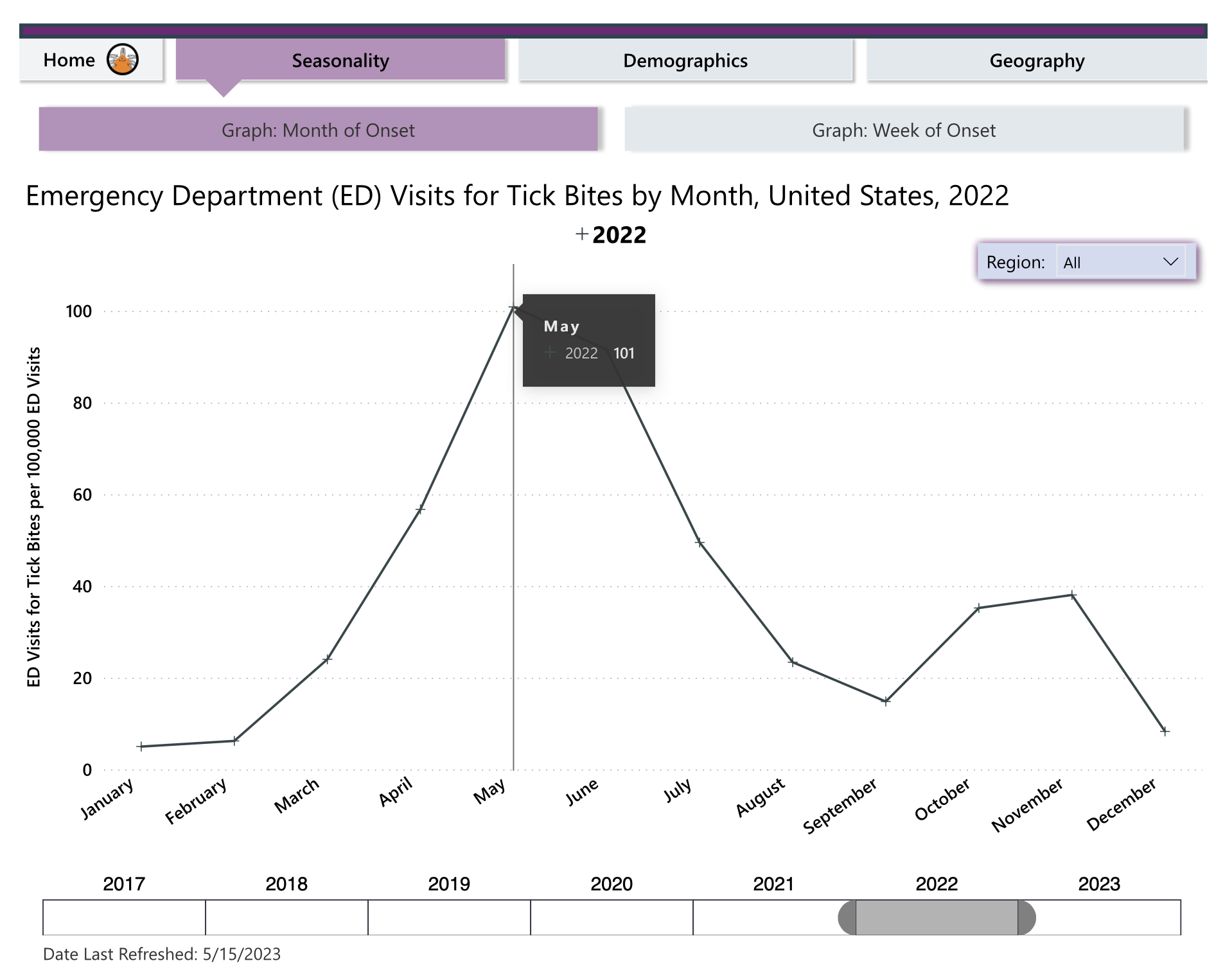
What we see on the Tick Bite Data Tracker is simply the number of persons per 100,000 with reported tick bites who sought care in an emergency room. The new data can indicate when tick bites are most common in a region, and unlike other CDC surveillance data, it is updated weekly, rather than annually.

Tick bites peak in Spring

You can clearly see in the graph below how tick bites peak in the spring in almost all regions of the United States.

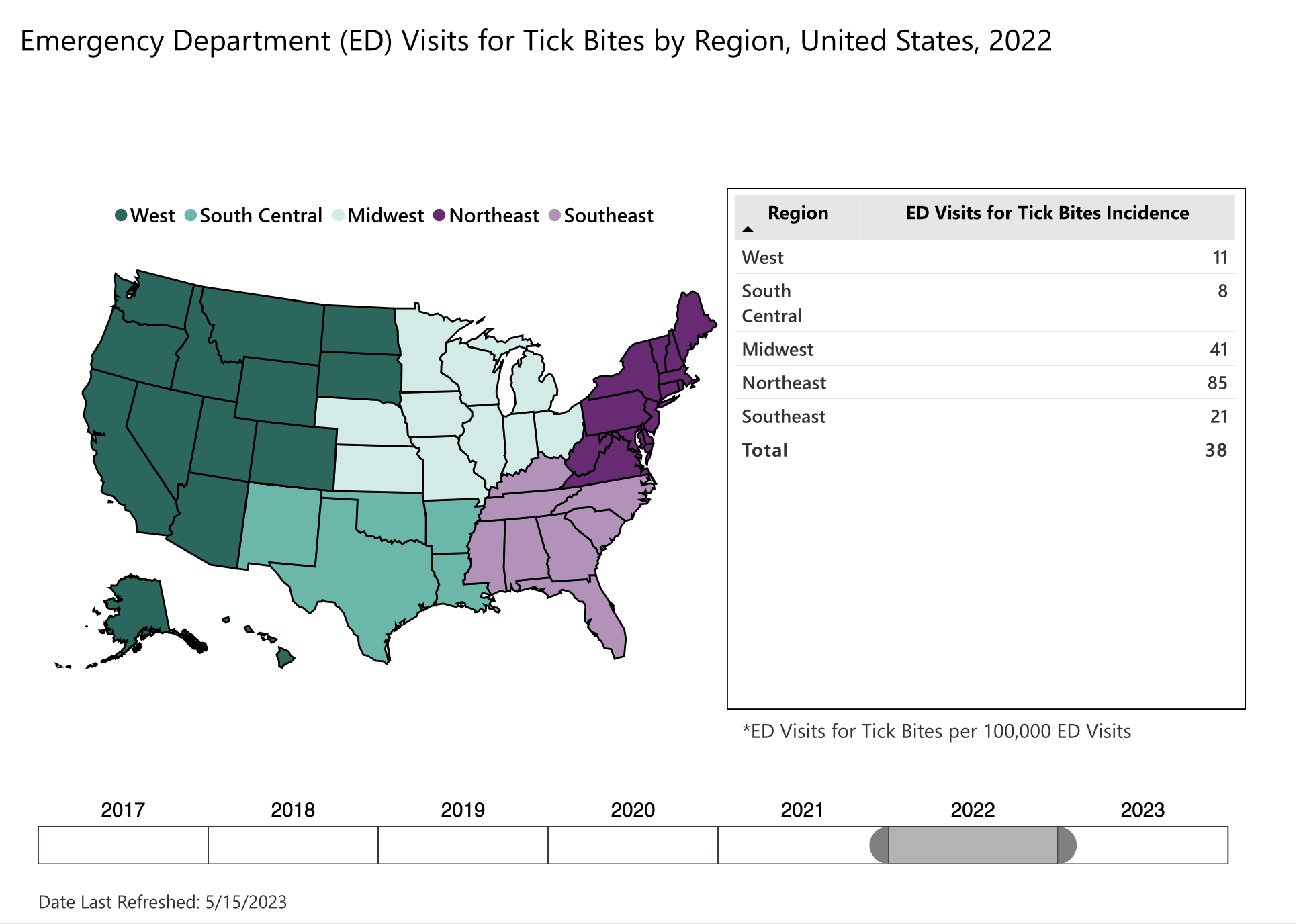
Unfortunately, the CDC lumps every state west of Nebraska as the “West.” Therefore, areas with higher incidence of tick bites, like California, are averaged with areas of lower incidence like Wyoming—giving an inaccurate picture.

In my opinion, at the very least, the CDC should have divided this huge region into the southwest and northwest to offer better representation of what is happening in those zones—but that’s another topic.

The site also points out several limitations of the tracker tool: “Results might not be generalizable to emergency departments that are not contributing data to the BioSense Platform. The keywords used to identify tick bite visits may under- or overestimate emergency department visits related to tick bites because of differences in coding, reporting, and availability of chief complaint text data between jurisdictions or over time. Finally, aggregated data by region might be less useful than state or local data.”

So essentially, you have to take this data for what it is: a slightly flawed tool that gives us a glimpse into what is happening in the tick-borne disease world.

Lyme Awareness Month is an opportunity to educate the public about the risks of Lyme disease and promote strategies for prevention and early detection. I hope you’ll use the Tick Bite Data Tracker, as well as additional information spread throughout the pages of our website to spread awareness.

LymeSci is written by Lonnie Marcum, a Licensed Physical Therapist and mother of a daughter with Lyme. She served two terms on a subcommittee of the federal Tick-Borne Disease Working Group. Follow her on Twitter: @LonnieRhea  Email her at: lmarcum@lymedisease.org.

___________________

**Comment**

A flawed tool that will  continued to be used against patients like the Iron Curtain.

For more:

When Alpha-Gal Syndrome is NOT Related to a Tick Bite

https://www.lymedisease.org/alpha-gal-syndrome-no-tick-bite/

When alpha-gal syndrome is NOT related to a tick bite

Oct. 27, 2022

Typically, alpha-gal syndrome is associated with the bite of a lone star tick, and can result in a life-threatening allergy to red meat. But, according to Pamela Traina, the picture can be more complicated than that. She delivered the following public comments at the Oct. 25 meeting of the federal Tick-Borne Disease Working Group.

Good morning. My name is Pamela Traina. I am 55 years old and live in Los Angeles, California.

My alpha-gal diagnosis came three years ago after spending several years in and out of hospitals due to idiopathic anaphylactic reactions.

I was lucky to have an allergist who never discounted my unusual symptoms, negative allergy tests, and numerous anaphylactic reactions. It still took over two years to pinpoint the cause.

Alpha-gal is virtually unheard of in California because most people who have received an alpha-gal diagnosis live in the southeastern United States and have been infected due to being bitten by the lone star tick. The lone star tick is not found in California. I have not been to the southeastern United States and do not remember ever being bitten by a tick. Yet, I have alpha-gal syndrome. More research is required to pinpoint other possible vectors of how this condition is contracted.

Since my alpha-gal diagnosis, I have been diagnosed with multiple other food and medication allergies, including an uncommon allergy to PEG (polyethylene glycol) and polysorbate. Neither one has a diagnostic test. In addition, my Alpha-Gal test is now negative, but my sensitivity and reactions are still severe.

We need better testing, more education

Current testing is inadequate. We need more accurate testing for Alpha-Gal and other food allergies. We need answers as to why other allergies and conditions emerge after an alpha-gal diagnosis and what are the possible long-term effects of alpha-gal. We also need transparency on all medication and product labels to include inert ingredients.

Finally, hospitals and emergency staff must be educated to treat alpha-gal patients adequately. The hospital and emergency room are extremely dangerous for me due to a lack of awareness of alpha-gal.

I have had eight significant reactions since my alpha-gal diagnosis requiring er visits and hospital stays. I have endured numerous invasive and expensive tests while they search for the cause, discounting my alpha-gal diagnosis.

I have been asked if I was taking drugs and denied breathing treatments and Benadryl during a reaction because they were going to “observe” me since my symptoms didn’t present like typical anaphylaxis.

Education is required for all healthcare providers in the United States, including pharmacists, dieticians, doctors, dentists, and EMS providers, so they are aware of this condition and know how to treat it safely. It is so much more than an allergy to red meat.

Thank you for your time and the work you’re doing for the alpha-gal community.

_______________

For more:

9 EpiPens in a Month: The Burden of Lyme, AGS, & More

https://www.lymedisease.org/9-epi-pen-a-month-mccord/

“Nine EpiPens in a month.” The burdens of Lyme, AGS, and more.

Cortney McCord delivered the following public comment at the Oct. 25 meeting of the federal Tick-Borne Disease Working Group.

I’m Cortney McCord, a registered nurse from Tupelo, Mississippi. Since May 8, 2021, I have been in a battle for my life against alpha-gal syndrome, Lyme borreliosis, bartonellosis, babesiosis, and mast cell activation syndrome.

I developed the most severe clinical presentation of alpha-gal syndrome: I react to airborne and contact exposures as well as dietary exposures to alpha-gal.

For me, it’s way more than just a meat allergy.

In January 2022, my infectious burden grew after I contracted COVID. COVID sent me into full-blown mast cell activation syndrome and made asthma and chronic urticaria a part of my daily life.

After being gaslighted by a local allergist who was ignorant of mast cell activation syndrome and airborne alpha-gal reactions, I made an appointment with expert allergist and former Working Group member Dr. Scott Commins. I am thankful to have him in my corner even if it takes a 12-hour drive to see him..

Patients like me do not have the luxury of time to sift through a myriad of ignorant doctors to find someone familiar with their condition. Because symptoms of tick-borne infections, alpha-gal syndrome, and mast cell activation syndrome are manifested in every organ system, physicians in every medical discipline should be literate in these conditions. Nobody deserves to be gaslighted because of a lack of physician education.

Another tick bite

I was bitten by another larval lone star tick at the end of this past August. In September alone, I had to use nine EpiPens. All of this from a tick the size of a speck of dirt.

In addition to long Lyme, I believe I have long COVID complicating my clinical picture.

Long COVID and long Lyme are very similar. Both Sars-CoV-2 and Borrelia burgdorferi are persistent in tissues. Both affect the host’s immune system. Both can cause mast cell activation syndrome. The medical world has no problem saying that COVID is a persistent “long” disease. Why is that not the case for persistent ‘long” Lyme borreliosis? There are stacks of good science supporting persistent “long” Lyme infection–some of which was done by current working group member Dr. Monica Embers.

I refuse to believe that this is the best that our medical and scientific community can do. Testing for both mast cell activation syndrome and tick-borne diseases is abysmal. That has to change. There should be a law requiring alpha-gal to be listed as a major allergen on every medicine, food, and consumable product that Americans have contact with. We need the Tick-borne Disease Working Group to continue in perpetuity because tick-borne conditions will affect more and more Americans as our planet warms.

Please help me. Ask Congress to address these needs. Thank you.

_________________

**Comment**

This is truly a complicated case, but most are in my experience.

While all patients deserve to be heard and treated properly, throwing yet more money at the TBDWG which is filled with people who do not believe in chronic infection, and which has done ZERO to help  patients is not helpful.  IF, and I mean IF any money is appropriated to study this, IMO – whoever is doing the work needs needs to be independently funded.  Researchers can not be the regular cast of characters – receiving grants from corrupt public health agencies, that is literally a Cabal regurgitating old, outdated, highly myopic work which is designed for a pre-determined outcome and completely ignores a huge subset of people.

Unfortunately many patients and even advocates are oblivious to the sordid backstory of the corrupt agencies controlling research and funding.  Insanity truly is doing the same thing over and over and expecting different results.  Time to ditch the public health monopoly and public health agencies controlling research, funding, doctors, testing, treatments, and “vaccines.”

For more: