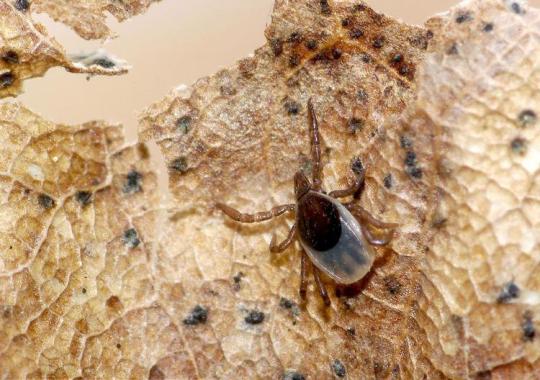
Ticks spread the widest variety of diseases that are harmful to humans, including Lyme disease. This is an image of a blacklegged (deer) tick nymph. Courtesy of Graham J. Hickling, University of Tennessee
Congress has had over six months to review a federal report on tick-borne diseases, which includes action items for prevention, diagnosis and treatment, and both doctors and researchers are frustrated that nothing has been done so far.
The report was written by a working group under the U.S. Department of Health and Human Services to address the growing number of tick-borne diseases in the United States. It was delivered to Congress in December.
The diseases, especially Lyme disease, are wreaking havoc on the Northeast and New York. About 400,000 new cases of Lyme disease are reported nationwide annually.
About one-fourth of those cases are from New York alone.
Despite the trend in New York, lawmakers did not put funding in this year’s state budget for tick-borne illness research, either.
The $1 million the state Senate had put back into the budget for studying Lyme disease and other tick-borne illnesses is no longer there.
The seemingly lack of action by state and federal lawmakers has frustrated advocates like Holly Ahern, an associate professor of microbiology at SUNY Adirondack. Ahern was also on the testing and diagnostic subcommittee of the federal tick-borne disease working group.
She was approached by the New York State Academy of Family Physicians, and Ahern and the academy’s director, Barbara Keber, wrote an op-ed column for Newsday, calling for a multi-billion dollar “national public-private partnership — an initiative that must address more than just Lyme disease and must go beyond the current low-impact strategy of telling the public to beware of ticks, wear white socks or shower after being outdoors.”
“This wasn’t just a ‘sit around and do a report’ kind of body,” Ahern said about the working group, in a phone interview Thursday. “This was, ‘Do a report and make recommendations and do what you find.’ … With that in mind, there’s accountability there. We sent the report to Congress, and Congress should take that report and should be acting on that.”
The modern history of Lyme disease starts with an outbreak in the early 1970s in Lyme, Connecticut of a mysterious illness that afflicted chil…
It isn’t often that physicians and advocates work together when it comes to Lyme disease, Ahern said. She was a bit surprised when the New York State Academy of Family Physicians reached out to her with similar frustrations about the lack of action.
Keber, who is a physician at Glen Cove Hospital, said doctors face many challenges when it comes to diagnosing and treating tick-borne illnesses.
One challenge, she said, is that there are people who are continuously bitten by ticks, and thus continuously contracting Lyme disease. Pumping a person with antibiotics could cause other negative side effects, making it difficult to treat someone with chronic Lyme.
There’s also not a good test for detecting Lyme disease. Blood tests, Keber said, are only useful about 50% of the time.
“I think another challenge for us is prevention, in either the geriatric age group, or the pediatric age group, because there are some kinds of repellents that are really not recommended in those age groups,” Keber said. “We need to really develop safer preventive measures and really, really what’s needed in terms of Lyme in particular, is a good, safe vaccine that really works.”
Vito Grasso, executive vice president of the academy, said there is new science around tick-borne illness research that needs to be explored.
“We would like to see investment in the development of one or more vaccines to address the various forms of tick-borne diseases, and we think that that’s feasible and that would be a very good investment,” Grasso said.
Ahern is less keen on a Lyme vaccine.
With a number of other tick-borne illnesses like borrelia miyamotoi and Powassan infecting people, Ahern would like to see a vaccine that’s more anti-tick than anti-Lyme.
Keber hasn’t heard of any anti-tick vaccines in the works, and said something like that would be difficult. But she talked about how, in the 1990s, a Lyme disease vaccine called LYMErix was introduced.
Some people had negative side effects, and it was pulled from distribution.
There is a Lyme disease vaccination in trials now, Keber said, but she hopes it will go through even more trials to make sure it’s completely safe before it hits the market.
Keber and Ahern are also focused on educating the public, including physicians, about the symptoms of different tick-borne illnesses and the changing recommended treatments.
The other challenge, Keber continued, is that often symptoms of these diseases are similar to the flu, or are more low-key like aches and pains.
Amidst all the challenges, advocates, researchers and physicians are joining forces in the hopes of moving the needle on funding this research. For Ahern, it was exciting to see the academy on board.
“This is a really large medical society saying we need more action, we need more help,” Ahern said. “They recognize the patient voice. They recognize the importance of the involvement of the patient voice, and whatever happens moving forward is key.”
Listen to Dr. Waters speak about the one thing all of us want to avoid—AGING! Weight gain, hormones, toxins, memory loss…we can help!
Saturday, September 28, 2019 ~ 10:00am
at the Quality Inn – Mineral Point 1345 Business Park Rd—Mineral Point WI 53565—608-987-4747Saturday, October 5, 2019 ~ 10:00am
at the AmericInn by Wyndam – Waupun 204 Shaler Drive—Waupun WI 53963—920-345-1140
Saturday, October 26, 2019 ~ 10:00am
at the Stoney Creek Hotel & Conference Center – LaCrosse Badger’s Den Room
3060 S Kinney Coulee Rd—Onalaska WI 54650—608-781-6060
Saturday, November 2, 2019 ~ 10:00am
at the Basics Co-op Community Room – Janesville 1711 Lodge Drive—Janesville WI 53545—608-754-3925
These events are free and seating is first come, first served! Question & answer following! Friends and family are welcome!
Diabetic Epidemic
Is this why I’m overweight and tired?
fatigue, cravings, aches and pains, brain fog, weight gain, hormone imbalances, depression… Do you have these symptoms or want to avoid them?
You may be pre-diabetic or diabetic. Learn how to find out if you are, why you are
and what to do about it!
Farm Chemicals
View slides from Dr. Waters 2016 lecture on the controversial usage of pesticides in farming by clicking on the .pdf link
LRBs 1652 and 3362 – Establishes a sixteen-member Tick-Borne Disease Study Committee to create a report for the legislature on consensus-based recommendations for policy changes on awareness, prevention, surveillance, diagnosis, reporting, and treatment of Lyme Disease
Since everything about Lyme/MSIDS is steeped in controversy, this panel could be made up of those who do not recognize that Lyme can be persistent, and that it’s common for coinfection involvement necessitating numerous drugs for extended periods of time. A great example of this happening as we speak is in the federal Tick Borne Disease Working Group:https://madisonarealymesupportgroup.com/2019/06/15/working-groups-abrupt-shift-excludes-lyme-patients/Excerpt:
Dr. Shapiro is much more than just a representative of the IDSA. In addition to financial conflicts of interest that should preclude him from serving on the Working Group, for years Dr. Shapiro has notoriously waged war on Lyme patients, their doctors, and advocacy groups. Putting him on the Working Group shows tremendous lack of respect for Lyme patients and their concerns. (More than 21,000 people have signed our petition to remove Shapiro from the TBDWG.
https://madisonarealymesupportgroup.com/2019/05/03/when-lyme-disease-doesnt-go-away/ Dr. Brian Fallon, a Columbia University Irving Medical Center psychiatrist states that patients with chronic, unexplained symptoms had all been healthy—until they got Lyme disease. These patients suffered from chronic pain, fatigue and cognitive problems that had a debilitating effect on their lives. They all had been treated with antibiotics with partial response but then relapsed.
SINCE SUCH PERSISTENT INFECTION WAS CONSIDERED IMPOSSIBLE, THEY WERE TOLD THEY WERE HYPOCHONDRIACS.
“Pets and Parasites: Diseases transmitted by fleas and ticks and their impact on animal and human health” – An Animal Health and Nutrition Forum
Fleas and ticks are the most common ectoparasites (external parasites) of dogs and cats worldwide. In addition to just being a nuisance, fleas are responsible for flea allergy dermatitis and Bartonellosis while ticks are important vectors of diseases that affect humans and animals. The geographic distribution of ticks is changing due to climate change, de-foresting, and the changing living and migrating patterns of deer, birds, and rodents. Ticks are in virtually all parts of the United States, including some urban areas, and many parts of the world. Tick-transmitted diseases include: Lyme disease, Ehrlichiosis, Anaplasmosis, Rocky Mountain Spotted Fever, Babesiosis, and Hepatozoonosis.
Featured Speakers:
Edward B. Breitschwerdt,
Ph.D., NCSU College of
Veterinary MedicineKerrie Powell, Ph.D.,
Cambrex
The AH&N EG forum will discuss Bartonellosis as well as outline the discovery and development of molecules that treat flea and tick infestations on companion animals.