https://healthimpactnews.com/2021/dr-cole-on-covid-vaccines-this-is-a-poisonous-attack-on-our-population-and-it-needs-to-stop-now/  Link to 17 Min video after article

Dr. Cole on COVID Shots: “This is a Poisonous Attack on our Population and it Needs to Stop Now!”

Aug. 9, 2021

by Brian Shilhavy
Editor, Health Impact News

Dr. Ryan Cole is the CEO and Medical Director of Cole Diagnostics, one of the largest independent labs in the State of Idaho. Dr. Cole is a Mayo Clinic trained Board Certified Pathologist.

He is Board Certified in anatomic and clinical pathology. He has expertise in immunology and virology and also has subspecialty expertise in skin pathology.

He has seen over 350,000 patients in his career. We featured a lecture he gave earlier this year back in April, where he discussed cures for COVID-19 symptoms, and warned about the dangers of the COVID “vaccines.”

Dr. Cole gave another presentation this past weekend in Texas, as part of a seminar with America’s Frontline Doctors.

Being a pathologist who runs his own private diagnostic laboratory, Dr. Cole is perhaps one of the most qualified physicians in America today to give an independent, honest evaluation of the current roll-out of the COVID-19 “vaccines,” and he didn’t pull any punches in his presentation, saying:

“We need to stop the insanity immediately. This is over. Game over. This is no longer good science. This is a poisonous attack on our population. And it needs to stop now!”

He lamented the fact that we are spending billions on advertising to get people to take these experimental shots, but nothing on the science to study their effects on the population.

Where’s the funding for science? We’re spending billions on advertising the “clot shots” to children.

When a new unapproved drug hits the market, we need to use the French legal system: guilty until proven innocent, and we are doing just the opposite right now.

He discussed how the “spike protein” is the toxin that is being injected into everyone, and that it crosses the blood-brain barrier.

Why in the world would we put a toxin into the human body that is going to disrupt the blood vessels in your brain, allow the spike in there, and cause inflammation?

This isn’t a vaccine. They keep lying to the public by calling this a vaccine. It’s an experiment on humanity.

These spike proteins cause damage in multiple organs, including the heart, which is what we are now seeing in children who are injured by the shots.

Once you have heart damage the heart does not heal itself. The heart is damaged forever.

We’re ruining kids’ hearts for life with these shots.

And what about long-term studies on issues such as fertility, cancer, etc.?

There are none. “We don’t know.”

He stated that he has seen a 10 to 20 fold increase in uterine cancer in the last 6 months since the shots came out.

Watch the entire presentation. (Approx 17 min). This is from our Rumble channel, and it is on our Bitchute channel as well.

Or you can watch his presentation here:   https://americasfrontlinedoctors.org/videos/summit-sessions-the-science-ryan-cole-md-covid-19-vaccines-autopsy/

For more:

Meanwhile, mafia-overlord Fauci states it’s time for local “vaccine” mandates, despite the fact data straight from the U.K. government, shows the Delta variant has a case fatality rate of 0.1%.

A case fatality rate (CFR) is many times higher than the actual death rate (infection fatality rate, or IFR), because the vast majority of COVID-19 cases go undetected. The World Health Organization runs its numbers based on the estimate that 1 in 20 cases are detected, while the CDC bases its estimates on a 1 in 10 ratio.

This means that based on CDC and WHO guidelines, the Delta variant’s death rate is actually significantly lower than the 0.1% number that appears in the U.K. government docs.


https://www.brighteon.com/fb424f6b-39c6-424a-b1c4-3d986babf421  Approx. 40 Min

Pfizer Whistleblower Confirms Bioweapon Global Extermination Plan

August 4, 2021

Dr. Andrew Kaufman & Karen Kingston (Pfizer whistleblower) discuss:

  • original patents
  • lack of good testing
  • deliberate avoidance of good testing and fraudulent misrepresentations of mRNA injections
  • Lipid nanoparticles which contain graphene oxide (conductor for electromagnetic fields & gene delivery) so it can withstand extreme temperatures as the synthetically made mRNA is very unstable.  Graphene oxide accumulates in tissues and organs.
  • The COVID injections are NOT vaccines, they are gene therapies. They don’t stop transmission, prevent illness or prevent death.
  • When using gene therapies, there is a high risk of shedding through bodily secretions.  In this case it’s the spike protein, which is foreign to us.  This protein goes systemic and accumulates in tissues and organs.
  • Pfizer has done many dubious and illegal things and has gotten away with it.
  • Autopsy in a COVID “vaccinated” person shows spike protein is in tissues and organs. More autopsies needed.
  • These injections are not effective.  They neglected to test a majority of those in the treatment group as they were becoming ill – so they purposely selected data and covered up data to give their wanted pre-determined outcome.  Regulators ignored this fraud.

For a 17 min presentation by pathologist Dr. Cole, go here:   https://madisonarealymesupportgroup.com/2021/08/10/pathologist-we-need-to-stop-the-insanity-immediately-this-is-over-game-over-this-is-no-longer-good-science/

Using slides Dr. Cole shows clearly how these spike proteins, which are the toxin in the injections, are going systemic (they initially thought they would stay at the injection site), accumulating in tissues and organs, causing wide-spread inflammation and microscopic blood-clotting.  They also cross the blood/brain barrier – causing issues in the brain.  They cause damage in the heart which does not heal itself.  The heart is damaged forever.  He states he’s seen a 10-20 fold increase in uterine cancer in the last 6 months since the shots came out.

For more:

click

https://www.lymedisease.org/maxwell-texas-tick-borne-diseases/

Ecologically diverse Texas needs county-level data for tick-borne diseases

Aug. 2, 2021

By Sarah Maxwell, PhD

Welcome to the complex world of tick-borne disease surveillance. But honestly, it should not be so difficult. Why does the public health system fail to inform schools, camps, parents, physicians, pediatricians, psychiatrists, and others about county-level risks of tick-borne disease? Why are prevention and diagnosis so difficult?

The answers are rooted in the lack of available, dis-aggregated, and comprehensive data. But they are also complicated  by the use of “Lyme” as a catch-all phrase encompassing a variety of tick-borne diseases, when Lyme may be less endemic in some areas than other tick-borne diseases.

From a health policy perspective, the importance of county-level data to prevention, diagnosis, and treatment cannot be overstated.  For almost all other diseases, sustainable and reliable county data are the foundations to building healthy communities. So why not tick-borne diseases?

Focusing on Texas

In a recent article, Drs. Connie McNeely, Kip Thomas, and Chris Brooks and I employed promising new approaches to tick-borne disease surveillance in Texas with the goal of linking differing forms of tick-borne disease surveillance data into a comprehensive picture. The Centers for Disease Control (CDC) supports the “One Health Model,” which considers people, animals, and the environment as interconnected in assessing and addressing zoonotic disease.

In our article in the journal Healthcare titled “Tick-Borne Surveillance Patterns in Perceived Non-Endemic Geographic Areas: Human Tick Encounters and Disease Outcomes,” we compared canine serological reports of Lyme, ehrlichiosis, and anaplasmosis; patient self-reported diagnoses and tick-bite recall; official reports of Lyme disease from the CDC; and ecosystem habitat suitability through multi-layer thematic mapping.

As noted in our study: “The overall purpose was to determine if clinically diagnosed and CDC-positive Lyme disease human reports are geographically similar in disaggregated form via county, bordering county, and ecosystem to canine and official CDC counts. Comparisons between patient self-reported disease and official counts of disease are not widely used methods of surveillance, but are important epidemiological tools when disease can be linked to an event, such as a tick bite.”

Texas is a large state and often perceived to be non-endemic for tick-borne diseases. However, at the county level, the picture is quite different. Numerous counties in Texas are endemic to tick-borne diseases. So why the dilemma?

Importance of county-level data

The need for such comprehensive and new surveillance techniques is imperative. Here is why: The CDC publishes county-level Lyme disease data for anyone to view. However, the CDC limits all other tick-borne diseases to state-level surveillance only. The public and researchers do not have access to these data.[1]

CDC’s Lyme disease spreadsheet, on the other hand, is updated annually and published on the CDC website. Therefore, public health officials should, in theory, have the data they need to design prevention campaigns and assess human disease risk. Nationally, however, those data are known to undercount the real presence of Lyme disease, as numerous scholars have demonstrated.

Additionally, some of the cases within the CDC dataset may not be locally acquired. Hypothetically, an individual may travel to the Northeast, return ill, and be listed in the CDC database as a case in Contra Costa, California. Researchers who study Lyme disease prevalence must dig, and dig hard, state by state to double check those cases that may not be locally acquired.[2]

In our paper in Healthcare, we did just that. However, our focus was Texas, so the digging was concentrated to one state, where we were able to remove non-locally-acquired cases.

Even if Lyme disease data were perfect, however, researchers and some public health officials are faced with a constant obstacle: Lyme disease is not the only tick-borne disease. Ticks can carry many different pathogens. Yet, the CDC does not publish county-level data for tick-borne diseases other than Lyme. Given many patients with Lyme disease report having multiple co-infections, knowing the disease risk is imperative for physician knowledge and adoption of prevention behaviors among local community residents.

“Lyme” is often a catch-all phrase

At the same time, “Lyme” is often used as a blanket term and adopted by national and state organizations to cover a host of possible other infections such as Babesia or ehrlichiosis. The catch-all phrase “Lyme” could potentially detract from the wide range and prevalence of other tick-borne diseases in the United States.

In our study, we attempted to improve surveillance of tick-borne diseases, including Lyme, using data drawn from a specialized survey—the Texans and Ticks Survey (TTS)—developed to collect state-, county-, and zip-code-level self-reported patient information.

TTS included the geographic location of tick bite encounters. All survey respondents reported a Lyme disease diagnosis by a medical professional. Survey respondents were asked if they had received a diagnosis, and if so, how they had been diagnosed. They could select: (1) Clinically (the doctor thinks you have Lyme disease based on your history and symptoms); (2) Western Blot, where some bands were positive; (3) Western Blot, where five or more bands were positive (“CDC-positive”); (4) IGeneX or other specialty lab; or (5) I do not know/Not sure.

Respondent tick bite encounters of those who self-reported a Lyme diagnosis were mapped at the county level. Since counties with higher populations would naturally experience more tick bites (all else held constant), by-county raw case frequencies were corrected with respect to the county’s population density, and standardized as the number of cases per 100,000 individuals.

Comparing maps

We overlaid survey respondents’ tick bite encounter locations on maps with official CDC human Lyme disease cases and canine cases of Lyme, ehrlichiosis, and anaplasmosis. Examples are below:

Overall, we found that the survey respondents only reported tick bites in areas known to be suitable to ticks and tick-borne disease transmission as shown via canine serological and official CDC human reports. These findings held true for all official human Lyme cases, as well as canine Lyme, ehrlichiosis, and anaplasmosis (not pictured).
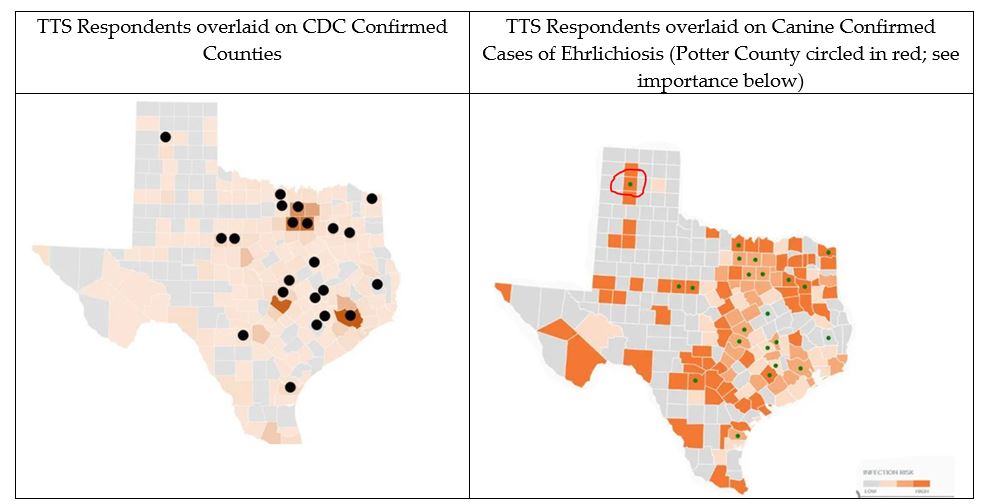
Importantly, clinically diagnosed patients match known and official cases of Lyme and other tick-borne diseases in Texas. Without access to CDC cases of other county-level tick-borne disease, self-reported tick bite encounters, associated diseases, and a one-health approach to assess overlap with human and canine cases, proved to be a promising exploratory study that warrants further attention at the national level. We suggest that self-reported clinically diagnosed patient reports and serological canine reports can serve as proxies for assessing human disease risk.

These findings were not a result of simple population density, and also followed the same hot-spot clusters as human and canine cases. Additionally, they occurred in ecosystems suitable for ticks. If these respondents were randomly lying about their tick bite locations, chances of all the respondents making up tick-bite encounters only in suitable or endemic counties would be almost impossible.

Diverse ecosystems

Back to our data dilemma: Why is providing only state level data insufficient? In states such as Texas, ecosystems are diverse and not all are suitable tick habitats. If the perception is that Texas is not endemic, we miss numerous counties where individuals have reported tick bites and a subsequent clinical Lyme diagnosis. Our study demonstrates that county-level data allow for more fine-tuned decision-making and risk assessment.

Take Potter County, Texas, as one example. The  drier northwestern area of the state, known as the Texas Panhandle, has an ecoregion suitable for tick habitat that extends into a drier, less tick-suitable ecosystem. The ecoregion that covers most of the panhandle is not as suitable for tick populations, However, the extension from the Rolling Plains into just a few counties does offer suitable tick habitat. We find overlap in Potter County with canine reports of tick-borne disease and CDC cases.
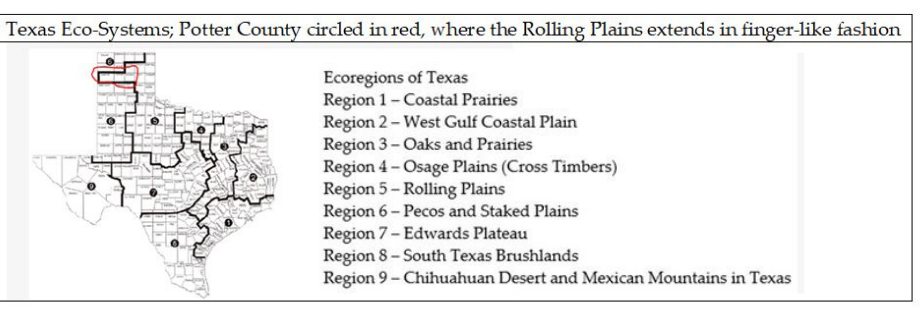
Did you know that in 2020, 1 in 20 dogs tested for ehrlichiosis in Potter County Texas was positive? However, only 1 in 1,000 canines in Potter County tested positive for Lyme disease. Should physicians test humans for ehrlichiosis in addition to Lyme disease in a few counties in the Texas Panhandle if the patient presents with tick-borne illness symptoms? I don’t have the answer to that. But I do know county-level data are desperately needed in tick-borne disease surveillance if public health officials hope to prevent disease.

Indeed, most diseases, for example West Nile, are incorporated into interactive, useful, county-level maps on the CDC webpage. Perhaps it is time to rethink the public health commitment to tick-borne disease surveillance so that both the general public and health officials can make informed and equitable decisions.

There are no sustainable, easy-to-access local tick-borne disease data that allow for communities to improve health outcomes for those who may be affected, including vulnerable populations who are the least likely to receive a diagnosis and care, especially in areas that are perceived to be “non-endemic.”

Click here to read the journal article.

Dr. Sarah Maxwell is an assistant provost and associate professor at the University of Texas at Dallas. Her research and grants focus on tick-borne disease surveillance and patient experiences with Lyme disease. She and her co-authors are founding members of ICI-Vector, created to Integrate, Communicate, and Inform others about tick-borne disease. She also serves on the scientific board of the Texas Lyme Alliance.

Footnotes

[1] Researchers may apply for these data from the CDC, but if granted access, are prohibited from publishing data at the county-level.

[2] My understanding is that not all states differentiate locally-acquired cases.

https://www.lymedisease.org/padula-lyme-affects-eyes/

TOUCHED BY LYME: How Lyme disease can affect your vision

Aug. 4, 2021

Dr. William Padula is a noted expert on how Lyme and other tick-borne diseases can affect the eyes.

According to his website, the following can all be symptoms of tick-borne illness: blur, visual fatigue, double vision, headaches associated with visual activities, light sensitivity, losing place when reading, seeing words appear to double or become double when reading, and more obscure problems often not associated with vision such as difficulty with balance, spatial orientation, memory, comprehension, feeling of being overwhelmed by being in a busy environment, and sensitivity to sound.

The website notes: “The cause of the visual symptoms is because the tick-borne disease affects visual processing in the brain.”

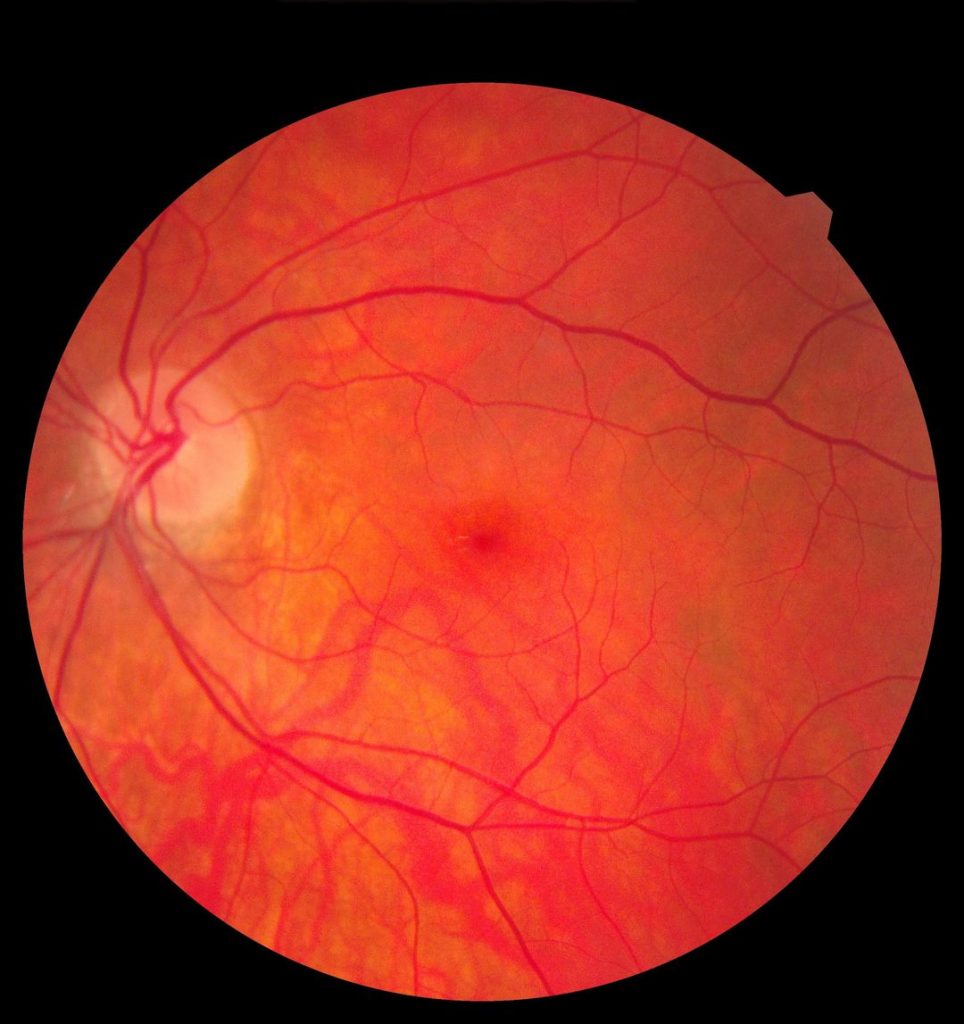
Recently, Dr. Padula has discovered two eye-related biomarkers for tick-borne infection. (A biomarker is something that can be found by examination or testing that indicates the presence of a particular disease or condition.)

In an article published by Healio, Dr. Padula reports:

“My colleagues and I have demonstrated that the presence of a hazy, white ring of peri-papillary ischemia around the optic nerve — especially in children or adults younger than 60 years who would not be expected to have ischemic changes — is associated with tick-borne infection. One way that spirochetes hide from the immune system is by building up protective biofilms. We believe that these biofilms clog the narrow capillary vessels just around the perimeter of the optic nerve, blocking blood flow.”

Dr. Padula recommends that optometrists and ophthalmologists who observe this condition in patients who also have convergence insufficiency or focusing should rule out the possibility of tick-borne infection.

In the same article, Dr. Padula also discusses something called the Visual Evoked Potential (VEP) test. He says that abnormal results on this test strongly indicate tick-borne disease.

As we in the Lyme community know well, it often takes a long time for people to get properly diagnosed with tick-borne infections. If eye doctors become alert to these biomarkers, that could speed up the process considerably.

Click here to read the article on Healio.

Click here to visit Dr. Padula’s website

TOUCHED BY LYME is written by Dorothy Kupcha Leland, LymeDisease.org’s Vice-president and Director of Communications. She is co-author of When Your Child Has Lyme Disease: A Parent’s Survival Guide. Contact her at dleland@lymedisease.org.

____________________

For more:

https://www.bitchute.com/video/ScDhkApVJMbd/  News Video Here

Published August 5, 2021

The Irish Department of Health Can’t Confirm COVID Has Been Isolated

Gemma O’Doherty, an Investigative Journalist in Ireland, states The Department of health refuses to confirm existence of a COVID “virus” in writing.

Confirmation that the virus was never isolated.

On top of this, the CDC in July revealed that there is no Covid-19 in a document titled “CDC 2019-Novel Coronavirus (2019-nCoV) Real-Time RT-PCR Diagnostic panel”, dated July 13, 2020. On Page 40 of this document titled “Performance Characteristics”:

“Since no quantified virus isolates of the 2019-nCoV were currently available…
assays designed for detection of the 2019-nCoV RNA were tested with characterized stocks of in vitro transcribed full length RNA (N gene; GenBank accession: MN908947.2) of known titer (RNA copies/µL) spiked into a diluent consisting of a suspension of human A549 cells and viral transport medium (VTM) to mimic clinical specimen.

Also stated on page 38 of the document under the heading “Limitations”:

  • Detection of viral RNA may not indicate the presence of infectious virus or that 2019-nCoV is the causative agent for clinical symptoms. 
  • The performance of this test has not been established for monitoring treatment of 2019-nCoV infection. 
  • The performance of this test has not been established for screening of blood or blood products for the presence of 2019-nCoV. 
  • This test cannot rule out diseases caused by other bacterial or viral pathogens.

So… What are they testing for? Because it’s not the virus, which has not been proven to exist.  What is being tested for is RNA that is PRESUMED to come from the virus – which hasn’t been proven to exist.

So, what are people dying of?  The same thing they die of every year!

UPDATE:
As part of our legal action we had been demanding:

  • evidence that this virus actually exists
  • evidence that lock downs actually have an impact
  • face-masks are safe and deter the spread of viruses

No such studies exist.  Social distancing is not based in science.  It’s made up.  Contact tracing does not have any bearing on the spread of a virus.  This organization here – is making it up as they go along. – Gemma O’Doherty

___________________

**Comment**

The UK admits COVID hasn’t been isolated:  https://madisonarealymesupportgroup.com/2020/10/09/foi-asking-uk-officials-for-proof-of-isolation-of-sars-cov-2-virus-they-cant-give-it/

Alberta, Canada has now admitted this:   https://madisonarealymesupportgroup.com/2021/08/06/canadian-court-victory-results-in-all-restrictions-being-dropped-in-alberta-as-they-cant-prove-covid-has-been-isolated/

For a great explanation on the lack of COVID viral isolation by Dr. Jane Ruby (Aug. 6, 2021):  https://www.brighteon.com/2726f974-3b5f-4c8a-9edf-6f6a20217714

*******************************************************************************************

U.S. Right to Know sued NIH for documents about SARS-CoV2 origins:  https://madisonarealymesupportgroup.com/2020/11/12/u-s-right-to-know-sues-nih-for-documents-about-origins-of-sars-cov-2/

This isolation issue is paramount in this house of cards.  To understand it better, as well as what’s behind it:

PLEASE WATCH NUMEROUS DOCTORS STATE HOW THE COVID RESPONSE IS OUT OF STEP WITH MEDICINE AND SCIENCE. 

Meanwhile, Fauci continues the COVID spin narrative and hopes that FDA approval of these dangerous, ineffective, unwarranted, fast-tracked injections, predicted to occur in weeks, will spur vaccine mandates. This of course will lead to vaccine passports, already being heavily protested in Europe.