Tick-borne disease that kills up to 15% of sufferers just claimed its first life in the US this year — and experts warn the virus is becoming more common due to CLIMATE CHANGE
The death in Maine this month is the first due to Powassan virus so far this year
The tick that causes the virus is most active in wooded areas in warmer months
Health officials in Maine reported the first death this year of an untreatable tick-borne illness, putting Americans on alert as outdoor warm-weather activities kick off.
Robert J. Weymouth, a 58-year-old from Topsham, Maine passed away due to complications from the Powassan virus, which caused severe neurological problems, according to the Maine Center for Disease Control and Prevention.
The illness is extremely rare with about 25 cases reported each year since 2015, but it is also untreatable and can lead to severe health problems including infection of the brain, called encephalitis, or of the membranes around the brain and spinal cord, known as meningitis.
Many people who become infected with the virus do not develop symptoms, but those that do typically notice them up to a month after being bitten by an infected tick, which could include flu-like symptoms, seizures, brain swelling, and, in up to 15 percent of cases, death.
Weymouth’s death marks the third Powassan death in Maine since 2015, and, as winters become warmer and shorter, the world becomes a more hospitable place for disease-causing ticks. (See link for article)
_________________
A few points:
Powassan, like any other virus IS TREATABLE; however, doctors are not catching it early enough because they are uneducated about tick-borne illness. It’s highly politicalized and has polarized the medical community. Doctors are too afraid to diagnose and treat it due to this and are either ignorant or acting ignorantly out of self-preservation. Either way, it’s not a good scenario & patients lose.
Powassan is rarely diagnosed because most who contract it are asymptomatic – similarly to many other viruses – but also because testing is not available through clinical or commercial laboratories, but only through the Health Department. Further limiting diagnosis:
Patients should be hospitalized with meningitis or encephalitis
Have a presumed infectious cause of illness
Be negative or concurrently tested for more common causes of meningitis and encephalitis such as West Nile virus, Lyme disease, herpes and varicella.
The patient’s wife was “frustrated at how little the doctors around her husband seemed to know about the illness. He was in the hospital for weeks before the medical team determined he had the virus.” And, BINGO! This, right here is the problem not that it is untreatable. Please begin to pick up the continued use of language blaming peripheral things instead of addressing the root of the problem.
Please note that Wisconsin is a hot-spot for Powassan. Please read this article on how Powassan IS NOT RARE.
Coppe Labs, a specialized CLIA-certified lab, right in Waukesha, Wisconsin tests for Powassan, West Nile, Anaplasma, Babesia, Human Herpes Viruses 6 & 7, COVID, and Lyme disease.
University of Washington; University of Edinburgh – Edinburgh Medical School
Date Written: May 14, 2023
Abstract
Early in the Covid pandemic concerns were raised that lockdown and other non-pharmaceutical interventions would cause significant multidimensional harm to society. This paper comprehensively evaluates the global state of knowledge on these adverse social impacts, with an emphasis on their type and magnitude during 2020 and 2021. A harm framework was developed spanning 10 categories: health, economy, income, food security, education, lifestyle, intimate relationships, community, environment and governance. The analysis synthesizes 600 publications with a focus on meta-analyses, systematic reviews, global reports and multi-country studies. This cumulative academic research shows that the collateral damage of the pandemic response was substantial, wide-ranging and will leave behind a legacy of harm for hundreds of millions of people in the years ahead. Many original predictions are broadly supported by the research data including: a rise in non-Covid excess mortality, mental health deterioration, child abuse and domestic violence, widening global inequality, food insecurity, lost educational opportunities, unhealthy lifestyle behaviours, social polarization, soaring debt, democratic backsliding and declining human rights. Young people, individuals and countries with lower socioeconomic status, women and those with pre-existing vulnerabilities were hit hardest. Societal harms should challenge the dominant mental model of the pandemic response: it is likely that many Covid policies caused more harm than benefit, although further research is needed to address knowledge gaps and explore policy trade-offs, especially at a country-level. Planning and response for future global health emergencies must integrate a wider range of expertise to account for and mitigate societal harms associated with government intervention.
I post this for two reasons: 1) it reveals the severe conflicts of interest in medicine today and shows advice from doctors can not be blindly followed 2) vaccines can serve as triggers to reactivate latent infections and autoimmune issues. Since Lyme/MSIDS patients are already in an epic war in which they are attempting to maintain immune balance, they need to understand a vaccine could serve to tip this balance making it easier for pathogens to emerge or reemerge.
Primary care providers across the U.S. were bribed with incentive programs to coerce patients into getting the toxic COVID shot. Anthem Blue Cross and Blue Shield paid doctors $50 for each Medicaid patient aged 6 months and older, who got the experimental jab
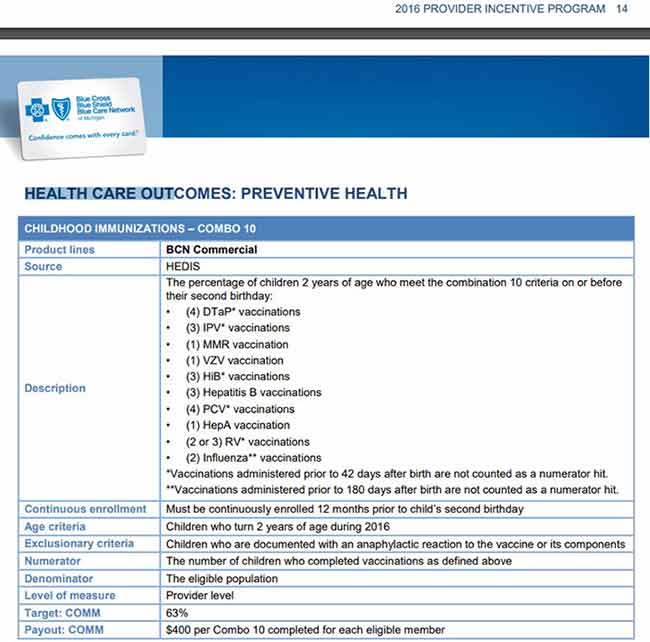
Doctors have been financially incentivized to vaccinate children for a long time. In 2016, Blue Cross Blue Shield paid pediatricians a $400 bonus for each patient that completed 10 vaccinations before their second birthday, provided 63% of their patients were fully vaccinated
“Client and family incentives” also exist. In 2015, the Community Preventive Services Task Force recommended boosting vaccination rates by giving small, inexpensive incentive rewards to patients
Bribery is also par for the course when it comes to vaccine mandates. Pfizer paid undisclosed sums to front groups that advocated for COVID jab mandates, thereby hiding their conflict of interest
While the COVID-19 pandemic furthered many globalist goals, it inadvertently tanked childhood vaccination rates. To get childhood vaccination rates back on track, a global alliance has launched “The Big Catch-Up” initiative. It’s touted as the largest childhood immunization effort ever
In April 2023, I reported how primary care providers across the U.S. were bribed with incentive programs to coerce patients into getting the toxic COVID shot. Since there was no medical malpractice liability, doctors profited while patients risked their lives as participants in an unprecedented medical experiment, all while being lied to about the safety and effectiveness of these injections.
Even more egregiously, once the U.S. Food and Drug Administration authorized the COVID shot for children, similar vaccination incentives were extended to pediatricians as well. As detailed in an Anthem Blue Cross and Blue Shield Medicaid provider bulletin1 dated July 2022, doctors received $50 for each Medicaid patient aged 6 months and older, who got the experimental jab.
Pediatricians Are Financially Incentivized to Vaccinate
As it turns out, doctors have been financially incentivized to vaccinate children for a long time. According to a 1999 JAMA Pediatrics article,2 the average patient load of American pediatricians is 1,546, although the number of patients was “significantly higher in less populated areas and solo practices.”
Of these, 8.3% were younger than 1 year, 9.5% were 1 year old and 8.6% were 2 years old.3 That means approximately 26.4% of the average pediatrician’s patients were 2 years old and younger. More recent data,4 published in 2021, show 75% of pediatricians have between 1,000 and 1,800 patients and 21% have around 1,200 patients; most practices, 65%, are in the 1,000 to 1,500 range.
As shown in the 2016 provider incentive program document from Blue Cross Blue Shield below,5,6 pediatricians were getting $400 for each pediatric patient that completed all the 10 vaccinations listed — 25 doses in all7 — before their second birthday. (Keep in mind that incentives can vary by state. The example provided is part of Michigan’s Blue Cross Blue Shield Performance Recognition Program.)8
How Much Money Is at Stake?
The math from there is pretty straight-forward (although keep in mind that we’re dealing with presumed averages and aged statistics here). Just multiply the number of patients under age 2 times $400. Using the average statistics from 1999, if a pediatrician has 1,000 patients, 264 can be expected to be 2 years old or younger. If all are fully vaccinated, the pediatrician would be eligible for a $105,600 year-end bonus.
While $400 per fully vaccinated child might seem incentivizing enough, there’s an added pressure here, because Blue Cross Blue Shield also has (or at least had, in 2016) a “target” level of 63%.
This means that if the pediatrician fails to vaccinate 63% of his eligible patients, he or she gets nothing. So, the pediatrician has a VERY high incentive to get as many toddlers fully vaccinated as possible, so as not to miss that target. It’s not just $400 that is at stake when parents decline one or more shots. Tens of thousands of dollars could be on the line. As noted by Dr. Bob Sears:9
“Such incentives … end up forcing a doctor to consider the financial implications of accepting patients who even just want to opt out of one vaccine … Maybe a few such families wouldn’t make them fail the chart reviews, but if they have too many, there goes their year-end bonus.”
Why Pediatricians Become Adversaries
Anytime financial incentives are part of the equation, one can reasonably assume that the lure of self-enrichment will win. With tens of thousands of dollars at stake, pediatricians can easily be lulled into complacency when it comes to digging deeper into the science.
After all, who wants to see evidence that what they’re doing is causing more harm than good? These kinds of incentives also encourage pediatricians to simply toss questioning parents out of their practice, to make room for more compliant patients that don’t put their income at risk. As reported by Children’s Health Defense back in 2018:10
“… the 11 well-child visits recommended by the AAP over a child’s first 30 months (with annual visits thereafter through age 21) ensure a steady stream of repeat customers and revenue for pediatricians.
In accordance with the Centers for Disease Control and Prevention’s vaccine schedule, pediatric practices are expected to administer vaccines (often as many as six at a time) at about half of well-child visits through the adolescent years, making vaccination a foundational bread-and-butter component of pediatricians’ job description …
It is quite common for pediatricians (and family doctors) to encounter parents who refuse one or more infant vaccines, most often due to safety concerns. These concerns also mean that pediatricians frequently get requests to modify or delay the vaccine schedule — nearly three-fifths (58%) of pediatricians reported such requests in a 2014 AAP survey …
Rather than recognize the validity of parents’ safety concerns or admit to their own ambivalence about some of the newer vaccines, many pediatricians — nearly two in five according to some estimates — choose to boot uncooperative families out of their practice …
Ultimately … subtle and not-so-subtle financial incentives and social pressures are likely to maintain widespread adherence by pediatricians to the vaccine schedule — even in instances where contraindications are present.
Although pediatricians have a legal duty to fully inform patients about vaccine risks and side effects, the lure of monetary perks and the desire to fit in may lessen their motivation to do so.”
Patients Are Bribed Too
In addition to the financial incentives given to physicians, “client and family incentives” also exist. A nongovernmental panel of public health and prevention experts called the “Community Preventive Services Task Force”11 in 2015 published a guide12 on how to boost vaccination rates using incentive rewards for patients.
The task force was established by the U.S. Department of Health and Human Services in 1996 “to develop guidance on which community-based health promotion and disease prevention intervention approaches work and which do not work, based on available scientific evidence.”13 As explained by this task force:14
“The Community Preventive Services Task Force recommends client or family incentive rewards, used alone or in combination with additional interventions, to increase vaccination rates in children and adults.
Client or family incentive rewards are used to motivate people to obtain recommended vaccinations. Rewards may be monetary or non-monetary, and they may be given to clients or families in exchange for keeping an appointment, receiving a vaccination, returning for a vaccination series, or producing documentation of vaccination status. Rewards are typically small (e.g., food vouchers, gift cards, lottery prizes, baby products).”
The scientific evidence supporting bribery of patients with food vouchers, gift cards and other products of limited value was said to be 4 out of 4, meaning very strong. In other words, incentives, even near-worthless ones, work.
Indeed, we saw this during COVID-19 as well. People were lining up for experimental COVID shots in return for a doughnut, hamburger and fries or even a free lap dance at the local strip club. The pattern is the same. Throw the patient a bone and they’ll agree to things that bring others big profits.
As patients, we need to get savvier about these kinds of tricks and interpret them for what they are. These kinds of “gifts” are not given out of kindness or concern for your well-being. It’s a compliance bribe, and your compliance is making someone rich. Meanwhile, any risks involved are on you.
Bribery and Vaccine Mandates
Bribery is also par for the course when it comes to vaccine mandates. As detailed in a previous article, Pfizer paid undisclosed sums to front groups that advocated for COVID jab mandates, thereby hiding their conflict of interest. In part due to the fake “grassroots” work of these groups, Pfizer was able to rake in a record-breaking $100 billion in sales in 2022.15
But the pressure from consumer groups, civil rights groups, patient groups and doctors’ groups — all of which had been paid off — was probably why COVID jab mandates could even be officially considered by the government. They created a false consensus that people desperately wanted vaccine mandates to keep everyone “safe.”
Special interest groups paid by Pfizer16 to push for COVID jab mandates and coercive vaccine policies included the Chicago Urban league (which argued that the jab mandate would benefit the Black community), the National Consumers League, the Immunization Partnership, the Advertising Council and a long list of universities and cancer, liver diseases, cardiology, rheumatology and medical science organizations.
Each of these organizations received anywhere from several thousand to hundreds of thousands of dollars from Pfizer in 2021 alone. Is it any wonder, then, that more than 50 major health care organizations called for vaccine mandates that year, including for their own workers?17
Childhood Vaccination Rates Tanked During COVID
While the COVID-19 pandemic furthered many globalist goals, it inadvertently tanked childhood vaccination rates, as many parents ended up missing routine well-child visits due to clinic closures, lockdowns and fear of taking their children outside. As reported by the American Medical Association (AMA) in November 2021:18
“… recently published research sheds new light on how the COVID-19 pandemic has disrupted some of those routine vaccinations, as parents and their children didn’t just stay home — they stayed away from the doctor.
The JAMA Pediatrics study19 … found that vaccine-administration rates were significantly lower across all pediatric age groups as the pandemic first surged in the U.S. … For example, only 74% of infants turning 7 months old in September 2020 were up to date on their vaccinations, a drop from 81% in September 2019.
And just 57% of infants who hit the 18-month mark in September 2020 were up to date, down from 61% the year before. The proportion of children up to date for routine vaccinations was lowest among Black children, with inequities more pronounced in the 18-month-old group.”
The Big Catch-Up Initiative
To get childhood vaccination rates back on track, Chelsea Clinton is now making the rounds promoting a new vaccine initiative called “The Big Catch-Up.” In a recent interview with Fortune Magazine,20 Clinton promised it would be “the largest childhood immunization effort ever.” Over the next 18 months, this initiative will attempt to “catch as many kids up as possible,” she said.
Partners in this effort include the World Health Organization, UNICEF, Gavi, the Vaccine Alliance, the Bill & Melinda Gates Foundation, Immunization Agenda 2030, and several other “global and national health partners.” As reported by the WHO, April 24, 2023:21
“The pandemic saw essential immunization levels decrease in over 100 countries, leading to rising outbreaks of measles, diphtheria, polio and yellow fever. ‘The Big Catch-up’ is an extended effort to lift vaccination levels among children to at least pre-pandemic levels and endeavors to exceed those …
While calling on people and governments in every country to play their part in helping to catch up by reaching the children who missed out, The Big Catch-up will have a particular focus on the 20 countries where three quarters of the children who missed vaccinations in 2021 live …
The 20 countries where three quarters of the children who missed vaccinations in 2021 live are: Afghanistan, Angola, Brazil, Cameroon, Chad, DPRK [Democratic People’s Republic of Korea], DRC [Democratic Republic of the Congo], Ethiopia, India, Indonesia, Nigeria, Pakistan, Philippines, Somalia, Madagascar, Mexico, Mozambique, Myanmar, Tanzania, Viet Nam.”
Vaccine Program Is Run ‘Soft Mafia’ Style
When you look at all these areas of bribery and financial incentives, doesn’t it seem as though the entire vaccine program runs on financial coercion? A sort of “soft mafia” kind of operation, where the threats and promises all revolve around money and public/professional shaming versus accolades.
What would happen if all financial incentives were removed? All the performance bonuses paid to doctors, the freebies given to patients, the “charitable donations” to industry-friendly organizations and payments to front groups?
What would happen if parents were simply given unbiased evidence and no one was financially driven to pressure them either way? I don’t have the answer. It’s a thought experiment. But I suspect that vaccination rates would drop dramatically.
Detection of five bacterial and five viral pathogens in serum and cerebrospinal fluid.
An increased frequency of Alzheimer’s disease patients positive for Treponema spp.
A significantly higher prevalence of cases with two and more simultaneous infections.
The studied pathogens were widespread equally in serum and cerebrospinal fluid.
Paralleled analysis of multiple sample specimens provides complementary information.
Abstract
Although the link between microbial infections and Alzheimer’s disease (AD) has been demonstrated in multiple studies, the involvement of pathogens in the development of AD remains unclear. Here, we investigated the frequency of the 10 most commonly cited viral (HSV-1, EBV, HHV-6, HHV-7, and CMV) and bacterial (Chlamydia pneumoniae, Helicobacter pylori, Borrelia burgdorferi, Porphyromonas gingivalis, and Treponema spp.) pathogens in serum, cerebrospinal fluid (CSF) and brain tissues of AD patients. We have used an in-house multiplex PCR kit for simultaneous detection of five bacterial and five viral pathogens in serum and CSF samples from 50 AD patients and 53 healthy controls (CTRL). We observed a significantly higher frequency rate of AD patients who tested positive for Treponema spp. compared to controls (AD: 62.2 %; CTRL: 30.3 %; p-value = 0.007). Furthermore, we confirmed a significantly higher occurrence of cases with two or more simultaneous infections in AD patients compared to controls (AD: 24 %; CTRL 7.5 %; p-value = 0.029). The studied pathogens were detected with comparable frequency in serum and CSF. In contrast, Borrelia burgdorferi, human herpesvirus 7, and human cytomegalovirus were not detected in any of the studied samples. This study provides further evidence of the association between microbial infections and AD and shows that paralleled analysis of multiple sample specimens provides complementary information and is advisable for future studies.