Despite being in clinical trial, the UK government has already agreed to a 10 year partnership with Moderna to produce up to 250 million shots a year and to build a new factory for it. Sounds like a great business venture which will not be so good for human health.
The trial includes only 50 healthy volunteers. There will be three groups of 10 participants each using 10, 25 and 50 micrograms. Follow-up is only for 1 year.
So many Americans want to put mRNA out of their minds after the COVID-19 vaccine debacle. Dreams of injections gone bad with side effects including heart attacks, strokes, blood clots, and nerve damage have so many people around the world fearful of the next technological step. On cue with a bad dream Tao and coworkers from Harvard published on a “mechanical pill” to directly inject the stomach lining. If this was a sci-fi movie, people would be heading for the exits! (See link for article)
______________
**Comment**
We’ve been warned that the COVID shots were the tip of the iceberg. Researchers, with your tax dollars, are working on a virtual pipeline of mRNA products – none of which are proven to be safe.
Meanwhile, there has been nothing done in Lymeland about the inaccurate tests, the ineffective treatments, and the continued gas lighting of sick patients.
_______________
Go here to look at Micron’s “peel & stick” microneedle patch. Please notice the smiling baby proving it’s all good.
Trial of Gates-Funded Vaccine Patch for Infants ‘Successful,’ Company Says
An Atlanta-based biotech company last week said it successfully concluded the first-ever clinical trial testing — with help from the Bill & Melinda Gates Foundation — of a microarray injection-free vaccine on children as young as 9 months old.
Micron Biomedical tested microneedle-based delivery of the measles-rubella (MR) vaccine on children in Gambia with backing from the Bill & Melinda Gates Foundation and the Centers for Disease Control and Prevention (CDC).
Microarray injections are administered via a microneedle patch that looks like a Band-Aid and is applied by pressing it to the skin. Once applied, microneedles penetrate the upper layer of the skin to deliver the vaccine.
The study, which researchers presented last week at the Microneedles 2023 conference in Seattle, evaluated the safety, immunogenicity and acceptability of the leading commercially available MR vaccine from the Serum Institute of India delivered by Micron’s microarray technology in adults, toddlers and infants. (See link for article)
Trials for vaccine patches against COVID-19, seasonal influenza and hepatitis B also are ongoing, while patches against human papillomavirus, typhoid and rotavirus are in preclinical development.
Dr. Francis Collins, then-director of the National Institutes of Health, chairs the White House panel discussion and is in on it.
Of course it’s all touted as “safe and effective,” just like every other vaccine despite reality.
Scholars have raised questions and have published a paper raising concerns about lack accountability on large scale clinical trials of untested or unapproved drugs where administering drugs is less regulated and cheaper.
Even the corruptLancet’s editorial board raised questions about Gates-funded research in low-income settings, pointing to the foundation’s limited transparency and tremendous power to direct health programs and research with its funding.
Encephalitis is a rare manifestation of Lyme disease with brain parenchymal inflammation being documented in only a handful of cases. In this study, the authors present the case of Lyme neuroborreliosis with encephalitis with “significant parenchymal inflammation on MRI imaging in an immunosuppressed patient.” [1]
In their article “Lyme neuroborreliosis with encephalitis: A rare case,” Rosendahl and colleagues describe a 74-year-old immunocompromised woman, who was admitted to the hospital with confusion, paranoid delusions, weight loss, back pains, and a history of fever and vomiting suspect of cancer and infection of unknown origin.¹
The woman had been hospitalized 4 times over a 4-month period.
She had a history of Lupus, myasthenia gravis (azathioprine and pyridostigmine treated), osteoporosis and atrial fibrillation. But did not have a history of dementia or psychiatric illness.
Initially, she was treated for possible bacterial meningitis and viral encephalitis.
The woman did not recall having a tick bite, EM rash or painful meningoradiculitis. “However, approximately three months prior the patient was efficiently treated for a non-itching universal skin rash with a topical steroid and antihistamines.”
This is the “first case of confirmed [Lyme neuroborreliosis] encephalitis with significant parenchymal MRI changes in a broadly immunosuppressed patient.”
Based on her spinal tap and MRI results, the woman was diagnosed with Lyme meningitis and treated with IV ceftriaxone followed by a week of oral doxycycline.
Her repeat spinal tap findings had improved. The hyperintensities in basal gangliae and thalamus resolved. However, she was left with cognitive problems, such as memory loss.
The authors discussed the need to consider Lyme encephalitis in a patient presenting with uncharacteristic symptoms for 3 months.
Note: This is a European case study involving a woman suspected of contracting Lyme disease from the tick species B. garinii.The results of this case may not apply to those in the U.S. involving infections from B. burgdorferi.
Did you know the Better Way Conference is an in-person AND virtual event? We understand not everyone can join us in Bath this June so we’ve made it easy and affordable for you to join us virtually! For less than £40/$50, you can participate in three full days of one-of-a-kind conversations right from the comfort of your own home.
Join Master of Ceremonies Neil Oliver and guests like Dr Simon Goddek, Andrew Bridgen, Dr Tess Lawrie, Laura Aboli, Vera Sharav, James Corbett, Dr Pierre Kory, Richard Vobes, Mattias Desmet, Dr Paul Marik, Derrick Broze, Dr Jessica Rose, and so many more!
General Assembly Meeting #87 Now Available
On May 1, 2023 we heard from Richard Vobes, Matthew Halma, Dr Mark Trozzi, and Christof Plothe, DO at General Assembly Meeting #87.
The following is critical information especially for Lyme/MSIDS patients as these pathogens also cause hypercoagulation and metabolic issues. Many patients have greatly benefitted from heparin as well as proteolytic enzymes as they both cut down fibrinogen, the proteins produced by the liver that help with blood clotting. Unfortunately, too much fibrinogen causes “thick blood” making it even harder to treat pathogens. Biofilm compounds this problem as well. The Japanese have demonstrated preventive antiviral effects against SARS-CoV-2 mutant strains and bovine herpes virus type 1 by using Nattokinase. The mechanism appears to be proteolytic cleavage of viral proteins.
There was a massive discrediting propaganda campaign hurled at aspirin by Big Pharma fifty years ago when it came out with expensive and dangerous non-steroidal anti-inflammatories (NSAIDs)
Aspirin is a staple medicine that is frequently recommended as a remedy to control inflammation and prevent blood clots. It could have helped limit the pandemic death toll, had it not been downplayed and ignored
According to research published in April 2021, aspirin reduced COVID-19 patients’ need for mechanical ventilation by 44%, ICU admission by 43% and mortality by 47%
Proteolytic enzymes like lumbrokinase, serrapeptase and nattokinase are safer and perhaps even superior choices to aspirin for its anticlot properties. These enzymes, when taken on an empty stomach, act as natural anticoagulants by breaking down fibrin
Proteolytic enzymes may also be helpful for long-COVID. Researchers have found that people who die from COVID have extensive lung damage caused by persistent virus-infected cells that cause scar formation. Proteolytic enzymes can help dissolve this scar tissue, as fibrin is a primary component
Aspirin (acetylsalicylic acid) was introduced in 1899 as an alternative to sodium salicylate,1 a pain reliever and anti-inflammatory known for its unpleasant side effects such as stomach cramps, heartburn, nausea and vomiting. It’s been a staple medicine in most households ever since and is frequently recommended as a remedy to control inflammation and prevent blood clots that can lead to stroke and heart attack.
Aspirin also has other health benefits. It helps increase the oxidation of glucose as fuel for your body while inhibiting the release of fatty acids from your fat cells, specifically linoleic acid (LA), an omega-6 fat which I suspect is a primary driver of chronic disease.
This is important because nearly everyone in the U.S. has excessive LA in their tissues, as it takes seven years of a low LA diet to get it down to healthy levels. So, the last thing you want to do is increase the release of LA into your body from fat stores. It is far better to release LA slowly and allow your liver to process it. It is water soluble, so you can urinate it out without it being metabolized into inflammatory prostaglandins.
Importantly, aspirin will also lower your baseline cortisol — indirectly by lowering inflammation, and directly by inhibiting the enzyme 11-beta-hydroxysteroid dehydrogenase Type 1. This enzyme synthesizes active cortisol from the inactive precursor cortisone.
Aspirin lowers the production of stressed induced aldosterone, which can help to lower blood pressure. Aspirin increases your levels of carbon dioxide and progesterone while inhibiting the major inflammatory pathway, NF kappa-B, which will help your body naturally increase the synthesis of two powerfully important hormones that your body needs, testosterone and progesterone.
Aspirin also uncouples mitochondria. Uncoupling of mitochondrial oxidative metabolism from ATP production can help to increase your metabolic rate and help you lose weight. Dinitrophenol (DNP) is a drug that, like aspirin, uncouples mitochondrial metabolism and produces incredible weight loss. Sadly, it has a very low therapeutic index, so its effective dose is close to its toxic dose and is widely considered too dangerous for clinical use and is no longer available in the U.S.
Aspirin Reduced COVID-Related Hospital Deaths by 47%
Aspirin could also have helped limit the pandemic death toll, had it not been downplayed and overlooked. Many news outlets and COVID-specific websites warned against the use of aspirin for COVID infection, saying it could cause serious bleeding.
While bleeding is a potential side effect, aspirin is no riskier than other anticoagulants, such as heparin,2,3,4 which was recommended by the National Institutes of Health.5
According to research6 published in April 2021, aspirin significantly reduced COVID-19 patients’ need for mechanical ventilation, ICU admission and subsequent mortality. The retrospective, observational cohort study included patients admitted for COVID infection at multiple hospitals across the U.S. between March and July 2020. As reported by General Surgery News:7
“The study’s principal investigator, Jonathan Chow, MD, an assistant professor of anesthesiology and critical care medicine at George Washington University, in Washington, D.C., said:
‘At the beginning of the pandemic, in March and April of 2020, my colleagues and I observed that all these COVID patients in the intensive care unit began to develop excess clot formation and complications related to blood clots and microclot formation throughout the body.’
Numerous autopsy studies from last spring showed these patients had activation of platelets throughout the body and an excessive number of precursors to platelets, according to Dr. Chow.
‘That got us thinking, ‘Why don’t we start using an antiplatelet medication, such as aspirin, to treat these patients?’ he said. ‘Aspirin has been studied extensively in cardiovascular disease to prevent clot formation, and it is widely available and inexpensive.’”
Chow and his team reviewed the charts of 412 patients, 23.7% of whom had either received aspirin within 24 hours of admission, or had taken aspirin for at least seven days prior to admission, and 76.3% who did not.
After adjusting for several confounding variables, including comorbidities, aspirin was independently associated with a:
44% decreased risk for mechanical ventilation
43% reduced risk for ICU admission
47% decrease in hospital mortality
Based on this research, it appears COVID-19-related hospital deaths could have been cut nearly in half, had aspirin been routinely used. Chow commented on the results:8
“The results of the study do not really surprise us because we know that COVID causes excess clot formation and we know that aspirin is a very potent blood thinner. So, when you have a disease that causes clots and a medication that thins your blood, that may lead to the protective effects that we found.”
Aberrant Coagulation in Severe Influenza Pneumonia
As in COVID-19, pneumonia caused by influenza also involves microclotting in the lungs. According to research published in 2016, aberrant coagulation is what causes a hyperinflammatory response in severe influenza pneumonia:9
“Dysfunctional coagulation is a common complication in pathogenic influenza, manifested by lung endothelial activation, vascular leak, disseminated intravascular coagulation and pulmonary microembolism.
Importantly, emerging evidence shows that an uncontrolled coagulation system, including both the cellular (endothelial cells and platelets) and protein (coagulation factors, anticoagulants and fibrinolysis proteases) components, contributes to the pathogenesis of influenza by augmenting viral replication and immune pathogenesis.”
This paper also highlighted the benefits of aspirin, noting it:10
Protects mice from lethal influenza virus infection
Acts as an anti-influenza virus agent in vitro by inhibiting pro-inflammatory NF-κB activity
Improves influenza outcomes
Potentially inhibits platelet activation
Fibrinolytics May Be the Key
According to the 2016 paper above, “Fibrinolysis is involved in both lung inflammation and the influenza A virus life cycle.” Fibrinolysis is a process that prevents blood clots from forming and growing. This is part of your body’s normal processes, but sometimes the clotting becomes too excessive, requiring a fibrinolytic to help break down the clots that have already formed.
Fibrin is the material that blood clots are made of, and while aspirin can help break them down, I believe proteolytic enzymes like lumbrokinase, serrapeptase and nattokinase are superior choices.
These enzymes, when taken on an empty stomach, away from food, act as natural anticoagulants by breaking down fibrin. They must be taken at least one hour before or two hours after meals containing protein, though. Otherwise, they’ll be wasted in the digestion of the protein in your food and won’t be able to activate their fibrinolytic properties.
Fibrinolytic Enzymes for COVID-19
Another paper11 published in July 2020, this one a case series, also hints at the usefulness of fibrinolytic enzymes for COVID. It presented three case studies of patients with severe COVID‐19 respiratory failure who were treated with tissue plasminogen activator (TPA), a serine protease enzyme found on endothelial cells that is involved in the breakdown of blood clots.12
All three patients benefited from the treatment, with partial pressure of oxygen/FiO2 (P/F) ratios, a measure of lung function, improving from 38% to 100%.
Other research13 has shown that the thrombolytic activity of equivalent amounts of nattokinase and TPA are identical, so nattokinase could be a useful alternative. The benefit of nattokinase is that you can take it at home, without a prescription, while TPA is an emergency stroke treatment that is only given intravenously to patients suspected of having an ischemic stroke.
Considering fibrinolytic enzymes are thrombolytics comparable to both aspirin14 and TPA, it seems reasonable to conclude that they can be helpful in the treatment of COVID-19.
Fibrinolytic Enzymes May Be Useful in Long-COVID as Well
Another paper15 published in November 2020 highlighted that people who died from COVID-19 had extensive lung damage, including clotting and long-term persistence of virus cells in pneumocytes and endothelial cells.
The findings indicate that virus-infected cells may persist for long periods inside the lungs, contributing to scar tissue. In an interview with Reuters,16 study co-author Mauro Giacca, a professor at King’s College London, described “really vast destruction of the architecture of the lungs,” with healthy tissue “almost completely substituted by scar tissue.”
This scar tissue, Giacca said, may be responsible for so-called “long COVID,” in which symptoms persist for months after the infection has cleared up. “It could very well be envisaged that one of the reasons why there are cases of long COVID is because there is vast destruction of lung (tissue),” he told Reuters. “Even if someone recovers from COVID, the damage that is done could be massive.”
The good news is that proteolytic enzymes can help dissolve scar tissue as well, as fibrin is a primary component. I would alternate between lumbrokinase and serrapeptase, as you’ll need to take it for about three months and sensitivity can develop over time if you use any one of them daily without interruption.
A Breakdown of the Top Three Fibrinolytics
While lumbrokinase, nattokinase and serrapeptase are all effective thrombolytics, lumbrokinase is by far the most potent, which is why it’s my personal favorite. Lumbrokinase is 30 times more potent than nattokinase and 300 times more potent than serrapeptase.17,18,19
This means you need much higher doses if you’re taking nattokinase or serrapeptase, compared to lumbrokinase. That said, as just mentioned, if you intend to take a fibrinolytic enzyme daily, I recommend alternating them to prevent a sensitivity or allergy from developing. Also remember that they must be taken on an empty stomach.
Aside from potency, each enzyme also has its own set of benefits that might make one preferable over another:
1.Lumbrokinase — A highly effective antithrombotic agent that reduces blood viscosity and platelet aggregation20 while also degrading fibrin, which is a key factor in clot formation.
I recommend that everyone keep some high-quality lumbrokinase in your emergency kit. A while back I developed a significant bruise from a weight training injury. I took a high dose of lumbrokinase for a week, which cleared it up.
I also took lumbrokinase after being stung by three wasps on my forehead right before bed. The stings swelled to nearly the size of half a tennis ball. Wasp venom contains proteins that fibrinolytic enzymes can break down, so I took half a dozen pills and went to sleep.
The next morning, the swelling was nearly gone. If you are going to try this, the sooner you take it after you’re stung, the better it will likely work as it denatures the venom proteins before they inflict their damage.
2.Serrapeptase — Research has shown serrapeptase can help patients with chronic airway disease, lessening the viscosity of sputum and reducing coughing.21 Serrapeptase also breaks down fibrin and helps dissolve dead or damaged tissue without harming healthy tissue.22
3.Nattokinase — Nattokinase has been shown to break down blood clots and reduce the risk of serious clotting23 by dissolving excess fibrin in your blood vessels,24 improving circulation and decreasing blood viscosity.
Aspirin Has Benefits Similar to Fasting
I have long been a fan of fasting for many reasons, but primarily because it has been known to lower biomarkers of inflammation as well as increase autophagy. Interestingly, there was a study done that suggests that aspirin also does precisely this. The study was in mice and used 8 mg/kg which is the equivalent of about two 5 grain (325 mg) tablets a day.25
The study showed that aspirin, or its active metabolite salicylate, caused autophagy by inhibiting the acetyltransferase activity of EP300 which is a specific gene, also known as p300, which codes for proteins that regulate the activity of many genes in tissues throughout your body. It plays an essential role in controlling cell growth and division, prompting cells to mature and take on specialized functions.
Purchasing Guidelines for Aspirin
Getting back to aspirin, if you do decide to use aspirin, be sure to avoid coated extended-release aspirin. It’s not recommended due to the additives they put in it. Immediate-release aspirin is the preferred version and can be found on Amazon.
Look carefully at the list of inactive ingredients. The only one should be corn starch. I looked long and hard and found one that meets all those criteria. The recommended dose is one 325 milligram tablet per day with your largest meal.
Earlier this year I became convinced of the prophylactic value of aspirin, and I now take 325 mg per day. But I use a version that is not a tablet and is 99% pure USP aspirin. I find its prometabolic, antilipolytic, anti-inflammatory, anticortisol, and anti-estrogen effects very appealing, and its safety is well-established.
It is important to understand that there was a massive discrediting propaganda campaign hurled at it by Big Pharma when it came out with its panoply of expensive and dangerous non-steroidal anti-inflammatories (NSAIDs) fifty years ago. Many may not recall that I was the first person on the internet to warn the dangers of one of these NSAIDs, Vioxx, a year before it was released into the market and killed around 100,000 people.
If you are sensitive to aspirin, it would be best to use a salicylic acid or willow bark supplement. When you consume aspirin, the acetylsalicylic acid is metabolized in your body into salicylic acid, which is the compound responsible for the anti-inflammatory, pain-relieving and antithrombotic effects of aspirin. This can be found in willow bark.
To learn more about the risks and benefits of aspirin, and how it compares to fibrinolytic enzymes, see “Daily Aspirin — Healthy or Harmful?”
Hear directly from a patient advocate about all the strategies she used to recover from Lyme.
Many have asked what I have done in my journey to heal, and I have finally typed it up.
I am the first to say it is a wide combination of things and choices I have made throughout the years that has got me here. Some of which I believe have made a significant impact in moving me forward. Most of the things I believe in exist within the empowering Rise Above Lyme Support Group. I share everything I have tried or still use. We also aim to share things we haven’t tried, as they may work for others. We are a group seeking solutions, first and foremost.
One of the biggest reasons this group was created was to provide hope by providing education, and most of all solutions, to those struggling.
This is just one of the few private pictures I have taken. Ones that I never intended on sharing, but I am learning that vulnerability is okay. It is a small glimpse into just a few moments of years of struggles. I have been to hell and back. But I feel that the things I chose moved me forward. I regret nothing in what I have or have not chosen- I followed my instincts. I am not saying my way is the only way. I am not saying this will heal you. I am not saying other methods are better or worse. I am simply living as an open book, and if sharing what I did helps you then I am certainly not going to be quiet about it.
Am I in perfect health? NO. Do I have bad days? YES. But I have a life now. I am a mother again. I am a wife again. I am a daughter again. I am a sister again. I am a friend to many. I do things in the world again. I laugh a lot. I am drastically better. I choose things that bring joy. And I protect myself.
Have I changed? For sure I have. I am extremely strong and I know it. Hell, I had to be strong enough to treat my child during my own battle. I had to be strong enough to set an example.
Now, I know I am resilient.
I know who I am without a hint of doubt. I have Lyme disease, Rocky Mountain Spotted Fever, Babesia, Bartonella, Erhlichia, TBRF and several more illnesses. I was once bedridden with the worst symptoms a human should ever have to experience.
But now, I wake everyday happy to enjoy my life. I am doing the treadmill consistently and don’t crash afterwards. I no longer live in pain and my brain is fully recovered. I have control over my health and I am grateful for each and every day.
Here is my list of each thing I chose along my healing journey:
(Join the Facebook page for posts on each subject)
💚 I let go of false friendships early on. I held on to the people that stood by me and let the rest go. I let go of anyone who judged me or didn’t believe me.
💚 I do not stay with dismissive doctors. They get fired. I will not let them dismiss me ever again.
💚 I did advocacy work to give me purpose and to fight back.
💚 I do not engage in negativity and avoid it at all costs.
💚 I am always seeking peace and joy wherever I can.
All of these things have contributed to my healing and improving my symptoms. Each thing I did moved me forward in some way. And I regret nothing. 🤜💚🤛
There is hope. You can Rise Above this disease.
Click below to sign up for GLA’s newsletter.
The above material is provided for information purposes only. The material (a) is not nor should be considered, or used as a substitute for, medical advice, diagnosis, or treatment, nor (b) does it necessarily represent endorsement by or an official position of Global Lyme Alliance, Inc. or any of its directors, officers, advisors or volunteers. Advice on the testing, treatment or care of an individual patient should be obtained through consultation with a physician who has examined that patient or is familiar with that patient’s medical history.
*Opinions expressed by contributors are their own. Jessica Devine, a lyme disease patient advocate, founded numerous support groups alongside a website, Rise Above Lyme, as a safe space to seek accurate information on any topic related to Lyme and co-infections. Now five years later, that group has expanded into the Rise Above Lyme of today. Her goal is to provide those suffering with hope, comfort, and, most of all, solutions to make each patient’s journey a little easier.





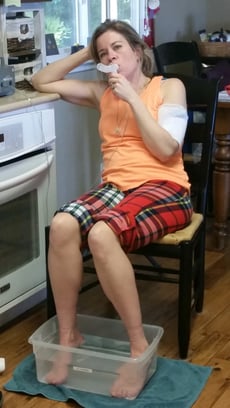 This is just one of the few private pictures I have taken. Ones that I never intended on sharing, but I am learning that vulnerability is okay. It is a small glimpse into just a few moments of years of struggles. I have been to hell and back. But I feel that the things I chose moved me forward. I regret nothing in what I have or have not chosen- I followed my instincts. I am not saying my way is the only way. I am not saying this will heal you. I am not saying other methods are better or worse. I am simply living as an open book, and if sharing what I did helps you then I am certainly not going to be quiet about it.