Archive for the ‘Transmission’ Category

Study: Lyme Can Not Survive Inside Mosquitoes Or Be Transmitted to Mice

https://www.globallymealliance.org/news/why-you-can-cross-mosquitoes-off-your-lyme-disease-worry-list?

A new study finds no evidence that mosquitoes can transmitBorrelia burgdorferi, the bacterium that causes Lyme disease. This study reinforces that ticks are the only proven source of infection.

What did the study show?

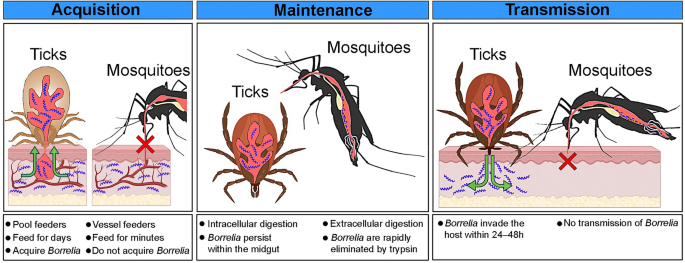
Many Lyme disease patients have questioned whether a mosquito bite could have been the source of their infection, especially as many do not remember finding a tick. This new study published just this June in the journal Parasites & Vectors offers strong reassurance that mosquitoes are not capable of carrying or transmitting the Lyme disease bacteria, Borrelia burgdorferi. Even when exposed under lab conditions, the bacteria could not survive inside mosquitoes or be passed to mice.

A diagram of insects with text
AI-generated content may be incorrect., Picture

Graphical abstract from Pekľanská et al. (2025), “Experimental evidence rules out mosquitoes as vectors of Lyme disease,” Parasites & Vectors. Image reused under an open-access Creative Commons license (CC by 4.0).

Why does this matter?

It’s common for patients to be unsure of how or when they were infected, and that’s completely understandable. Many people don’t recall a tick bite because the deer tick nymphs responsible for most Lyme disease cases are very small (the size of a poppy seed!), and their bites often go unnoticed. With that in mind, knowing Lyme disease is only spread by ticks helps patients and families focus on the right prevention strategies and worry less about every mosquito or bug bite. 

How was the study done?

To find out if mosquitoes can spread Lyme disease, scientists ran a detailed series of lab experiments. First, they let different species of mosquitoes feed on mice infected with Lyme-causing bacteria. In some cases, a few mosquitoes did pick up the bacteria, but the numbers were extremely low and the bacteria quickly died during digestion.

The researchers also tested whether the bacteria could survive long enough to be passed on to a new host, either naturally or through interrupted feeding. In every case, the answer was no. The bacteria couldn’t stay alive or infectious inside mosquitoes, and they never made it into the saliva, which is the only way a mosquito can transmit disease. 

To make sure the experiment was working properly, the researchers also included infected deer ticks, which did successfully transmit the Lyme disease bacteria to mice. These findings confirm that mosquitoes cannot maintain or transmit the bacteria that cause Lyme disease.

What is the takeaway?

This research addresses a long-standing question within the Lyme disease community about the potential role of mosquitoes in transmission. By providing evidence that mosquitoes cannot serve as competent vectors for Borrelia burgdorferi, the findings help refine public health messaging and support prevention strategies that remain focused on tick exposure.

To learn how to protect yourself and your family from ticks, visit our guide on how to be Tick AWARE.

Publication: 
Pekľanská M, Kuníková K, Vlčková R, et al. Experimental evidence rules out mosquitoes as vectors of Lyme disease. Parasit Vectors. 2025;18(1):206. Published 2025 Jun 4. doi:10.1186/s13071-025-06823-x 
_______________
**Comment**
I find it incredibly sad that we are over 40 years into this madness and it took this long for this study to be done.  Sad.
We desperately need properly done transmission studies for all things Lyme/MSIDS.
One thing to keep in mind: the study found mosquitoes seemingly can not carry or transmit Lyme.  This could change in the future with different lab techniques and technology.  Science is forever changing.
And lastly, the article makes it appear that ticks are the ONLY way to get Lyme.  This is patently false as congenital transmission has been proven.  There is also much to indicate it can be transmitted sexually as well.
The fact transmission studies have not been done shows clearly how far behind we are in knowledge of this complex illness impacting more and more people every year.

Asian Longhorned Tick Found to Carry Ehrlichia

https://www.pennlive.com/life/2025/06/tick-spreading-throughout-pa-found-to-carry-pathogen

Tick spreading throughout Pa. found to carry pathogen

Article Excerpts:

An invasive species of tick — one that’s been spreading rapidly in Pennsylvania and beyond — was just found to be the carrier of a bacterium.

A rare bacteria that might be deadly.

While WHYY mentions that scientists weren’t sure what kind of diseases — if any — these ticks may carry, new information has emerged: According to Patch, The Connecticut Agricultural Experiment Station has confirmed the first case of the Asian longhorned tick carrying Ehrlichia chaffeensis.

Ehrlichia chaffeensis is an obligately intracellular, tick-transmitted bacterium that is maintained in nature in a cycle involving at least one and perhaps several vertebrate reservoir hosts,” explains the National Institutes of Health (NIH).

Symptoms of the illness, according to Cleveland Clinic, include fever, chills and headache. Fortunately, most people make a recovery if treated quickly after a formal diagnosis by a medical professional.  (See link for article)

_______________

For more:

Massachusetts Man Dies From Tick-Borne Powassan Virus

https://www.lymedisease.org/massachusetts-powassan-death/

Massachusetts man dies from tick-borne Powassan virus

May 15, 2025

Kevin Boyce, a 62-year-old resident of the Boston area, passed away last year from Powassan virus. Now, his family is raising awareness about the risks of tick bites and urging people to take precautions.

Boyce fell ill in April 2024. Within days, his condition worsened, leading to hospitalization and a diagnosis of Powassan virus, which can cause severe brain inflammation. Despite intensive care, he succumbed to the disease several weeks later.

His family hopes to prevent similar tragedies by encouraging early detection, tick prevention measures, and public awareness. Watch this report from NBC10, Boston.

For More:

Red Meat Allergy Surges As WEF’s ‘Human Engineering’ Blueprint Becomes Reality

https://thepeoplesvoice.tv/red-meat-allergy-surges-across-america-as-wefs-human-engineering-blueprint-becomes-reality/

Red Meat Allergy Surges Across America as WEF’s ‘Human Engineering’ Blueprint Becomes Reality

Fact checked by The People’s Voice Community

A dangerous tick-borne illness that leaves victims unable to eat red meat is quietly spreading across the U.S., raising alarms years after the World Economic Forum floated the idea of using the ticks in a “human engineering” scheme to curb global meat consumption.

Known as Alpha-gal Syndrome (AGS), the condition is caused by the bite of the Lone Star tick, which injects a sugar molecule called alpha-gal into the body. This molecule triggers a potentially severe allergic reaction to red meat and other mammal-based products.

According to the Centers for Disease Control and Prevention (CDC), more than 110,000 suspected cases of Alpha-gal Syndrome were reported between 2010 and 2022, however the true number is believed to be much higher due to underdiagnosis and lack of awareness in the medical community.

Every week, I hear of more cases near me,” said Dr Ben Braddock. “Some farmers and ranchers can’t even go near their livestock. The government needs to treat this with much more urgency.”

In a 2016 panel discussion at the World Science Festival, bioethicist Dr. S. Matthew Liao explored speculative ideas about “human engineering” to address climate change, including reducing meat consumption.

Liao mentioned the Lone Star tick’s possible role in “engineering” humanity by causing red meat allergies, heralding the possibility as an example of how biology can influence dietary habits.  (See link for article and video)

______________

**Comment**

Alpha Gal Syndrome (AGS) recently made The Jimmy Dore Show.  He shares that Bill Gates, who regularly partnered with USAID, and who is a prominent globalist who wants the world’s population to be reduced, funded research into genetically engineered cattle. Suddenly, people have meat allergies.

‘Fact checkers’ are frantically debunking this, by stating only the lone star tick transmits it, but here’s the deal: AGS is relatively new.  Scientists don’t have a clue what and how many ticks can transmit it.

Gates is also behind the manufacture of GM mosquitos that have been released creating hybrid wild mosquitoes.

History has proven that proclaiming a tick only transmits this or that eventually ends up being proven false.

So far the following ticks have been identified as perps for AGS:

  • Asian longhorned tick has caused AGS in Asia, but the tick has made its way here to the U.S.
  • Cayenne tick found in South Texas and Florida has also been linked to AGS in Central America.
  • As recently as April, 2025 a pair of research papers for the FIRST TIME have identified that black-legged ticks and western black-legged ticks can also cause AGS. Please note this evidence has not been obtained by lab experiments, but a case study of a woman who developed the condition after being bitten by a western black-legged tick and a case study of another woman after being bitten by a black-legged tick.

Until ticks, birds, mammals, and reptiles get the memo that they aren’t supposed to cross boundary lines, good luck stopping them from showing up where they shouldn’t be and transmitting stuff they shouldn’t have!

I find it mind boggling that there are NO lab experiments determining what ticks transmit this considering the anaphylactic shock from it can be fatal

Plus, are you sitting down?  

  • You don’t even need a tick bite to get this.  To my knowledge, the only reason ticks have been blamed at all is because certain tick’s saliva contains trace quantities of a sugar, alpha-gal, a known human irritant that many researchers and clinicians believe induces the dangerous allergic responses that are the hallmark of AGS.  But, just because you believe something, doesn’t make it true.
  • Symptoms are often delayed making it hard to pinpoint the cause.
  • There are no insurance billing codes for AGS.
  • Since it’s not a reportable illness to the CDC, nobody has a clue about prevalence.
  • Not everyone bitten by a tick containing AGS will develop AGS and not everyone who carries antibodies to AGS will get AGS, and a positive test does not always mean a person has been exposed to alpha-gal.  Confused yet?
  • The number of lab-confirmed cases grew from 12 in 2009 to over 34,000 in 2019.
  • There’s no treatment for it – just avoiding anything that triggers symptoms.
  • Similar to Lyme, you can have coinfections with AGS, making symptoms and treatment even more challenging

Some farmers can’t go near their livestock, and for some, it’s not just meat, it’s any product made from mammals like lard, milk, cream, ice cream, cheese, gelatin, lanolin, glycerin, collagen, jello, medications, anti-venom, surgical mesh, carrageenan, ‘natural flavorings’, tallow, and vaccines.

Regarding anaphylaxis:  A 2021 study described cases of severe anaphylaxis in individuals receiving vaccines containing gelatin. The authors stated:

“Gelatin-containing vaccines should be administered with caution or avoided in patients with AGS because of their high potential to activate basophils indicating a risk for anaphylaxis.”

And of course the ‘overheating planet’ and milder winters are repeated like a mantra as the cause of all the mayhem due to ticks supposedly expanding their ranges, which has been disproven by independent science.  

Nobody ever wants to talk about the very real 50 year history of geoengineeringspraying our skies with toxic elements in the name of ‘climate change,’ or the fact our own government has experimented on and force fed ticks with pathogens and then dumped them from airplanes, conducted biological experiments on allied soldiers, and experimented on prisoners.

The Jimmy Dore Show presented that there is a new patented FDA approved genetically modified breed of pig called GalSafe pigs, which are modified to eliminate alpha-gal so those suffering from AGS can still eat pork.

The pPL657 rDNA construct which integrated into the genome consisted of the DNA sequence used to disrupt the GGTA1 gene and the sequence of the neomycin phosphotransferase (nptII) gene, an antimicrobial resistance marker.

Because the nptII gene is a known antimicrobial resistance marker, it was used as a molecular biology tool during the development of the IGA.

Based on evidence from the scientific literature, information in databases of the DNA and amino acid sequences of known food allergens and toxins, and the permitted use of the nptII gene in genetically engineered plants intended for human food, FDA concluded that it is unlikely that the protein encoded by the nptII gene is a food allergen or other human food safety hazard. Source

Well, we’ll see how that one works out…..

What do you bet that this too will lead to another patentable product?

Lyme Disease Increases Risk for Multiple Gynecological Conditions

https://www.medrxiv.org/content/10.1101/2025.03.03.25323258v1

Lyme disease increases risk for multiple gynecological conditions

Paige S. Hansen ColburnGrace BlackerSarah GallowayQingying FengPrasanna S. PadmanabhamGuido PisaniBrandon T. LeeGrace LoeserMonika W PerezKunzan LiuJade KuanEmelia von SaltzaSatu StrauszLisa M. MatteiSophie VanderWeeleGeorge R. Nahass, Amie KitjasateanphunRangarajan BharadwajHari-Hara SK PotulaMaia Atzmon ShohamFinngenVictoria L. MascettiEric GarsHanna M OllilaKaylon L. Bruner-Tran, Irving WeissmanSixian You, Beth PollackLinda GriffithNasa Sinnott-ArmstrongMichal Caspi Tal

Abstract

Lyme disease (LD) is an illness caused by the spirochete Borrelia burgdorferi (B. burgdorferi). Borrelia is known to disseminate through organs, including the skin, joints, spinal cord, bladder, and heart, leading to Lyme arthritis, neuroborreliosis, and Lyme carditis. While previous studies have investigated the impact of LD on pregnancy in both mice and humans and have found the presence of B. burgdorferi in the uterus of mice, we studied the impact of LD on the non-pregnant female reproductive tract. We use a mouse model for LD and find an ongoing and severe infection of the reproductive tract of female mice, which persists up to 15-months post-inoculation. This infection results in uterine glandular cysts and endometrial hyperplasia as well as vaginal epithelial thickening, polymorphonuclear and mononuclear cell epithelial infiltration, and epithelial desquamation into the vaginal lumen. Strikingly, we find that age has an impact on the extent of gynecologic pathology such that aged female mice (1-year old) that are reproductively senescent have more gynecologic pathology with infection compared to young mice (15-weeks old) when infected for the same length of time. Using large-scale electronic healthcare record data, we report that LD additionally results in increased infection-associated risk of:

  1. menorrhagia (1.5-fold)
  2. miscarriage (1.62-fold)
  3. uterine fibroids (1.42-fold)
  4. endometriosis (1.93-fold)

Underreporting of gynecological outcomes is pervasive throughout many different infectious diseases, and LD-associated gynecological pathologies may have been similarly underappreciated in the field. This work suggests that further study of the female reproductive tract and the effects of B. burgdorferi infection therein will help clarify and expand the knowledge of myriad LD outcomes.

For more: