Archive for the ‘Transmission’ Category

Lyme in the South: 4 Kids Infected at 1 Camp

https://danielcameronmd.com/lyme-in-the-south-children-infected-camp/

LYME DISEASE IN THE SOUTH: 4 CHILDREN INFECTED AT ONE CAMP

lyme in the south

Some doctors have questioned the existence of Lyme disease in the south, but in their “Morbidity and Mortality Weekly Report,” published January 2020, the Centers for Disease Control and Prevention (CDC) describe 4 cases of Lyme disease in young children who attended a wilderness day camp in North Carolina. [1]

The number of tick-borne diseases, including Lyme, has been steadily rising in the South as tick populations expand into new territories. One study reports, “The trends in these data paint a clear picture of southward expansion of Lyme disease.” As a result, communities once considered non-endemic for Lyme disease will be at risk, including those in the south, the study warns. [2]

The CDC recently reported several children infected with Lyme disease at a single camp, located in the south. The children, who were between the ages of 6 and 8, attended the wilderness day camp at least 1 day a week in the Fall and Spring. Three of the four children were homeschooled but attended the camp. Three children had ticks removed.

“Further investigation identified an earlier camp participant who had received a diagnosis of Lyme disease in 2017,” the authors explain.

READ MORE: Culture Evidence of Lyme disease in antibiotic-treated patients living in the Southeast

Using a “flagging and dragging” method across 0.27 acres of the camp, investigators collected 37 Ixodes Scapularis ticks, commonly called deer ticks.

Study Results

Out of 35 ticks tested, 6 were positive for B. burgdorferi sensu stricto, the causative agent of Lyme disease.

“Results indicated that nymphal ticks collected at the campsite had a B. burgdorferi infection prevalence of 17%,” the authors write.

Additionally, 1 of the 6 ticks tested positive for Borrelia miyamotoi.

None of the ticks tested positive for the pathogens responsible for Anaplasmosis or Babesia microti.

In 3 of the 4 children, blood tests confirmed a Lyme disease diagnosis. Two of the children had an erythema migrans (bull’s eye) rash. One was considered probable because the test was positive by ELISA and IgM Western blot but not IgG Western blot.

Symptoms and Treatment

The clinical presentations included brief, recurrent attacks of joint swelling, arthralgia, fever, headaches, loss of appetite, and fatigue. One had radiculoneuropathy and Bell’s palsy.

All were treated with doxycycline. The authors did not indicate how long they treated the young children or the outcome of treatment.

Authors Conclude

“Clinicians should be aware of the risk for transmission of Lyme disease in North Carolina and consider recommended diagnostic testing and treatment.”

Other studies have also identified ticks infected with the causative agent of Lyme disease in the south. One study reports, “The trends in these data paint a clear picture of southward expansion of Lyme disease.” As a result, communities once considered non-endemic for Lyme disease will be at risk, including the southeastern United States, the study warns. [2]

Editor’s note: I hope this cluster of cases in children attending a single camp in North Carolina will remind doctors of the tick-borne problems in the Southeastern USA.
References:
  1. Barbarin AM, Seagle SW, Creede S. Notes from the Field: Four Cases of Lyme Disease at an Outdoor Wilderness Camp — North Carolina, 2017 and 2019. MMWR Morb Mortal Wkly Rep. 2020 Jan 31; 69(4): 114–115.
  2. Lantos PM, Nigrovic LE, Auwaerter PG, et al. Geographic Expansion of Lyme Disease in the Southeastern United States, 2000–2014. Open Forum Infectious Diseases. 2015;2(4):ofv143. doi:10.1093/ofid/ofv143. Available at https://www.ncbi.nlm.nih.gov/pmc/articles/PMC4629694/

_________________

**Comment**

Lyme disease still is not recognized for the pandemic it truly is. This study demonstrates how authorities are still hanging on to ancient data that never was accurate to begin with.

  1. It demonstrates a Southerly tick expansion.  We’ve been told ad nauseam that ticks are expanding Northward due to climate change. Well, it’s already hot in the South so there goes that theory.  Also, independent research has already blown that theory out of the water some time ago, yet it isn’t accepted because it doesn’t fit the narrative: https://madisonarealymesupportgroup.com/2018/11/07/ticks-on-the-move-due-to-migrating-birds-and-photoperiod-not-climate-change/ This researcher claims the narrative is widely held because researchers working at institutions need ‘accepted’ topics to receive funding for their work.  In essence, those with little research experience call the shots. Ticks laugh at the weather. They just don’t care. They will find a way to survive.  https://madisonarealymesupportgroup.com/2019/06/17/ontario-public-health-officials-called-out-on-shoddy-biased-research-utilizing-an-erroneous-climate-change-model-to-program-a-futuristic-tick-problem/
  2. Lyme disease STILL isn’t widely accepted and treated appropriately.  It’s even worse in the South: https://madisonarealymesupportgroup.com/2019/04/22/its-just-crazy-why-is-lyme-disease-treatment-so-difficult-to-find-in-mississippi/, https://madisonarealymesupportgroup.com/2016/09/24/arkansas-kids-denied-lyme-treatment/, https://madisonarealymesupportgroup.com/2018/05/31/no-lyme-in-the-south-guess-again/
  3. Even with a 17% tick infection rate with Bb, 4 kids got infected. It isn’t always a linear connection between tick infection rates and human infection rates. Trust me, if you’re the sorry sucker who gets infected – it matters!
  4. Notice not all found ticks, got the EM rash, and tested positive on serology – yet those parameters are still held like an iron curtain in mainstream medicine to prove infectivity.
  5. The symptoms these kids had are hallmark Lyme symptoms.
Man Develops Fever, Arthritis in Knee & Rash After Dog Licks Insect Bite

https://www.ncbi.nlm.nih.gov/pubmed/32087981

2020 Feb 19. pii: S0151-9638(20)30077-6. doi: 10.1016/j.annder.2020.01.016. [Epub ahead of print]

[Multiple erythema annulare centrifugum associated with knee monoarthritis revealing Capnocytophagacanimorsus infection].

[Article in French]

Abstract

INTRODUCTION:

Capnocytophagacanimorsus (C. canimorsus), a commensal Gram-negative bacillus found in the oral cavity of dogs and cats, is pathogenic for humans, with the most common clinical manifestations being septicemia, meningitis and endocarditis. Herein we report a case of CC bacteremia manifesting as multiple plaques of erythema annulare centrifugum associated with monoarthritis of the knee.

PATIENTS AND METHODS:

A 66-year-old man consulted for a skin rash and monoarthritis of the right knee with fever following an insect bite on his right hallux. Cutaneous examination revealed numerous erythematous annular plaques on the trunk and limbs with centrifugal extension. Analysis of synovial fluid from the right knee showed an inflammatory liquid with a sterile bacteriological culture and PCR was negative for Borrelia. C. canimorsus bacteria were isolated from blood cultures. 16S RNA PCR performed on the synovial fluid was positive for the same organism.

The patient’s history revealed that his hallux wound had been licked by his dog.

DISCUSSION:

C. canimorsus most frequently affects immunosuppressed subjects. Cutaneous signs are seen in half of all cases, most frequently presenting as cellulitis, pathological livedo or thrombotic purpura. We report herein a case of CC bacteremia in an immunocompetent patient manifesting as multiple plaques of erythema annulare centrifugum, an unusual sign, and monoarthritis of one knee.

_______________

**Comment**

I post this because many patients have pets.  Here we see the result of a man with an insect bite on his big toe being licked by his dog.  He was in good health but developed a skin rash, fever, and arthritis in the knee joint.  

This demonstrates that many organisms can cause pain & arthritis.

For more on erythematous annular plaques:  

annular-erythema-03__WatermarkedWyJXYXRlcm1hcmtlZCJdhttps://creativecommons.org/licenses/by-nc-nd/3.0/nz/legalcode

What are the clinical features of erythema annulare centrifugum?

Erythema annulare centrifugum typically affects the thighs, buttocks, and upper arms. However, any location on the body can be affected.

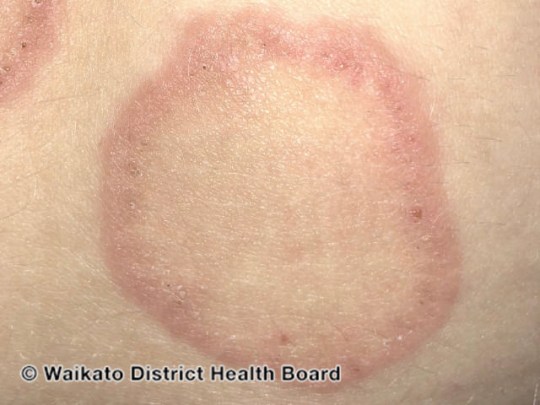
Erythema annulare centrifugum usually starts as a small pink papule that gradually enlarges over several weeks to form annular plaqueswith central clearing. These plaques can vary in size from a few millimetres to a few centimetres in size. Annular lesions can be partial (arciform) and coalesce to form polycyclic (ringed), serpiginous (wavy), and gyrate (revolving) patterns.

Classically, the annular or arciform lesions have an advancing outer erythematous edge with a trailing (inner) scaly edge. The rash may be itchy.

How is erythema annulare centrifugum diagnosed?

Erythema annulare centrifugum can sometimes be diagnosed on clinical features alone if the characteristic trailing scale is present. The diagnosis can be confirmed by skin biopsy in which the typical features of superficial or deep erythema annulare centrifugum are noted: a dense perivascular lymphocytic infiltrate involving either the superficial or deep vascular plexus, which is known as a ‘coat-sleeve’ appearance. Secondary changes to the epidermis may include spongiosis (inflammation of intercellular oedema), parakeratosis (disturbance in the keratinisation process), and hyperkeratosis (thickening of the outer layer of the epidermis) [2].  https://www.dermnetnz.org/topics/erythema-annulare-centrifugum/


Study Shows 100% of Robins Infected With Lyme & Songbirds are Spreading Lyme into New Areas

https://www.mdpi.com/2227-9032/8/1/59/htm

Healthcare 2020, 8(1), 59; https://doi.org/10.3390/healthcare8010059

Article

Monitoring of Nesting Songbirds Detects Established Population of Blacklegged Ticks and Associated Lyme Disease Endemic Area in Canada

Abstract

This study provides a novel method of documenting established populations of bird-feeding ticks. Single populations of the blacklegged tick, Ixodes scapularis, and the rabbit tick, Haemaphysalis leporispalustris, were revealed in southwestern Québec, Canada. Blacklegged tick nymphs and, similarly, larval and nymphal rabbit ticks were tested for the Lyme disease bacterium, Borrelia burgdorferi sensu lato (Bbsl), using PCR and the flagellin (flaB) gene, and 14 (42%) of 33 of blacklegged tick nymphs tested were positive. In contrast, larval and nymphal H. leporsipalustris ticks were negative for Bbsl. The occurrence of Bbsl in I. scapularis nymphs brings to light the presence of a Lyme disease endemic area at this songbird nesting locality. Because our findings denote that this area is a Lyme disease endemic area, and I. scapularis is a human-biting tick, local residents and outdoor workers must take preventive measures to avoid tick bites. Furthermore, local healthcare practitioners must include Lyme disease in their differential diagnosis.
___________________
**Comment**
The article is quick to point out that while THIS study didn’t find Bbsl in H. leporsipalustris ticks (rabbit tick), past research has.  If you read the entire study you will see the following excerpts:

4.4. H. leporispalustris Vector Competency

In this study, we did not identify Bbsl in H. leporispalustris ticks. However, Banerjee et al. detected Lyme disease spirochetes in H. leporispalustris ticks collected from a snowshoe hare, Lepus americanus, in northern Alberta [47]. As well, Scott et al. discovered Borrelia lanei-like spirochetes and a Babesia divergens-like piroplasm concurrently in a H. leporispalustris (female) collected from an eastern cottontail, Sylvilagus floridanus, in southern Manitoba [48]. Scott & Durden provide the first record of a Bbsl-positive H. leporispalustris (nymph) collected from an avian host (Swainson’s Thrush) in Canada [14]. Previously, Scott et al. found Bbsl in a H. leporispalustris larva parasitizing a passerine (Canada Warbler) in Québec suggesting that this tick species is a reservoir-competent host [8]. During southbound, fall migration in Canada, larval and nymphal H. leporispalustris frequently parasitize passerines, and are widely dispersed in southern regions.

4.5. Ticks Co-infest Songbirds

One Veery was co-infested with H. leporispalustris (one nymph and one larva), and I. scapularis (two nymphs). Not only is there a breeding colony of I. scapularis present in this Laurentian River basin, an established population of H. leporispalustris is also there. Since these ixodid ticks were collected during the nesting and fledgling period, this bird parasitism denotes a cohabitation of two tick species in this sylvan locale, and signifies that these two tick species are sympatric. The Veery has trans-border and trans-equatorial migration during its northward spring flight, and has a breeding range in southern Canada, including southwestern Québec and northern United States; the wintering range is in central and southeastern Brazil (Figure 4). During the breeding, nesting, and fledgling period, Veeries have localized activity in juxtaposition to the stationary nest. When the young have fledged the nest, these passerines replenish their fat reserves, and prepare for the southbound trek to wintering ranges in southern latitudes during August and September. In late July, they typically moult in preparation for the southbound marathon flight.
Why this is important:  because we continue to be told that ONLY the black legged tick transmits Lyme to humans.  Here we are told transmission by the rabbit tick (H. leporispalustris) is rare:  https://en.wikipedia.org/wiki/Haemaphysalis_leporispalustris
The following pathogens have been found in the rabbit tick:

The two studies used as references in the wikipedia article state the following about the rabbit tick.  While Lyme (borrelia) isn’t mentioned (but should be), Rickettsia is:

Our results support a possible role of H. leporispalustris in the enzootic maintenance of R. rickettsii in Latin America, as previously suggested by earlier works.  https://link.springer.com/article/10.1007%2Fs10493-008-9220-4

We have been able to isolate 2 strains of rickettsiae from the rabbit tick , indistinguishable from isolated from humans in our country (Costa Rica). http://www.ajtmh.org/content/journals/10.4269/ajtmh.1985.34.564

Regarding borrelia (Lyme) in the rabbit tick please note that in 4.4 above, Scott et al. found Bbsl in a H. leporispalustris larva parasitizing a Warbler suggesting that this tick species is a reservoir-competent host. In essence, the rabbit tick clearly has borrelia strains within it.  And further, during southbound, fall migration in Canada, larval and nymphal H. leporispalustris frequently parasitize passerines, and are widely dispersed in southern regions.  In essence, ticks with borrelia are infecting birds that are then going South and spreading their pathogens there.

Let’s say hypothetically that the rabbit tick is incapable of transmitting Lyme to humans.  Who’s to say that an animal that is co-infested with both black-legged ticks & rabbit ticks (as happened in this study) can’t then harbor all of these pathogens simultaneously that could in the the future be be transmitted to humans through the feedings of successive ticks?
I’m just a simple woman, but it appears to me that nobody is considering this.  They would rather look at old studies that state emphatically that only certain ticks in certain locations can transmit to humans and then smugly send patient after patient home with an anti-depressant.  Either we are all nuts or lying, OR something is happening out there that isn’t being picked up.  I vote for the latter.
The study shows that established borrelia infested ticks feeding on songbirds are spreading borrelia (and other things I’m sure) into new areas – far away from where they started and rodents are maintaining the cycle all year round.  
There is no “safe” time of the year.
Lastly, of epidemiological merit 100% of tested American Robins were positive for Bbsl.

Vector Competence Studies With Hard Ticks & Borrelia Sensu Lato Spirochetes: A Review

https://www.ncbi.nlm.nih.gov/pubmed/32067949

2019 Dec 14:101359. doi: 10.1016/j.ttbdis.2019.101359. [Epub ahead of print]

Vector competence studies with hard ticks and Borrelia burgdorferi sensu lato spirochetes: A review.

Abstract

Use of emerging technology allowing for identification of genetic material from pathogens and endosymbionts in ticks collected from humans, domestic animals, wildlife, or the environment has resulted in an avalanche of new data on tick-microorganism associations. This rapidly growing stream of new information is a tremendous resource but also presents challenges, including how detection of pathogen genetic material in ticks should best be interpreted. There is a tendency in the more recent published literature to incorrectly use the term “vector” based on detection of pathogen genetic material from tick species not experimentally confirmed to serve as vectors of the pathogen in question.

To serve as a vector of a horizontally maintained pathogen, such as a Borrelia burgdorferi sensu lato (s.l.) Lyme borreliosis spirochete, the tick species in question must be capable of acquiring the pathogen while feeding in the larval or nymphal stage on an infectious host, maintaining it transstadially through the molt, and then transmitting the pathogen to a naïve host while feeding in the subsequent nymphal or adult stage.

This review examines the experimental evidence for and against species of hard (ixodid) ticks from different genera to serve as vectors of B. burgdorferi s.l. spirochetes.

  • Of the 18 Ixodes species ticks evaluated to date, 13 were experimentally confirmed as vectors of B. burgdorferi s.l. spirochetes.
  • These studies focused primarily on the three major Lyme borreliosis agents: Borrelia burgdorferi sensu stricto, Borrelia afzelii, and Borrelia garinii.
  • In striking contrast, none of 8 tick species from other genera (1 Amblyomma species, 5 Dermacentor species, and 2 Haemaphysalis species) evaluated to date were unequivocally experimentally confirmed as vectors of B. burgdorferi s.l. spirochetes.

The strength of the evidence for or against each tick species to serve as a vector of B. burgdorferi s.l. spirochetes is discussed together with key knowledge gaps and research challenges.

_________________

**Comment**

This author, a CDC employee, is basing his findings on previous research.  There’s nothing new here.  

Also of import is the fact borrelia has been found in other ticks – just not enough for to be “statistically” important, OR in the instance of the Lone Star tick (Amblyomma americanum) there has been hot debate as to whether STARI is Lyme or not.  Patients and advocates alike claim the symptoms are one in the same.  The debate continues.

The trouble is, what if you are the poor sucker that gets bitten by that “statistically” insignificant tick?  Well, you lose because mainstream doctors are going to skim this review and conclude that ONLY certain ticks transmit Lyme/borrelia. They are going to write you off as psychosomatic:

Important excerpt:

Yes, vector competence was confirmed experimentally; No, vector competence was evaluated experimentally but could not be confirmed; Blank space, tick species not yet evaluated for this B. burgdorferi s.l. species.

There were numerous places where competence couldn’t be confirmed (which is a far cry different from it can’t happen) as well as the fact there were tons of blank spaces – which means the tick species hasn’t even been evaluated yet.

Here’s the dealeo, all ticks transfer fluid.  ALL TICKS should be suspect.  Period.  Remember all the research I’ve posted stating Lyme “didn’t exist” in various geographical places until someone pushed hard enough to get it recognized:  https://madisonarealymesupportgroup.com/2018/05/31/no-lyme-in-the-south-guess-again/

https://madisonarealymesupportgroup.com/2016/09/24/arkansas-kids-denied-lyme-treatment/

Excerpt:

According to Dr. Naveen Patil, Director of the Infectious Disease Program, ADH,

“We don’t have Lyme Disease in Arkansas, we have the ticks that transmit Lyme Disease but we don’t have any recorded cases of Lyme Disease.” 

We can thank a mother from Arkansas for getting Arkansas on the map for Lyme disease.

And so it goes:  https://madisonarealymesupportgroup.com/2017/10/24/no-lyme-in-oklahoma-yeah-right/

https://madisonarealymesupportgroup.com/2019/04/22/its-just-crazy-why-is-lyme-disease-treatment-so-difficult-to-find-in-mississippi/

https://madisonarealymesupportgroup.com/2019/11/25/hundreds-of-people-impacted-by-tick-borne-illnesses-in-north-carolina/

Tick research is similar in that until something gets documented (published), researchers and doctors alike treat it as if it’s never, ever happened, and therefore (circular reasoning) it won’t happen in the future.

Grace Period For Ticks – Nope

https://www.lymedisease.org/lyme-sci-tick-attachment-time/

LYME SCI: There’s no grace period for tick bites. Let’s quit implying that there is.