Archive for the ‘Transmission’ Category

4 New Published Articles on Ticks

https://lymediseaseassociation.org/news/james-occi-phd-4-new-published-articles-on-ticks/

James L. Occi, PhD: 4 New Published Articles on Ticks

James L. Occi, PhD
James L. Occi, PhD

James L. Occi, PhD, is the lead author of four new published articles regarding ticks over the last three years that have added to the scientific data necessary to understand the spread of ticks and the diseases they carry and transmit in the Northeast and that have provided a basis for moving the field of tick-borne diseases forward.

Jim has been on the Lyme Disease Association’s (LDA) Scientific & Professional Advisory Board since its inception in 1999.  He has been an invaluable resource to the LDA providing lectures, blogs, tick images, and consultations on ticks and the diseases they carry.

LDA Congratulates James Occi (Jim), who recently received his PhD at Rutgers University, the Center for Vector Biology (New Brunswick), and wishes him every success with his future endeavors.  He studied tick-borne diseases in New Jersey tick populations under the direction of Dr. Dina Fonseca and co-authored the below four published research articles for his dissertation.


Annotated List of the Hard Ticks (Acari: Ixodida: Ixodidae) of New Jersey,” J Med Entomol., April 2019, examines documented cases of hard ticks found in NJ.  After a thorough review of the scientific literature, government documents, and evaluation of tick collections (vouchers) in museums and other repositories, the authors determined there were 11 verifiable species of ticks found in NJ.  Nine are native to North America, while two are invasive (Asian longhorned tick and brown dog tick).  In addition, there are seven tick species that may be present or become established in the future, but confirmation with existing NJ vouchers was not found.

Five tick species were reviewed that were reported in NJ but not found in NJ vouchers or that were found within neighboring states.  The importance of vouchers for tick research and surveillance is discussed.

A detailed statewide tick surveillance program would give public health professionals and physicians information to help protect the public from tick-borne diseases.  They would be knowledgeable about what tick species were present, what the principal hosts were and what pathogens the ticks carry and transmit.  (Click here for published article)


“New Jersey-Wide Survey of Rickettsia (Proteobacteria: Rickettsiaceae) in Dermacentor variabilis and Amblyomma americanum (Acari: Ixodida: Ixodidae)” was published in Am J Trop Med Hyg., Sept. 2020, and concludes the increase in Spotted Fever Group Rickettsioses (SFGR) in NJ is unlikely to come from D. variabilis.  Infection with the tick-borne R. rickettsia bacterium causes Rocky Mountain spotted fever (RMSF) which can be fatal if left untreated.

Two tick species, that are considered Rickettsia vectors, were collected from all 21 NJ counties.  560 Dermacentor variabilis Say, American dog tick; 245 Amblyomma americanum L., lone star tick; and an additional 394 D. variabilis were collected at different time periods.   Zero D. variabilis and zero A. americanum were found to be infected with Rickettsia rickettsia.  They detected R. montanensis in D. variabilis and R. amblyommatis in A. americanum.

Collaboration among medical doctors, public health professionals, medical entomologists, and diagnostic laboratories will be needed to understand the causes of SFGR east of the Mississippi. What is causing human cases of SFGR in NJ remains unanswered. (Click here for published article)
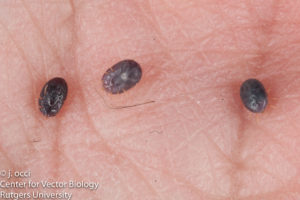

Carios kelleyi, tick vector, on hand (Photo Credit: J. Occi, Center for Vector Biology, Rutgers Univ.)
‘Carios kelleyi’ on hand (Photo Credit: J. Occi, Center for Vector Biology, Rutgers Univ.)

“First Record of Carios kelleyi (Acari: Ixodida: Argasidae) in New Jersey, United States and Implications for Public Health,” J Med Entomol., March 2021.  Carios kelleyi is a soft tick that is almost exclusively a parasite of bats and had been found in at least 29 states, Canada, Mexico, Costa Rica, Cuba, and now in New Jersey.  The nymphs and adults take several short blood meals (min. to hrs.), while the larvae remain attached for several days. Relapsing fever Borrelia is known to come from soft ticks that feed on small rodents, and when bats are removed, ticks begin to seek blood meals from humans.

C. kelleyi has been found infected with a novel spotted fever Rickettsia; a novel relapsing fever-related Borrelia;  Bartonella henselae; and a novel relapsing fever spirochete, identified as Borrelia johnsonii.

Although C. kelleyi is not thought to be an important vector of pathogens, its prevalence in bats in New Jersey is increasing.  This creates the possibility for transmission to humans, animals, and livestock.  New Jersey bats and the pathogens they carry should be monitored to assess the risk to the public. (Click here for published article)


“Ixodes scapularis (Ixodida: Ixodidae) Parasitizing an Unlikely Host: Big Brown Bats, Eptesicus fuscus (Chiroptera: Vespertilionidae), in New York State, USA,” was published in J Med Entomol, Jan. 2022.  I. scapularis is a three-host tick found throughout the Northeast, Southeast, and Upper Midwest in the U.S  and is the most common vector of tick-borne diseases to humans in North America.  It feeds on over 150 species of terrestrial vertebrates, yet it had not previously been reported to feed on bats.   During 2019 and 2020, injured big brown bats in four locations in rural NY had larvae and nymphs attached to them.  Bats are known to carry a large number of pathogens and these ticks could go from hosting on a bat to hosting on a human. This poses a significant epidemiological risk and should be investigated further.  It also threatens bat species that are at risk. (Click here for published article)
Tick Bites & Coinfections

https://www.globallymealliance.org/blog/dear-lyme-warrior-help-tick-bites-and-co-infections

Every few months, Jennifer Crystal devotes a column to answering your questions. Do you have a question for Jennifer? If so, email her at lymewarriorjennifercrystal@gmail.com.
Now that tick season is upon us, friends ask me what to do when they find an embedded tick. What should I tell them?

While this question seems like it should have a simple answer, people probably get conflicting information from the internet and even from physicians about what they should do if they find a tick. This is because there is debate about how long a tick needs to be attached to a human or pet in order to transmit the bacteria that causes Lyme disease. The old standard of 36-48 hours doesn’t necessarily apply anymore, now that we know that ticks can transmit bacteria faster if they were already partially fed before biting you, and that some tick-borne diseases can be transmitted much faster than Lyme disease—Powassan virus in as little as 15 minutes.

There are two general rules of thumb that I always tell people: the first is that the longer a tick is attached, the greater chance it has of transmitting pathogens. And unless you see the tick bite you, you can’t really know how long it’s been attached. If you notice it after a long day of hiking, you don’t know if it bit you early in the morning, or just as you were leaving. What if you don’t notice it until the next day, after you’ve done some gardening and walked through the grass? If a tick is engorged, you know it has been feeding, but it can be hard to pinpoint exactly where and when it became attached to you, which makes the certain-number-of-hours recommendation moot.

This leads to my second rule of thumb: with Lyme and other tick-borne diseases, it is always better to be safe than sorry. I tell people that if they find a tick, they should call their doctor and get right on antibiotics. Even if those antibiotics end up being prophylactic, it is safer than the alternative—finding out weeks, months or years later that they’re sick with Lyme and possibly with co-infections, too—and then needing far more extensive treatment than the initial antibiotic course. Waiting for test results (often faulty, especially early in infection), waiting for a rash (which doesn’t appear in up to 30% of people with Lyme), or waiting for other symptoms (different for everyone), is a dangerous approach to Lyme disease. (For more information, see my blog post “The Danger of ‘Waiting and Seeing’ with Lyme Disease”).

The next question is, how long a course of prophylactic antibiotics should you take? The Infectious Diseases Society of America (IDSA) recommendation of a single dose of prophylactic doxycycline is based on one study that showed good efficacy in preventing Lyme rash, but as we’ve established, not everyone with Lyme disease gets a rash. The International Lyme and Associated Diseases Society (ILADS) recommends a 10-20 day course of antibiotics. For me personally, I’d rather have the coverage of a full treatment course that is used for actual Lyme infection, rather than take my chances that a single dose will keep me safe. Each person needs to make their own decision with their doctor, but it’s important that decision be an informed one!

Do other tick-borne diseases have the same treatment as Lyme disease?

This is a great follow-up question to the first, because some people might think, “Well, if I’m taking antibiotics for Lyme disease, then I’ve got other tick-borne diseases covered.” That’s true for some co-infections, but not for all, so this, too, is dangerous thinking. Some co-infections like anaplasmosis and ehrlichiosis are treated with the same antibiotic as Lyme disease, but the length of treatment might be different. Other tick-borne diseases like babesiosis, which is a parasite that infects the red blood cells, require completely different treatment. And still another co-infection, bartonellosis, needs more urgent research for better treatments (learn more about GLA’s Bartonella Discovery Program here). I always tell people, “If you’re being treated for Lyme disease and don’t know you have babesiosis, you’re only fighting half the battle.” If you find a tick attached to you, it’s imperative that you talk to your doctor about other tick-borne diseases, not just Lyme, and know the signs of them (see “Common Tick-Borne Diseases”).

***

The Bartonella Discovery Program:

GLA is currently fundraising for The Bartonella Discovery Program, a research project bringing together some of the top researchers world-wide who are experts on Bartonellosis. These researchers will learn more about the bacteria and which treatments are most likely to cure patients like Beth, who are suffering from Bartonellosis.

None of the work GLA has accomplished would be possible without your support. To learn more and fund this project, click on top link.

Writer

Jennifer Crystal

Opinions expressed by contributors are their own. Jennifer Crystal is a writer and educator in Boston. Her work has appeared in local and national publications including Harvard Health Publishing and The Boston Globe. As a GLA columnist for over six years, her work on GLA.org has received mention in publications such as The New Yorker, weatherchannel.com, CQ Researcher, and ProHealth.com. Jennifer is a patient advocate who has dealt with chronic illness, including Lyme and other tick-borne infections. Her memoir about her medical journey is forthcoming. Contact her via email below.

Email: lymewarriorjennifercrystal@gmail.com

_________________

**COMMENT**

Before you take the 10-20 days of doxy too literally, please read this excerpt from the ILADS website:

Treatment Guidelines

Gundersen Still Giving Wrong Advice About Tick Bites

Please see my comment after the article.

https://www.gundersenhealth.org/health-wellness/be-well/how-to-remove-an-embedded-tick/

Removing ticks: The right way and the wrong way

Tick season is here! While most tick bites are harmless, some ticks can carry diseases, such as Lyme disease. Knowing what steps to take following a tick bite can reduce your risk of infection.

Remove the embedded tick as soon as possible. The longer a tick is attached, the higher the risk of transmitting tick-borne illnesses.

Follow these steps:

  • Gently pull the tick out with tweezers by grasping its head as close to the skin as possible.
  • If the head remains, try to remove with a sterile needle.
  • Wash the bite site with soap and water. Rubbing alcohol may be used to disinfect the area.
  • Apply an ice pack to reduce pain.

Avoid the following:

  • Do not grab the tick at the rear of the body
  • Do not twist or jerk tick while pulling it out
  • Do not use alternative methods to remove it; such as fingernail polish, alcohol, petroleum products, or a hot match.

Identify the tick. Take note of the size and color of the tick, whether it was attached to the skin (ticks must bite you to spread their germs), if it was engorged (full of blood) and about how long it was attached. A healthcare provider may ask you these questions if you begin to experience symptoms.

Watch for symptoms. If signs of infection, rash or flu-like symptoms occur within 30 days of the tick bite, seek medical attention.

Remember, a tick that is crawling on you but has not attached to your skin cannot infect you. However, if you find one tick, there could be more. Check your body carefully and use these tips to prevent future bites. Prevention is the best medicine.

If you have questions regarding tick bites or bug bites, contact our 24/7 Nurse Advisor Line at (608) 775-4454.

____________________

**Comment**

Taking the “wait and see” approach has doomed thousands to a life-time of misery.  Wisconsin has a high rate of infected ticks, which simply means you have a higher likelihood of becoming infected. Any risk involved with taking a few weeks of antibiotics is well worth it.  This 5 year old article states:

On average, about 22 percent of deer tick nymphs in Wisconsin have been found to be infected with Borrelia burgdorferi. The infection rate for adults is about twice as high, around 40-45 percent. In some locations, though, researchers have found infection rates as high as 75 percent of the tick population.

I assure you, it’s only getting worse.

ILADS recommends at least 20 days of doxycycline for an acute tick-bite. It’s important to remember that this mono therapy will not cover many of the confections so it’s important to track symptoms and keep in close contact with your doctor – preferably an ILADS-trained doctor who understand the nuances of treatment.  And coinfections are just as bad if not worse than Lyme disease.  Some of these infections can be transmitted within minutes and have a high mortality rate, so each and every tick bite needs to be taken as seriously as a heart attack.

This article is much more thorough.  Please file it away for future reference if you get a tick bite.

Also, go here for prevention methods.

Connecticut Reports its First Case of Tick-borne Powassan Virus in 2022: What to Know

https://www.srgblog.com/connecticut-reports-its-first-case-of-tick-borne-powassan-virus-in-2022-what-to-know/

Connecticut reports its first case of tick-borne Powassan virus in 2022: What to know

By

The Connecticut Department of Public Health announced the state’s first reported Powassan virus infection of the year this past Wednesday. Powassan virus is a rare disease spread by the same tick that causes Lyme disease, according to a recent press release. 

“The identification of a Connecticut resident with Powassan virus associated illness emphasizes the need to take actions to prevent tick bites from now through the late fall,” said Dr. Manisha Juthani, who is the commissioner of the Connecticut Department of Health.

“Using insect repellent, avoiding areas where ticks are likely, and checking carefully for ticks after being outside can reduce the chance of you or your children being infected with this virus.”

Powassan virus, first discovered in Powassan, Ontario in 1958, is usually spread through the bite of an infected black-legged or deer tick, officially known as Ixodes scapularis, and can be transmitted in as little as 15 minutes after a tick bite, but it can take a week up to one month to develop symptoms, per the release. (See link for article)

________________

SUMMARY:

  • The article regurgitates the myth that it takes 36-48 hours for a tick to transmit Lyme, when minimum transmission times have never been establishedTreat each and every tick bite as seriously as a heart attack.
  • They state infections secondary to Powassan have been recognized.  In fact, there are 19 and counting different infections ticks transmit – and they can transmit them simultaneously.
  • They falsely state that Powassan infections are rare.  What is rare, is they are rarely reportedBig difference.
  • While those who work outdoors are perhaps at greater risk, you can become infected right in your own back yard.
  • The infected Connecticut man had central nervous system symptoms and was hospitalized and diagnosed, but is now recovering at home.
  • Early symptoms look like every other tick-borne illness (headache, flu-like symptoms, and even no symptoms at all) but can rapidly progress to confusion, loss of coordination, difficulty speaking and seizures.
  • Since it’s a virus, mainstream medicine believes there is no effective treatment.  Similarly to COVID, there is.  Please see a Lyme literate doctor asap. 
  • 1 in 10 cases are fatal, with half of survivors experiencing long-term complications.
  • The article falsely states touts the EM or bulls-eye rash as an “early symptom”.  This rash is highly variable and many never get it at all.  To be clear, IF you get the rash you have Lyme disease and should immediately start treatment.  To wait is foolish and irresponsible.
  • The article ends as every single article on TBIs ends – with tick prevention.  It’s sad that I can almost state what these articles say without even reading them.  Same old, same old – nothing new here.

For more: 


Bill Gates Warns of ‘More Fatal’ COVID Variant & Calls for Pandemic Task Force Helmed by WHO to the Tune of $1 BILLION a Year

https://www.theblaze.com/news/bill-gates-2657245873?

Bill Gates warns of possible ‘more fatal’ COVID variant, calls for pandemic task force helmed by WHO that will cost $1 billion a year

Bill Gates – the software developer – gave an interview to the Financial Times where he rang the alarm about the possibility of a “more fatal” variant of COVID-19. In an interview with the British economic publication, the Microsoft billionaire petitioned for a pandemic response task force that would cost $1 billion. (See link for article)

_________________

SUMMARY:

  • Gates warns of a variant that would be more transmissible and more fatal.
  • Gates called Omicron a “type of a vaccine” that creates both B & T cell immunity, which has done a better job of getting out to the world population than man-made “vaccines.”
  • He warns there will be another pandemic with a different pathogen
  • Gates has been predicting pandemics for years.
  • He has a new book coming out this week where he outlines the need for a firefighter-like pandemic task force named “global epidemic response and mobilization,” or GERM, that would be a part of the WHO and could stop outbreaks of disease from spreading.
    • According to Keean Bexte, writing for The Counter Signal reports:

      Bill Gates has announced the creation of a pandemic “GERM” team that will monitor sovereign nations and decide when they need to suspend people’s civil liberties, force them to wear masks, and close borders.

    • Please read this article on how Gates has been buying the controlling interest in the WHO for over a decade through the Gates Foundation, as well as other organizations and enterprises he funds. As an unelected official, he has been influencing public health policy for decades. Fauci (NIAID), Collins (NIH), and Birx (doctor on the White House Coronavirus Task Force under Trump & sits on the Board of The Global Fund) have financial ties to Gates as well as Moderna, a COVID “vaccine” manufacturer.  The conflicts of interest between Gates and our public health ‘authorities’ is astounding.
    • Newsweek reported:  Bill Gates made a dry joke about tracking people using COVID vaccines while giving a talk about pandemic prevention.
    • If you haven’t read about the proposed WHO “pandemic treaty”, please do because it’s all connected.
    • And speaking of connections: top FDA officials recently wrote in JAMA that an annual COVID shot may soon become the “new normal.”  As if we couldn’t see that one coming a mile away.
  • Gates states about 3,000 full-time employees to the tune of $1 BILLION would be needed and that the WHO is the only group that is credible globally.

http://  Approx. 14 Min

May 4, 2022

http://  Approx. 15 Min

May 1, 2022

Bill Gates, Pandemic Book

Dr. John Campbell goes through Gates’ book “How to Prevent the Next Pandemic” and disagrees with Gates that there will be more seriously virulent and infectious variants of COVID.

Dr. Vanden Bossche: Science vs. Politics

http://  Approx. 14 Min

April 7, 2022

“Never vaccinate people with a live attenuated vaccine as it can cause disease.” 

“The vaccinees are going to be more susceptible to the virus.”

“You are entering into a kind of snow ball effect that is becoming bigger and bigger.”  

“The infectious pressure remains very very high. In that situation you can never, ever end the ‘pandemic.'” ~ Dr. Vanden Bossche

Dana Loesch talks with Dr. Geert Vanden Bossche who has a PHD in virology – and is a certified expert in microbiology and infectious diseases – with a long standing career in human vaccinology, and Dr. Vanden Bossche talks about the evolution from a mild variant (Omicron), to what is now being reported as more deadly variants of SARS CoV-2.

He wrote a paper for his colleagues, warning about the immediate future – so if you’d like to see what Dr. Vanden Bossche had to say about what to expect, see it here: https://uploads-ssl.webflow.com/61600…

Basically, the ‘vaccine’ is causing the immune pressure that allows the virus to evolve, because it doesn’t actually spark your immune system as traditional vaccines do – therefore the virus can survive by evolving and becoming even more severe in an endless cycle, which we can only stop by ending these ‘vaccines’ and turning to viral prophylactics (anti-viral treatments) to deal with and eliminate the threat. If this doesn’t happen the virus wins and more will die.

The data on deaths in countries WHO ARE VACCINATED has been updated with some pretty alarming numbers: https://www.economist.com/graphic-det…

For more: