Tick-borne parasite found in Scottish sheep in UK first
20 November 2019
Image copyrightGETTY IMAGESImage captionThe tick-borne parasite causes a disease called babesiosis
An exotic and potentially deadly tick-borne parasite has been found in the UK for the first time.
A study conducted by the University of Glasgow found the parasite in sheep in the north east of Scotland.
This is the first time the organism, called Babesia venatorum, has ever been found in sheep anywhere in the world.
The parasite causes a disease called babesiosis which is recognised as an emerging infection in human health.
It has been extensively recorded in China and in Europe with two human infections confirmed in Italy in the last 20 years.
Babesiosis is treatable in most cases, although this depends on rapid and accurate diagnosis.
The European Centre for Disease Prevention and Control said infected people may get symptoms such as flu and jaundice but severe cases can lead to death.
Scientists believed the risk of people contracting this infection however is believed to be low.
‘A new risk’
Researchers targeted areas where tick-borne viruses had been previously detected and collected blood from sheep, cattle and deer.
Scientists believed the parasite could have travelled to the north east of Scotland via migrating birds from Scandinavian countries.
Ticks have a considerable importance for public health.
•
Few data are present about ticks collected from humans.
•
128 ticks from 92 patients were analysed.
•
Almost 30% of the analysed tick pools were positive for Babesia spp.
•
The zoonotic species Babesia venatorum was the most prevalent species observed.
Abstract
Ticks are able to transmit several pathogens to the host while feeding, and thus are considered the most important vectors of infectious agents together with mosquitos. The global incidence of tick-borne diseases (TBDs) is rising, due to increased interactions between pathogens, hosts and vectors, linked to global changes. Given that information about the prevalence of tick-borne pathogens in ticks removed from humans in Italy are scarce, the aim of the present study was to identify the species of ticks biting humans in Northwestern Italy and tick-borne pathogens they harbour. An overall number of 128 ticks from 92 patients were collected from April to October 2018, almost 98% of which belonging to the Ixodes ricinus species. Molecular analysis showed the presence of Babesia spp. in 29 out of 93 analysed tick pools, with a Minimum Infection Rate (MIR) of 31.18% (29/93; CI95% 22.67–41.19%), while 1 out of 93 pools tested positive for SFG Rickettsiae (MIR = 1.08%; CI95% 0.19–5.84%). No samples tested positive for A. phagocytophilum and Borrelia spp. Sequencing revealed the presence of Babesia venatorum (28 pools), Theileria buffeli/orientalis complex (1 pool) and Rickettsia monacensis.Among these, B. venatorum and R. monacensis are zoonotic pathogens able to cause from moderate to severe infections in humans. These data highlight the importance of passive surveillance to assess the epidemiology of TBDs that pose a threat to human health.
It transmits numerous pathogens of medical and veterinary importance including Borrelia burgdorferi s.l. causing Lyme borreliosis, tick-borne encephalitis virus, Anaplasma phagocytophilum causing human granulocytic ehrlichiosis, Francisella tularensis causing Tularaemia, Rickettsia helvetica and Rickettsia monacensis, Babesia divergens and Babesia microti responsible for Babesiosis,Louping ill virus and Tribec virus.
The fact that 30% of ticks had Babesia should cause all doctors to pause and consider.
Bartonella is the monotypic genus of the family Bartonellaceae among Alphaproteobacteria[1]. Bartonella species are fastidious Gram-negative, slightly curved rod bacteria characterized by a small cell size (0.5–0.6 × 1.0 μm) [2]. They are facultative intracellular bacteria with a unique intraerythrocyte lifestyle. Currently the Bartonella genus includes 35 validly published species and three subspecies [3], [4]. Bartonella species usually colonize the intestine of the arthropod vector or the bloodstream of the mammalian host [4], [5]. In addition, our understanding of the involvement of these microorganisms in human diseases continues to grow, as does the range of clinical manifestations [6], [7]. At least 13 Bartonella species are responsible for human diseases, including B. bacilliformis, B. quintana and B. henselae, which cause Carrión disease, trench fever and cat-scratch disease respectively. Bartonella species are also associated with chronic bacteraemia and/or endocarditis, bacillary angiomatosis, peliosis hepatis, prolonged fever of unknown origin, retinitis, uveitis and myocarditis in humans[6]. Other mammalian species that may host Bartonella species include dogs, coyotes, foxes, cattle, deer, elk, bats and many rodent species [8], [9], [10].
Here we present the description of Bartonella massiliensis strain OS09T (= CSURB624T = DSM 23169), a new species of the genus Bartonella isolated from a soft tick, Ornithodoros sonrai, including its complete annotated genome.
Sarah LeBlanc with her 10-year-old barrel racing horse, Sloane. (Submitted by Sarah LeBlanc)
A Yarmouth, N.S., horse owner wants others to know about anaplasma, a tick-borne disease that her horse, Sloane, contracted before Halloween.
“If you see swollen legs on your horse, it means something, do something,” said Sarah LeBlanc, Sloane’s owner.
Anaplasma causes serious fevers, loss of appetite and swollen and painful limbs. If a fever is left untreated, it can lead to other complications like laminitis, which can damage a horse’s hooves. Anaplasma is rarely fatal and usually responds well to treatment.
On Monday, LeBlanc received confirmation that a blood test determined Sloane had anaplasma and Lyme disease.
LeBlanc said she first realized something was wrong with her 10-year-old barrel racing horse last Wednesday.
Sloane is responding well to treatment of anaplasma. Her owner, Sarah LeBlanc, says she first knew something was wrong when she saw Sloane’s legs were swollen. (Submitted by Sarah LeBlanc)
“If you have a horse with four swollen legs, it’s not the result of an injury, it’s got to be the result of a side effect or something,” LeBlanc said. “And so I thought I would give it 24 hours to see if it goes away on its own.”
Swollen legs aside, LeBlanc said Sloane seemed pretty normal and she was still eating.
But when a horse farrier, a person whose job it is to put horseshoes on horses, saw Sloane that night, she was advised to speak with a vet as soon as possible.
LeBlanc called Dr. Megan Crouse, a veterinarian from the South Shore Veterinary Services in Wileville, N.S., and described the symptoms. Crouse told her it could be anaplasma, a disease LeBlanc had never heard of.
Crouse told CBC News in an email that anaplasma pops up at this time of year. She said it can be treated with antibiotics, anti-inflammatory medications and supportive care.
Local vet sees uptick in anaplasma cases
Crouse said her clinic has treated between 10 to 12 cases this year and all have been in the last four weeks. She said it is spread through tick bites.
“The carrier must bite and be attached for 24 to 48 hours to spread infection,” Crouse said.
Tick prevention is key.
“Things such as keeping pastures clipped short, using fly/tick repellent daily, daily thorough tick checks are all things to help prevent exposure,” she said.
LeBlanc said she always checks Sloane and her other horse for ticks. She said there are a lot of them in her area.
“I’ve been picking hundreds of the ticks off the horses,” she said.
LeBlanc posted about the ordeal on Facebook last week and as of Monday, it has been shared about 500 times.
“It’s an illness, it’s a disease and you just can’t ignore it and let it go untreated,” she said.
The good news, LeBlanc said, is Sloane’s temperature continues to be normal and she’s responding well to the medicine.
“She seems happy and content, so she is certainly on the road to recovery,” she said.
Ticks Tick Borne Dis. 2019 Oct 17:101310. doi: 10.1016/j.ttbdis.2019.101310. [Epub ahead of print]
Presence of diverse Rickettsia spp. and absence of Borrelia burgdorferi sensu lato in ticks in an East Texas forest with reduced tick density associated with controlled burns.
As tick-borne diseases continue to emerge across the United States, there is need for a better understanding of the tick and pathogen communities in the southern states and of habitat features that influence transmission risk. We surveyed questing and on-host ticks in pine-dominated forests with various fire management regimes in the Sam Houston National Forest, a popular recreation area near Houston, Texas. Four linear transects were established- two with a history of controlled burns, and two unburned. Systematic drag sampling yielded 112 ticks from two species, Ixodes scapularis (n=73) and Amblyomma americanum (n=39), with an additional 106 questing ticks collected opportunistically from drag cloth operators.
There was a significant difference in systematically-collected questing tick density between unburned (15 and 18 ticks/1000 m2) and burned (2 and 4 ticks/1000 m2) transects. We captured 106 rodents and found 74 ticks on the rodents, predominantly Dermacentor variabilis. One unburned transect had significantly more ticks per mammal than any of the other three transects. DNA of Rickettsia species was detected in 146/292 on and off-host ticks, including the ‘Rickettsial endosymbiont of I. scapularis’ and Rickettsia amblyommatis, which are of uncertain pathogenicity to humans. Borrelia lonestari was detected in one A. americanum, while Borrelia burgdorferi sensu stricto, the agent of Lyme disease, was not detected in any tick samples. Neither Borrelia nor Rickettsia spp. were detected in any of the mammal ear biopsies (n=64) or blood samples (n=100) tested via PCR.
This study documents a high prevalence in ticks of Rickettsia spp. thought to be endosymbionts, a low prevalence of relapsing fever group Borrelia in ticks, and a lack of detection of Lyme disease-group Borrelia in both ticks and mammals in an east Texas forested recreation area. Additionally, we observed low questing tick density in areas with a history of controlled burns. These results expand knowledge of tick-borne disease ecology in east Texas which can aid in directing future investigative, modeling, and management efforts.

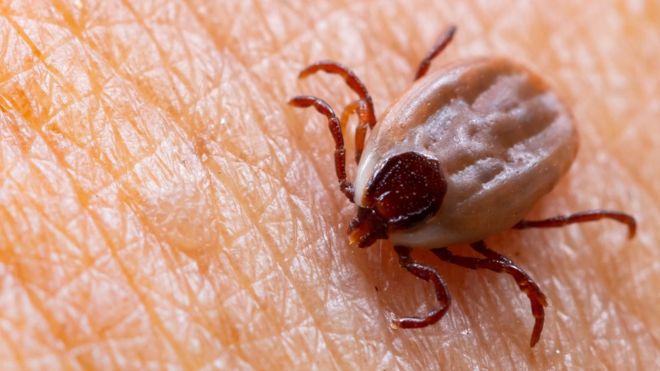 Image copyrightGETTY IMAGES


