
Two Tests Outperform Current Tests for Detecting Early Lyme Disease
Journal of Clinical Microbiology Studies Demonstrate Two Investigational Diagnostics Outperform Current Tests in Detecting Early Lyme Disease
FOR IMMEDIATE RELEASE
Journal of Clinical Microbiology Studies Demonstrate Two Investigational Diagnostics Outperform Current Tests in Detecting Early Lyme Disease
Studies utilize Bay Area Lyme Foundation’s Lyme Disease Biobank samples to point to the promise of single-tier diagnostics to potentially transform early detection
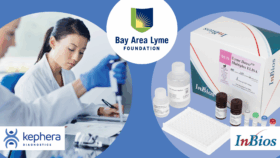
PORTOLA VALLEY, Calif., October 9, 2025 — Bay Area Lyme Foundation, the leading nonprofit funder of Lyme disease research in the US, today announced results from two independent studies published in Journal of Clinical Microbiology, conducted by researchers at Tufts University School of Medicine, and Kephera Diagnostics, respectively, demonstrating the potential of novel investigational single-tier Lyme disease tests to improve accuracy in the earliest stages of infection. Each study uses well-characterized samples from Bay Area Lyme Foundation’s Lyme Disease Biobank and demonstrated unprecedented accuracy, far exceeding the current CDC-recommended Lyme disease two-tier test, which can miss up to 70% of early-stage cases as well as later-stage cases.
“The CDC’s standard two-tier Lyme diagnostic misses the majority of early cases, delaying treatment and increasing the risk of developing persistent, debilitating symptoms for patients. The two novel single-tier assays—while not yet FDA-cleared for clinical use—point to a future where Lyme disease can be diagnosed quickly, accurately, and with a single test,” Liz Horn, PhD, MBI, a coauthor on both studies, and Principal Investigator of Lyme Disease Biobank, a Bay Area Lyme Foundation program that provides much-needed samples to approved researchers working to better understand tick-borne diseases and develop improved diagnostic tests and therapeutics. “These single tier tests, like InBios Lyme Detect™ and Kephera’s Hybrid Lyme ELISA could mark a turning point for Lyme diagnostics, giving physicians and patients more accurate tools that are urgently needed.”
The first study, evaluating the InBios Lyme Detect™ Multiplex ELISA, was conducted by Pete Gwynne, PhD, a 2022 Bay Area Lyme Emerging Leader Award (ELA) winner, and colleagues at Tufts University School of Medicine. Using samples from the Lyme Disease Biobank, this new diagnostic correctly identified all two-tier positive samples evaluated in the study, while also detecting 21 of 79 clinically diagnosed patients who were missed by following the current CDC guidance for testing using FDA-cleared standard two-tier tests (STTT) and had erythema migrans (EM) skin lesions. Importantly, the InBios test maintained >99% specificity, with only one false positive across more than 200 control and lookalike disease samples and was shown to be highly reproducible.
“Improving diagnostics for early Lyme detection is critical to reducing missed cases and enabling patient access to treatment when it is most effective, helping prevent disease progression,” said Pete Gwynne, PhD, Research Assistant Professor of Molecular Biology and Microbiology at Tufts University School of Medicine. “The use of Lyme Disease Biobank samples to validate this research highlights the important role biorepositories can play in innovative science.”
InBios’ microarray-based assay is designed to capture reactivity against a set of 10 different Borrelia burgdorferi antigens simultaneously including VlsE and multiple OspC variants, and it uses machine learning to analyze results, identifying complex patterns.
“The Lyme Detect Multiplex ELISA offers a significant improvement in early Lyme detection while simultaneously providing important independent IgG and IgM antibody reactivity against a broad panel of targets,” said James Needham, PhD, Director of New Product Development at InBios International.
Another recent independent study published in the Journal of Clinical Microbiology in August found Kephera Diagnostics’ Hybrid Lyme ELISA demonstrated 94% sensitivity in patients with EM skin lesions, compared to just 64% for STTT and 76% for modified two-tier testing (MTTT). The Hybrid Lyme ELISA likewise outperformed both two-tier methods in detection of EM patients within the first week after onset of symptoms. This single-tier test achieved equivalent specificity to both STTT and MTTT, based on a unique approach that requires antibodies to bind both the Borrelia C6 peptide and the VlsE protein. The test is now in clinical trials to support an FDA submission.
“Our Hybrid Lyme ELISA demonstrates that it’s possible to achieve both high sensitivity and high specificity in a single-tier format, even in the earliest stages of Lyme disease,” said Andrew Levin, PhD, Chief Executive and Scientific Officer of Kephera Diagnostics, who led this study using samples from the Lyme Disease Biobank, the CDC, and New York Medical College. “Access to well-characterized samples was essential to validating this approach and moving the field closer to a reliable, first-line diagnostic for Lyme.”
About Lyme disease
The most common vector-borne infectious disease in the US, Lyme disease is a potentially disabling infection caused by bacteria transmitted through the bite of an infected tick to people and pets, and can be potentially passed from a pregnant mother to her unborn baby. If caught early, most cases of Lyme disease can be effectively treated, but it is commonly misdiagnosed due to lack of awareness and inaccurate diagnostic tests. There are more than 620,000 new cases of Lyme disease each year, according to Bay Area Lyme Foundation estimates. As a result of the difficulty in diagnosing and treating Lyme disease, up to two million Americans may be suffering from the impact of its debilitating long-term symptoms and complications, according to Bay Area Lyme Foundation estimates.
About Lyme Disease Biobank
Lyme Disease Biobank (LDB), a program of Bay Area Lyme Foundation, is a non-profit organization working to accelerate research of Lyme disease and other tick-borne infections. With a collection of biological specimens from more than 1,250 participants, including blood, serum, plasma, urine and tissue, LDB provides much-needed samples to approved researchers working to better understand tick-borne diseases and develop improved diagnostic tests and therapeutics. Blood and urine samples are collected from the Northeast, Upper Midwest and West Coast areas of the US, and tissue samples are collected throughout the country. Researchers interested in obtaining samples should visit www.lymebiobank.org or contact info@lymebiobank.org.
About Bay Area Lyme Foundation
Bay Area Lyme Foundation, a national organization committed to making Lyme disease easy to diagnose and simple to cure, is the leading public charity sponsor of innovative Lyme disease research in the US. A 501c3 organization based in Silicon Valley, Bay Area Lyme Foundation collaborates with world-class scientists and institutions to accelerate medical breakthroughs for Lyme disease. It is also dedicated to providing reliable, fact-based information so that prevention and the importance of early treatment are common knowledge. Historically, a pivotal donation from the LaureL STEM fund covered all overhead costs through 2024. In 2023, a Bay Area Lyme Endowment was formed, which allows for 100% of all donor contributions to the Bay Area Lyme Foundation to go directly to research and prevention programs in perpetuity. For more information about Lyme disease or to get involved, visit www.bayarealyme.org or call us at 650-530-2439.
About InBios
Since 1996, InBios has been a leader in the development of diagnostic tests for emerging infectious diseases and biothreats. Products are designed for superior performance, efficiency and value. These include several FDA market authorized and CE marked assays for arboviruses, parasitic infections, biothreats, and more. InBios continues to anticipate and serve the growing global public health demand. Products in the pipeline include next generation platforms for Chagas, dengue, tick-borne and respiratory diseases. For more information, visit www.inbios.com.
About Kephera Diagnostics
Kephera Diagnostics is a young and growing company that is addressing the public health challenges of global infectious diseases using new assay technologies. We also operate a CLIA-certified and CAP-accredited diagnostic laboratory delivering excellence in specialized diagnostics. We focus on diagnostic solutions for diseases where there are significant gaps in addressing patient needs, particularly in underserved areas of healthcare including infectious diseases and women’s health. Our mission is to promote more effective and affordable medical treatment through faster diagnosis. We collaborate with a global community of researchers and clinicians to develop and translate new technologies into accessible products for clinical diagnostics and research applications.
# # #
Media Contact:
Tara DiMilia
Phone: 908-369-7168
Tara.DiMilia@tmstrat.com
______________
**Comment**
Not sure why Bay Area Foundation is stating that congenital Lyme can potentially happen. It can happen – period and 33 years of of documentation proves it.
Interesting to note:
“study co-author Gary P. Wormser, MD, New York Medical College said, “This test [Kephera Diagnostics’s Hybrid Lyme ELISA] could potentially change the standard of clinical practice, allowing clinicians to diagnose all manifestations of Lyme disease with a time-saving one-step antibody test.”
Why the Lyme/MSIDS community is still working with Gary Wormser is beyond me. His track record is clear.
Having a quicker, more accurate test for early Lyme is important, but so is an accurate test for the thousands upon thousands who are chronically infected.
It will be interesting to see what ‘the powers that be’ do with all these new tests coming out. The concerted effort against direct testing or any test that is deemed competition to FDA/CDC testing has been decades in the making.
-
- Just yesterday I posted about IGeneX’s new FDA cleared Lyme ImmunoBlot tests: https://madisonarealymesupportgroup.com/2025/10/09/inside-igenexs-new-lyme-test/
- In 2024 ID-Fish Technology announced that iDart Lyme IgG ImmunoBlot Kit is FDA cleared: https://www.cidrap.umn.edu/lyme-disease/fda-clears-new-lyme-disease-test
- Then there’s LymeSeek, from Aces Diagnostics, a multiplexed antigen assay which tests for 10 different immune responses at once which is in clinical trials: https://madisonarealymesupportgroup.com/2025/09/17/lymeseek-test-promises-earlier-more-accurate-diagnosis/


 Madison Area Lyme Support Group