Archive for the ‘Testing’ Category

Lyme Disease, Tests & Treatment: A Review of the Controversy on the Effectiveness of Biological Tests & Proof of the Existence of a Chronic Form

https://www.fortunejournals.com/articles/lyme-disease-tests-and-treatment-a-review-of-the-controversy-on-the-ineffectiveness-of-biological-tests-and-proof-of-the-existence.

Lyme Disease, Tests and Treatment: A Review of The Controversy on The Ineffectiveness of Biological Tests and Proof of The Existence of A Chronic Form

Alexis Lacout*, 1, Christian Perronne2

1Centre de diagnostic, ELSAN, Centre médico –chirurgical, 83 avenue Charles de Gaulle, Aurillac, France

2Infectious and tropical diseases, Paris, France

*Corresponding author: Alexis Lacout, Centre de diagnostic, ELSAN, Centre médico –chirurgical, 83 avenue Charles de Gaulle, Aurillac, France

Received: 04 December 2024; Accepted: 09 December 2024; Published: 27 December 2024

Article Information

Citation: Alexis Lacout, Christian Perronne. Lyme Disease, Tests and Treatment: A Review of The Controversy on The Ineffectiveness of Biological Tests and Proof of The Existence of A Chronic Form. Archives of Microbiology and Immunology. 8 (2024): 543-561.

DOI: 10.26502/ami.936500203

View / Download PdfShare at Facebook

Abstract

Lyme disease is caused by infection with the bacterium Borrelia burgdorferi. Other species of Borrelia have been discovered and cause similar diseases. The first described species, Borrelia burgdorferi sensu stricto, was isolated in the United States. Lyme disease is a great imitator that can resemble many illnesses, including autoimmune diseases. ELISA and Western Blot diagnostic tests, which are supposed to have a sensitivity of almost 100%, are in fact often negative in many patients with genuine Lyme disease. These tests are poorly calibrated, of mediocre quality, with an arbitrarily defined threshold for antibody positivity, so that no more than 50% of patients with a positive test are ever found. Controversy surrounds the existence of the chronic form. However, chronicity is observed in many patients, and the mechanisms of Borrelia persistence are well documented in the literature. Recently, in 2018, the Haute Autorité de Santé (French National Authority for Health) defined SPPT (Syndrome Persistant Polymorphe Après-Piqure de Tique), enables empirical antibiotic treatment even in the absence of erythema migrans and with negative Lyme serology. Lyme disease is frequently associated with a number of other infections known as co-infections, whether parasitic, bacterial or viral. Treatment must be effective against Borrelia and other co-infections. A long course of antibiotics lasting several weeks or months may be required. Relapses are frequent when treatment is stopped, due to Borrelia’s persistence mechanisms, and require rapid reintroduction of previously effective treatments. Denial of the scientific realities described in this article has resulted in hundreds of thousands of patients wandering around with untreated, disabling symptoms, despite the fact that appropriate, low-cost anti-infective treatment enables remission in many cases.

For more:

Understanding Tick-Borne Disease Testing in 2026

http://

Understanding Tick-Borne Disease Testing in 2026

IGeneX Inc.

Tick-borne diseases continue to be among the most complex and misunderstood conditions in modern medicine. As the landscape of diagnostics evolves rapidly, clinicians and healthcare professionals face increasing challenges—and opportunities—in accurately identifying infections, co-infections, and immune responses that directly impact patient outcomes.
 
In this forward-looking IGeneX webinar, learn how advances in laboratory science, expanded pathogen detection, and improved testing methodologies are reshaping the way tick-borne diseases are evaluated and managed. Attendees will gain a clear, practical understanding of how modern diagnostics are addressing longstanding limitations in sensitivity, specificity, and clinical interpretation.
 
This session will examine:
  • The current and emerging challenges in tick-borne disease testing, including evolving pathogens, regional variability, and complex clinical presentations
  • Advances in diagnostic technologies, such as enhanced immunoblots, cellular immune assays, and expanded multi-species detection
  • How testing has evolved beyond single-pathogen models to better identify co-infections and immune dysfunction
  • The role of clinical context in test interpretation, and how modern diagnostics support more informed decision-making
  • What to expect in 2026 and beyond, including trends in test development, regulatory considerations, and data-driven diagnostics

Designed for physicians, nurse practitioners, physician assistants, and other healthcare professionals involved in diagnosing and managing tick-borne diseases, this webinar bridges the gap between laboratory innovation and real-world clinical practice. Whether you are new to advanced tick-borne testing or looking to stay ahead of emerging diagnostic trends, this session will provide actionable insights to support more confident testing strategies and improved patient care.

For more:


Scientists Issue Warning Over Rise to Ticks Carrying Multiple Diseases

https://www.newsweek.com/us-northeast-warned-rise-multiple-disease-bearing-ticks

Scientists Issue Warning Over Rise of Ticks Carrying Multiple Diseases

By 

Ticks capable of carrying and transmitting more than one potentially fatal disease at the same time are becoming increasingly common in the northeastern U.S., according to a new long-term analysis that raises fresh public health concerns for the region.

The research found that a growing share of blacklegged ticks—also known as deer ticks—are infected with multiple disease-causing pathogens. The study was led by Cary Institute of Ecosystem Studies disease ecologist Shannon LaDeau and conducted in partnership with the SUNY Center for Vector-Borne Diseases at Upstate Medical University.

The findings come from nearly a decade of tick surveillance and point to a more complex and potentially dangerous tick-borne disease landscape, particularly because different infections require different treatments.

“Healthcare workers should be on the lookout for rising co-infection risks,” LaDeau said in a statement. “And for people spending time outdoors in the Northeast, as a general rule, if the ground is not freezing, it’s a good idea to take precautions to avoid tick bites. Prevention is key.”  (See link for article)

_____________

Findings:

  • 1 in10 nymphs tested positive for at least two pathogens: Borrelia burgdorferi (19.3%) and Babesia microti (21%) were the most common followed by Anaplasma phagocytophilum (5.8%) and Borrelia miyamotoi (2%)
  • by the end of the study period 11% of sampled ticks had coinfections
  • coinfection rate has been increasing over time
  • 38% of nymphs were capable of transmitting at least one disease to humans

For more:


Podcast: Why Lyme Disease Happens to Some People and Not Others

https://www.lymedisease.org/why-lyme-happens-some-not-others/  Go here for video

PODCAST: Why Lyme disease happens to some people and not others

By Fred Diamond

One of the most common questions I hear from Lyme survivors is simple but deeply loaded: “Why did this happen to me? Why did I get Lyme when others didn’t?”

If you’ve ever asked yourself, “Why me?” know that you’re not alone.

Thousands of Lyme survivors have pondered that same question. They were healthy. They were hiking. They were gardening. They were kayaking. They were simply living their lives. And then something changed.

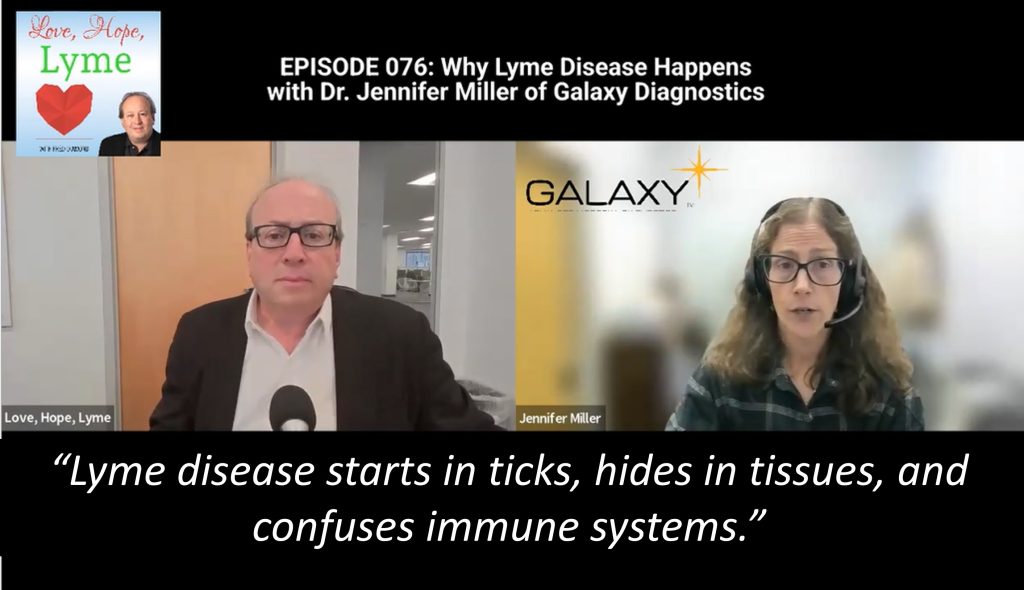
On this week’s Love, Hope, Lyme podcast, Dr. Jennifer Miller of Galaxy Diagnostics, a scientist who has spent her career studying the Lyme bacterium, Borrelia burgdorferi, discusses why Lyme happens and why its effect may differ from person to person.

Her explanation reveals just how complex, and insidiously strategic, this organism truly is.
It starts in the wild

Lyme disease is what scientists call a vector-borne infection. In simple terms, that means it is transmitted by a vector and in this case, ticks.

But ticks are not born infected.

“The tick has to pick it up from a host that’s already infected,” Dr. Miller explains. “The larval tick will feed on an infected animal… and acquire the infection.”

That infected animal is usually a small mammal such as a mouse, chipmunk, or squirrel. These animals act as reservoir hosts. They carry the bacteria without becoming visibly sick.

After feeding, the tick molts into a nymph which is the stage most responsible for transmitting Lyme to humans. Nymphs are tiny, often no bigger than a poppy seed, and difficult to detect.

Many people assume deer are the main source of Lyme. Dr. Miller clarifies the nuance.

“Deer can have Lyme disease, but people aren’t going to get it from a deer.”

Deer play a role in the tick life cycle, but they are not the direct cause of human infection. The real issue is ecological.

“Because we have all these reservoir hosts, it’s a big part of the problem as to why Lyme disease incidence is increasing and why it’s spreading,” she says. “As humans, we occupy and consume more and more space… we’re encroaching on the territory of the deer, and with that, very unfortunately, comes Lyme disease.”

In other words, Lyme is not random. It is the byproduct of an expanding interface between humans and the natural infection cycle.

Borrelia is not an ordinary bacterium

Lyme disease is caused by a bacterium, not a virus, but it behaves unlike most bacteria.

Borrelia belongs to a family called spirochetes. It has a corkscrew shape that gives it unusual mobility.

“Borrelia will literally outrun the immune system,” Dr. Miller says. “Because it’s a corkscrew, it literally will burrow into the tissues.”

That corkscrew motion allows it to penetrate deeply into connective tissue, joints, and even cross protective barriers like the blood-brain barrier.

Even more concerning, Borrelia is highly adaptive.

“It literally will coat itself with host proteins. That allows it to evade immune detection.”

Camouflage

In essence, the bacterium can camouflage itself. It changes the proteins on its surface depending on whether it is inside a tick or inside a human. Once inside the body, it can alter its “coat” again to hide from immune surveillance.

Unlike some bacteria that cause disease by releasing toxins, Borrelia’s damage often comes indirectly.

“They’re not making toxins or poisons like other bacteria,” Dr. Miller explains. “But a lot of what happens with Borrelia is triggered by the immune system.”

The medical literature uses the phrase immune dysregulation to describe this phenomenon.

“Borrelia really interferes with the immune system,” she says.

In some individuals, the immune response becomes excessive and inflammatory, leading to joint damage, neurological symptoms, and widespread pain. In others, the immune response is blunted or misdirected, allowing the bacterium to persist quietly.

Why do some people get so sick while others don’t?

This may be the most painful question Lyme survivors ask.

“That’s still the biggest question that we need to answer,” Dr. Miller says candidly. “What I’ll tell you quite openly is that we don’t have all the answers.”

But there are clues.

Different strains of Borrelia produce slightly different surface proteins.

“Depending on which version of those proteins they’re making, some of those versions disagree with certain humans more than others.”

Some strains provoke a strong immune reaction. Others may slip past immune detection more easily.

Borrelia also actively interferes with antibody production.

“Borrelia will interfere with the timing of the antibody response. It interferes with the strength of the antibody response,” she explains. “It will trick them and confuse them so that they don’t produce antibodies in the right timeframe or of the right strength.”

This has enormous implications. If the immune system does not respond in a predictable way, both symptoms and laboratory tests become harder to interpret.

Host factors matter too. Genetics, previous infections such as Epstein-Barr virus, co-infections, mold exposure, chronic stress, and environmental burdens may all influence how a person responds.

There is likely no single reason why one person clears infection and another develops chronic symptoms. It is a complex interaction between pathogen and host.

The complication of co-infections

Lyme rarely travels alone.

“The number of different pathogens that were in the tick was far more than anybody would’ve thought… easily dozens,” Dr. Miller notes.

Ticks may carry Borrelia along with Babesia (a parasite similar in some ways to malaria), Bartonella (a different type of bacteria), Anaplasma, Ehrlichia, and even viral pathogens.

“You really have a lot of diversity of pathogens with these co-infections. That’s part of why they can be so very difficult to treat.”

A tick can acquire pathogens from one animal, survive the molt, then feed on another animal and acquire additional organisms. Birds, which can transport infected ticks across geographic regions, add another layer of complexity.

This microbial diversity means that two people bitten by ticks in different environments may experience very different symptom patterns.

Why testing fails so often

Few topics frustrate Lyme patients more than testing.

The standard two-tier antibody testing protocol has been in use for more than three decades. It measures antibodies but not the bacteria itself.

“The current tests are detecting that antibody response, and that can be very tricky,” Dr. Miller explains.

Antibodies only tell you that your immune system has seen the pathogen at some point. They do not reliably indicate active infection. And because Borrelia interferes with antibody production, some people never produce a strong enough response to meet diagnostic thresholds.

“Not everybody even generates an antibody response to Borrelia, one that’s strong enough or in line with what our out-of-date tests measure.”

False negatives can occur. Partial antibody bands may appear but not meet reporting criteria. Cross-reactivity with other infections can create additional confusion.

Adding to the challenge, Borrelia does not remain in high concentrations in the bloodstream.

“They don’t hide out at large numbers in the blood. There’s just not a lot of Borrelia in the blood.”

After transmission through the skin, the bacteria migrate into tissues. Blood-based detection becomes inherently difficult. This is why some researchers are working to develop direct detection methods, including antigen testing strategies.

“Borrelia are unique,” Dr. Miller explains. “When Borrelia shed their outer proteins it just gets released into the environment.”

Unlike many bacteria, Borrelia sheds structural components that may be detectable in other bodily fluids, offering a potential alternative to antibody-based testing.

A final word to patients

Lyme disease is biologically complex. It is ecologically driven. It is immunologically disruptive, and it does not behave like many other infections.

The science is still evolving. Researchers do not have all the answers.

But one thing is clear.

“If you think you have symptoms of Lyme disease and you haven’t seen a tick and you don’t have that bull’s-eye rash, please don’t assume that you don’t have Lyme disease,” Dr. Miller urges. “Go and get checked out.”

For survivors searching for understanding, the question why did this happen may never have a simple answer. But understanding biology, ticks, the bacterium, the immune system, and the co-infections can bring clarity.

And the more we understand that organism, the closer we move toward better diagnostics, better treatments, and better outcomes for every Lyme survivor.

Visit the Galaxy Diagnostics website to learn more about Lyme disease testing.

Click here to listen to all episodes of the Love, Hope, Lyme Podcast or on YouTube.

Yet Another Mainstream Media Hit Piece Minimizing Lyme Disease

https://www.cbc.ca/player/play/video/9.7048962

Why do so many celebrities have Lyme disease?

January 17, 2026

  1. Pulling a tick off before 24 guarantees nothing. Pathogens can be in the salivary glands which means transmission can and does happen rapidly.  They should have interviewed independent Canadian tick researcher John Scott.  He immediately would have set them straight on all things tick related.
  2. Early antibiotic treatment has to be early enough, long enough, and smart enough, but again, does not a guarantee a person will not develop a chronic infection requiring years of complex, expensive, and savvy treatment, not to mention the fact untold numbers are misdiagnosed or undiagnosed – making their cases even tougher because they weren’t caught early.  This large subgroup is simply kicked to the curb.
  3. There are other pathogens complicating the picture besides multiple strains of borrelia that cause disease and are transmitted by ticks.  They each require different treatments but aren’t even mentioned in this piece.
  4. The ‘experts’ that say there are ‘no risk areas’ are full of beans. To date, ticks are marching into places they’ve never been before, yet because of Andrew Spielman‘s antiquated and faulty maps of where ticks supposedly are and are not, untold numbers are being denied diagnoses and treatment.  See: the-counfounding-debate-over-lyme-in-the-south-speilmans-maps.  The fact ticks travel globally on birds,  reptiles, and mammals, as well as the fact our government spread ticks via airplane hasn’t helped either.
  5. ‘Early Lyme’ being ‘straight forward’ to diagnose is laughable.  This website has recorded story after story of those who were misdiagnosed and sent home only worsen into chronic Lyme. Doctors are still telling people with an EM rash that it’s just a spider bite, and sending them packing. In my experience, most patients have to figure it all out themselves. Lyme/MSIDS has been called a ‘do it yourself plague.’
  6. The reporter states that in 2024, Canada had 5,700 reported cases of Lyme. In the U.S. even the corrupt CDC admits that the number of Lyme disease cases is likely much higher than reported, due to under-reporting and changes in surveillance methods. In 2024 in the U.S., reported cases of Lyme disease rose from an average of about 37,000 from 2017–2019 to 62,000 in 2022. That’s an increase of nearly 70%. In order to report a case, you must meet the strict and arbitrary CDC reporting criteria using a test that is only 50% sensitive in the early phase of disease. Further, each state has their own voluntary reporting standards and ‘low incidence’ states are held to a stricter standard by having to show not only positive lab evidence, but clinical info which puts a heavy burden on local health officials. Lack of awareness and under-diagnosis is still a known long-standing issue for many states including California. You can’t count something that hasn’t been reported and you can’t report something you aren’t educated about. Due to these issues, the CDC includes insurance claim data to estimate cases. In 2021, there were 24,611 cases reported but the CDC estimated the actual number to be 476,000.  In the past, the CDC has said that Lyme disease cases are underreported by a factor of 10, which if used for 2024 – would total 620,000 annual cases.  Source Hopefully, it’s clear to see all of this is very unclear!
  7. Chronic Lyme is recognized by science, but you have to depart from IDSA ‘approved’ science, look at the global science, and realize Lyme/MSIDS will never fit neatly into a large randomized controlled trial (RCT). RCTs were designed for standardized drug testing, not complex, multi-systemic conditions such as Lyme/MSIDS.  This is something ‘mainstream’ medicine refuses to acknowledge, and the media blindly follows. Lyme science has been rigged from the get-go and continues to entirely omit the sickest patients due to how they create the study design for research.
  8. The doctor who spoke in the news story, Dr. Paul Auwaerter of Johns Hopkins has a long, known history of denying chronic Lyme. He only presents one side of a very disputed coin. To only choose to represent one side and over emphasizing that there’s a ‘whole industry created for chronic Lyme that’s taking advantage of people’ is not only unethical from a journalistic perspective, it ignores people like me, my husband, and virtually every single patient I work with who very well might be dead without this life-saving treatment.  Unconscionable.  
  9. All independent testing is presented as quackery – a long used trick of the establishment to monopolize testing. Cabalists spout ‘unvalidated’ test, as if there’s a true gold standard.  Make no mistake, currently ALL testing for tick-borne disease is abysmal – and everyone knows it until biased pieces like this are presented and they revert back to regurgitating and not thinking.
  10. Since the report is made by CBC News in Canada, they should have at least interviewed Vett Lloyd, a biology professor at Mount Allison University in New Brunswick, who says most Lyme cases are missed with the standard test. She co-authored a study  with Dr. Ralph Hawkins, a clinical associate professor at the University of Calgary, using data from New Brunswick where they found the two-tiered tests miss 90 per cent of real Lyme infections. In Ontario, she says about 80 per cent of cases are missed.
  11. Current testing relies upon measuring antibodies that take 4-6 weeks to develop, can not distinguish between active infection from prior exposure or measure response to treatment.  The window for accurate testing is so small that only a handful of those infected are getting positives.  Trust me, there’s few false negatives. As Dr. McDonald aptly states:

    “If false results are to be feared, it is the false negative result which holds the greatest peril for the patient.” –Alan McDonald, Pathologist

  12.  Cabalists admit early diagnosis and treatment is best as the infection worsens with time, so how does a test that takes over a month to work help at all?
  13. A gold standard culture method test did exist but was disappeared due to the CDC testing monopoly.  There’s been a long and concerted effort to suppress direct detection tests.  In 2025, a study showed two investigational diagnostics outperform current tests for early detection yet nothing changes.
  14. The same doctor would rather regurgitate the long-held Cabalist phrase of ‘medically unexplained symptoms,’ (MUS) as the cause of why people are unwell than dare to even consider tick-borne infections and learn from ILADS.
  15. The journalist continues following the Cabalist MO when she makes sure to politely empathize that there are sick people who feel dismissed by the system, but that ‘private testing’ comes with significant risk – and then cites a paper done with the same faulty study design by none other than Dr. Paul Auwaerter, the same doctor who denies chronic Lyme and uses the MUS diagnosis so freely.  Seeing a trend yet?
  16. Treatment for early Lyme disease is not so ‘simple,’ due to the fact that many continue with symptoms – proving it’s obviously not working! Not to mention treatment failures have been seen in nearly every antibiotic study ever done. 
  17. It is not rare to have chronic Lyme when you consider the fact researchers only count those who are diagnosed and treated early into this group. When you add in those diagnosed and treated late, a whopping 40-60% go on to suffer long-term symptoms.
  18. The piece uses the infamous Cabalist term ‘Post Treatment Lyme Disease Syndrome’ (PTLDS) which is horribly inaccurate, and faulty to the core. Then, while stating it’s ‘incurable,’ the report bashes alternative treatments and gives the ancient yet faulty 2001 Klempner study as ‘proof’ long term antibiotics don’t work and carry significant risks. In other words, just accept your sad, sorry lot, stay sick, and die already.
  19. The piece finishes with stating the media needs to be more critical of extremely ill celebrities who claim they have Lyme disease – as if being sick isn’t hard enough! Imagine if this was posited for cancer patients!  Can you even imagine?  Yet, it’s perfectly fine to dismiss Lyme/MSIDS patients.
  20. Another issue completely bypassed by this piece is that due to the controversy, doctors are too afraid to diagnose and treat patients, giving yet another reason for massive underreporting. For decades doctors have had to close their practices or have been sanctioned and have had to pay hefty fines.  My own doctor went through this gauntlet, paying 50K to protect his practice.  This is why LLMD’s do not accept insurance.  It’s quite often the insurance companies turning them in.  All of this plays a part in this Shakespearian like tragedy and should be fairly represented.

It’s high time the media wakes up and smells the coffee.  There was once a time when journalists endeavored to be unbiased, present the various sides of a story, and let the reader/viewer come to their own conclusions.  Sadly, those days appear to be long gone.  My journalism profs are rolling over in their graves.