Archive for the ‘research’ Category

Stevia – Clinical Trial Underway

http://www.newhaven.edu/news/releases/2016-2017/professor-and-her-students-may-have-found-a-cure-for-lyme-disease.php#.WYxm4eOZNkI.linkedin

University of New Haven Professor and Her Students May Have Found a Cure for Lyme Disease

July 07, 2017

Could a common sweetener that’s already in the kitchen cupboards in many American homes — stevia — prove to be an effective treatment for a disease as debilitating and persistent as Lyme disease?

It’s too early to say that for sure, but research by Eva Sapi, a University of New Haven professor of cellular and molecular biology, and the students in her Lyme Disease Research Group looks promising.

In a paper published in the European Journal of Microbiology & Immunology, Eva Sapi and her students found that the most antibiotic resistant form of Borrelia burgdorferi, the bacteria that causes Lyme disease — called biofilm — actually increased in mass with individual antibiotics.

But liquid, whole-leaf stevia extract — not the powdered varieties that people most commonly use — reduced the biofilm mass by about 40 percent, they found.

UNH professor could have cure for Lyme disease

“Is it the one?” Sapi asked. “I don’t know.” But in confirmation test after confirmation test, “that is the one that jumped out.”

A small clinical trial based out of New York got underway just a few months ago, and researchers there are using stevia along with antibiotics to try and treat Lyme disease, while others are taking the extract themselves.

“I’ve got emails from people saying they’re getting better, but again, we need to have double-blind clinical trials before we say ‘yes’. Everybody is holding their breath to see if it helps, and let’s hope for it. That would be wonderful.” 
– Professor Eva Sapi, Ph.D

WFSB 3 CT News (Go to link at top of page for News video)

For more on Stevia:  https://madisonarealymesupportgroup.com/2015/11/19/stevia-and-bb/

Study excerpt:

In this study, we provided evidence that Stevia A, as an individual agent, was capable of eliminating the spirochetes and the persisters of Borrelia similar to the reported three-drug combination treatment. Our data also showed that the antibiotics in combination on the persist- ers of Borrelia was indeed consistent with the previous study [30]; this result further confirms the effectiveness of Stevia A.

**Please note Sapi tried numerous forms of Stevia and only some were effective.  The exact Stevia product is not mentioned.  Also, please remember all of this was done in vitro (test tube).  How that plays out in vivo (the human body) has yet to be determined.

Also:

In a study using a sugar alcohol, it was reported that xylitol acts as an antiplaque agent by disrupting the formation of biofilms in the oral cavity [54]. In another study, they showed that xylitol affects the production of adhesive polysaccharides of Streptococcus mutans [55].

It was previously shown that sugars prime the uptake of antibiotics in Staphylococcus aureus and Escherichia coli [56]. Based on these previous findings, we hypothesize that Stevia could act as a sugar derivative, which might prime the uptake of the phytochemicals responsible for the antimicrobial effect and, thereby, disrupt the biofilm structure.

I know of certain LLMD’s who use Stevia or Xylitol in their Lyme treatment regimens.  As always, work with your medical professional if you want to try it as some report significant herxes.

In one case, they take 2 tsp of Xylitol once daily along with 500 mg of Lactoferrin.  This regimen tells patients not to use any Stevia/Xylitol related products for the duration of treatment.  Dr. Mary Ross advises starting with 1 drop of Nutramedix brand liquid Stevia twice a day and increasing by 1 drop per dose until at 5 drops twice a day.  http://www.treatlyme.net/treat-lyme-book/stevia-lyme-disease/  Others have stated to build up to 7 drops of Stevia in a glass of water on an empty stomach daily.

Dr. Horowitz has a blog on his Facebook page where patients compare notes on their use of Stevia:  https://m.facebook.com/drrichardhorowitz/posts/926372540784878


Lyme Testing Using Two Recominant Proteins

Improved serodiagnostic performance for Lyme disease by use of two recombinant proteins in ELISA as compared to standardized two tier testing

Bradshaw GL, Thueson RK, Uriona TJ.

Journal of Clinical Microbiology, online first, 2017 Aug 2.

https://doi.org/10.1128/JCM.01004-17

Abstract

The most reliable test method for the serological confirmation of Lyme Disease (LD) is a 2-tiered method recommended by the CDC in 1995. The first-tier test is a low specificity ELISA test and the second-tier tests are higher specificity IgG and IgM Western blots. This study describes the selection of two Borrelia burgdorferi-recombinant proteins and evaluation of their performance in a simple 1-tier test for the serological confirmation of LD.

These two proteins were generated from
(a) the full length dbpA gene combined with the invariable region 6 of the VlsE gene (dbpA/C6) and
(b) the full length OspC gene.

The expressed dbpA/C6 and the OspC proteins were useful in detecting anti-Borrelia IgG and IgM antibodies, respectively. A blind study was conducted on a well-characterized panel of 279 human sera from the CDC comparing ELISA tests using these two recombinant antigens with the 2-tiered test method. The two methods (dbpA/C6-OspC vs 2-tiered) compared equivalently in identifying sera from negative control subjects (99% vs 100% specificity, respectively) and in detecting stage II & III LD patient sera (100% vs 100% sensitivity). However, the dbpA/C6-OspC ELISA test was markedly better (80% vs 63%) than the 2-tiered test method in detecting anti-Borrelia antibodies in stage I LD patients.

The finding suggest that these antigens could be used in a simple 1-tier ELISA assay that is faster to perform, easier to interpret, and less expensive than the 2-tiered test method, and which is better at detecting Borrelia specific antibodies in patient sera with stage I LD.

More on testing:

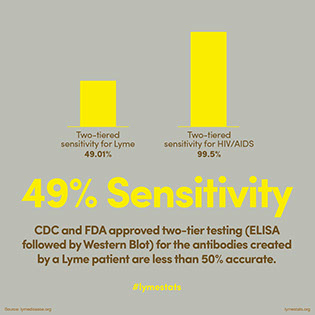
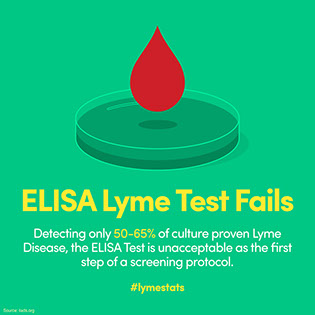
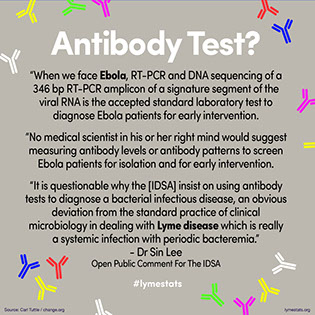
https://madisonarealymesupportgroup.com/2017/04/12/comparing-lyme-testing-with-hiv-testing/

38_sensitive316x316   01_test_petri316x31625_antibody316x316

https://www.lymedisease.org/lyme-basics/lyme-disease/diagnosis/  Testing explained and interpreted.


Chronic Lyme Patients Bemoan Dearth of Local Doctors

http://www.capecodtimes.com/news/20170604/chronic-lyme-patients-bemoan-dearth-of-local-doctors

Chronic Lyme patients bemoan dearth of local doctors
By Cynthia McCormick  Posted Jun 4, 2017 at 2:00 AM

Twice a year, Joanne Creel of Yarmouth Port and her husband, Clarence Eckerson, make a pilgrimage to the Hyde Park, New York, office of Dr. Richard Horowitz to get treated for Lyme disease and co-infections.

It’s a long day, punctuated by coffee on the way there and and a stop at a diner for lunch on the five-hour drive back to the Cape.

“I’ve gone 14 years to New York,” putting the bill on credit cards since Horowitz does not take insurance, Creel said. She said she doesn’t have a choice.

Despite the prevalence of Lyme and other tick-borne disease on the Cape and Islands, no full-time medical specialist in Barnstable County treats Lyme disease patients with persisting symptoms that include cognitive deficits, swollen joints, vision problems and anxiety and depression.

“All of these patients are out there,” said Creel, a social worker and former marathon runner. “There is no doctor who is specifically for Lyme patients.”

But at a time when the U.S. Centers for Disease Control says there are 300,000 new cases of Lyme a year, advocates for people with the disease say they are dismayed at the lack of resources available to study the illness and at the paucity of physicians who are willing to treat patients with lingering symptoms, a problem exacerbated by the fact most treatments for lasting symptoms consist of the controversial long-term use of antibiotics.

Now a physician from the Dean Center for Tick Borne Illness at Spaulding Outpatient Center Boston is calling for a massive effort to fund research and help patients whose lives have been uprooted by the disease named in the 1970s after an outbreak in Lyme, Connecticut.

“This is a national emergency. This is an epidemic,” said Dr. Nevena Zubcevik, clinical co-director of the Dean Center, which filled up shortly after opening in 2015.

“We should act fast,” Zubcevik said. “It’s just getting worse every year.”

And it’s not just Lyme. Co-infections including babesiosis, anaplasmosis, Borrelia miyamotoi and the Powassan virus are expanding their reach.

Lack of good diagnostic tools and limited physician time with patients — most appointments now run between 10 to 30 minutes — “are insufficient to properly evaluate the complex clinical presentation of a patient presenting with chronic effects of tick-borne illness,” Zubcevik said.

Patients can present with a “very complicated” cluster of symptoms including stomachaches, headaches, numbness and tingling, cardiac issues, hearing loss, eye and balance problems and —most detrimental — cognitive issues that can derail school work and cost people their jobs, Zubcevik said.

Lyme in its post-acute stages is known by various names including chronic Lyme, persisting Lyme, disseminated Lyme, late-stage Lyme and post-treatment Lyme disease syndrome.

Whatever the nomenclature, it’s not uncommon, Zubcevik said.

Research by Dr. John N. Aucott at Johns Hopkins University School of Medicine shows about 20 percent of people continue to have symptoms after being treated with recommended antibiotics after being diagnosed with Lyme disease, Zubcevik said. “We need to devote more research dollars to understand why.”

Katie Crocker, of Marstons Mills, said getting bitten by ticks, first as a child, upended her life.

Now 36, she had to quit college and go on disability while she dealt with a variety of symptoms from the Lyme and co-infections including headaches, joint pain, “air hunger,” sleep disorders, poor circulation and problems gaining muscle.

Her symptoms got worse after a bad car accident, said Crocker, who has since been treated. “My life just kind of stopped from chronic illness,” she said.

“It’s like having the flu for the rest of your life,” said Aucott, assistant professor of medicine at Johns Hopkins University School of Medicine and director of the Lyme Disease Research Center.

Aucott studies both acute and post-treatment Lyme disease syndrome and says he has proof that not all Lyme patients treated with antibiotics in the acute phase of the disease recover.

His 2015 study of post-Lyme patients published in the Infectious Disease Clinics of North America journal show that immune system proteins known as CCL19 chemokines remain elevated in post-treatment patients who complain of lingering symptoms of illness.

“The immune system is still active and talking to itself and moving immune cells around,” possibly to sites of inflammation, Aucott said.

The pain isn’t all in patients’ heads, Aucott said. It’s in their bodies and possibly their nerves or nervous systems, he said.

But figuring out what is driving the immune system to act out and how to treat suffering patients is the controversial part, Aucott said.

The few physicians who specialize in Lyme disease treatment, such as now-retired Dr. Sam Donta of Falmouth, include long-term antibiotics in their arsenal on the premise that bacterial infections are still present and active.

But the Centers for Disease Control, while acknowledging that symptoms can persist beyond six months, discourages the use of long-term antibiotics, citing studies that show them to be of limited or no use compared with placebos.

Patients may claim improvement, but those cases are anecdotal, said Dr. Patrick Cahill, an infectious disease specialist at Cape Cod Hospital. Cahill, who accepted an invitation to join the Barnstable County Tick-Borne Disease Task Force of which Donta is also a member, said there is no research that shows Lyme patients improve after more than 28 days of antibiotic treatment.

Cahill said he advocates for 10 days of treatment with doxycycline in early acute stages of Lyme and up to 28 days in cases where treatment has lagged or not worked, and Lyme has gone into a disseminated stage.

Inflammation and autoimmune responses could account for some chronic cases of Lyme, Zubcevik said. But animal studies have shown live spirochetes following antibiotic treatment, which suggests elements of persistence might be a factor in some cases, she said.

In a reversal of the usual Lyme disease transmission from tick to person, a study led by Dr. Linden Hu at Tufts University suggests it’s possible that “clean” ticks got sick after feeding on people who complained of lingering symptoms of Lyme including fatigue and arthritis.

One or two of the ticks who fed on the study participants showed the presence of Lyme pathogens after being tested by polymerase chain reaction in the lab, Aucott said. The study is currently in phase two, but Aucott said he could not comment since he is participating in the research.

If pathogen-free ticks pick up the disease after feeding on Lyme patients who complain of lingering symptoms, scientists consider it a good indication that the spiral-shaped bacteria that causes Lyme disease can survive in its human host even after being zapped for 21 to 28 days with antibiotics.

But until studies are complete, chronic Lyme patients and doctors who treat them say it’s cruel to deny patients the long-term antibiotics that many say improves their lives.

Long-term oral antibiotics prescribed by Dr. Nichola LaCava, of West Boylston, who travels to the Cape to see patients twice a month at Entire Healtha and Wellness in Mashpee “saved my life,” said landscaper Shelley Bouthillette.

She said she went to several physicians on the Cape and in Boston before seeing LaCava after a year and a half of misery with symptoms that including shaking, swelling of lymph nodes and one leg and unbearable itching. “I was bed ridden,” said Bouthillette, who credits LaCava for getting her back on her feet.

Donta, an infectious disease specialist in Falmouth who retired in 2015, said that one problem with clinical trials disproving the effectiveness of long-term antibiotics is that none of them lasted longer than three months.

His own studies — which are not considered double blind since they do not include a placebo group — demonstrate that a protocol involving different types of antibiotics can eliminate symptoms almost entirely, Donta said.

Solving the mystery of Lyme calls for a lot more research dollars, said Dr. Katherine Murray, of Plymouth, who said she follows Donta’s protocols but adds sulfa treatments to the antibiotics.

“There is so much we do not know about Lyme and so much that needs to be done,” said Murray, who said she only takes patients referred by their regular physicians. “It’s everywhere now.”

And so are the patients, as Lyme has reached every state but Hawaii.

The Dean Center, located in Spaulding at the Charlestown Naval Yard, has seen more than 650 Lyme and tick-borne disease patients since its launch and now has a waiting list of about a year for new patients, said Carole Stasiowski, spokeswoman for Spaulding Rehabilitation Hospital Cape Cod in Sandwich.

“It’s not going to go away. It’s only going to get worse,” Creel said. “Cape Cod Healthcare needs to realize they need to get a doctor here.”

— Follow Cynthia McCormick on Twitter: @Cmccormickcct.

**Comment**

Every state in the U.S. needs to realize they need to get doctors who treat tick borne infections!

Everytime I read something about Dr. Zubcevik I literally want to hug the woman.

This article truly brought up some great points.  Please share.


Predators Curb Lyme Disease

https://www.nytimes.com/2017/08/02/science/ticks-lyme-disease-foxes-martens.html?smid=fb-share  Lyme Disease’s Worst Enemy? It Might Be Foxes
By AMY HARMON AUG. 2, 2017

It is August, the month when a new generation of black-legged ticks that transmit Lyme and other diseases are hatching. On forest floors, suburban estates and urban parks, they are looking for their first blood meal. And very often, in the large swaths of North America and Europe where tick-borne disease is on the rise, they are feeding on the ubiquitous white-footed mice and other small mammals notorious for harboring pathogens that sicken humans.

But it doesn’t have to be that way. A new study suggests that the rise in tick-borne disease may be tied to a dearth of traditional mouse predators, whose presence might otherwise send mice scurrying into their burrows. If mice were scarcer, larval ticks, which are always born uninfected, might feed on other mammals and bird species that do not carry germs harmful to humans. Or they could simply fail to find that first meal. Ticks need three meals to reproduce; humans are at risk of contracting diseases only from ticks that have previously fed on infected hosts.

For the study, Tim R. Hofmeester, then a graduate student at Wageningen University in the Netherlands and the lead researcher of the study, placed cameras in 20 plots across the Dutch countryside to measure the activity of foxes and stone martens, key predators of mice. Some were in protected areas, others were in places where foxes are heavily hunted.

Over two years, he also trapped hundreds of mice — and voles, another small mammal — in the same plots, counted how many ticks were on them, and tested the ticks for infection with Lyme and two other disease-causing bacteria. To capture additional ticks, he dragged a blanket across the ground.

In the plots where predator activity was higher, he found only 10 to 20 percent as many newly hatched ticks on the mice. Thus, there would be fewer ticks to pass along pathogens to next generation of mice. In the study, the density of infected “nymphs,” as the adolescent ticks are called, was at 15 percent of levels in areas where foxes and stone martens were less active.

“The predators appear to break the cycle of infection,’’ said Dr. Hofmeester, who earned his Ph.D. after the study.

Despite stuffing his pant legs into his socks and using permethrin, a tick repellent, he said he removed more than 100 ticks from his own body.

Interestingly, the predator activity in Dr. Hofmeester’s plots did not decrease the density of the mouse population itself, as some ecologists had theorized it might. Instead, the lower rates of infected ticks, Dr. Hofmeester suggested in the paper, published in Proceedings of the Royal Society B, may be the result of small mammals curtailing their own movement when predators are around.

“This is the first paper to empirically show that predators are good for your health with respect to tick-borne pathogens,” said Dr. Taal Levi, an ecologist at Oregon State University who was not involved in the study. “We’ve had the theory but this kind of field work is really hard and takes years.” He also said of Dr. Hofmeester, “Wow, I have to send him an email.”

Habitat fragmentation, hunting and the removal of larger predators like cougars may all figure into the dwindling of small mammal predators like foxes, weasels, fishers and martens, Dr. Levi said. If the study’s results are borne out by more research, public health officials might be moved to try interventions like protecting foxes or factoring the habitat needs of particular predators into land-use decisions to foster their population size. Nothing else — like culling deer or spraying lawns with tick-killing pesticide — has worked so far to stem the incidence of tick-borne disease, which is spreading in the Midwestern United States, in parts of Canada and at higher altitudes across Europe.

“The takeaway is, we shouldn’t underestimate the role predators can play in reducing Lyme disease risk,” said Richard S. Ostfeld, a senior scientist at the Cary Institute of Ecosystem Studies, who originally speculated on the importance of small mammal predators in a 2004 paper. “Let’s not discount these cryptic interactions that we don’t see very often unless we put camera traps in the woods.”

Correction: August 3, 2017
Because of an editing error, an earlier version of this article incorrectly described the number of newly hatched ticks found on mice in areas of a study where predator activity was higher. It was 10 to 20 percent, not 5 to 10 percent. The density of infected adolescent ticks in areas where foxes and stone martens were active was also incorrectly described. It was 15 percent, not 6 percent, of levels in areas where foxes and stone martens were less active.

Science For Sale

http://gmwatch.org/en/news/latest-news/17764-uncovered-monsanto-campaign-to-get-seralini-study-retracted  Published 02 August, 2017  GM Watch

It seems that about every other day uncovers some sort of fraud when it comes to public health and “accepted” science.  At the end of the article I give links to more fraud – directly related to research being done on Lyme Disease and other tick borne illnesses.  This article by GM Watch is the recent discovery that the author of a retracted study by Gilles-Eric Seralini, which shows the toxic effects of Roundup, entered into a contract with Monsanto shortly before the retraction.

The study clearly showed that very low doses of Roundup had toxic effects on rats including liver and kidney damage and initiated cancer tumors.

“Monsanto scientist David Saltmiras admitted to orchestrating a third party campaign in which scientists who were apparently independent of Monsanto would bombard the editor-in-chief of the journal Food and Chemical Toxicology with letters demanding he retract the study.”

“Now that Monsanto’s involvement in the retraction of the Séralini paper is out in the open, FCT and Hayes should do the decent thing and issue a formal apology to Prof Séralini and his team. FCT cannot and should not reinstate the paper, because it is now published by another journal. But it needs to draw a line under this shameful episode, admit that it handled it badly, and declare its support for scientific independence and objectivity.”

The third party campaign tactic was used in the tobacco industry and I believe it is also being used in research regarding tick borne illness.  The people doing the CDC/NIH studies and the people sticking up for them are all in a group I like to call The Cabal.  Most receive money for patents for everything from vaccines to test kits, keep pushing the same agenda (Borrelia isn’t persistent and 21 days of doxy will cure everyone), keep research from being published that does not agree with their agenda, and foster an environment of fear in the research community which essentially states, “Conform or you will be ridiculed.”

It appears the days of scientific integrity are gone.

More fraud:  https://madisonarealymesupportgroup.com/2017/01/13/lyme-science-owned-by-good-ol-boys/

https://madisonarealymesupportgroup.com/2017/01/02/fake-science/

https://madisonarealymesupportgroup.com/2017/01/28/sit-down-science/

https://madisonarealymesupportgroup.com/2016/11/29/spider-attacks-cdc/

https://madisonarealymesupportgroup.com/2017/01/19/cdc-denies-to-downplay-lyme-epidemic/