Archive for the ‘Psychological Aspects’ Category

The Dark History of SSRIs

**UPDATE**

Please see this 17 minute video by The Highwire on new science showing long term issues even after discontinuing SSRIs including sexual dysfunction and ‘brain zaps.’ Despite this, ‘the powers that be’ want to make these dangerous drugs over-the-counter.  

https://www.midwesterndoctor.com/p/there-is-decades-of-evidence-that?

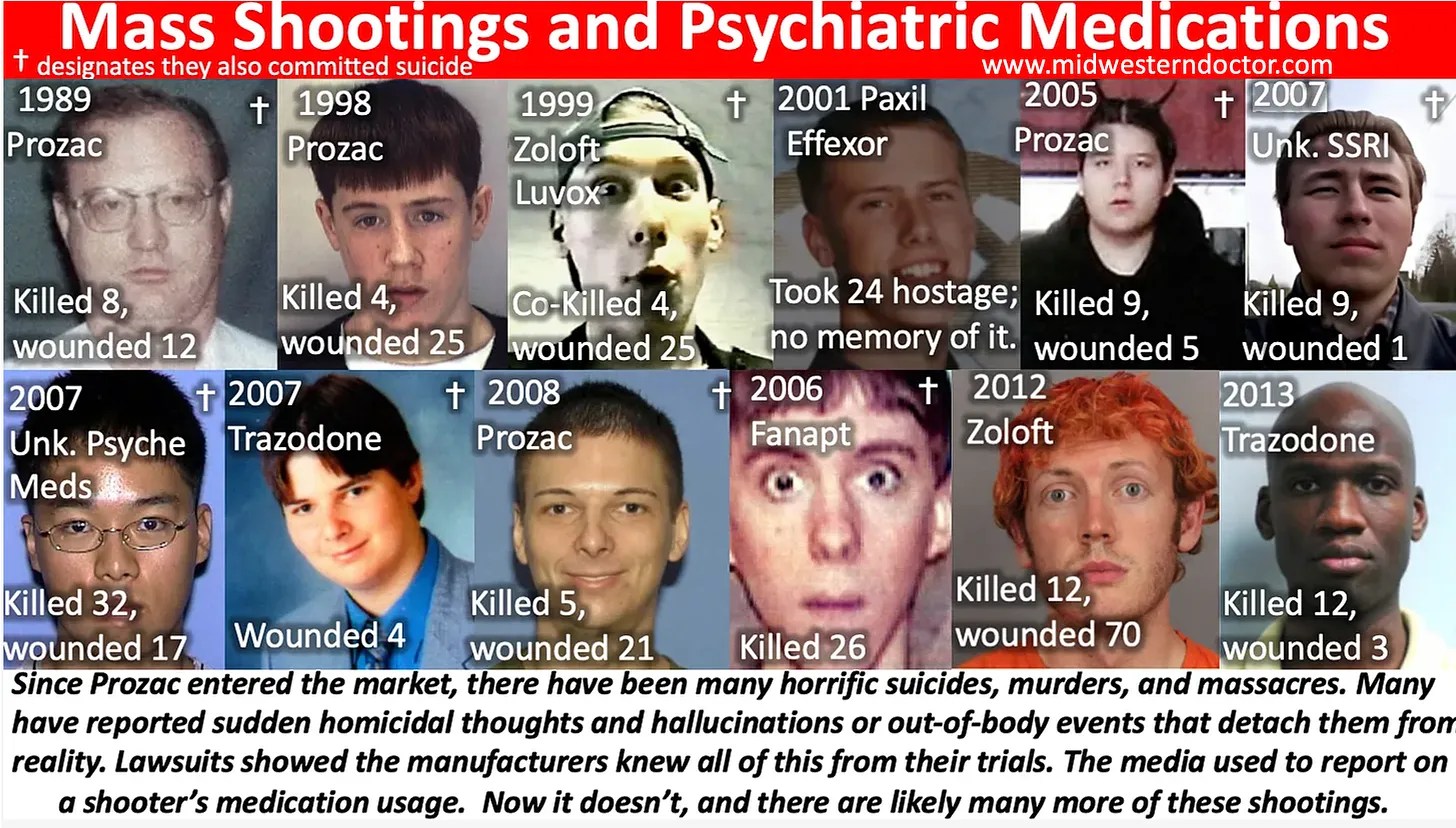
The Decades of Evidence That SSRI Antidepressants Cause Mass Shootings

How Dangerous Must a Drug Be Before it is Pulled from the Market?

Most holistic doctors consider Selective Serotonin Reuptake Inhibitors (SSRI) anti-depressants to be one of most harmful mass-prescribed drugs on the market (it typically makes their top 5). However unlike the other drugs, which are just unsafe and ineffective, SSRIs also have a fairly unique problem—they can kill people who are not even taking the drugs.

Note: other common contenders for that list are StatinsNSAIDs (e.g., ibuprofen), and acid reflux medications (proton pump inhibitors like prilosec). The harms and irrationality of those drugs are discussed herehere and here.

What follows is a revised and updated article summarizing the extreme dangers of those drugs I was requested by a few readers to write in light of recent tragic events.  (See link for article)

______________

**Comment**

This is one of the most important articles I’ve read for a long time.  The reason?  The topic of harm caused by anti-depressants is completely denied and ignored by Big Pharma, Big Media, and Big Medicine. I highly recommend you read this in full and share widely because it affects so many people, particularly Lyme/MSIDS patients who often struggle with psychiatric symptoms including depression.  Educating yourself on this is imperative if not for you than for someone you know.

Executive Summary:

  • While a minority of patients, particularly those with deficient methylation, who take SSRIs greatly benefit from them, much evidence has accumulated that they cause psychotic violence.
  • The author states that out of all of the controversial medical issues, the topic of SSRIs being linked to mass shootings has caused the most vitriol.
  • Unfortunately, like COVID and “vaccines” SSRIs have been highly politicalized, often among party lines.
  • Each time a mass shooting occurs the same script is repeated (ban all guns and have more mental health care [i.e. psych meds] for everyone).
  • Similarly to the “vaccine” topic, the oft repeated argument to dismiss the link between SSRIs and psychotic violence is that “correlation is not causation,” however:
    • clinical trial data hidden from the public gives this evidence
    • a black-box warning states SSRIs increase the risk of suicide
    • the psychotic events are completely out of character and the offenders report a very similar narrative of what they experienced prior to and during the shooting
  • SSRIs which entered the market in 1988 have a similar primary mechanism of action as cocaine
  • The SSRI Prozac received nearly 40,000 adverse events after 9 years which is far more than any other drug. These events include:
    • hundreds of suicides
    • atrocious violent crimes
    • hostility and aggression
    • psychosis, confusion
    • distorted thinking
    • convulsions
    • amnesia
    • brain-zaps
    • long-term or permanent sexual dysfunction
    • homicides: a website has compiled thousands of documented occurrences
  • A significant portion of the article came from the book Deadly Psychiatry and Organized Denial by Peter C. Gøtzsche (which builds upon the critical work Peter Breggin did to expose this issue)
  • For those taking SSRIs, do NOT suddenly stop taking them as you can have very strong withdrawal symptoms.  Please read the stories in the article to see how very serious this is.
  • Psychosis and Akathisia (extreme restlessness) are known side-effects of SSRIs that have led to strange impulses, or suicide, homicide, or both and are so disturbing they are often described as the individual being possessed, and patients have shared they felt as though a dark force was trying to take over their body
  • A clinical investigator wrote to Pfizer that during treatment with SSRIs, patients reported depersonalization and that their range of emotions were blunted as they were unable to feel or express themselves.  Pfizer responded with the admission that this happens with SSRIs and nobody knows why.
  • A common thread has occurred with these violent homicides:
    • the act of violence was immediately preceded by a significant change in the meds 
    • they occur in all ages who were completely normal before the act and no precipitating factors besides the psychiatric medication
    • there were clear symptoms of akathisia
    • the offenders returned to their normal personality when they came off the antidepressant
  • Similarly to the “vaccine” industry, the psychiatric industry aggressively gaslights victims rather than accept any responsibility
  • Individuals with a mutation in the gene that metabolizes psych drugs are much more vulnerable to developing excessive levels of these drugs triggering psychosis and akathisia but this is never considered when the meds are prescribed
  • Gøtzsche reviewed some key SSRI legal cases and in 2001 a jury found a pharmaceutical firm liable for deaths caused by an antidepressant. Central to a case were SmithKline Beecham internal documents showing the company was aware that a small number of people could become agitated or violent from Paxil, but they did not include a package warning about suicide, violence or aggression.  Two volunteers attempted suicide, but the company till denies that Paxil can cause homicides, suicides, and withdrawals.
  • Similarly to the false illusion that remdesivir helps COVID and that the COVID gene therapy injections are effective, Prozac was originally assessed to treat obesity, but was switched for depression which has a subjective metric which was easier to approve with doctored studies (after which they pivoted to using marketing off-label for obesity). “So, even though the evidence showing Prozac worked for depression was atrocious while abundant evidence existed for its harm, with a few well priced bribes and statistical creativity, Eli-Lilly was able to secure their approval.”  Sound familiar?
  • Government corruption has followed a playbook that existed long before the COVID debacle
  • While the COVID injections have complete legal immunity, SSRIs are toxic enough to have severely harmed large numbers of people motivated to fight the drug companies in court
  • The author states he was able to accurately predict and understand the COVID shot shenanigans due to being intimately familiar with the SSRI story.

Finding Happiness Even When You’re Chronically Ill

https://www.lymedisease.org/happiness-when-chronically-ill/

Finding happiness even when you’re chronically ill

By Mark Rego, MD

10/10/23

In my years of psychiatric practice and my following years of illness, one problem has appeared unsolvable. How does someone who is chronically ill (me included) build a happy life?

The usual recipes for happiness simply do not work if your life is marked by continuous illness. The obstacles of disease will sabotage plans taken from normal life.

So, how do you advise someone whose life has been brought to a halt by illness on how to build a new, contented existence? Is there a different recipe for the chronically ill?

Chronic illness: physical and mental dimensions

So, what and who do I mean by chronically ill? What are the limitations of being ill, and how do they thwart the usual formulas for happiness? And, finally, is there a way around these barriers?

The diseases I have in mind are things like rheumatologic disorders (severe arthritis, such as rheumatoid arthritis and Lupus), neurologic disorders (multiple sclerosis, degenerative diseases), severe mental illness (when severe, almost any mental disorder fits here), injuries that leave you impaired and in pain, cancer, and other severe medical conditions, such as organ failure (congestive heart failure, kidney failure, liver insufficiency, significant breathing impairment, etc.). [Editor’s note: and persistent Lyme disease!]

When serious enough, these illnesses have something in common. They leave you greatly diminished. This can be forever or for long stretches that will undo much of your life.

There is less of all of you, not just a bad bone, back, or blood test. You can no longer get up in the morning and go out to live your plans. Work, taking care of yourself, having regular personal interactions, and, lastly, some frequent enjoyment become parts of your past.

Your shrinking world

This is not normal aging or the physical limitations that many people face. It is a fundamental change in all of your life. A change that shrinks your world to a lesser version of everything you knew.

People will compliment your fighting spirit. You are brave and heroic and have amazing coping skills. But it rings hollow. In reality, you tread water very well. Or, perhaps, you are told it’s the journey, not the destination. But the sick already have a journey; what they want is a life.

You work hard to get better, go to doctors, take medicines, and do rehabilitation and psychotherapy. If you’re in this group, you know that this work is never done.

What troubles me most about these situations is wherever I look for advice on building a happy life, these unlucky souls are not included.

Finding happiness in sickness and in health

Such advice is generally based on either finding meaningful activity or having strong connections to others. How does one do these things when isolated and disabled from chronic illness? Trouble walking, shortness of breath, persistent pain, problems with mood and thoughts, or the low energy that is almost universal in this group make even brief tasks quite difficult.

For meaningful activity or connecting to others, you need to be places on certain days, at certain times, and for a certain number of hours. Sickness knows no such schedules. Bad days appear when they will.

If lucky, you have folks who will visit. But these are visits to your life; they are not in your life the way immediate family members, coworkers, and others you may see and talk to regularly are. While such visits are greatly appreciated and enjoyed, they do not constitute the full dimensions of a social life. Being in someone’s life means knowing the ins and outs of their days. The catch-ups that occupy many visits are not needed in these connections.

Another common obstacle to happiness is depression itself. This is very often a part of the sickness process. But if we look at research about impediments to recovery from depression, we find that people who are in pain, chronically ill, disabled, or isolated all have difficulty recovering. The sick are often all of these.

Of course, sometimes things come together, and a different version of life takes shape. People find a place for themselves, maybe some work that is doable and meaningful. I am not sure how often this happens, but such experiences are not the rule.

Step 1: Build back a version of what you had

So, what are some guidelines for happiness for the sick? The first step is to build back a version of what was lost. This entails calls and emails to invite friends for a visit. As stated above, this will not be a full replacement for a social life, but without connections, people wither and become depressed. In addition, activities to pass your time with a modicum of interest or enjoyment must be found. Time passes very slowly without things to do.

The burden of rebuilding falls squarely upon the chronically ill. A life must be built brick by brick. But as discussed above, this is not enough. There is more work to be done.

Step 2: Acceptance as a necessary bridge

The next step is the work of acceptance. It is hard to underestimate how deeply we can reject the reality of our lives. Emotional acceptance of circumstances is not assured by the passage of time. There are, of course, many ways to walk this leg of the journey. Religions have ways to approach this, but many people find their own paths. This work is an ongoing process. Grieving losses such as your own health, work, and social life can be a lifelong process.

Acceptance is a bridge to the next step. This is because the flip side of acceptance is letting go of the burdens of normal life. By accepting your plight, you also allow yourself to participate less in worldly goings on. This frees you to spend time as you like.

Step 3: Building a bigger internal world

This brings us to the final and most important step: building an internal life. Normal life is lived in the world. It gets bigger as we do more, grow our skills and relationships, and expand our horizons. Chronic illness ends this.

As your external life grows smaller, your internal life must now expand. The path is lit by wonder, amazement, curiosity, and interest. Find what amazes you and begin there. This might be revisiting things that were fascinating in school but you could not do more of. Or perhaps you are learning something you have always wondered about. An art, craft, skill, a secret story to follow, or a new one to tell.

In my case, I took up portrait painting (something I never would have imagined) and studied areas of science that I loved in school but did not have any role in my job as a psychiatrist. Each time I begin one of these, I am excited about what I will discover. They are new worlds for me.

Find what amazes you and begin there

How does a chronically ill person find this? The way is to ask what amazes you. What makes a small smile appear on your lips, not because it is funny but because it is beautiful and amazing, incredibly interesting, beyond understanding? Then open a book, a web page, or whatever tools you need. A daily meal of what expands the horizons within your mind becomes the guiding path of your new life. The more something astonishes you, the more space it will open within you.

There is no one you must help here, nothing to build or express. No homework. No reports. No schedule or tasks to do. You do it just because it amazes, excites, piques your curiosity. This is enough and has been the driving energy behind the most incredible lives. This is when you exercise the flip side of acceptance and excuse yourself from needing to achieve something other than to be very interested.

Will this lead to other things? Maybe. But the point is, it does not need to. It will be just you and a happier you with a spacious inner world to explore.

The chronically ill build a happy life by constructing a version of normal life, finding acceptance for a new self, and, most importantly, expanding their inner life. You can reside in a small part of the external world but have endless room to roam in what delights and astounds you.

Mark Rego, MD, is a psychiatrist and a clinical assistant professor at the Yale School of Medicine. He is the author of Frontal Fatigue: The Impact of Modern Life and Technology on Mental Illness. You can learn more about his work at his website.

For more:

Bizarre Psychiatric Cases Among the COVID “Vaccinated,” & COVID Shots ‘Saved No Lives’

https://www.theepochtimes.com/article/psychosis-panic-attacks-hallucinations-bizarre-psychiatric-cases-among-the-covid-vaccinated

Panic Attacks, Hallucinations: Bizarre Psychiatric Cases Among the COVID Vaccinated

Beginning in late 2020 with the COVID vaccine rollout, some doctors have seen an increase in unusual psychiatric illnesses.

Published on 

Written by Marina Zhang

Dr. Patrick William Slater is a 60-year-old neurotologist. A few years ago, he had a full-time medical practice in Austin and enjoyed hunting and fishing in the mountains during his downtime.

Then, in October 2021, Dr. Slater came down with cerebellar ataxia, a disease affecting movement. He couldn’t eat or go to the bathroom without help.

While his ataxia could be managed using drugs, it wasn’t always effective against his biggest complaint: unprecedented panic attacks.

Almost every night, Dr. Slater would experience panic attacks that left him in “abject terror.” He thought about killing himself many times, he told The Epoch Times.

No one could provide a satisfactory answer about why he had developed these symptoms. Nothing abnormal showed up on his laboratory reports, and his neurologists and psychiatrists dismissed his symptoms as anxiety.

But Dr. Slater is convinced that the COVID-19 mRNA vaccines are the culprit.

Dr. Slater was suspicious when the symptoms first appeared within about two weeks of getting the second dose of the COVID shot. The second—and worse—wave of career-ending symptoms had coincided with his third shot.

After taking the booster, “there was no question in my mind,” Dr. Slater said.

Increase In Unusual Psychiatric Illness

Beginning in late 2020 with the COVID vaccine rollout, some doctors have seen an increase in unusual psychiatric illnesses.

Psychiatrist Dr. Amanda McDonald noticed a wave of psychiatric destabilization among her stable patients. They experienced flare-ups, often manifesting with worsened or new psychiatric symptoms.

“I couldn’t figure out why,” Dr. McDonald told The Epoch Times. “My patients typically stay stable.” But many stable patients were suddenly arriving at her office with insomnia, depression, and anxiety “without any sort of rhyme or reason.”

She increased some patients’ medication doses or added new drugs to their regimen, but it had little effect.  (See link for article)

_______________

**Comment**

Lyme/MSIDS patients need to be aware of this as they are already at risk for unusual psychiatric illness.  Please read the article in full as it contains a lot of important and helpful information including:

  • Helpful treatments including ivermectin, anti-inflammatories, vasodilating drugs, and hyperbaric
  • Studies show the lipid nanoparticles carried in the mRNA vaccines interact with psychotropic drugs. Some drugs may persist longer in the patient, and a normal dose may become toxic.

“Vaccine-injured people, especially those who took the vaccine out of goodwill, may experience both a breakdown of their worldview and of themselves, said Dr. Ciora.  He uses the iconic scene from the movie ‘The Matrix’ as an analogy.  Neo, the main character, takes a red pill and discovers that he has been living in a machine-generated reality for his entire life. He cannot accept this reality, and vomits in disbelief.  You don’t know who to trust.” ~ Dr. Critian Ciora, psychiatrist

https://twitter.com/EpochTimes/status/1711106689305358478  5 Minute Video Here

‘No Lives Were Saved’ by COVID-19 “Vaccines”

As the number of deaths clearly increased, upon closer examination, scientists noticed that the excess deaths coincided with the timing of the #COVID19 “vaccine” program rollout.

From the study “COVID-19 Vaccine-Associated Mortality in the Southern Hemisphere.”

The large age dependence and large values of vDFR quantified in this study of 17 countries on 4 continents, using all the main COVID-19 vaccine types and manufacturers, should induce governments to immediately end the baseless public health policy of prioritizing elderly residents for injection with COVID-19 vaccines, until valid risk-benefit analyses are made.  Source

For more:

Link Between Chronic Pain & Suicide

https://www.paintreatmentdirectory.com/posts/the-link-between-chronic-pain-and-suicide-understanding-and-prevention

The Link Between Chronic Pain and Suicide: Understanding and Prevention


The Link Between Chronic Pain and Suicide: Understanding and Prevention

Chronic pain not only leads to physical suffering but can also have severe psychological and emotional consequences. One of the most concerning correlations is the connection between chronic pain and suicide. Chronic pain patients are at least twice as likely to commit suicide as the general population. This article aims to shed light on this link, its underlying causes, and provide valuable prevention strategies.

Understanding the Link

Chronic pain and suicide are intertwined in a complex relationship that involves both physical and psychological factors.

Individuals living with chronic pain often experience a significant reduction in their overall quality of life. This can lead to feelings of hopelessness, despair, and isolation, which can contribute to the development of suicidal thoughts and attempts.

Key Factors Contributing to the Link:

  1. Psychological Impact: Chronic pain can lead to depression, anxiety, and feelings of hopelessness which increase the risk of suicide.
  2. Loss of Functionality: Many individuals with chronic pain find it challenging to engage in daily activities, work, or hobbies they once enjoyed. This loss of functionality can lead to feelings of inadequacy and a sense of purposelessness.
  3. Social Isolation: Chronic pain often limits an individual’s ability to socialize, leading to isolation and feelings of loneliness. Lack of social support can contribute significantly to the risk of suicide.
  4. Inadequate Pain Management: Poorly managed pain can exacerbate all the above factors. In some cases, individuals may turn to substances or risky behaviors in an attempt to alleviate their suffering, further compounding the risk.
  5. Stigma and Misunderstanding: People with chronic pain often face skepticism or disbelief from others, including family, friends, coworkers and healthcare providers. This can lead to a sense of invalidation and make it even more challenging to seek help.

The Connection Between Opioids and Suicide Risk

“The relationship between opioid prescribing and suicide risk is a complex one. This is particularly the case when people have their opioids tapered,” says Mark Olfson, MD, MPH, professor of epidemiology at Columbia School of Public Health. People can become desperate if their pain is not well controlled. Yet opioids also pose a greater risk of overdose than any other drug class and approximately 40 percent of overdose suicide deaths in the U.S. involve opioids. At a population level, the national decline in opioid prescribing over the last several years appears to have
reduced the number of people who died of suicide.”

The Truth about Chronic Pain TreatmentsOrder now!

“If opioid prescribing per capita had held constant from 2009 to 2017, there would have been an estimated 10.5 percent more suicide deaths involving opioids in 2017,” noted Olfson. In the U.S., geographic regions with the greatest declines in people filling opioid prescriptions also tended to have the greatest declines in total suicide deaths.

People who abuse opioids are 14 times more likely to die by suicide compared to the general population, a statistic that shows the very strong link between mental distress, chronic pain, opioids and suicide.

Prevention Strategies

  1. Seek Professional Help: If you or someone you know is struggling with chronic pain and experiencing thoughts of suicide, it is crucial to seek help from a healthcare professional. They can provide a comprehensive evaluation, recommend appropriate treatments, and connect individuals with mental health resources.
  2. Comprehensive Pain Management: Effective pain management is essential in reducing the risk of suicide in individuals with chronic pain. Often pain patients lose hope when the limited options offered by conventional medicine don’t help. There are many little-known alternative pain treatments that can provide safe and effective pain relief. Search the Alternative Pain Treatment Directory for helpful informationproducts and alternative healthcare providers.
  3. Address Mental Health Concerns: It is vital to address any co-occurring mental health conditions, such as depression or anxiety, as part of a comprehensive treatment plan.
  4. Build a Support System: Establishing a strong support network is crucial. Friends, family, and support groups can provide emotional support and a sense of belonging, which can significantly improve an individual’s outlook and resilience.
  5. Education and Awareness: Raising awareness about the link between chronic pain and suicide is essential in reducing stigma and fostering understanding. Education can help individuals recognize the signs of distress in themselves or others and encourage seeking help.
Cindy explains how to quickly reduce stress and pain naturally!

Resources for Prevention

  1. National Suicide Prevention Lifeline (USA): 1-800-273-TALK (1-800-273-8255) – Provides free, confidential support 24/7.
  2. Crisis Text Line (USA): Text “HOME” to 741741 – A free, confidential texting service for individuals in crisis.
  3. International Suicide Hotlines: For a comprehensive list of suicide hotlines around the world, visit https://www.suicide.org/international-suicide-hotlines.html.
  4. National Alliance on Mental Illness (NAMI): Provides resources, support, and education for individuals and families dealing with mental health conditions. Website: https://www.nami.org/.

Conclusion

The link between chronic pain and suicide is a serious concern that requires attention and intervention. By understanding the complex factors contributing to this connection and implementing prevention strategies and effective pain relief, we lessen the suffering that drives pain patients to want to end their lives.

Remember, seeking help is a sign of strength, and there are resources available to assist individuals in their journey towards improved mental and physical well-being.

For more:

Case Report: Substantial Improvement of Autism in Child By Using Treatment For Vector Borne Infections

https://www.frontiersin.org/articles/10.3389/fpsyt.2023.1205545/full

Case report: Substantial improvement of autism spectrum disorder in a child with learning disabilities in conjunction with treatment for poly-microbial vector borne infections

CASE REPORT article

Front. Psychiatry, 18 August 2023
Sec. Autism
Volume 14 – 2023 | https://doi.org/10.3389/fpsyt.2023.1205545
  • 1Heart and Soul Integrative Health, Marble Falls, TX, United States
  • 2Intracellular Pathogens Research Laboratory, Department of Clinical Sciences, and the Comparative Medicine Institute, College of Veterinary Medicine, North Carolina State University, Raleigh, NC, United States

Poly-microbial vector-borne infections may have contributed to neuropsychiatric symptoms in a boy diagnosed with autism spectrum disorder. Targeted antimicrobial treatment resulted in substantial improvement in cognitive (such as learning disabilities, focus, concentration) and neurobehavioral (such as oppositional, defiant, anti-social, disordered mood, immaturity, tics) symptoms.

Conclusion

This teenage boy had a drastic improvement in his neuropsychiatric symptoms and in his academic standing, moving from special education services with accommodations to grade level academic standing without accommodations, to college acceptance. Progressive symptomatic improvement occurred only following targeted administration of antimicrobial agents directed at suspected, underlying, chronic infectious pathogens, namely the causative agents of bartonellosis and borreliosis. Further research is clearly needed to define if or the extent to which occult infections can contribute to neuropsychiatric illness, such as ASD.

(See link for full article)

_________________

For more: