Archive for the ‘Lyme’ Category

Experts Don’t Understand What Vaccines Are Doing But 68% of Parents Eagerly Await Lyme Vaccine

https://www.precisionvaccinations.com/2024/02/29/68-parents-eagerly-await-lyme-disease-vaccines

68% of Parents Eagerly Await Lyme Disease Vaccines

February 29, 2024
by Alfonso Cerezo
(Precision Vaccinations News)

Article Excerpts:

Announced on February 28, 2024, this survey found addressing safety concerns important, and a healthcare provider recommendation could also encourage those unsure or unwilling to be vaccinated.

Initially developed by Valneva SE, the VLA15 Lyme disease vaccine candidate development program was granted Fast Track designation by the U.S. Food and Drug Administration in 2017.  (See link for article)

For more:

_______________

https://popularrationalism.substack.com/p/vaccinologists-do-not-entirely-understand

Vaccinologists Do Not Entirely Understand What Vaccines Are Doing: A Closer Look at Non-Specific Effects, Especially Population-Level Adverse Events

Co-administration of vaccines and the order in which vaccines are given may result in population-level adverse events.

Article Excerpts:

Vaccines are lauded as monumental achievements including the prevention of myriad deadly diseases. Yet, a full command of the available research shows that the impact of vaccines transcends their primary preventive roles, challenging the foundational understanding held by vaccinologists. The evidence is strong that vaccine-induced non-specific effects (NSEs), which we will rechristen “population-level adverse events (PLAEs)”, to enhance a full comprehension of immunization-related non-specific events.

WHO’s Response and Inaction

The World Health Organization (WHO) has recognized the potential importance of NSEs, establishing a working group to review the evidence. Despite this, nearly a decade has passed without significant action to address the concerns raised by these findings. The delay highlights a gap in our understanding and application of vaccine science.

The global health community must remain open to reevaluating assumptions about vaccines, guided by the principle of maximizing overall health outcomes, not robotically pushing vaccines as a panacea for infectious diseases.  (See link for article)

_______________

**Comment**

If you are a blind and faithful ‘vaccine’ proponent, COVID should have opened your eyes to the unabashedly fraudulent system surrounding it all. Corrupt government agencies who own patents and receive royalties have been repeating ‘safe and effective‘ now for decades despite all evidence to the contrary.  Similarly to Lymeland, studies have been rigged for a pre-determined outcome or they simply eliminate inconvenient evidence, including suddenly retracting peer-reviewed science.  All sorts of shenanigans occur to make vaccines look good all the while ignoring and gas-lighting the vaccine-injured and the unvaccinated.

Go here to listen to doctor after doctor discussing the very real problems surrounding vaccinations. Vaccine information is being censored from nearly every platform.  ‘Authorities’ simply don’t want you to know the following truths about vaccines:

  • They contain toxic ingredients
  • The CDC has been lying about vaccine injuries and deaths for decades
  • The vaccine given in trials are often not what is given to the public
  • Vaccines are used in lieu of a true placebo making them appear safer than they are
  • Trials often do not have a true control group
  • Infant deaths due to vaccines are NEVER listed on death certificates but are listed as SIDS due to a lack of ICD code
  • Vaccines can reactivate latent infections
  • Vaccines have contained retroviruses and other cancer and disease causing viruses
  • Corrupt ‘public health’ has never done a study comparing the vaccinated to the unvaccinated
  • Corrupt ‘public health’ has never done a study looking at the cumulative effect of vaccines – particularly looking at metal accumulation
  • Corrupt ‘public health’ never admits vaccines can cause the very disease they are supposed to cure
  • Doctors get kickbacks for pushing vaccines on their patients
  • Go here for more shenanigans ‘public health’ plays

Novel Lyme Antibiotic Heads For Human Safety Trials

https://news.northeastern.edu/2024/02/28/lyme-antibiotic-treatment-human-trials/

Experimental antibiotic treatment for Lyme heads for human safety trials

By Cynthia McCormick Hibbert, Northeastern University

2/28/24

Human safety trials of a novel antibiotic treatment for Lyme disease developed by Northeastern professor Kim Lewis are scheduled to start this spring in Australia, with results anticipated by fall.

“Hopefully, the results will be positive,” says Lewis, University Distinguished Professor of Biology.

So far the therapeutic agent, an antibiotic known as hygromycin A, has not been toxic in animals and has cleared Lyme in mice, he says.

Existing standard treatments for Lyme disease, doxycycline and amoxicillin, have proved far from silver bullets for the nearly half-million people stricken by the tick-borne illness in the U.S. each year.

The Centers for Disease Control and Prevention estimates that 5% to 10% of Lyme patients have persistent symptoms after early treatment, while the Global Lyme Alliance says that as many as 2 million Americans could suffer post-treatment disability.

Overlooked antibiotic

Lewis says that hygromycin A is different from the broad spectrum antibiotics in that it specifically targets spirochetes including Borrelia burgdorferi, the spiral-shaped bacterium that transmits Lyme disease through the bite of a deer tick.

The expectation is not only that hygromycin A will prove more effective in curing Lyme disease in the early, acute stage but that it could also mop up residual pathogens that may persist in some patients with chronic disease, Lewis says.

He suspects many cases of chronic Lyme symptoms are caused by changes to patients’ microbiomes due to the use of broad spectrum antibiotics.

With hygromycin’s specific targeting of spirochetes, Lewis says that is less likely to lead to chronic disease.

“What we’re testing for now is a treatment for acute Lyme that will be more effective and won’t wreck the microbiome and will hopefully lead to fewer chronic cases,” he says.

People with chronic, long-term or persistent Lyme call it a life-changing experience, leaving them with arthritis, cardiac problems, fatigue, brain fog, depression and anxiety.

Made by a bacterium found in the soil, hygromycin A has been a known but overlooked antimicrobial since 1953, Lewis says.

“Nobody really cared about this compound because it’s very weak against regular bacteria. What we discovered is that it is indeed very weak against regular pathogens but exceptionally potent against spirochetes.”

Phase 1 trials set for April

Lewis’ team has licensed the compound to Flightpath, a biotech company focused on Lyme disease that is conducting the phase 1 trial scheduled to start in April. Flightpath is leading the clinical development effort with funding from the Cohen Foundation.

“A safety trial simply asks the question, ‘Is it safe for healthy people to take this drug,’” Lewis says.

If it passes toxicity screenings, it can advance to phase 2 to determine effective dosing ranges “and see if it cures acute Lyme disease,” he says.

Success at that stage would lead to a clinical trial involving a larger group of patients, with the possible end result of requesting FDA approval for the treatment via a new drug application.

Even if approved, human efficacy trials probably wouldn’t start until 2025, Lewis says.

That hasn’t stopped the Global Lyme Alliance, which helped fund Lewis’ Lyme drug discovery program, from expressing excitement over the prospect of seeing hygromycin A in doctors’ hands.

In a statement on Instagram in February, the alliance quoted Flightpath CEO Matt Tindall saying that reaching this stage is a “landmark achievement for Lyme patients.”

If the trials make it to phase 2, researchers will reach out to Lyme specialists at places such as Johns Hopkins and Massachusetts General Hospital to recruit Lyme patients for the study, Lewis says.

Most projects that researchers in academia and industry toil on for years “do not get to the point when we feel, based on extensive animal studies, that the compound has sufficient efficacy and safety features that we can now introduce it into humans,” Lewis says.

“We are at that point with hygromycin A. That is, of course, encouraging,” he says.

SOURCE: Northeastern University

______________

For more:

Military Report: Most Frequently Diagnosed Vector-borne Diseases

https://health.mil/News/Articles/2024/01/01/MSMR-Vector-Diseases

Brief Report: The Four Most Frequently Diagnosed Vector-borne Diseases Among Service Member and Non-Service Member Beneficiaries in the Geographic Combatant Commands, 2010–2022

Vector-borne diseases may pose an increased risk for U.S. service members during recurring military training exercises, operations, and response missions, in addition to residence in endemic regions within and outside the continental U.S.1,2 Prior MSMR reports address VBD surveillance, described by surveillance data for 23 reportable medical events, among active duty and reserve component service members.3,4 This report covers a 13-year surveillance period, from January 2010 to December 2022, and provides linear trends of selected VBDs among Armed Forces service and non-service member beneficiaries diagnosed at installations within the Northern Command (NORTHCOM), Africa Command (AFRICOM), Central Command (CENTCOM), European Command (EUCOM), Indo-Pacific Command (INDOPACOM), or Southern Command (SOUTHCOM). Trends of only the four most frequently reported VBDs were evaluated, as Lyme disease, malaria, Rocky Mountain Spotted Fever, and dengue fever comprised 90% (n=5,199) of all 23 VBDs (n=5,750) among Military Health System beneficiaries documented as RMEs during the surveillance period.

Methods

This study includes all MHS beneficiaries from January 2010 through December 2022. Data were acquired from RME records of 23 VBDs from the Defense Medical Surveillance System, limited to the four most-diagnosed VBDs in DMSS during the surveillance period; a full listing of VBD RMEs are available in a prior MSMR report.3 A VBD case was defined as an individual identified through a RME report, classified as “confirmed,” “probable,” or “suspect” by having met specified laboratory or epidemiologic criteria.5

Demographic information including military component (active, reserve, guard), beneficiary status (service members or non-service member), and U.S. Combatant Command at time of diagnoses were included. Non-service member beneficiaries included dependents, former service members, and retirees. MHS beneficiaries diagnosed as a case before the surveillance period were excluded. An individual could qualify as a case once for each RME type. Incidence date was the earliest event date, with classification determined by utilizing all available data, prioritizing confirmed over probable or suspect records.

Results

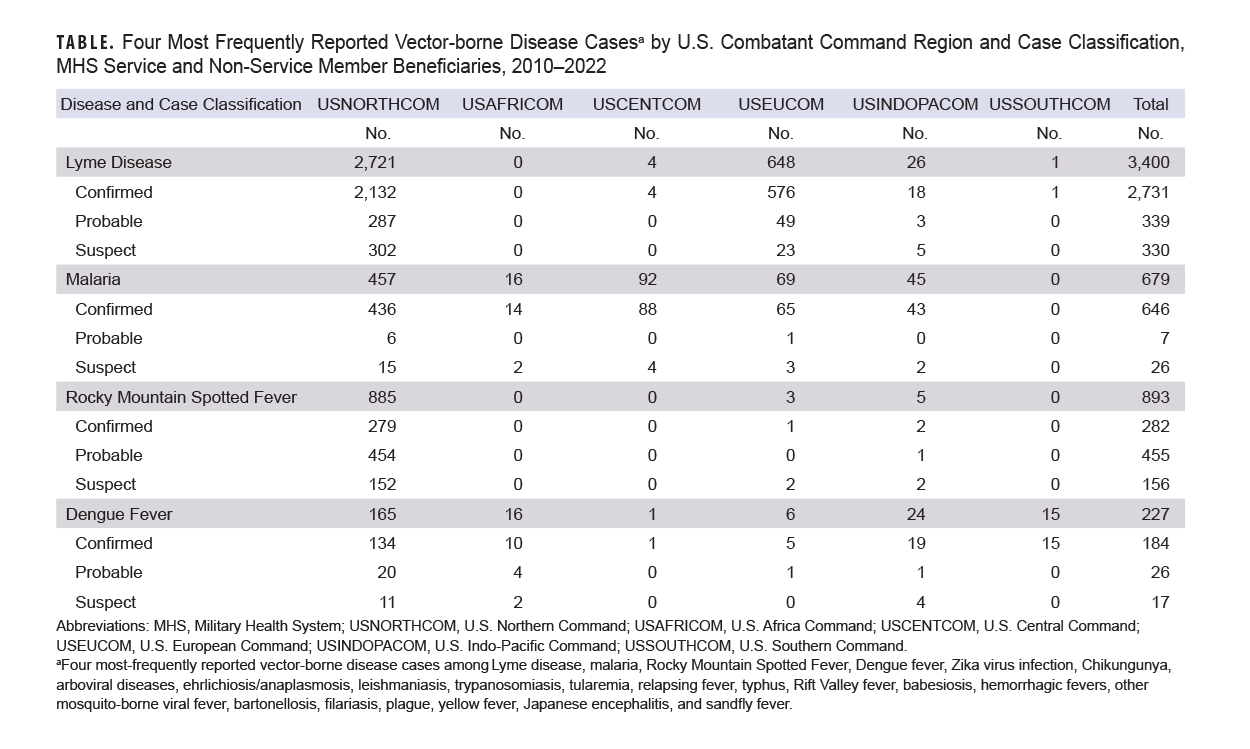
Click on the table to access a 508-compliant PDF versionClick on the table to access a 508-compliant PDF version

A total of 5,199 confirmed, probable, and suspect cases of Lyme disease (n=3,400), RMSF (n=893), malaria (n=679), and dengue fever (n=227) were identified among MHS beneficiaries from January 2010 through December 31, 2022 (Table). Of those confirmed, probable, and suspect cases, 2,343 were diagnosed in service members and 2,918 were diagnosed in non-service member beneficiaries (data not shown). Lyme disease and RMSF, both caused by tick-borne pathogens, accounted for 83% of cases, while malaria and dengue fever, transmitted by mosquito vectors, comprised the remainder.

Since Lyme disease was the most common VBD of the four diseases evaluated during the surveillance period, trends of confirmed and probable cases of Lyme disease over time by CCMD are presented in the Figure. Confirmed Lyme disease cases peaked in 2012 (n=455) and then gradually decreased over the study period to a low of 75 cases in 2022; probable cases peaked in 2017 (n=53) and steadily decreased to a low of 15 cases in 2022; suspect cases peaked in 2016 (n=73) and progressively declined to a low of 8 cases in 2022 (data not shown). Cases from NORTHCOM represented the greatest number of confirmed and probable Lyme disease cases during the entire surveillance period (Figure). The annual number of confirmed and probable Lyme disease cases from EUCOM were greatest in 2011 and lowest in 2017; Lyme cases were very low in all other CCMDs, ranging from 0 to 6 cases annually (data not shown).

The Atlantic and central regions of the U.S contributed 85% of NORTHCOM’s reported RMSF cases (data not shown). NORTHCOM averaged 30 RMSF cases annually between 2010 and 2016, dramatically increasing to an average of 149 cases between 2017 and 2019 (data not shown). NORTHCOM was only able to confirm 32% of RMSF cases reported during the surveillance period (Table).

Discussion

Lyme disease cases constituted the largest proportion of overall RMEs in this report, with highest numbers occurring in 2012. A substantial proportion of Lyme disease cases were reported from locations in the northeastern U.S., where Lyme disease is known to be endemic: 43% of service members and non-service beneficiaries were diagnosed at NORTHCOM Groton (New London Submarine Base, CT) and NORTHCOM New England. The New London Submarine Base is close to Lyme, Connecticut, where an epidemiological evaluation of a cluster of children with arthritis resulted in the first complete description of the infection in 1976, giving the disease its name.6 Connecticut still ranks in the top 10 states for reported Lyme disease cases.7 No Lyme disease cases were reported in AFRICOM during the surveillance period, because the vectors (Ixodes pacificus and Ixodes scapularis) are not present in the region.

In 2017, the armed forces expanded its RME guidelines to include all spotted fever rickettsioses (SFR), to better align with CDC case definitions.2 Diagnoses and reports of rickettsial diseases at military hospitals and clinics in NORTHCOM (where RMSF is endemic) significantly increased after the surveillance requirement expansion from only RMSF to the broader SFR group. In this review, all SFR cases were RMSF diagnoses (n=893).

Approximately 68% of RMSF cases reported during the surveillance period could not be confirmed. All laboratory tests performed at military health facilities for RMSF were Indirect Fluorescent Antibody (IFA) assay and other antibody tests, and no records of testing with PCR of blood or eschar specimens were found. Definite identification of Rickettsiae is not feasible solely by IFA due to considerable serologic cross-reactivity, particularly when high-endpoint titers are seen for more than 1 rickettsial antigen.8 Increased use of molecular assays (i.e., real-time PCR) can both confirm and offer species-specific diagnosis in a single sample, facilitating identification and management of rickettsial diseases in both service members and non-service beneficiaries.

The observed decline in the incidence of mosquito-borne cases, such as malaria and dengue, among deployed service members over the last decade is likely due to reduced deployments to endemic regions, with the exception of EUCOM.4 Although dengue fever is not represented significantly in EUCOM in this study, there is a rising risk of dengue and other VBDs due to environmental changes and expanding global travel and trade.9,10,11

VBDs often manifest with non-specific symptoms, and when unconfirmed could constitute a number of other infections or health conditions. Lyme disease is frequently misdiagnosed as chronic fatigue syndrome, fibromyalgia, or multiple sclerosis. This non-specificity of symptoms and related issues such as diagnostic availability and cross-reactivity in diagnosis confirmation can pose challenges for accurate case identification and classification, resulting in the major limitations to this study’s findings.

This report summarizes data from electronic reports of RMEs and examines the incidence and geographic distribution of the top four vector-borne infectious diseases among service members and non-service MHS beneficiaries in the CCMDs during a recent 13-year period. Awareness of the risk of these VBDs will help senior leaders develop and employ strategies to decrease avertable medical problems in MHS beneficiaries, maximizing the productivity and readiness of the medical force.

Author Affiliations

Epidemiology and Disease Surveillance Department, U.S. Army Public Health Command–West, Joint Base San Antonio–Fort Sam Houston, TX: Dr. Stidham; Human Health Services, U.S. Public Health Command–Pacific, Tripler, HI: COL Cole; Epidemiology and Analysis Branch, Armed Forces Health Surveillance Division, Defense Health Agency: Dr. Mabila

(See link for article and graphs)

________________

For more:

Art Recognizing Lyme Disease

https://www.lymedisease.org/emily-bromberg-art/

Her art reflects long-term struggle with unrecognized Lyme disease

By Dorothy Kupcha Leland
2/23/24

Emily Bromberg is a painter and ceramic artist based in Seattle, Washington. She’s struggled with unexplained chronic pain for much of her life. Things dramatically intensified in 2021, however, forcing her to stop working.

It took two more years of visiting about a dozen doctors before she was finally diagnosed with Lyme disease and began treatment.

She has recently completed a body of work called “For your Convenience.” It is an art installation that combines paintings and ceramic vases in a reflection on her long-term struggle with misdiagnosed and untreated tick-borne infection and mold illness.

Creating visual representations of her heart, lungs, and gut covered in ticks, infectious bacteria, intracellular parasites, and mold, is a cathartic process through which she hopes to make visible what is often an invisible illness.  (See link for article)

See more of her work at her website: emilybromberg.com. Her Instagram handle is @emily.bromberg .

For more:

NYC Ticks Found to Carry 5 Different Infections

https://www.lymedisease.org/nyc-ticks-found-to-carry-5-different-infections/

NYC ticks found to carry 5 different infections