| Dear Editor,
As authors of the International Lyme and Associated Disease (ILADS) guidelines, which address the usefulness of antibiotic prophylaxis for known tick bites, the effectiveness of erythema migrans (EM) treatment and the role of antibiotic retreatment in patients with persistent manifestations of Lyme disease,[1] we are appreciative that Kullberg et al included our recommendations in their State of the Art Review in the British Medical Journal.[2] However, their assertions regarding the credibility of our guidelines cannot go unchallenged.
We encourage readers to study ILADS guidelines and render their own judgment regarding their validity. The guidelines were transparently produced under the Grading of Recommendations, Assessment, Development and Evaluations (GRADE) system and conform to the National Academy of Medicine standards for trustworthy guidelines and until its recent demise were listed on the National Guidelines Clearinghouse. They were rigorously peer-reviewed and published in a journal not controlled by our medical society. Although faulted by some for making treatment recommendations on low or very low- quality evidence,[3] we utilized the same trial evidence as the IDSA[4] but reached different conclusions regarding the strength of that evidence. In our view, their inflation of the strength of the evidence cannot be supported. We are not outliers in determining that the evidence quality was low or very low; other GRADE-based assessments, including the exquisitely detailed National Institute for Health and Care Excellence (NICE) assessments and another by Centers for Disease Control and Prevention (CDC) epidemiologists also found that the evidence was of low or very low quality.[5,6]
The low quality of evidence reflects the existing evidence base in Lyme disease, which is inadequate. Despite the high incidence and severity of Lyme disease, little research has been done regarding treatment of those with persistent manifestations of Lyme disease. The result has been a stagnant research environment— in the US, only three grants have been funded by the National Institutes of Health (NIH) to assess treatment response in patients who remained ill after a short course of antibiotics—the last was funded over 20 years ago.
In the absence of accurate diagnostic testing for patients with persistent manifestations of Lyme disease, the caution regarding the potential of diagnostic anchoring bias is not unfounded. Given the exclusion of some pertinent evidence and a one-dimensional discussion of other evidence regarding persistent infection and the utility of antibiotic retreatment, we are concerned that the authors have fostered the potential for confirmation bias. Specifically, Kullberg et al fail to inform readers regarding the growing body of evidence that documents, via positive culture and/or PCR, persistent infection in humans following antibiotic therapy, evidence which is discussed in detail in ILADS’ paper on chronic Lyme disease.[7] They failed to acknowledge recent research findings such as the National Institutes of Health xenodiagnostic study[8] or the work of Feng et al, which now includes a mouse model of persistent infection, suggesting the need for antibiotic combination therapy,[9-11] that would have helped physicians in their decision making.
The value of antibiotic retreatment has been demonstrated in EM trials conducted in Europe and the US,[12-17] in the Logigian studies of chronic Lyme disease and Lyme encephalopathy,[18,19] and the randomized controlled trials of antibiotic retreatment by Krupp and Fallon.[20,21] Although the authors’ discussion mirrors others’ beliefs regarding the US retreatment trials,[4] we think it was incomplete and potentially deceptive. These trials relied on average treatment effects, employed small samples (ranging from 37-129), and excluded over 89% of patients who sought to enroll.[20-22] Additional issues of trial design and the interpretation of the results have been highlighted by others.[23,24] As a result, the trials’ findings and conclusions are not generalizable to most patients seen clinically, and are too small for subgroup analysis which would permit more targeted treatment approaches. While it is true that neither Krupp nor Fallon made a generalized recommendation for IV ceftriaxone in this patient population, both found the improvement in fatigue encouraging and recommended additional studies of less expensive and invasive therapies.[20,21] Furthermore, in a subsequent paper, Fallon supported the use of antibiotic retreatment on a case-by-case basis.[24]
Evidence-based medicine is defined as “the integration of best research evidence with clinical expertise and patient values”.[25] In the absence of high-quality evidence, evidence-based medicine holds that therapeutic decisions should strongly consider clinician expertise and patient values.[25] The National Academy of Medicine (NAM) reaffirms the role of clinical judgment and patient preferences, as does the widely used evidence assessment scheme, GRADE.[26,27] As NAM notes, conflicting guidelines most often arise when evidence is weak, organizations use different assessment schemes, or when evidence developers place different values on the benefits and harms of intervention.[27]
Such is the case here. Using the same evidence base, the IDSA overstates the quality of the evidence and based on its values provides no care for patients who remain ill. ILADS recognizes the heterogeneity of patients’ prior treatment history, ongoing manifestations, comorbidities and therapeutic responses as well as the heterogeneity of their values and goals.[1] ILADS and NICE guidelines share concerns about the limitations of the current testing, the low quality of evidence, and recognize the role of clinical judgment when assessing whether to treat or to continue treatment.[1,5] The ILADS guidelines encourage clinicians to individualize care by engaging in shared decision-making with their patients and to closely monitor patients during retreatment, adjusting therapies when necessary.[1] Perhaps this is why only 6% of US patients with persistent Lyme disease report being treated by IDSA clinicians,[28] with the rest choosing to be treated by clinicians who are more willing to provide further treatment utilizing innovative approaches.
1. Cameron DJ, Johnson LB, Maloney EL. Evidence assessments and guideline recommendations in Lyme disease: the clinical management of known tick bites, erythema migrans rashes and persistent disease. Expert Rev Anti Infect Ther. 2014;12(9):1103-1135.
2. Kullberg BJ, Vrijmoeth HD, van de Schoor F, Hovius JW. Lyme borreliosis: diagnosis and management. BMJ. 2020;369:m1041.
3. Naktin JP. “Late You Come: Legislation on Lyme Treatment in an Era of Conflicting Guidelines”. Open Forum Infect Dis. 2017;4(4):ofx152.
4. Wormser GP, Dattwyler RJ, Shapiro ED, et al. The clinical assessment, treatment, and prevention of lyme disease, human granulocytic anaplasmosis, and babesiosis: clinical practice guidelines by the Infectious Diseases Society of America. Clin Infect Dis. 2006;43(9):1089-1134.
5. National Institute for Health and Care Excellence. [L] Evidence review for the management of ongoing symptoms related to Lyme disease. https://www.nice.org.uk/guidance/ng95/evidence/l-management-of-ongoing-symptoms- related-to-lyme-disease-pdf-172521756184 last accessed 6/4/20.
6. Hayes E, Mead P. Lyme disease. Clin Evid. 2004(12):1115-1124.
7. Shor S, Green C, Szantyr B, et al. Chronic Lyme Disease: An Evidence-Based Definition by the ILADS Working Group. Antibiotics (Basel). 2019;8(4).
8. Marques A, Telford SR, 3rd, Turk SP, et al. Xenodiagnosis to detect Borrelia burgdorferi infection: a first-in-human study. Clin Infect Dis. 2014;58(7):937-945.
9. Feng J, Auwaerter PG, Zhang Y. Drug combinations against Borrelia burgdorferi persisters in vitro: eradication achieved by using daptomycin, cefoperazone and doxycycline. PLoS One. 2015;10(3):e0117207.
10. Feng J, Shi W, Zhang S, Sullivan D, Auwaerter PG, Zhang Y. A Drug Combination Screen Identifies Drugs Active against Amoxicillin-Induced Round Bodies of In Vitro Borrelia burgdorferi Persisters from an FDA Drug Library. Front Microbiol. 2016;7:743.
11. Feng J, Li T, Yee R, et al. Stationary phase persister/biofilm microcolony of Borrelia burgdorferi causes more severe disease in a mouse model of Lyme arthritis: implications for understanding persistence, Post-treatment Lyme Disease Syndrome (PTLDS), and treatment failure. Discov Med. 2019;27(148):125-138.
12. Strle F, Preac-Mursic V, Cimperman J, Ruzic E, Maraspin V, Jereb M. Azithromycin versus doxycycline for treatment of erythema migrans: clinical and microbiological findings. Infection. 1993;21(2):83-88.
13. Weber K, Wilske B, Preac-Mursic V, Thurmayr R. Azithromycin versus penicillin V for the treatment of early Lyme borreliosis. Infection. 1993;21(6):367-372.
14. Massarotti EM, Luger SW, Rahn DW, et al. Treatment of early Lyme disease. Am J Med. 1992;92(4):396-403.
15. Nadelman RB, Luger SW, Frank E, Wisniewski M, Collins JJ, Wormser GP. Comparison of cefuroxime axetil and doxycycline in the treatment of early Lyme disease. Ann Intern Med. 1992;117(4):273-280.
16. Luft BJ, Dattwyler RJ, Johnson RC, et al. Azithromycin compared with amoxicillin in the treatment of erythema migrans. A double-blind, randomized, controlled trial. Ann Intern Med. 1996;124(9):785-791.
17. Eppes SC, Childs JA. Comparative study of cefuroxime axetil versus amoxicillin in children with early Lyme disease. Pediatrics. 2002;109(6):1173-1177.
18. Logigian EL, Kaplan RF, Steere AC. Chronic neurologic manifestations of Lyme disease. N Engl J Med. 1990;323(21):1438-1444.
19. Logigian EL, Kaplan RF, Steere AC. Successful treatment of Lyme encephalopathy with intravenous ceftriaxone. J Infect Dis. 1999;180(2):377-383.
20. Krupp LB, Hyman LG, Grimson R, et al. Study and treatment of post Lyme disease (STOP-LD): a randomized double masked clinical trial. Neurology. 2003;60(12):1923-1930.
21. Fallon BA, Keilp JG, Corbera KM, et al. A randomized, placebo-controlled trial of repeated IV antibiotic therapy for Lyme encephalopathy. Neurology. 2008;70(13):992-1003.
22. Klempner MS, Hu LT, Evans J, et al. Two controlled trials of antibiotic treatment in patients with persistent symptoms and a history of Lyme disease. N Engl J Med. 2001;345(2):85-92.
23. Delong AK, Blossom B, Maloney EL, Phillips SE. Antibiotic retreatment of Lyme disease in patients with persistent symptoms: a biostatistical review of randomized, placebo-controlled, clinical trials. Contemp Clin Trials. 2012;33(6):1132-1142.
24. Fallon BA, Petkova E, Keilp JG, Britton CB. A reappraisal of the u.s. Clinical trials of post-treatment lyme disease syndrome. Open Neurol J. 2012;6:79-87.
25. Sackett D, Straus S, Richardson W, Rosenberg W, Haynes R. Evidence-based medicine: how to practice and teach EBM, 2nd ed.; Churchill Livingstone: Edinburgh, 2000. last accessed 6/4/20.
26. Guyatt GH, Oxman AD, Kunz R, et al. Going from evidence to recommendations. BMJ. 2008;336(7652):1049-1051.
27. Institute of Medicine (U.S.). Committee on Standards for Developing Trustworthy Clinical Practice Guidelines., Graham R. Clinical practice guidelines we can trust. Washington, DC: National Academies Press; 2011.
28. Johnson L, Shapiro M, Mankoff J. Removing the Mask of Average Treatment Effects in Chronic Lyme Disease Research Using Big Data and Subgroup Analysis. Healthcare (Basel). 2018;6(4). |

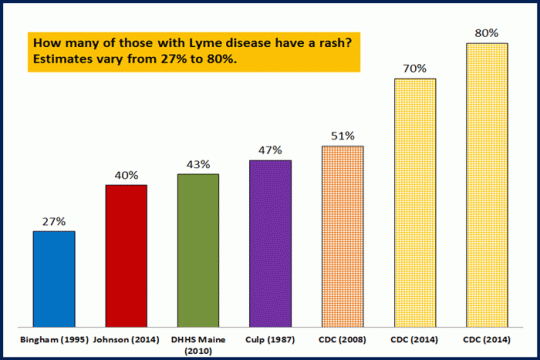 Various studies showing how many get the EM rash.