Archive for the ‘Lyme’ Category

Pandas & Lyme in a 7-Year Old

https://danielcameronmd.com/pandas-and-lyme-disease-in-a-7-year-old-child/

PANDAS AND LYME DISEASE IN A 7-YEAR-OLD CHILD

PANDAS-Lyme-disease

Hello, and welcome to another Inside Lyme Podcast. I am your host Dr. Daniel Cameron. In this podcast, I will be discussing the case of a 7-year-old child who was initially diagnosed with PANDAS and later, Lyme disease.

The article by Cross et al. entitled “Case Report: PANDAS and Persistent Lyme disease with Neuropsychiatric Symptoms: Treatment, Resolution and Recovery” was published in Frontiers in Psychiatry. [1]

The 7-year-old girl developed multiple physical and neuropsychiatric symptoms six months after travelling to a tick endemic region of the U.S. During this period, she was treated for 3 separate strep infections and was subsequently diagnosed with Pediatric Autoimmune Neuropsychiatric Disorders Associated with Streptococcal infections (PANDAS). PANDAS was considered based on classic symptoms and a history of strep, a positive ASO titer and a slightly elevated DNase B titer.

However, despite treatment, the patient’s symptoms continued to worsen. Additional testing revealed that she was also positive by CDC’s criteria for Lyme disease. The Lyme EIA and western blot IgM were positive (with 2 of 3 bands). The western blot IgG was positive for 3 of 10 bands at the IGeneX lab. Her B. henselae IgG was positive at Quest labs. Her IgG Mycoplasma and IgG Babesia duncani antibodies were positive at IGeneX.

Dr. Charles Ray Jones, co-author and treating physician, describes the patient’s broad range of symptoms.

Neuropsychiatric symptoms

On her first visit, “the patient presented with crying, anxiety, headache, joint pain, decreased cognitive functioning, fatigue, nighttime awakening and an extreme fear of sleeping alone.”

The patient’s symptoms were extensive, Jones explains, and included:

• Obsessions, compulsions
• ADHD-like behavior
• Decline in school work
• Separation anxiety
• Panic attacks
• Muscle and joint pain
• Mood lability
• Aggressive behavior
• Fatigue
• Headaches
• Difficulty sleeping
• Word selection problems
• Cognitive decline
• Irrational fears (would not sleep alone)

Functional decline 

The young girl was considered a gifted child and excelled in academics. But cognitive symptoms emerged. She reportedly told her mother, “Mom, something happened to my brain.”

“The patient regressed from being a year ahead of her class in math, to being unable to add beyond the number 10. She began having trouble comprehending more difficult reading,” the authors explain.

“During a ride home with her mother, the patient asked, ‘Who are you? What’s your name again?’ And ‘I know you are mommy but what’s your name?’”

Lyme disease, PANDAS and PANS

PANDAS may be diagnosed when a strep infection triggers multiple neurologic and psychiatric symptoms. PANS or Pediatric Acute-Onset Neuropsychiatric Syndrome, on the other hand, may be triggered by other bacterial, viral or fungal infections. Researchers believe that Borrelia burgdorferi, the bacteria that causes Lyme disease can trigger PANS in some patients.

Lyme disease, PANS and PANDAS can present with similar symptoms. Dr. Bransfield, a psychiatrist who specializes in tick-borne diseases, describes a broad range of neuropsychiatric symptoms that he has seen in his Lyme disease patients. [2]

These include: behaviors associated with developmental disorders or autism spectrum disorder, schizoaffective disorders, bipolar disorder, depression, anxiety disorders (panic disorder, social anxiety disorder, generalized anxiety disorder, posttraumatic stress disorder, intrusive symptoms), eating disorder, decreased libido, sleep disorder, addiction, opioid addiction, cognitive impairments, dementia, seizure disorders, suicide, violence, anhedonia, depersonalization, dissociative episodes, derealization and other impairments.”

Treatment

According to the authors, the child was treated with multiple courses of oral and IV antibiotics including: intravenous ceftriaxone, Omnicef 300 mg BID, Zithromax 250 mg BID, 500 mg BID and Tindamax 250 mg QD (Saturdays and Sundays only), Bactrim and Mepron. Despite this, her symptoms continued and the Cunningham Panel™ of tests was ordered.

Cunningham Panel™ and IVIG

“The Cunningham Panel was ordered to assess the presence of antineuronal antibodies against specific neuronal receptors,” the authors write. “If the Cunningham Panel is positive or strongly positive, that would be an indication that one has an autoimmune problem that needs to be treated with IVIG, as well as antibiotics,” explains Jones.

READ MORE: Highlights from the case report

Panel results indicated the patient had elevated levels for 3 out of 4 autoantibodies: Dopamine D1 Receptor (DRD1), Dopamine D2L Receptor (DRD2L), and Tubulin (TUB).

“Based upon the patient’s Cunningham Panel tests results, the decision was made to prescribe IVIG,” the authors write.

“Over a span of 31 consecutive months of treatment with various antimicrobials and 3 courses of IVIG she experienced complete remission and remains symptom free at the time of this publication.”

Outcome

“Currently this patient appears to be fully recovered and has been discharged from the care of the pediatric Lyme disease specialist. She is asymptomatic and performing academically at the “top” of her class according to her mother,” the authors write.

According to Jones, “multiple concomitant infections may be involved and require treatment to effectively resolve symptoms. Improvement in neuropsychiatric symptoms does not typically occur unless all co-infections are addressed and resolved.”

This podcast addresses the following questions:

  1. What is Pediatric Autoimmune Neuropsychiatric Disorders Associated with Streptococcal infections (PANDAS)?
  2. What are the typical symptoms of PANDAS?
  3. What are the similarities between Lyme disease, PANS and PANDAS?
  4. Why was Lyme disease and other tick-borne illnesses considered?
  5. Why was the name Pediatric Acute-onset Neuropsychiatric Syndrome (PANS) introduced?
  6. What is the Cunningham Panel™ of tests and why was it ordered?
  7. What tests did the girl have that supported the diagnosis of a tick-borne illness?
  8. Can you discuss the range of symptoms this patient experienced?
  9. Can you discuss the girl’s treatment for PANS?
  10. Can you discuss the girl’s treatment for Lyme disease, Bartonella, and Babesia duncani?
    Thanks for listening to another Inside Lyme Podcast. You can read more about these cases in my show notes and on my website @DanielCameronMD.com. As always, it is your likes, comments, reviews, and shares that help spread the word about Lyme disease. Until next time on Inside Lyme.

Please remember that the advice given is general and not intended as specific advice as to any particular patient. If you require specific advice, then please seek that advice from an experienced professional.

Inside Lyme Podcast Series

This Inside Lyme case series will be discussed on my Facebook and made available on podcast and YouTube.  As always, it is your likes, comments, and shares that help spread the word about this series and our work. If you can, please leave a review on iTunes or wherever else you get your podcasts.

References:
  1. Case Report: PANDAS and Persistent Lyme Disease With Neuropsychiatric Symptoms: Treatment, Resolution, and Recovery. Cross A., Bouboulis D., Shimasaki C., Jones C.R. Front. Psychiatry, 02 February 2021
  2. Bransfield RC. Suicide and Lyme and associated diseases. Neuropsychiatr Dis Treat. 2017;13:1575-1587. Published 2017 Jun 16. doi:10.2147/NDT.S136137.

___________________

For more:  

Sometimes the Memory is Better Than the Real Thing

https://globallymealliance.org/sometimes-the-memory-is-better-than-the-real-thing/

By Jennifer Crystal

In last week’s post, I talked about the various dreams I had during different stages of my battle with tick-borne illnesses. Some were hallucinogenic nightmares. Some were meaningful. And some gave me a simple message of rest. Hardest to endure were the dreams that reminded me of activities I could no longer do and feelings I no longer experienced. These dreams left me longing for my old life.

In my waking hours, I also longed for healthier days.  I kept talking about getting back on track: getting back to work, back to my apartment that I’d given up to move in with family when I became too sick to care for myself, back to the life in Colorado I’d left to convalescence in my home state of Connecticut. When I finally did achieve remission, I even threw a big “Back to Life” party.

Illness is not the only challenge that makes us long for the past. Whether healthy or sick, simply growing older makes many people nostalgic for “the good old days.” Young professionals remember the ease and fun of college. New parents remember the freedom of being newly married. The elderly long for the stamina of their youth. These days, we all long for our pre-pandemic lives.

It’s easy to view the past through rose-colored glasses, forgetting that college also meant long hours of studying; that the first year of marriage can be the hardest; that youth comes not just with stamina, but also with financial and emotional stresses. Our memory of a time or event might be brighter than what the experience actually was.

When your life is changed indefinitely or irrevocably, this can actually be a good thing.

Let me give a very simple example. When I went on the “Lyme diet,” I craved my favorite treats. I was strict about not eating gluten or sugar, but boy, did I miss them. For three years I didn’t touch chocolate. All I wanted was a bowl of ice cream. Sometimes I even dreamed about it.

One day my mom came home with a chocolate milkshake from my favorite ice cream shop. “How could you drink that in front of me?” I whined.

She held it out. “Take a sip. It won’t kill you.”

I hesitated only for a moment and then reached for the straw, taking a long sip of what I thought would be a delicious indulgence.

It was disgusting.

The milkshake tasted so sickeningly sweet that I immediately spit it out in the sink. I’d gotten so accustomed to not consuming sugar that even a small amount of it tasted terrible to me. After that, I never craved a milkshake again.

I am so glad I took that tempting sip that day, because it showed me that sometimes the memory of something is better than the real thing. Those memories are sweet and real. We experienced them and we should look back on them happily. But they belong in the past. One sip of a milkshake helped me reframe my entire perspective on what I was actually hoping to achieve with treatment for Lyme disease, babesiosis, ehrlichiosis and chronic Epstein-Barr virus. I realized that the goal was not actually to go back; it was to move forward in the context of my illnesses, to shift from surviving to thriving, even though that meant making certain adaptations to my lifestyle.

Since then, I’ve found many new treats that work within my dietary restrictions, including naturally-sweetened chocolate ice cream that may even taste better than the “real thing.” I never would have discovered all of the options available if I’d spent my time hankering for a treat I could no longer have. This doesn’t mean we should give up on dreams of the past entirely. I have regained my ability—albeit in moderated ways—to do many of the activities I loved in my pre-illness life. I have gone back to work, though not on the 9-5 schedule I once led. My new schedule is more flexible, and works better for my needs. Once I stopped clinging to the idea of my old life, I opened myself up to opportunities I never knew were possible.

A friend recently asked me, “When the pandemic is over, do you think people will still wear masks when they’re sick?” I replied that I hope they do (or better yet, that they’ll stay home). We won’t ever fully recover to our pre-pandemic state—certainly, we can’t get back the more than 400,000 lives that have been lost—but we have learned some lessons that can make things better in the future. We can make changes that we otherwise wouldn’t have thought to make. Hopefully, we’ll take better care of ourselves, and be more mindful of how our actions affect others.

These improvements will be worthy of celebration—with a milkshake!

To read more blogs click here.

jennifer crystal_2

Opinions expressed by contributors are their own.

Jennifer Crystal is a writer and educator in Boston. Her memoir about her medical journey is on submission. Contact her at lymewarriorjennifercrystal@gmail.com.

______________________

**Comment**

If you are sick, stay home if you can and recover. This is not new, sage advice – it’s common sense.  Masks were never intended to be worn 24/7 and with regard to infections, don’t do anything but impede air flow to you causing harm, as well as harbor germs.  I’ve posted on this repeatedly – with science.  We should return to our pre-pandemic state because germs have always lived within us and around us.  This too is not new.

Sadly, lives have always been lost. COVID deaths should be no more or no less important than other deaths.

The question that haunts me is how many lives could have been saved due to the mishandling of tick-borne illness?  This question isn’t even on our public authorities’ radar.

ILADS February Newsletter

https://mailchi.mp/ilads.org/member-newsletter-august-687499?e=14b78402e1  Newsletter here

c21b938f-f61c-4ed6-b86b-2c11cb9a33a0

ILADS Newsletter February 2021

In this issue

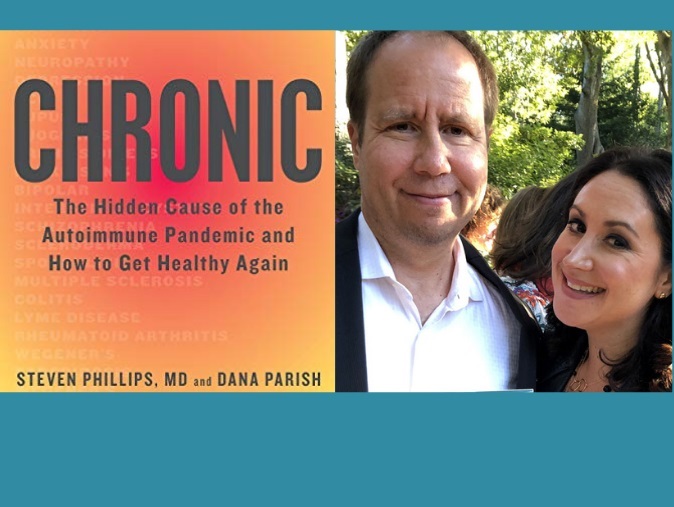
Chronic: The Hidden Cause of the Autoimmune Pandemic & How To Get Healthy Again

https://www.lymedisease.org/excerpt-chronic-phillips-parish/

TOUCHED BY LYME: Read excerpt of “Chronic,” long-awaited book by Phillips and Parish

By Dorothy Kupcha Leland

CDC Lyme Count is Still Too Low

https://www.lymedisease.org/cdc-lyme-disease-cases-undercount/

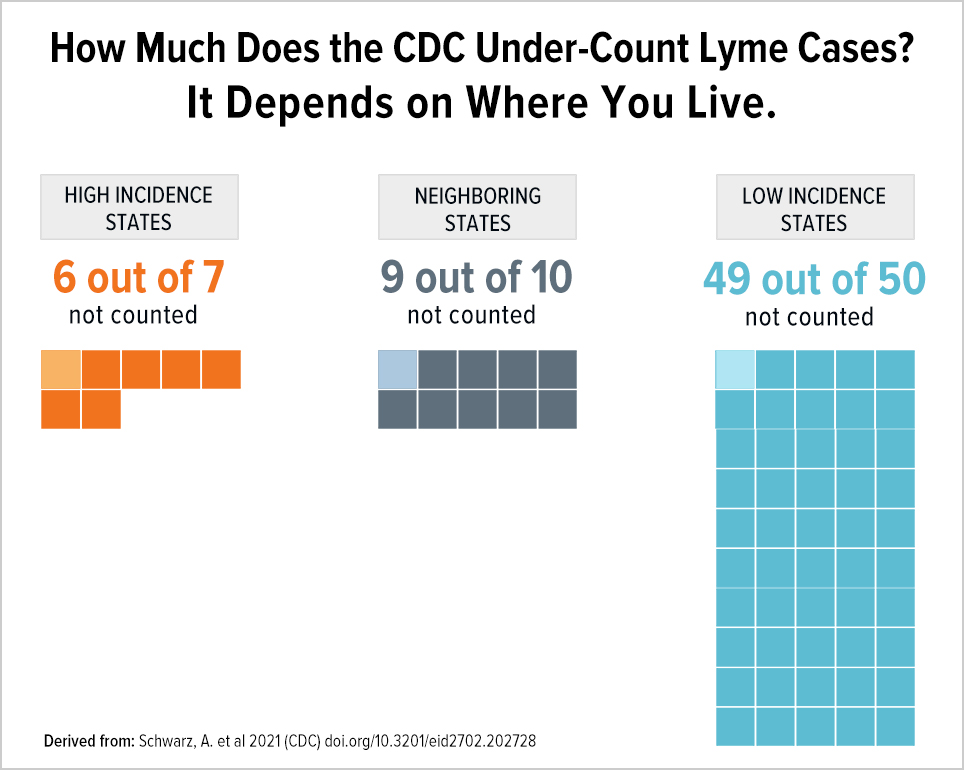
How Much Does the CDC Undercount Lyme Cases?  It Depends on Where You Live

By Lorraine Johnson, JD, MBA

2/2/2021

The Centers for Diseases Control and Prevention recently compared its annual surveillance Lyme numbers [those that meet the agency’s narrowly defined case definition] to the number of Lyme cases tallied in a major insurance claims data base from 2010 to 2018. Their study concludes that the CDC is still undercounting cases1.

But, if you dig deep into the numbers, you see that the undercounting is much more severe in some areas—namely in southern and western states. This has huge implications for Lyme patients in those regions, making it much harder for them to get properly diagnosed and treated.

Here are my four main take-aways from the study:

  • Undercounting is the rule: The CDC increased its estimate of annual cases of Lyme disease from 300,000 to 476,000, based on insurance claims made. That’s a 58% increase in estimated cases.
  • Not all states are equal: In states the CDC considers low incidence, only 1 in 50 cases is counted, while in high incidence states 1 in 7 is counted.
  • State-based gender bias: In states the CDC considers low incidence, 63% of cases are female.
  • The revised estimate does not affect surveillance cases reported by the CDC, which reporters and physicians rely on. This leaves the public unaware and harms patients by giving their physicians a false sense of complacency that Lyme disease is not a big problem.
CDC undercounting of Lyme disease is more severe in some areas — namely in southern and western states

Misdiagnosis of Lyme disease by geography is a big problem

It’s important that the CDC is acknowledging an extraordinary amount of undercounting and it is also important that they are looking at other big data sources (here insurance claims) to see how far off the mark they are. However, the degree to which the CDC surveillance system undercounts cases is not equally distributed geographically. States that are considered low incidence states are disproportionately undercounted.

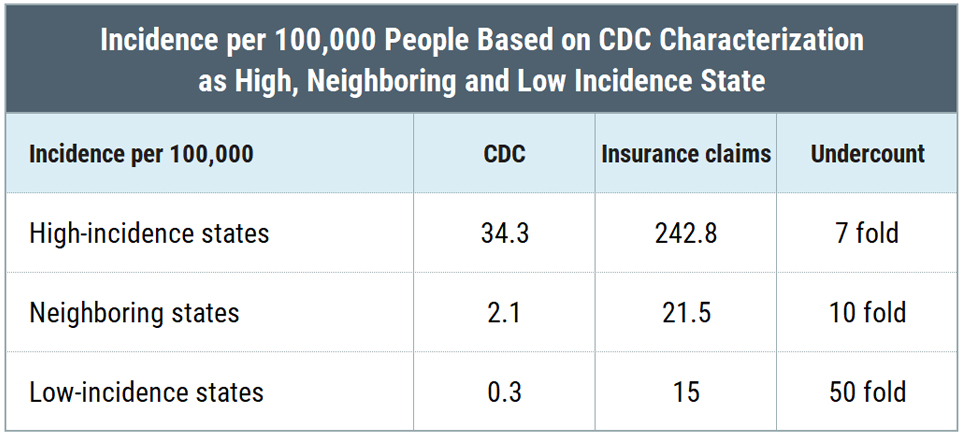
Here’s a table comparing the amount of underreporting reflected in the reduced number of surveillance cases compared to insurance claims in the CDC study in high-incidence, neighboring states, and low-incidence states:

How much does the CDC undercount Lyme disease?
Table - CDC undercount of Lyme disease in high-incidence, neighboring states, and low-incidence state

What we see is that the undercount is not equal among the three categories: high-incidence states are undercounted by a factor of 7, neighboring states by a factor of 10, and low-incidence states by a factor of 50. Undercounting cases by a factor of 50 means that for every single case identified, the CDC throws out another 49 cases. Thus, the CDC geographic case restriction impairs accurate counting of cases.

How much does the CDC undercount Lyme cases? It depends on where you live.

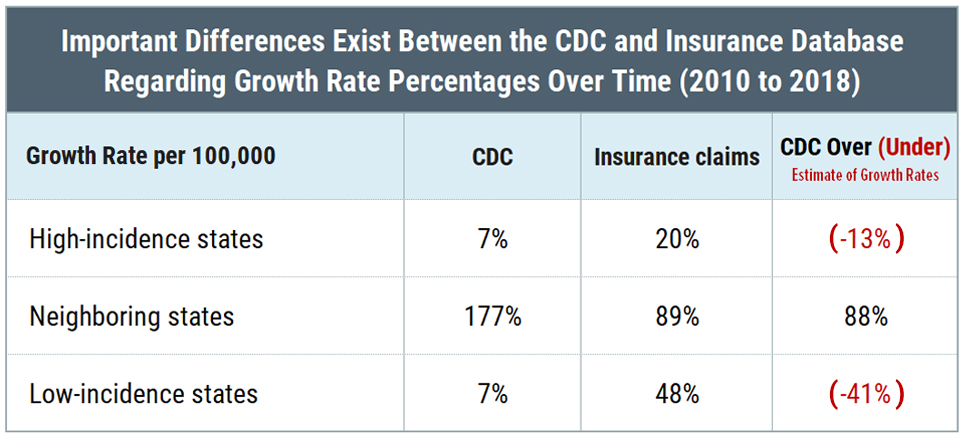
Moreover, the percentage of increase in cases reported by the CDC compared to insurance claims data shows the same anomalies among the different categories of states.

Table - Differences Between the CDC and Insurance Database Regarding Lyme Disease Growth Rate Percentages

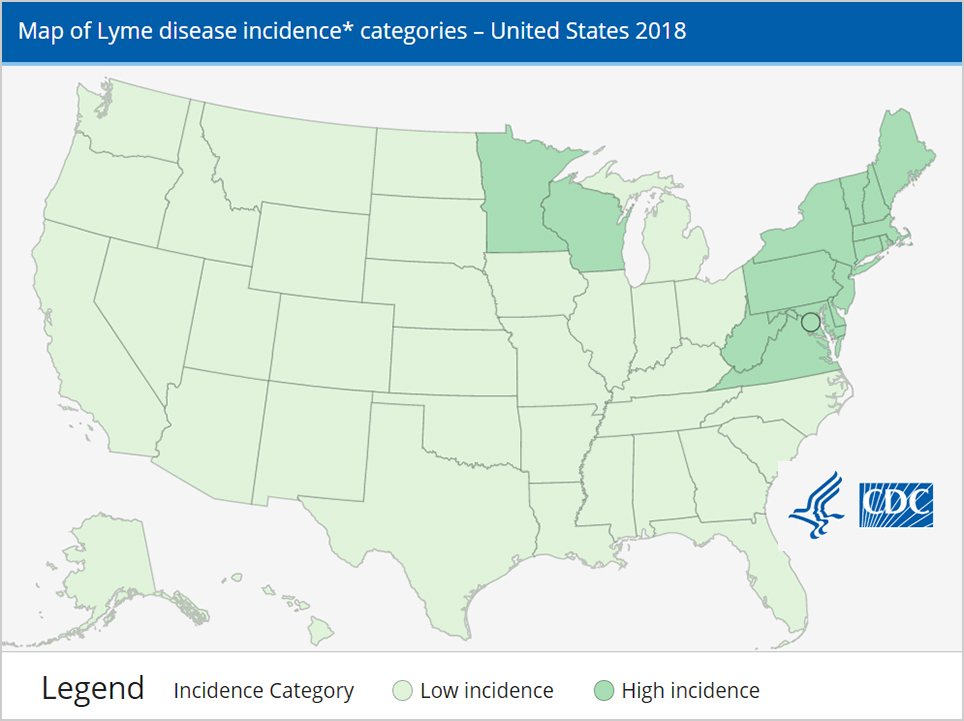
The CDC surveillance counts place a heavy emphasis on “high incidence” states—which are primarily confined to the East Coast and Midwest as the map below illustrates.

CDC Lyme Disease Incidence Map

Unfortunately, saying that a state is either high or low incidence oversimplifies the complex geographic distribution which is driven by whether the local ecosystem will support and sustain the tick population that carries Lyme disease. In California, for example, there are areas as highly endemic as the east coast. The CDC totally ignores such variation within a single state. This emphasis on high incidence states is not only inaccurate, it also leads to misdiagnosis in other states where clinicians are led to believe the risk is not present. The feedback loop is further distorted because the CDC case report form includes endemicity as a requirement for counting cases, which in turn reflects awareness of risk, physician diagnosis, and counting of future cases. This misleading feedback loop will artificially suppress case counts in areas outside the Northeast and Midwest in perpetuity until it is abandoned.

For years, the Lyme community’s complaints about misdiagnosis by geography have fallen on deaf ears. Although the study increased the number of cases by 58% with the new 476,000 estimate, it also demonstrates how much cases in low incidence states are under-counted compared to high incidence states when different data sources are compared.

So for example, while surveillance data shows 93.2% of cases in high-incidence states, insurance data shows only 80.5%. That’s a 12% difference and it matters. It means that the CDC is undercounting cases in states that it does not characterize as high-incidence. We know this is likely true because another insurance data base study showed many states the CDC considers to be low incidence states to be in the top five states in insurance claims.

As reported in the Wall Street Journal: “North Carolina reported 32 Lyme cases to the CDC in 2016 but in the same year made 88,539 health-care claims for a Lyme diagnosis. California reported 90 cases to the CDC but had 46,820 claims. Texas reported 31 cases to the CDC but had 31,129 claims. All three are considered low incidence states 2”.

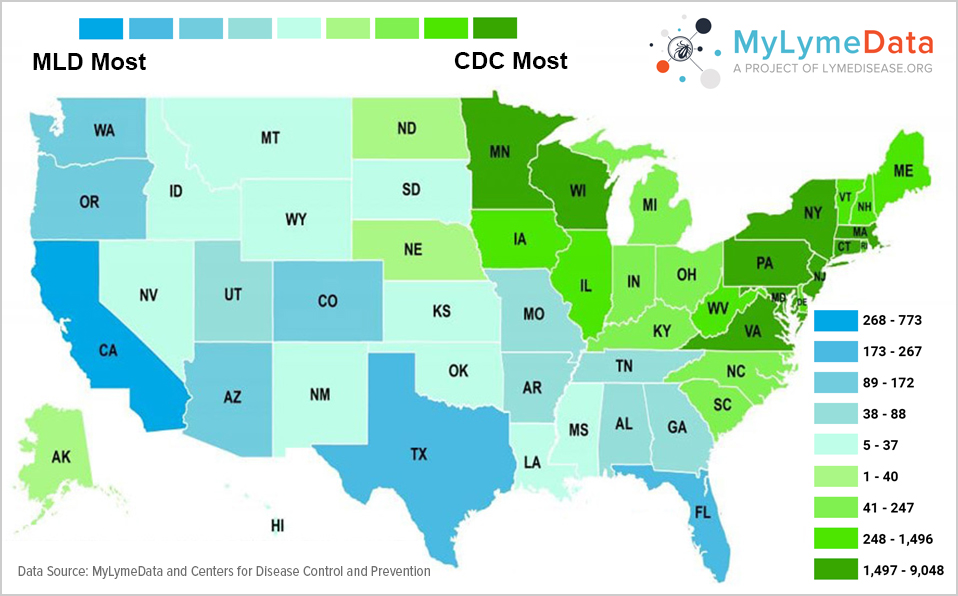
We also see this in the differences between MyLymeData geographical distribution of cases compared to the CDC below. The states in blue have a higher number of people enrolled in MyLymeData than are included in total CDC Lyme disease case reports. (In green states, the CDC has more cases.) The differences reflected on the map suggest a broad pattern of underreporting by the CDC of Lyme disease in the South and the West.

Differences between MyLymeData geographical distribution of cases compared to the CDC

If the CDC is going to look at real word data, it should be willing to consider that its preconceived notions of geographical distribution are incorrect and “listen to the data.”

A similar variation in seasonality occurred. A higher proportion from high-incidence states (59%) occurred during the summer compared with diagnoses from neighboring (53%) and low-incidence states (42%). This may reflect the warmer weather in the west and southwest and an extended tick season.

Do more males have Lyme disease than females? It depends.

Distributions by sex also differed across high-incidence, neighboring, and low-incidence states. Male patients accounted for a greater proportion of diagnoses in high-incidence states (50.8%) than in neighboring (41.9%) and low-incidence (36.6%) states. Biodiversity of strains and ticks across different ecosystems may affect males and females differently. But the fact that 63% of cases in low incidence states are female underscores the fact that gender-based assumptions may not accurately reflect the real world data. We do not know.

The CDC’s increased Lyme disease case estimate is important, but not enough.

The increase should be viewed as part of an effort by the CDC to find other ways of tracking Lyme cases because the current surveillance system is essentially broken. The current surveillance system imposes too great a burden on healthcare providers and on the local departments of health. As a result, cases are simply not reported. Streamlining this process by using either automated laboratory results or insurance claims from sources that already exist would dramatically reduce these burdens and hopefully more accurately reflect cases that occur in the real world.

Significantly, the new CDC study concludes that the MarketScan insurance claims data they used “provided a stable source of data for . . . diagnosis. . .that could serve as a resource efficient adjunct to surveillance.”.

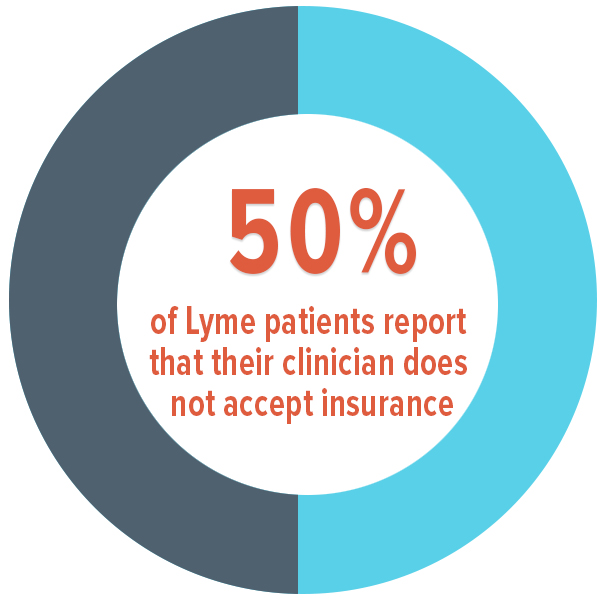
The CDC’s increased estimate based on it’s comparison of real world insurance claims data to surveillance data is important. Even this increase widely misses the mark though. MyLymeData tells us that 50% of patient report that their clinician does not accept insurance. Those patients may not be included in the insurance data base.

 
50% of patient report that their clinician does not accept insurance

I am also bothered by the fact that when the geographic real-world data differs from the surveillance data, the CDC assumes that the real world data is wrong—that it’s due to miscoding or misdiagnosis. Why not consider the possibility that the CDC’s surveillance data could be incorrect? That independent data sources may provide us with a look at a larger reality and geographic and gender-based difference that require a deeper examination?

Even with the increased CDC estimate in Lyme disease cases, patients in the south and west will continue to be harmed by delayed and missed diagnosis because of the weight the CDC places on geography in the surveillance case reporting.

Click to tweet

We know that the surveillance data is skewed because it has inherent biases for cases that present with a rash and for cases that are geographically on the East coast or Midwest. Both of these factors play a large role in meeting the requirements of the surveillance case definition. Even with the increased estimate in cases, patients in the south and west will continue to be harmed by delayed and missed diagnosis because of the weight the CDC places on geography in the surveillance case reporting.

It’s good news that the CDC has increased its estimate of the annual number of cases after seeing that they are well below insurance claims cases. It would be better if they overhauled their surveillance case definition so that reporters don’t use these drastically under counted cases in their news articles and physicians are given the tools to promptly diagnose patients.

If you are a patient who is not enrolled in MyLymeData,  please enroll today. If you are a researcher who wants to collaborate with us, please contact me directly.

The MyLymeData Viz Blog is written by Lorraine Johnson, JD, MBA, who is the Chief Executive Officer of LymeDisease.org. You can contact her at lbjohnson@lymedisease.org. On Twitter, follow her @lymepolicywonk.  If you have not signed up for our patient-centered big data project, MyLymeData, please register now.

MyLymeData Lyme Disease Research
About MyLymeData Lyme Disease Research

MyLymeData is one of the largest patient-driven registries in the nation, with over 13,500 patients enrolled. It was created by patients, is run by patients and will address the issues that Lyme disease patients care about. MyLymeData Viz provides the community with results from MyLymeData. If you are enrolled in MyLymeData, we thank you for providing the data that will accelerate the pace of research in Lyme disease. If you are not enrolled, please enroll today.

_________________________
 
 
**Comment**
 
Great points.  The CDC has been assuming incorrectly for a very long time.