https://entomologytoday.org/2018/01/16/up-close-look-tiny-sensory-pits-ticks-use-smell/ by Meredith Swett Walker
An Up-Close Look at the Tiny Sensory Pits That Ticks Use to Smell

A new study in the Journal of Medical Entomology analyzes the the Haller’s organs of three tick species, including that of Ixodes scapularis, shown above. The Haller’s organ is a sensory pit on the foreleg used to detect heat and chemical odors emitted by potential hosts. “Landmarks” used in analysis of the organs are numbered. (Image originally published in Josek et al, 2017, Journal of Medical Entomology)
If you ever find a tick before it finds you—that is when it’s still hanging out on vegetation hoping you’ll brush past it—you may notice the little bloodsucker waving its “arms in the air like it just don’t care.” But ticks aren’t fans of 1980’s hip hop. They’re waving their arms because they are trying to get a whiff of you.
While insects primarily smell with their antennae, ticks are not insects; rather, they’re arachnids, and they don’t have antennae. Instead, a tick smells using a structure on its forelegs called the Haller’s organ. The Haller’s organ is described as a tiny “sensory pit” that can detect chemicals like carbon dioxide, ammonia, or pheromones. It can even sense humidity and infrared light, which includes body heat emitted by the warm, blood-filled creatures that the tick wants to find.
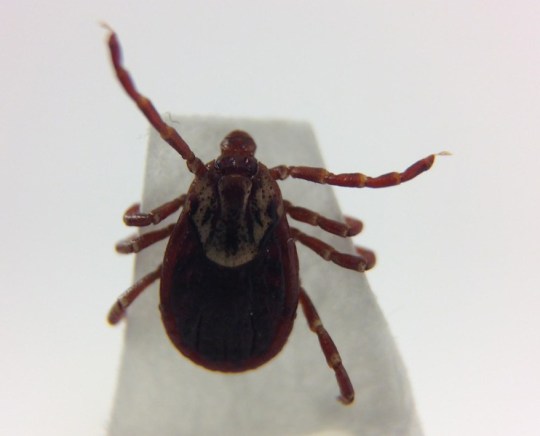 When seeking a host, ticks such as the American dog tick (Dermacentor variabilis) wave their forelegs, in a behavior called “questing.” The ticks’ forelegs feature tiny sensory pits called Haller’s organs used to detect a passing host. (Photo credit: Tanya Josek)
Despite the importance of the Haller’s organ in tick’s ability to find hosts, it hasn’t been described in detail for many important tick species. But in research published in December in the Journal of Medical Entomology, Tanya Josek, Brian Allan, Ph.D., and Marianne Alleyne, Ph.D., of the University of Illinois examine the Haller’s organ in three medically important species of tick: the blacklegged tick (Ixodes scapularis), the lone star tick (Amblyomma americanum), and the American dog tick (Dermacentor variabilis).
Each of these species is an important disease vector: I. scapularis transmits the bacterium that causes Lyme disease, A. americanumtransmits the bacteria that cause ehrlichiosis, and D. variabilis transmits the bacterium that causes Rocky Mountain spotted fever. A better understanding of how these ticks find their hosts may aid in reducing disease transmission.
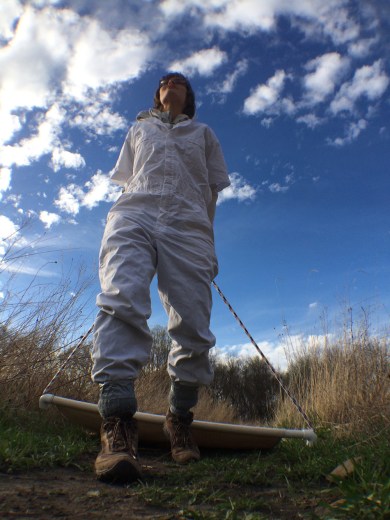
Tanya Josek, a graduate researcher at the University of Illinois, suits up in Tyvek and duct tape during tick collection. Ticks are gathered by dragging a white cloth through vegetation and then collecting ticks that attach to the cloth. (Photo credit: Tanya Josek)
Josek, a graduate student in Alleyne’s lab, was interested in arthropod sensory structures. The Haller’s organ seemed a great research topic: Relatively little was known about it, and the potential findings could have important applications in real-world tick-control efforts. The only problem? Josek had a phobia of ticks stemming from some bad experiences in childhood. “This was a complete shock to me because I have loved spiders and insects my whole life,” she says.
But Josek conquered her fear with knowledge, reading up on where you’re most likely to pick up the parasites and how long it takes them to transmit disease. She trained with Allan to learn tick collection skills. Then, arming herself with a white Tyvek suit and ample duct tape, she set out into the forests and fields of Illinois in search of ticks.
Previous studies of the Haller’s organ were mostly qualitative, which, while informative, are not useful to making quantitative comparisons between species. In addition, recent advances in scanning electron microscope technology provided an opportunity to look more closely at the tiny structure. Josek and her collaborators used environmental scanning electron microscopy (ESEM) to get high resolution images of Haller’s organs.
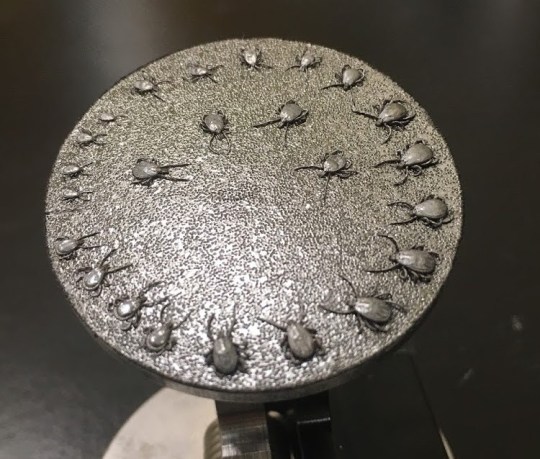 What might look like the latest in tick inspired jewelry design is rather a set of tick samples prepared for environmental scanning electron microscopy. In this case, ticks were mounted with forelegs turned so their Haller’s organ faced upwards, and they were then coated with gold and platinum. According to entomologist Marianne Alleyne, Ph.D., “the gold/platinum mixture is an especially good electrical conductor” and helps keep the sample from being “fried” by the electron beam. (Photo credit: Tanya Josek)
The team focused on the overall shape of the Haller’s organ in each tick species as well as the organ’s major components: the capsule aperture, anterior pit, and the number of setae and sensilla (hair-like structures) in the pit. They analyzed their images using Geometric Morphometrics Analysis, a technique that essentially translates shape measurements into data that can be used in quantitative comparisons.
They found that the structure of the Haller’s organ was significantly different in each species of tick. In one species, D. variabilis, the morphology of the Haller’s organ was significantly different between females and males. This study did not test the consequences of these differences in shape, but the detailed quantitative measurements it provides can serve as a basis for future studies in differences in function of the Haller’s organs between species.
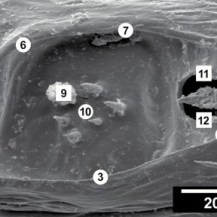
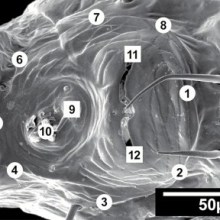
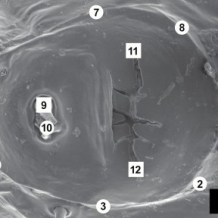 Environmental scanning electron microscopy reveals detailed close-ups of the Haller’s organs of three tick species: Ixodes scapularis (Is), Amblyomma americanum (Aa), and Dermacentor variabilis (Dv). The Haller’s organ is a sensory pit on the foreleg used to detect heat and chemical odors emitted by potential hosts. “Landmarks” used in analysis of the organs are numbered. (Image originally published in Josek et al, 2017, Journal of Medical Entomology) “
I. scapularis, A. americanum, and D. variabilis have different preferred hosts and different strategies for finding them. The differences in the structure of their Haller’s organs may reflect this. In order to understand how Haller’s organ morphology relates to tick life histories, “within-genus comparisons, as well as comparisons between ticks with different host-seeking behaviors or between ticks that have a generalist or specialist host-range,” are necessary, say the authors.
Meanwhile, Josek is working on determining the specific chemicals, infrared wavelengths, or humidity variables the Haller’s organ is sensing. Josek and Alleyne are also looking at the organ from a genomics perspective and will soon publish a paper that examines the chemoreceptors and binding proteins expressed in the Haller’s organ.
Alleyne’s main research interest is bioinspired design, and, while she’s not a huge fan of ticks, she finds inspiration in the Haller’s organ. “To think that arthropods have an exoskeleton that protects them from the environment … and yet are able to sense minute amounts of chemicals is amazing to me. The Haller’s organ is an example of a multi-functional sensor that is very sensitive yet rather simple in design, compared to a vertebrate’s nose, for instance,” she says.
If we can better understand the structure ticks use to find us (and their other hosts,) we might devise ways to elude them. This could reduce transmission of serious diseases, as well as make ticks less of a creepy problem for people who work or play outdoors. Josek has overcome her tick phobia and is now comfortable collecting and handling them, but “I still have the occasional nightmare about them,” she admits.
Meredith Swett Walker is a former avian endocrinologist who now studies the development and behavior of two juvenile humans in the high desert of western Colorado. When she is not handling her research subjects, she writes about science and nature. You can read her work on her blogs Pica Hudsonia and The Citizen Biologist or follow her on Twitter at @mswettwalker.
_______________
**Comment**
Well, I can certainly understand Josek’s phobia. It would be interesting to know where she got her information on tick location and transmission time as those issues are hot-beds of controversy.
For more accurate info: https://madisonarealymesupportgroup.com/2017/04/14/transmission-time-for-lymemsids-infection/ In under 6 hours after a tick bite a little girl couldn’t walk. Powassan can be transmitted in mere minutes.
http://steveclarknd.com/wp-content/uploads/2013/11/The-Confounding-Debate-Over-Lyme-Disease-in-the-South-DiscoverMagazine.com_.pdf (go to page 6 and read about Speilman’s maps which are faulty but have ruled like the Iron Curtain, and have been used to keep folks from being diagnosed and treated)
https://madisonarealymesupportgroup.com/2017/10/06/remembering-dr-masters-the-rebel-for-lyme-patients-who-took-on-the-cdc-single-handedly/ Dr. Masters argued with the “powers that be” that Lyme or a Lyme-like illness was in the South for decades to no avail.
Also, I am concerned about the fact that more research needs to be done on so many other issues besides ticks. For instance:
Do other insects transmit Lyme? Are there other modes of transmission?
What other vectors transmit the co-infections that typically come with Lyme?
When are the “powers that be” going to admit that the interplay of Lyme and various coinfections require far more than 21 days of doxycycline?
Does ELQ cure Babesia or not? (would more money speed up research?)
And what about Alzheimer’s and Lyme? Researchers like Alan McDonald are in their basements using their own microscopes!
Once again, proving a science cabal exists, Moir recounts how at a Korean conference, attendees were asked to raised hands if they thought infections played a part in AD and a majority of hands went up.
“Ten years ago, it would have been four guys in a corner, all huddled together, not talking to anyone else,” Moir says.
I could go on an on to infinity, but the point is that this emphasis on ticks shouldn’t be the end-all as so many other factors are involved. Please understand, I’m thankful for all research but don’t stop with ticks! Researchers need to pretty much scrap everything they thought they knew about Lyme/MSIDS and start over with an open mind.
Until then we are living in a fantasy.


 Madison Area Lyme Support Group