Outdoor Survival Expert tells of the dangers of Lyme Disease.
__________________
Great video reminding us of how our those working in the outdoors including search and rescue folks, police, fire, EMS, and forest workers are in harms way. These folks are in the elements, including grassy ditches and other tick friendly habitats.
Schizophrenia Linked with Abnormal Immune Response to Epstein-Barr Virus
01/09/2019
Credit: iStock
New research from Johns Hopkins Medicine and Sheppard Pratt Health System shows that people in the study with schizophrenia also have higher levels of antibodies against the Epstein-Barr virus (EBV), a herpes virus that causes infectious mononucleosis, so-called mono.
Researchers proposed two explanations for the association of heightened immune responses in patients with schizophrenia and EBV infection: schizophrenia might alter the immune systems of these patients and make them more susceptible to EBV, or EBV infection might increase the risk of schizophrenia.
“We are interested in the role of infectious agents such as Epstein-Barr virus in schizophrenia and other serious psychiatric disorders, so we did this study to look at the associations,” said Robert Yolken, M.D., the Theodore and Vada Stanley Distinguished Professor of Neurovirology in pediatrics at Johns Hopkins Children’s Center and senior author of the study. Yolken cautioned that the study wasn’t designed to determine cause and effect.
Schizophrenia is a mental disorder where patients have distorted thinking, perception, emotions, language, sense of self and behavior. According to the World Health Organization, schizophrenia affects more than 21 million people worldwide.
While schizophrenia has some genetic associations, genes that have been found to date explain only a portion of the disease risk. Environmental exposures, including to some infectious agents, have also been identified in previous studies as increasing the risk for schizophrenia.
EBV initially causes fever and swollen lymph nodes, and is commonly transmitted through oral contact such as kissing. In severe cases, it can spread to the central nervous system and cause persistent infection. Researchers wanted to see the relationship between this EBV infection and schizophrenia.
The researchers conducted a study among 743 people—432 with a schizophrenia diagnosis and 311 without a history of a psychiatric disorder to serve as a control group. Around 55 percent of the participants were men.
The researchers first measured levels of antibodies against components of EBV by comparing antibody levels in healthy people with those of people who have schizophrenia. They looked at the odds of having these antibodies in the 50th, 75th and 90th percentiles and found that people with schizophrenia were 1.7 to 2.3 times more likely to have increased levels of some EBV antibodies compared with people without schizophrenia.
Then they measured the antibodies to other related viruses such as varicella/chicken pox or herpes simplex type 1/cold sore virus, and didn’t find an increase of antibodies against these viruses in people with schizophrenia. These findings suggest that only EBV was associated with increased risk of schizophrenia.
After that, the researchers sequenced a portion of the participants’ DNA to determine their genetic risk for schizophrenia. Results from the analysis showed that people who had both evidence of increased genetic risk for schizophrenia and increased antibody levels to EBV had a more than eight times higher chance of being in the schizophrenia group as compared with controls. Approximately 10 percent of the individuals with schizophrenia had increased levels of both antibodies and genetic risk as compared with slightly more than 1 percent of the controls.
“We found that individuals with schizophrenia had an unusual response to Epstein-Barr virus,” said Yolken. “This indicated that the prevention and treatment of Epstein-Barr virus might represent an approach for the prevention and treatment of serious psychiatric disorders such as schizophrenia.”
Currently, there are no treatments available for EBV approved by the Food and Drug Administration, but a number of compounds that may prevent or treat replication of the virus are under investigation. The researchers considered the development of these approaches a high priority so that people with schizophrenia or other disorders associated with susceptibility to EBV could use them. In the meantime, researchers recommend preventing EBV transmission through good hygienic practices such as hand-washing and avoiding oral contact, such as kissing, with infected people.
The study is supported by the National Institute of Mental Health (MH-94268) and by the Stanley Medical Research Institute (07-1690).
Other authors on the study included Lorraine Jones-Brando of Johns Hopkins; Faith Dickerson, Cassie Stallings, Andrea Origoni, Emily Katsafanas, Kevin Sweeney and Sunil Khushalani from the Stanley Research Program at Sheppard Pratt; Glen Ford from VanPelt Biosciences; Giulio Genovese and Colm O’Dushlaine from Broad Institute of MIT and Harvard.
This press release is modified from a release prepared by Sheppard Pratt Health System.
A decade ago, Dr. Miyaoka accidentally discovered one. He treated two schizophrenia patients who were both institutionalized, and practically catatonic, with minocycline, an old antibiotic usually used for acne. Both completely normalized on the antibiotic.When Dr. Miyaoka stopped it, their psychosis returned. So he prescribed the patients a low dose on a continuing basis and discharged them.
Minocycline has since been studied by others. Larger trials suggest that it’s an effective add-on treatment for schizophrenia. Some have argued that it works because it tamps down inflammation in the brain. But it’s also possible that it affects the microbiome — the community of microbes in the human body — and thus changes how the immune system works.
https://madisonarealymesupportgroup.com/2017/10/03/treat-the-infection-psychiatric-symptoms-get-better/LLMD, Dr. Horowtiz, goes on record stating that antibiotics are effective in Schizophrenia. With irony he points out that the authors attribute the reason minocycline helped these patients is due to its ability to affect glutamate pathways in the CNS, blocking nitric oxide-induced neurotoxicity, and inflammation in the brain. He reminds them that minocycline is a tetracycline antibiotic that very well may be treating an infection. He also emphatically states that he has had several schizophrenic patients test positive for Bb, the agent of Lyme Disease. After taking doxycycline they improved significantly and with the help of their psychiatrist, were able to reduce and in some cases eliminate all of their antipsychotic medication. It is important to note that patients remained stable on antibiotics but their symptoms returned if they stopped treatment.
https://madisonarealymesupportgroup.com/2017/01/17/lymemsids-and-psychiatric-illness/In this presentation, Dr. Markes questions if psychiatric disorders are inflammatory diseases. She lists: Autism, Alzheimer’s, Schizophrenia, Bipolar, PTSD, Depression, Stress, Sleep Deprivation, Self-harm, and Suicide Attempts. She also describes a study in England observing children for over a decade in which children with a high IL-8 at age 8 have an 81% change of developing depression by age 18 and a 2-fold chance of becoming psychotic.
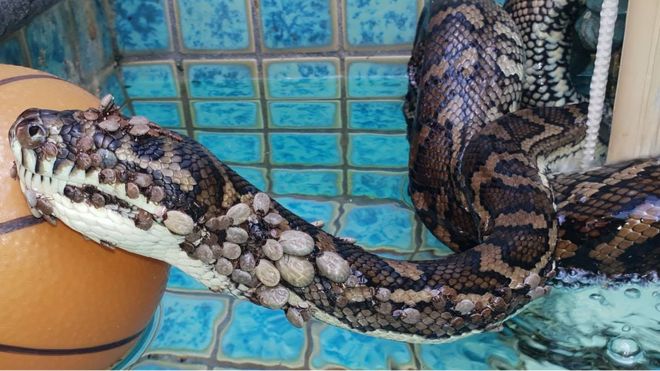
Python covered with more than 500 ticks rescued in Australia
11 January 2019
Image copyright GOLD COAST AND BRISBANE SNAKE CATCHER/FACEBOOK
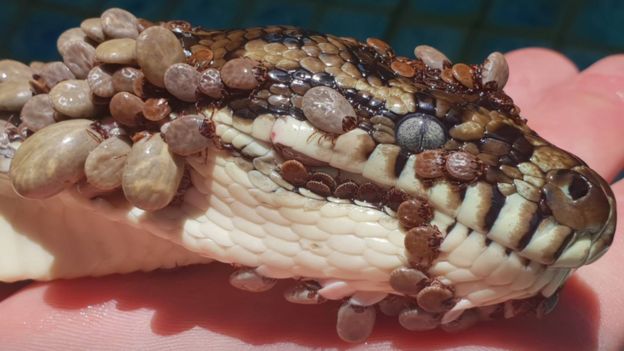
Snake catchers in Australia have rescued a carpet python which was found covered in hundreds of ticks.
The reptile, which was believed to be ill and was coated in the parasites, was lying in a backyard swimming pool on the Gold Coast in Queensland.
A professional handler removed the snake and took it for treatment at a wildlife clinic.
Vets removed more than 500 ticks, snake catcher Tony Harrison told the BBC, and it is expected to recover.
‘Like holding a bag of marbles’
Gold Coast and Brisbane Snake Catchers worker Mr Harrison said he believed the snake, which has been given the name Nike, had been trying to drown the ticks in the pool.
“Obviously, [the snake] was extremely uncomfortable,” he said.
Image copyright GOLD COAST AND BRISBANE SNAKE CATCHER/FACEBOOK
“Its whole face was swollen and blooming and it was completely overwhelmed by the ticks breeding on him.”
He said removing the tick-laden snake had felt like “holding a bag of marbles that were moving under my hands”.
Snakes often pick up small numbers of ticks or other parasites in the wild, said Associate Prof Bryan Fry from the University of Queensland.
However the presence of such a large number of ticks indicated that the snake was likely to have an underlying illness, he said, possibly be due to heat stress or drought conditions.
“Clearly it was a seriously unwell animal to have had its natural defences so broken down,” Associate Prof Fry said.
“I doubt it would have survived if it hadn’t been taken out and gotten treatment.”
Mr Harrison later shared that Nike was suffering from an infection, though he was now “doing well”.
The first eight months of WWII with no fighting was called The Phoney War. Using millimetre waves as a fifth-generation or 5G wireless communications technology is a phoney war of another kind. 237 scientists from 43 countries consider 5G a threat to health, yet the UN’s Secretary General jokes about his ignorance on 5G, despite WHO reports going back almost two decades stating their harms. Read the article:http://www.greenmedinfo.com/slide/un-…
C. Ben Beard, PhD1; James Occi, MA, MS2; Denise L. Bonilla, MS3; Andrea M. Egizi, PhD4; Dina M. Fonseca, PhD2; James W. Mertins, PhD3; Bryon P. Backenson, MS5; Waheed I. Bajwa, PhD6; Alexis M. Barbarin, PhD7; Matthew A. Bertone, PhD8; Justin Brown, DVM, PhD9; Neeta P. Connally, PhD10; Nancy D. Connell, PhD11; Rebecca J. Eisen, PhD1; Richard C. Falco, PhD5; Angela M. James, PhD3; Rayda K. Krell, PhD10; Kevin Lahmers, DVM, PhD12; Nicole Lewis, DVM13; Susan E. Little, DVM, PhD14; Michael Neault, DVM15; Adalberto A. Pérez de León, DVM, PhD16; Adam R. Randall, PhD17; Mark G. Ruder, DVM, PhD18; Meriam N. Saleh, PhD14; Brittany L. Schappach10; Betsy A. Schroeder, DVM19; Leslie L. Seraphin, DVM3; Morgan Wehtje, PhD3; Gary P. Wormser, MD20; Michael J. Yabsley, PhD21; William Halperin, MD, DrPH22 (View author affiliations)
Summary
What is already known about this topic?
Haemaphysalis longicornis is a tick indigenous to Asia, where it is an important vector of human and animal disease agents, which can result in human hemorrhagic fever and substantive reduction in dairy production.
What is added by this report?
During 2017–2018, H. longicornis has been detected in Arkansas, Connecticut, Maryland, New Jersey, New York, North Carolina, Pennsylvania, Virginia, and West Virginia on various species of domestic animals and wildlife, and from two humans.
What are the implications for public health practice?
The presence of H. longicornis in the United States represents a new and emerging disease threat. Characterization of the tick’s biology and ecology are needed, and surveillance efforts should include testing for potential indigenous and exotic pathogens.
Haemaphysalis longicornis is a tick indigenous to eastern Asia and an important vector of human and animal disease agents, resulting in such outcomes as human hemorrhagic fever and reduction of production in dairy cattle by 25%. H. longicornis was discovered on a sheep in New Jersey in August 2017 (1). This was the first detection in the United States outside of quarantine. In the spring of 2018, the tick was again detected at the index site, and later, in other counties in New Jersey, in seven other states in the eastern United States, and in Arkansas. The hosts included six species of domestic animals, six species of wildlife, and humans. To forestall adverse consequences in humans, pets, livestock, and wildlife, several critical actions are indicated, including expanded surveillance to determine the evolving distribution of H. longicornis, detection of pathogens that H. longicornis currently harbors, determination of the capacity of H. longicornis to serve as a vector for a range of potential pathogens, and evaluation of effective agents and methods for the control of H. longicornis.
H. longicornis is native to eastern China, Japan, the Russian Far East, and Korea. It is an introduced, and now established, exotic species in Australia, New Zealand, and several island nations in the western Pacific Region. Where this tick exists, it is an important vector of human and animal disease agents.In China and Japan, it transmits the severe fever with thrombocytopenia syndrome virus (SFTSV), which causes a human hemorrhagic fever (2), and Rickettsia japonica, which causes Japanese spotted fever (3).Studies in Asia identified ticks infected with various species of Anaplasma, Babesia, Borrelia, Ehrlichia, and Rickettsia, and all of these pathogen groups circulate zoonotically in the United States (4,5). In addition, parthenogenetic reproduction, a biologic characteristic of this species, allows a single introduced female tick to generate progeny without mating, thus resulting in massive host infestations. In some regions of New Zealand and Australia, this tick can reduce production in dairy cattle by 25% (6). Before 2017, H. longicornis ticks were intercepted at U.S. ports of entry at least 15 times on imported animals and materials (James W. Mertins, U.S. Department of Agriculture [USDA], personal communication).
The USDA Animal and Plant Inspection Service coordinated cooperative efforts through telephone conference calls with various local, state, and federal agricultural and public health agencies. Through these efforts, enhanced vector and animal surveillance were implemented to detect additional tick infestations. Suspect archival specimens that were available among previously collected ticks were also examined. Ticks were identified definitively by morphology at the USDA National Veterinary Services Laboratories or by DNA sequence analysis (molecular barcoding) at Rutgers University Center for Vector Biology, Monmouth County (New Jersey) Mosquito Control Division; College of Veterinary Medicine, University of Georgia; and Center for Veterinary Health Sciences, Oklahoma State University. By definition, a “report” is any new morphologic or molecular identification of H. longicornis ticks with a new county or host species from that county, identified from August 2017 through September 2018. Subsequent repeat collections are not reported here.
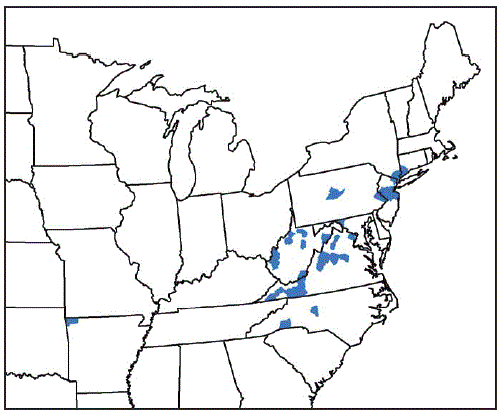
From August 2017 through September 2018, vector and animal surveillance efforts resulted in 53 reports of H. longicornis in the United States, including 38 (72%) from animal species (23 [61%] from domestic animals, 13 [34%] from wildlife, and two [5%] from humans), and 15 (28%) from environmental sampling of grass or other vegetation using cloth drags or flags* or carbon dioxide–baited tick traps.† With the exception of one report from Arkansas, the remaining reports of positively identified ticks are from eight eastern states: New Jersey (16; 30%), Virginia (15; 28%), West Virginia (11; 21%), New York (three; 6%), North Carolina (three; 6%), Pennsylvania (two; 4%), Connecticut (one; 2%), and Maryland (one; 2%) (Figure). Among the 546 counties or county equivalents in the nine states, ticks were reported from 45 (8%) counties (1.4% of all 3,109 U.S. counties and county equivalents) (Table 1). Excluding 15 reports of positive environmental sampling using flagging, dragging, or carbon dioxide traps, the remaining 38 reports reflect collection of ticks from infested host species (Table 2). Surveillance efforts did not include testing the ticks or hosts for pathogens.No cases of illness in humans or other species were reported. Concurrent reexamination of archived historical samples showed that invasion occurred years earlier. Most importantly, ticks collected from a deer in West Virginia in 2010 and a dog in New Jersey in 2013 were retrospectively identified as H. longicornis.
Discussion
Cooperative efforts among federal, state, and local experts from agricultural, public health, and academic institutions during the last year have documented that a tick indigenous to Asia is currently resident in several U.S. states. The public health and agricultural impacts of the multistate introduction and subsequent domestic establishment of H. longicornis are not known.At present, there is no evidence that H. longicornis has transmitted pathogens to humans, domestic animals, or wildlife in the United States. This species, however, is a potential vector of a number of important agents of human and animal diseases in the United States, including Rickettsia, Borrelia, Ehrlichia, Anaplasma, Theileria, and several important viral agents such as Heartland and Powassan viruses. Consequently, increased tick surveillance is warranted, using standardized animal and environmental sampling methods.
The findings in this report are subject to at least two limitations. First, the findings are limited by the variable surveillance methods used to identify the geographic and host distribution of H. longicornis. These methods included both passive and active surveillance. Conclusions about the geographic and host distribution might reflect the biases in the collection and submission of samples to states and USDA and the paucity of available information. Second, the data in this report reflect the collection of specimens that were positively identified by morphology or molecular barcoding. These represent sentinels that H. longicornis is present in different U.S. states and regions, and not a comprehensive assessment of the distribution of H. longicornis in the United States. The absence of positive samples from many states and counties might reflect the absence of infestation, absence of sampling, or failure to recover the tick. Even in states where H. longicornis has been found, the available data do not describe the actual extent or intensity of infestation.
The biology and ecology of H. longicornis as an exotic species in the United States should be characterized in terms of its vector competence (ability to transmit a pathogen) and vectorial capacity (feeding habits, host preference, climatic sensitivity, population density, and other factors that can affect the risk for pathogen transmission to humans) for tickborne pathogens known to be present in the United States (5). Surveillance for H. longicornis should include adequate sampling of companion animals, commercial animals, wildlife, and the environment. Where H. longicornis is detected, there should be testing for a range of indigenous and exotic viral, bacterial, and protozoan tickborne pathogens potentially transmitted by H. longicornis. Given the similarity between SFTSV and Heartland virus, a tickborne phlebovirus (https://www.cdc.gov/heartland-virus/index.html), further evaluation of the potential role of H. longicornis in transmission of this disease agent among animal reservoirs and possibly to humans is warranted. A broad range of interventions should be evaluated, including insecticide and acaricide sensitivity testing. Many state and federal agencies are developing and disseminating information for stakeholders, including development of hotlines, and some states are identifying ticks submitted by the public. The recently documented occurrence of H. longicornis in the United States presents an opportunity for collaboration among governmental, agricultural, public health agencies and partners in academic public health, veterinary sciences, and agricultural sciences to prevent diseases of potential national importance before onset in humans and other animal species.
Wes Watson, Andrew D. Haddow, Naomi Drexler, Gleeson Murphy, Harry Savage, Howard Ginsberg, Kim Cervantes, field and laboratory personnel.
Corresponding author: C. Ben Beard, cbeard@cdc.gov, 970-221-6418.
* Drags consist of white cloth (usually 1 m2) that have a wooden leading frame and are dragged by a cord through grass or a leafy forest floor. Flags are similar but are used to brush uneven surfaces such as small bushes in wooded areas. Drags and flags are used to sample the environment for ticks trying to locate a host.
† Carbon dioxide traps consist of dry ice–filled small boxes with holes that allow the CO2 to escape which are placed on a white cloth or mat in a grassy area or forest floor. Ticks, attracted by the CO2, crawl on to the cloth or mat surface, which is inspected for ticks after a period of time.
Rainey T, Occi JL, Robbins RG, Egizi A. Discovery of Haemaphysalis longicornis (Ixodida: Ixodidae) parasitizing a sheep in New Jersey, United States. J Med Entomol 2018;55:757–9. CrossRefPubMed
Luo L-M, Zhao L, Wen H-L, et al. Haemaphysalis longicornis ticks as reservoir and vector of severe fever with thrombocytopenia syndrome virus in China. Emerg Infect Dis 2015;21:1770–6. CrossRefPubMed
Mahara F. Japanese spotted fever: report of 31 cases and review of the literature. Emerg Infect Dis 1997;3:105–11. CrossRefPubMed
Kang J-G, Ko S, Smith WB, Kim H-C, Lee I-Y, Chae J-S. Prevalence of Anaplasma, Bartonella and Borrelia species in Haemaphysalis longicornis collected from goats in North Korea. J Vet Sci 2016;17:207–16. CrossRefPubMed
Rosenberg R, Lindsey NP, Fischer M, et al. Vital signs: trends in reported vectorborne disease cases—United States and territories, 2004–2016. MMWR Morb Mortal Wkly Rep 2018;67:496–501. CrossRefPubMed
Heath A. Biology, ecology and distribution of the tick, Haemaphysalis longicornis Neumann (Acari: Ixodidae) in New Zealand. N Z Vet J 2016;64:10–20. CrossRefPubMed
FIGURE. Counties and county equivalents* where Haemaphysalis longicornis has been reported (N = 45) — United States, August 2017–September 2018
* Benton County, Arkansas; Fairfield County, Connecticut; Washington County, Maryland; Bergen, Hunterdon, Mercer, Middlesex, Monmouth, Somerset, and Union Counties, New Jersey; Davidson, Polk, and Rutherford Counties, North Carolina; Richmond, Rockland, and Westchester Counties, New York; Bucks and Centre Counties, Pennsylvania; Albemarle, Augusta, Carroll, Fairfax, Giles, Grayson, Louisa, Page, Pulaski, Rockbridge, Russell, Scott, Smyth, Staunton City, Warren, and Wythe Counties, Virginia; Cabell, Hardy, Lincoln, Mason, Marion, Monroe, Putnam, Ritchie, Taylor, Tyler, Upshur Counties, West Virginia.
TABLE 1. Percentage of Haemaphysalis longicornis–infested counties or county equivalents in infested states — nine states, August 2017–September 2018
State
No. of counties* per state
No. (%) of counties* with H. longicornis on host or in environment
Arkansas
75
1 (1)
Connecticut
8
1 (13)
Maryland
24
1 (4)
New Jersey
21
7 (33)
New York
62
3 (5)
North Carolina
100
3 (3)
Pennsylvania
67
2 (3)
Virginia
134
16 (12)
West Virginia
55
11 (20)
Total
546
45 (8)
* Counties or county equivalents
TABLE 2. Distribution of Haemaphysalis longicornis, by host and species — nine states, August 2017–September 2018
Host category, no. (% of total)/Species
No. (% of host category)
Domestic animal, 23 (61)
Cat
1 (4)
Cow
4 (17)
Dog
12 (52)
Goat
2 (9)
Horse
2 (9)
Sheep
2 (9)
Total
23 (100)
Wildlife, 13 (34)
Coyote
1 (8)
White-tailed deer
7 (54)
Gray fox
1 (8)
Groundhog
1 (8)
Virginia opossum
2 (15)
Raccoon
1 (8)
Total
13 (100)
Human, 2 (5)
2 (100)
Total
38 (100)
Beard CB, Occi J, Bonilla DL, et al. Multistate Infestation with the Exotic Disease–Vector Tick Haemaphysalis longicornis — United States, August 2017–September 2018. MMWR Morb Mortal Wkly Rep 2018;67:1310–1313. DOI: http://dx.doi.org/10.15585/mmwr.mm6747a3.
____________________
**Comment**
In the section discussing the species and the other pathogens it’s been known to transmit, Theileria was mentioned. Theileria is a malarial-like pathogen similar to Babesia:
Babesia IS also spread by ticks and is a frequent coinfection with Lyme.
An important difference from malaria is that T. microti does not infect liver cells. Additionally, the piroplasm is spread by tick bites (Ixodes scapularis, the same tick that spreads Lyme disease), while the malaria protozoans are spread via mosquito. Finally, under the microscope, the merozoite form of the T. microti life cycle in red blood cells forms a cross-shaped structure, often referred to as a “Maltese cross“, whereas malaria forms more of a diamond ring structure in red blood cells.[3]
One of the biggest discoveries by Mather was how the ticks line up on stalks of grass resembling grains of wheat. When anything touches this, it’s like a tick cluster bomb and ticks go everywhere. Not just one or two, mind you, but hundreds at one time. See link for pictures.




 * Benton County, Arkansas; Fairfield County, Connecticut; Washington County, Maryland; Bergen, Hunterdon, Mercer, Middlesex, Monmouth, Somerset, and Union Counties, New Jersey; Davidson, Polk, and Rutherford Counties, North Carolina; Richmond, Rockland, and Westchester Counties, New York; Bucks and Centre Counties, Pennsylvania; Albemarle, Augusta, Carroll, Fairfax, Giles, Grayson, Louisa, Page, Pulaski, Rockbridge, Russell, Scott, Smyth, Staunton City, Warren, and Wythe Counties, Virginia; Cabell, Hardy, Lincoln, Mason, Marion, Monroe, Putnam, Ritchie, Taylor, Tyler, Upshur Counties, West Virginia.

