Archive for the ‘Transmission’ Category

Transmitted in the Womb – Children Battle Lyme Disease From Birth

https://www.newscentermaine.com/article/news/health/transmitted-in-the-womb-kids-battle-lyme-disease-from-birth/97-612998682  (News Video within link – Approx. 5.5 Min)

Transmitted in the womb -Kids battle Lyme disease from birth

Author: Vivien Leigh
Published:  November 9, 2018
Shortly after birth, these kids started suffering from debilitating symptoms doctors could not diagnose or explain. Out of desperation, their families were forced to seek treatment out of state.

BRUNSWICK (NEWS CENTER Maine) – The CDC says every year about 300-thousand people in the U.S. are diagnosed with Lyme Disease, which is transmitted by deer ticks. Experts say a quarter of those cases are children — the highest infection rates are happening in kids ages 5 to 14.

But a small number of kids in Maine didn’t contract Lyme through a tick bite. Instead, doctors believe the disease was passed to them in the womb through their moms living with undiagnosed Lyme for years.

Celeste Zelasko was five months pregnant when she discovered a rash on her body. ‘I definitely had a bulls eye rash we thought it was a spider or another bug.,’

9 months after her son was born he started losing weight, broke out in rashes and his hair fell out. But it didn’t stop there.

‘Miles was constantly getting ear infections, respiratory problems, asthma trips to the ER.’

Doctors blamed germs from day care — but couldn’t figure out what was wrong with Miles. Celeste was also experiencing joint pain, extreme fatigue, memory loss an, brain fog.

Celeste and Miles underwent testing for Lyme disease, but they were negative. The two step blood test recommended by the CDC checks for antibodies against Lyme bacteria. But some experts say the test is unreliable — failing up to 40 percent of the time even within 30 days of a tick bite. She and her son — now 6-years old were diagnosed with Lyme disease based on their symptoms. A provider recommended treatment out of state. Celeste found a doctor for herself in New York and a pediatrician for Miles in New Haven, Connecticut.

The only pediatric Lyme specialist in the country and he was in his 80’s and it would be a four hour drive.

Pediatrician Dr. Charles Jones practices outside the CDC guidelines. He has treated more than 15-thousand children across the Us and from around the world. He says is cure rate is at 98 percent.

Those guidelines recommend treatment as one dose of antibiotics for children over 8 years old would include twice daily for 2-4 weeks.

“What’s important,” he says, “is to treat continuously, not stopping until all symptoms are gone.” said Dr. Jones.

Angela and Aaron Gilbert say after their son Noah was born, he experienced medical problems no doctors could explain. Besides rashes and stomach problems their son was rarely awake.

‘The fatigue was unbelievable, he would sometimes sleep 22 to 23 hours a day,’ said Angela.

After multiple trips to the emergency room to treat her son’s many fevers doctors still couldn’t figure out what was wrong with Noah. A friend suggested Lyme disease, but the family couldn’t get a medical provider even to consider the possibility. But Angela then heard about Dr. Jones.  At this point, her son Noah was a little more than a year old.

‘There were no options for us to get medical treatment and he was getting sick and sicker and sicker,’ said Angela.

Dr. Jones treated Noah multiple doses of antibiotics at the same time over more extended periods of time. After Noah’s younger brother Elijah because experiencing similar symptoms, the family knew they had to make a drastic decision. They sold their house in Maine and moved to Connecticut so both boys could be treated for Lyme disease and other co-infections by Dr. Jones.

“What’s important,” he says, “is to treat continuously, not stopping until all symptoms are gone.”

Dr. Jones believes both Celeste and Angela were living with undiagnosed Lyme Disease when they had their children and passed the disease to them in the womb.

Angela ended up getting diagnosed with late stage Lyme and a number of co-infections. After several months of treatment, Gilbert says she and her sons started getting better. The joint pain subsided and the severe fatigue improved. The family returned to Maine 9 months later and found a Lyme literate provider familiar with the vast range of symptoms that may indicate infection at various stages of the disease, as well as potential co-infections and other complexities. But Angela says families should not have to make extreme sacrifices to get their kids treated for Lyme. She says if CDC revised its guidelines for pediatricians on antibiotic treatment for Lyme disease, more doctors in Maine would be willing to treat children who may have undiagnosed Lyme.

‘They are in fear of losing their license that is the bottom line.’

— For information about Lyme Disease, Diagnosis and Treatment https://www.cdc.gov

— Maine Medical Center Research Institute www.ticksinmaine.com

— Information on finding a provider to treat late-stage Lyme disease. Midcoast Lyme Disease Support & Education, www.mldse.org

— International Lyme & Associated Diseases Society, www.ilads.org

— Information about Dr. Charles Jones https://health.usnews.com/doctors/charles-jones-115055

— Information on prevention, testing, treatment guidelines, support groups and other resources

Lyme Resource Card/Nelson Family Project

For real-time data on Lyme Disease rates compiled by the Maine CDC go to https://data.mainepublichealth.gov/tracking/home or www.maine.gov/lyme

NEWS CENTER Maine’s Vivien Leigh is joined by Dr. Sean McCloy, Integrative Health Center of Maine and Dr. Jacob Aguiar, Scarborough Integrative Health discussing the topic on Facebook.

________________

**Comment**

Mainstream medicine is still in denial, but congenital Lyme/MSIDS is real and more prevalent than realized.  While I’m thankful for this story, please note that they couldn’t conjure up ONE pediatrician to speak on congenital Lyme.  If it wasn’t for Dr. Jones, kids would be dead.  Everyone STILL is cowering behind the antiquated and unscientific CDC guidelines.

This has to stop.

The research on Lyme is ancient and poorly done.  We need new research and new laboratory techniques as borrelia is extremely fastidious and hard to culture and study.  Many coinfections are just as difficult to study and aren’t even on the radar for most doctors.  The combined effect of these pathogens is what is making us so ill:  https://madisonarealymesupportgroup.com/2018/10/30/study-shows-lyme-msids-patients-infected-with-many-pathogens-and-explains-why-we-are-so-sick/

For the first time, Garg et al. show a 85% probability for multiple infections including not only tick-borne pathogens but also opportunistic microbes such as EBV and other viruses.  Also, 83% of all commercial tests focus only on Lyme (borrelia), despite the fact we are infected with more than one microbe.

Key Quote: “Our findings recognize that microbial infections in patients suffering from TBDs do not follow the one microbe, one disease Germ Theory as 65% of the TBD patients produce immune responses to various microbes.”

More on Congenital Lyme:  https://madisonarealymesupportgroup.com/2018/06/19/33-years-of-documentation-of-maternal-child-transmission-of-lyme-disease-and-congenital-lyme-borreliosis-a-review/

https://madisonarealymesupportgroup.com/2018/12/14/scientists-weigh-in-on-the-seriousness-of-tick-borne-illness-video/

https://madisonarealymesupportgroup.com/2018/12/22/doctors-public-left-in-the-dark-on-danger-to-babies-from-lyme/

https://madisonarealymesupportgroup.com/2018/11/11/gestational-lyme-other-tick-borne-diseases-dr-jones/

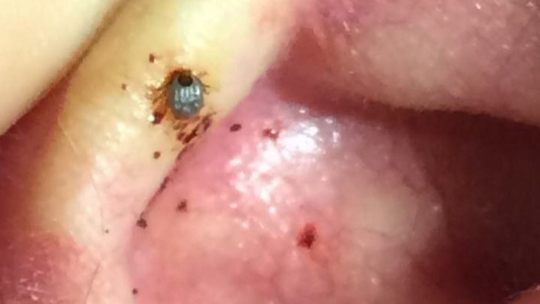
Tick Bite in Ear Gave UK Teacher Rickettsial Typhus Infection

https://www.foxnews.com/health/rare-tick-infection-leaves-teacher-with-memory-loss-fatigue

Rare tick infection leaves teacher with memory loss, fatigue

tick1-solent-news
Keith Poultney was teaching English in Nepal when he was bitten by a tick, which spread a rare infection throughout his body leaving him with memory loss and fatigue. (Solent News)

A 40-year-old English teacher from the U.K. who was bitten by a tick in his ear while volunteering in Nepal two years ago said he still has trouble with his memory and coordination after the infection left him suffering from hallucinations and brain swelling.

Keith Poultney, who said he didn’t realize he had been bitten by the tick during his 2017 trip until a few days after developing discomfort in his ear, initially wasn’t concerned about his illness while in Nepal because others in his group had developed colds or the flu, according to The Sun.

“They treated me with antibiotics, but what they didn’t know was that the type of infection I had developed was resistant,” he said of his treatment in Nepal. “I flew home as planned, but the flight, a 12-hour flight via the Middle East, was the worst experience of my life.”

tick2-solent-newsPoultney initially wasn’t concerned about his symptoms because others in his group had been dealing with colds, but then he developed hallucinations and severe head pain. (Solent News)

He said at one point his temperature reached 104.9 and he developed severe head pain. He was rushed to Queen Alexandra Hospital in Portsmouth, where he was eventually diagnosed with encephalitis and a rickettsial typhus infection, which is typically transmitted by fleas, ticks, mites and lice and in some cases can be fatal.

According to the Centers for Disease Control and Prevention (CDC), immediate treatment should be started in a patient with a suspected case of rickettsioses before confirmation is complete due to the rapid progression of the infection.

Transmission is most common during outdoor activities in the spring or summer months when ticks and fleas are most active, with a 5-14 day incubation period for most rickettsial diseases, meaning symptoms often don’t start until after the trip as ended. The most common rickettsial diseases found in travelers are in the spotted fever or typhus groups.

“I felt different in myself,” Poultney, who is still dealing with fatigue, told The Sun. “I had real problems with my balance and was unable to walk in a straight line. I physically felt as though I was impaired or drunk. I could not gauge space or distance and would often walk into door frames or knock things such as drinks over.”

Nearly two years after his diagnosis and treatment, Poultney said he still has issues with his memory, and has started working with Headway, an organization that provides support to brain injury patients.

“Without Headway’s help, I know my recovery would have been slower and more frustrating,” he told The Sun. “They were there to pick me up from a very low point in my life. I know my brain has been altered and that will most likely never change. But I also know that I shouldn’t try to deal with this on my own.”

____________________

**Comment**

In this article, a treatment resistant Rickettsial Typhus is obviously transmitted by a tick.  This is important to acknowledge.  In the following CDC information, there are numerous types of typhus but not many commonly thought to be transmitted by ticks.  

Tick-associated reservoirs of R. prowazekii (epidemic typhus) have been described in Ethiopia, Mexico, and Brazil, but the role of ticks in the natural transmission of R. prowazekii has not been characterized.

Unfortunately, the article does not mention what typhus strain caused this.

https://wwwnc.cdc.gov/travel/yellowbook/2018/infectious-diseases-related-to-travel/rickettsial-spotted-and-typhus-fevers-and-related-infections-including-anaplasmosis-and-ehrlichiosis  Excerpt below:

Rickettsial infections are caused by various bacterial species from the genera Rickettsia, Orientia, Ehrlichia, Neorickettsia, Neoehrlichia, and Anaplasma.  Rickettsia spp. are classically divided into the typhus group and spotted fever group (SFG).

Most rickettsial pathogens are transmitted by ectoparasites such as fleas, lice, mites, and ticks. It can also be transmitted by inoculating infectious fluids or feces from the ectoparasites into the skin. Inhaling or inoculating conjunctiva with infectious material may also cause infection.  Transmission after transfusion or organ transplantation is rare but has been reported.

Clinical presentations vary with the causative agent and patient; however, common symptoms that typically develop within 1–2 weeks of infection include fever, headache, malaise, rash, nausea, and vomiting. Many rickettsioses are accompanied by a maculopapular, vesicular, or petechial rash or sometimes an eschar at the site of the tick bite.

Treatment of patients with possible rickettsioses should be started when disease is suspected and should never await confirmatory testing, as certain infections can be rapidly progressive. Immediate empiric treatment with a tetracycline, most commonly doxycycline, is recommended for all ages. Almost all other broad-spectrum antibiotics are not helpful. Chloramphenicol may be an alternative in some cases, but its use is associated with more deaths, particularly for R. rickettsii. In some areas, tetracycline-resistant scrub typhus has been reported. Azithromycin may be an effective alternative. Anaplasma phagocytophilum infections may respond to rifampin, which may be an alternate drug for pregnant patients. Expert advice should be sought if alternative agents are being considered.

Doxycycline is the front-line drug for typhus and broad-spectrum antibiotics aren’t helpful.

Fact sheet on typhus: https://www.health.nsw.gov.au/Infectious/factsheets/Factsheets/typhus.PDF   The perps are typically lice, fleas, mites, and ticks.
https://madisonarealymesupportgroup.com/2018/08/19/monster-ticks-found-in-germany-threaten-europe-with-deadly-disease-crimean-congo-fever/ In this article, they found a tropical form of tick typhus in tropical ticks found in Germany. Typhus is making a comeback, particularly in the southern U.S. Migrating birds are transporting ticks as well as the diseases they carry worldwide.

Remember:  There’s no such thing as a “good” or “insignificant” tick.

All ticks are suspect until proven otherwise.


Relapsing Fever Spirochete Uniquely Adapted to Highly Oxidative Salivary Glands of Soft-bodied Tick

https://www.ncbi.nlm.nih.gov/pubmed/30489694

2018 Nov 29:e12987. doi: 10.1111/cmi.12987. [Epub ahead of print]

The relapsing fever spirochete Borrelia turicatae persists in the highly oxidative environment of its soft-bodied tick vector.

Abstract

The relapsing fever spirochete Borrelia turicatae possesses a complex life cycle in its soft-bodied tick vector, Ornithodoros turicata. Spirochetes enter the tick midgut during a bloodmeal, and during the following weeks spirochetes disseminate throughout O. turicata. A population persists in the salivary glands allowing for rapid transmission to mammalian hosts during tick feeding. Little is known about the physiological environment within the salivary glands acini in which B. turicatae persists. In this study, we examined the salivary gland transcriptome of O. turicata ticks and detected the expression of fifty-seven genes involved in oxidant metabolism or antioxidant defenses. We confirmed the expression of five of the most highly expressed genes including glutathione peroxidase (gpx), thioredoxin peroxidase (tpx), manganese superoxide dismutase (sod-1), copper-zinc superoxide dismutase (sod-2), and catalase (cat) by reverse-transcriptase droplet digital PCR (RT-ddPCR). We also found distinct differences in the expression of these genes when comparing the salivary glands and midguts of unfed O. turicata ticks.

Our results indicate that the salivary glands of unfed O. turicata nymphs are a highly oxidative environment where reactive oxygen species (ROS) predominate, while midgut tissues comprise a primarily nitrosative environment where nitric oxide synthase is highly expressed. Additionally, B. turicatae was found to be hyperresistant to ROS compared to the Lyme disease spirochete B. burgdorferi, suggesting that it is uniquely adapted to the highly oxidative environment of O. turicata salivary gland acini.

___________________

**Comment**

Much can be learned about Borrelia turicatae by reading this case study:  https://wwwnc.cdc.gov/eid/article/23/5/16-2069_article

We learn:

  • Ornithodoros turicata soft bodied ticks, are endemic to Texas and Florida
  • They are found in caves and ground squirrel or prairie dog burrows  https://madisonarealymesupportgroup.com/2018/04/23/tick-borne-relapsing-fever-found-in-austin-texas-caves/
  • Once infected, they remain infected for the rest of their lives, which can be up to ten years.
  • Attachment is painless
  • They are rapid night feeders (5-60min)
  • Due to their rapid feeding they are rarely found or leave lesions
  • Patient in study suffered with headache, nausea, & pain behind knees
  • Had numerous lesions which resolved after 6 days (without treatment)
  • Developed persistent fever
  • Developed thrombocytopenia (low platelets)
  • Developed elevated Erythrocyte sedimentation rate & C-reactive protein
  • Improved rapidly with doxycycline
  • Platelet count normalized within 2 weeks
  • Asymptomatic soldiers with similar exposure were treated prophylactically
  • TBRF is a neglected and probably underdiagnosed disease
  • Published cases in Texas have been supported by serology for the TBRF group, exposure location, and tick collections, but the authors state successful identification of B. turicatae in a human has not been reported
  • Military training groups in Israel have declared certain caves off limits because of heavy tick presence https://madisonarealymesupportgroup.com/2017/10/27/israeli-kids-get-lyme-disease-from-ticks-in-caves/ and have prophylactically administered doxycycline to those suspected to have been exposed
  • Asymptomatic patients given doxy don’t have a Jarisch-Herxheimer reaction but those with active illness do
Another study demonstrating the wily and adaptable nature of spirochetes.


Baggio-Yoshinari Brazil’s Lyme-Like Illness From Ticks That Shouldn’t Transmit it

https://www.ncbi.nlm.nih.gov/pmc/articles/PMC6218955/

. 2018; 73: e394.
Published online 2018 Nov 6. doi: 10.6061/clinics/2018/e394
PMCID: PMC6218955
PMID: 30462754

Passage of Borrelia burgdorferi through diverse Ixodid hard ticks causes distinct diseases: Lyme borreliosis and Baggio-Yoshinari syndrome

Abstract

Baggio-Yoshinari syndrome is an emerging, tick-borne, infectious disease recently discovered in Brazil. This syndrome is similar to Lyme disease, which is common in the United States of America, Europe and Asia; however, Brazilian borreliosis diverges from the disease observed in the Northern Hemisphere in its epidemiological, microbiological, laboratory and clinical characteristics. Polymerase chain reaction procedures showed that Baggio-Yoshinari syndrome is caused by the Borrelia burgdorferi sensu stricto spirochete. This bacterium has not yet been isolated or cultured in adequate culture media. In Brazil, this zoonosis is transmitted to humans through the bite of Amblyomma and Rhipicephalus genera ticks; these vectors do not belong to the usual Lyme disease transmitters, which are members of the Ixodes ricinus complex. The adaptation of Borrelia burgdorferi to Brazilian vectors and reservoirs probably originated from spirochetes with atypical morphologies (cysts or cell-wall-deficient bacteria) exhibiting genetic adjustments, such as gene suppression. These particularities could explain the protracted survival of these bacteria in hosts, beyond the induction of a weak immune response and the emergence of serious reactive symptoms. The aim of the present report is to note differences between Baggio-Yoshinari syndrome and Lyme disease, to help health professionals recognize this exotic and neglected zoonosis.

___________________

**Comment**

This abstract shows a Bbss spirochete NOT YET isolated or cultured in adequate culture media, i.e., is invisible to current lab techniques.  Also, please note that the ticks mentioned are not TYPICALLY thought of as transmitting Lyme.

Two commonly touted myths busted to smithereens.

The plot thickens with the mere mention of ATYPICAL morphologies (cysts or cell wall deficient) bacteria as well as GENETIC ADJUSTMENTS WITH GENE SUPRESSION, and the ability of these bacteria to SURVIVE FOR A LONG TIME.  

To this day, the CDC/IDSA refuses to recognize the persistent nature and pleomorphism of Bb.

Researchers who talk about pleomorphism are almost always from outside the U.S.:  https://www.frontiersin.org/articles/10.3389/fmicb.2017.00596/full  There’s only a handful of U.S. researchers taking on pleomorphism.  All the IDSA-authors (The Cabal) report about Lyme as if it were a mere nuisance, which it is not.

In short, we have a LYME-LIKE Illness that:

  • can’t be picked up with common lab techniques
  • coming from ticks that don’t normally transmit it
  • caused by a bacteria that shape-shifts
  • makes genetic adjustments to survive

Now add other potential pathogens to this stew and it’s quite clear why patients are so ill and why it takes far more than 21 days of the mono-therapy of doxycycline.

Please spread the word!

For More:  https://madisonarealymesupportgroup.com/2018/10/30/study-shows-lyme-msids-patients-infected-with-many-pathogens-and-explains-why-we-are-so-sick/  This international group of researchers state that:

“Our findings recognize that microbial infections in patients suffering from TBDs do not follow the one microbe, one disease Germ Theory as 65% of the TBD patients produce immune responses to various microbes.”

They also point out that 83% of all commercial tests focus only on Lyme (borrelia), despite the fact we are infected with more than one microbe.

They too mention the pleomorphism of borrelia:

“In addition to tick-borne co-infections and non-tick-borne opportunistic infections, pleomorphic Borrelia persistent forms may induce distinct immune responses in patients by having different antigenic properties compared to typical spirochetes32,33,34,35. Nonetheless, current LD diagnostic tools do not include Borrelia persistent forms, tick-borne co-infections, and non-tick-borne opportunistic infections.”

It’s all right here in bright purple crayon.


Doctors, Public, Left in the Dark on Danger to Babies (From Lyme)

https://www.thechronicleherald.ca/opinion/doctors-public-left-in-the-dark-on-danger-to-babies-270535/

Dec. 21, 2018

The Chronicle Herald

OPINION: Doctors, public left in the dark on danger to babies

Jane Bailey

The following statement is false. You can only get Lyme disease from a black-legged tick. The next two statements are true. You can pass Lyme disease to your unborn baby. Your baby can suffer very serious adverse outcomes, including from miscarriage, stillbirth, and newborn death, as well as serious neurological development issues, and various other illnesses and developmental delays/issues as a result of Lyme infection during pregnancy.

Earlier this fall, on Nov. 12, a new, peer reviewed research article was published in the highly reputable science and medical journal PLOS ONE. It was authored by several senior Public Health Agency of Canada (PHAC) scientists and one Centers for Disease Control and Prevention (CDC) scientist. The paper unequivocally acknowledged mother-to-fetus (transplacental) transmission of Lyme disease as a fact.

This newly published paper also looked at case reports and studies from the past 30-plus years and found that there was a significant statistical difference in adverse outcomes for baby if the mother was infected with Lyme and had been untreated during pregnancy.

In their meta-analysis of several studies, 50 per cent of untreated women experienced fetal adverse outcomes compared to 11 per cent of treated women. In those cases, the authors state:

“Across 59 cases, negative outcomes for the fetus or newborn occurred in 61 per cent of pregnancies … (they) ranged from spontaneous miscarriage … fetal death and stillbirth … and death shortly following birth … to a range of congenital abnormalities and health issues.“

This is beyond alarming. It is an extremely important paper. And yet, not a word in the press, or notification to our doctors, nor, most importantly, to the public.

As far back as 1986, both the World Health Organization (WHO) and the CDC acknowledged mother-to-fetus transmission, and warned of possible adverse outcomes for baby. In June 1988, Health Canada released its own report acknowledging the same thing.

Nobody did anything. The information just sat there, hiding in plain sight.

In the summer of this year, the federal parliament of France, the Assemblée Nationale, issued a statement from the minister of health acknowledging mother-to-fetus transmission of Lyme disease.

And the WHO, after almost 10 years of considering the evidence, earlier this year (June 2018) issued a new International Classification of Diseases (ICD) code for congenital Lyme borreliosis (meaning babies born with Lyme disease) for physicians around the world. But on Monday (Dec. 17), the new WHO ICD-11 code for congenital Lyme borreliosis was the only code to be suddenly deleted from more than 55,000 new ICD-11 codes. At this point, it’s unclear why.

Something very strange and very unsettling is happening.

Where is Canada on this issue? Why isn’t Health Canada and the Public Health Agency of Canada saying anything? Why aren’t our public health departments and health authorities notifying doctors, women and parents-to-be of this very important issue? There should be national outrage over this appalling state of affairs regarding the non-notification of mother-to-fetus infection of Lyme disease. It is, actually, scandalous that the authorities have kept this from the public.

This mode of transmission changes everything.

Since 2014, I have corresponded on many Lyme issues with Dr. Robert Strang, chief medical officer for Nova Scotia, and Dr. Todd Hatchette, chief microbiologist for the Nova Scotia Health Authority and an infectious diseases doctor. They either denied that transplacental Lyme disease exists, or they refused to discuss it with me. They have both been provided with much of the 30-plus years of evidence, the same evidence considered by the scientists in the PLOS ONE article, the same evidence considered by the WHO, the CDC and PHAC.

At a meeting I attended at the Department of Health and Wellness on Sept. 1, 2016, I even had autopsy reports and photographs of babies with unequivocal evidence of the Lyme disease bacteria in their tissues and organs — everybody at the table declined to look at this evidence. As difficult and heartbreaking as such material is, this kind of behaviour from a department responsible for our health is unacceptable, and contributes to perpetuating the problem of no action.

It has been suggested by me, many times, that our doctors, and the public, be notified of the fact of mother-to-baby transmission of Lyme disease. All of my requests have been refused. On May 31, 2016, I was even told by Strang,

“I will no longer be responding to inquiries from you.”

It is despicable that the alarm has not been raised. And by not doing so, it could be argued, much unnecessary pain and suffering has been caused to many women, parents and children.

In a recent email (Oct. 23) Strang wrote to me regarding the above PLOS ONE research article, he stated,

“As you may be aware from the recent Lyme Hope meeting with PHAC, our national Public Health Agency has recently completed a comprehensive review of the evidence on Lyme disease in pregnancy. This review is undergoing peer review as part of possible publication. My public health practice will certainly follow the outcomes of this work.”

What Strang did not know when he sent me that email was that I was actually at that meeting with Lyme Hope and PHAC on Oct. 5 in Ottawa. I advised Strang of this fact, and of the fact that the scientists around the table, as well as one MD at that meeting, plus two MDs on the phone (a pediatric Lyme disease specialist, and an internal medicine specialist), the president of PHAC, and the director of the Infectious Diseases Branch, PHAC, all agreed that transplacental transmission was possible. Strang’s next response to me was, “I will not engage in an ongoing dialogue with you regarding this issue.” Appalling!

Strang is now silent on this issue. He has not made any public statement since the publication of the research article, neither has he responded to my last article on Lyme disease (“Lyme disease tunnel vision: Provincial authorities must expand horizons, review medial evidence”) published by The Chronicle Herald on Nov. 3. Why this silence? There is no getting around this, no “positive spin” can be put on this. The public, and our doctors, need to know. Shame on him. He, too, has the suffering of many on his conscience; or he should have.

With regard to mother-to-baby Lyme disease, doctors and women should know that babies and children present with symptoms very differently from adults.

For those of you reading who may have concerns regarding possible transplacental (mother-to-child) transmission of Lyme disease, I would direct you to the LymeHope.ca resources web-page. There you will find many credible and reputable resources and evidence that you can use to take to your doctor and discuss your concerns.

Jane Bailey lives in Wolfville. She has science and education diplomas and is a member of The Royal Society for Public Health.

__________________

**Comment**

AMEN!

PLOS ONE article:  https://madisonarealymesupportgroup.com/2018/12/12/systematic-review-on-gestational-lyme/

For more:  https://madisonarealymesupportgroup.com/2018/06/19/33-years-of-documentation-of-maternal-child-transmission-of-lyme-disease-and-congenital-lyme-borreliosis-a-review/

https://madisonarealymesupportgroup.com/2018/02/26/transplacental-transmission-fetal-damage-with-lyme-disease/

https://madisonarealymesupportgroup.com/2018/05/24/new-berlin-mom-given-life-altering-lyme-disease-diagnoses-after-pregnancy/

https://madisonarealymesupportgroup.com/2018/08/16/why-do-officials-continue-to-deny-gestational-lyme/

https://madisonarealymesupportgroup.com/2018/07/24/congenital-transmission-of-lyme-myth-or-reality/

https://madisonarealymesupportgroup.com/2018/10/05/canada-acknowledges-maternal-fetal-transmission-of-lyme-disease/

https://madisonarealymesupportgroup.com/2018/11/11/gestational-lyme-other-tick-borne-diseases-dr-jones/

https://madisonarealymesupportgroup.com/2018/08/16/why-do-officials-continue-to-deny-gestational-lyme/

https://madisonarealymesupportgroup.com/2017/10/15/pregnancy-in-lyme-dr-ann-corson/