Archive for the ‘Ticks’ Category

Tick Inside Eye

http://www.news-leader.com/story/news/local/ozarks/2017/07/15/pokin-around-he-knew-watching-naked-and-afraid-he-had-tick-inside-eyelid/472178001/ Steve Pokin, Spokin@NEWS-LEADER.COM  July 15, 2017

Pokin Around: He knew from watching ‘Naked and Afraid’ he had a tick on inside of eyelid636354599974837121-jcoyle-eye
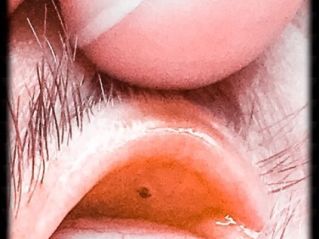
Jim Coyle has been bitten by ticks hundreds of times in his 47 years. But never like this.

He thinks he was bit on the Fourth of July. He spent the holiday with girlfriend Cara Dee Stucke and others on his 9 acres in Northview, in Webster County.

He was in the yard that day.

“But I wasn’t rolling around in the grass or anything,” he says.

He also did some woodworking.

“There was some sawdust,” he explains.

He returned to work July 5 here at the News-Leader, where he is a senior computer analyst.

“My eye was irritated,” he says. “It was very annoying.”

He first thought it might be from the sawdust. But he could not spot anything on his eyeball. Then, he started thinking tick bite.

The only reason he even considered it might be a tick bite is because he is a fan of the reality TV show “Naked and Afraid,”  on the Discovery Channel. In the show, two people — a man and a woman — meet for the first time and must survive in the wilderness for 21 days. Naked.

“I had recently seen a woman on the show get a tick bite in the eye,” Coyle tells me. “I told the kids about that show on the Fourth and when I said the next day I thought I had a tick bite in my eye they thought I was kidding.”

His girl friend, Stucke, a professional photographer, stopped by to see him at work on July 5.

Coyle rolled back the top eyelid of his left eye and there it was — an embedded tick.

“Since she’s a photographer she said, ‘I have to have a picture,'” Coyle says.

He put that photo on his Facebook page, which is where I saw it and immediately went, “Eeewwww, gross.”

He quickly called Heffington Optical Company, which is near the News-Leader on West Chestnut Expressway, and snagged an appointment that afternoon.

First, the optometrist put anesthetic eye drops in Coyle’s left eye. It took Dr. Charles Hornby about 15 seconds to remove the tick, which did not let go easily.

“He then handed me a tissue,” Coyle says. “He told me my eye was bleeding.”

According to Coyle, Hornby said that over the years he has removed countless bugs from the eyes of motorcycle riders. But never before had he dislodged a tick from the inside of an eyelid.

Coyle says that as a hiker and a former Boy Scout leader — as well as a horse rider who has ridden through tall grass — he has been bitten many of times, several times a year.

I found that strange. I told him I don’t recall ever being bitten by a tick. He found that strange.

The mosquitoes love me, as do chiggers.

In fact, Coyle says, after a tick bit him in 2014 he contracted Rocky Mountain spotted fever.

According to the Mayo Clinic Rocky Mountain spotted fever is a bacterial infection. Without prompt treatment, it can cause serious damage to internal organs, such as the kidneys and heart.

Although it was first identified in the Rocky Mountains, the infection is commonly found in the southeastern part of the United States.

Early symptoms include severe headache and high fever. A rash usually appears on the wrists and ankles. The infection responds well to prompt treatment with antibiotics.

In 2014, Coyle says, his fever spiked at 105. He had intense joint pain for six weeks before full recovery.

I remember that. I had just started the News-Leader Running Club on Mondays after work.

In those early days, Coyle ran with us a couple of times.

“I stopped because of the joint pain,” he tells me. “And because I really don’t like running.”

These are the views of Steve Pokin, the News-Leader’s columnist. Pokin has been at the paper five years and over the course of his career has covered just about everything — from courts and cops to features and fitness. He can be reached at 836-1253, spokin@gannett.com, on Twitter @stevepokinNL or by mail at 651 N. Boonville, Springfield, MO 65806.

Brave New Worlds: The Expanding Universe of Lyme Disease

http://online.liebertpub.com/doi/abs/10.1089/vbz.2017.2127#utm_source=FastTrack&utm_medium=email&utm_campaign=vbz

Brave New Worlds: The Expanding Universe of Lyme Disease

Stone Brandee L., Tourand Yvonne, and Brissette Catherine A.. Vector-Borne and Zoonotic Diseases. July 2017, ahead of print. https://doi.org/10.1089/vbz.2017.2127

Online Ahead of Print: July 20, 2017

Abstract

Projections around the globe suggest an increase in tick-vectored disease incidence and distribution, and the potential for emergence of novel tick-borne pathogens. Lyme disease is the most common reported tick-borne illness in the Unites States and is prevalent throughout much of central Europe. In recent years, the worldwide burden of Lyme disease has increased and extended into regions and countries where the disease was not previously reported. In this review, we discuss the trends for increasing Lyme disease, and examine the factors driving Lyme disease expansion, including the effect of climate change on the spread of vector Ixodid ticks and reservoir hosts; and the impacts of increased awareness on disease reporting and diagnosis. To understand the growing threat of Lyme disease, we need to study the interplay between vector, reservoir, and pathogen. In addition, we need to understand the contributions of climate conditions to changes in disease risk.

**Comment**

Once again we see the emphasis of climate change despite recent reports of fraudulent data used to support this assertion.  For more, please see:  https://madisonarealymesupportgroup.com/2017/07/08/global-warming-numbers-fudged/

We can all agree that ticks are expanding and infecting people and animals; however, you only have to listen to Lyme advocates and patients for about one minute before you realize that there have been infected people across the United States for a very long time.

Problem is, nobody believed them.

https://madisonarealymesupportgroup.com/2016/09/24/arkansas-kids-denied-lyme-treatment/  Thousands of patients for years have been complaining that Lyme/MSIDS is in their geographical area but experts look at out of date and out of touch vector maps which medical practitioners then use against patients.  They will not even entertain the thought if goes contrary to the map.

https://madisonarealymesupportgroup.com/2016/11/03/ld-not-in-australia-here-we-go-again/

We can be thankful that people are not taking this sitting down any longer and are pushing until it finally gets reported:  https://madisonarealymesupportgroup.com/2017/03/02/hold-the-press-arkansas-has-lyme/

Why We’re Losing To Lyme Disease

http://www.wbur.org/radioboston/2017/07/17/losing-to-lyme (Click link to hear story) Approx. 8:30 Min.  July 17, 2017 Radio Boston

Lyme disease reports have more than doubled since 2005 but the disease remains drastically under-reported. While over 5,000 case of Lyme are reported in Massachusetts each year, there are probably more than 50,000 case a year.

With ticks predicted to be in particular abundance this year, CommonHealth explores the issue in a new series, “Losing to Lyme.”

Guests

Carey Goldberg, host of WBUR’s CommonHealth blog, which tweets @commonhealth.

Dr. David Scales, physician at Cambridge Health Alliance.

This segment aired on July 17, 2017.

**Comment

The diagnostic tests for Lyme are abysmal.  And compared to testing for other diseases, Lyme testing is an absolute joke.  I do not call testing that misses over half of all cases to be even remotely acceptable.  https://madisonarealymesupportgroup.com/2017/04/12/comparing-lyme-testing-with-hiv-testing/

Busting Lyme Myths – NYC

Senator Sue Serino’s Lyme and Tick Borne Disease Forum 2017

NYC Senator, Sue Serino of the 41st District, is the Chair of the Senate’s Task Force on Lyme and TBIs.  Task Force members and state leaders in New York are holding awareness events across the state.  One event was a public forum, in the video above, busting prevalent myths surrounding all things TBI related.

Microbiologist Holly Ahern speaks first and educates the public on common Lyme and TBI myths.  Then Dr. Matt Frye, Integrative Pest Management IPM specialist, speaks on myths about ticks.

https://a.pgtb.me/tgZFPJ  Take a Bite Out of Lyme Disease website with more info.

**This is a fantastic talk full of great and accurate information.

My only possible disagreement is that Frye states ticks can not fall & bite from trees.  I’ve heard many patients swear (including the recent video I posted of TV anchor Mike Schneider) they were bit as they sat under a tree on a patio.  https://madisonarealymesupportgroup.com/2017/07/13/tv-anchor-speaks-out-about-lyme-disease/

Besides loving Japanese Barberries (shrub), https://madisonarealymesupportgroup.com/2015/09/30/barberry-friend-or-foe/  ticks at least here in Wisconsin love certain pine trees and I personally know of a family that would hang their laundry on a line outside where the clothes would gather ticks quite possibly from the pine trees that hung over top the line.  They would find the ticks when they dumped the laundry onto the bed.  Both the husband and wife become infected this way.

https://madisonarealymesupportgroup.com/2017/03/13/ticks-found-on-rocks/  This link reveals that ticks can show up in unexpected places like on top of rocks, under picnic tables, and on picnic benches.

As to trees and using logic, if birds and small rodents travel up and down trees 24/7, it only makes sense some are going to drop off and find a blood meal.


Transmission time for Borrelia Mayonii by Nymphal Ticks – Mouse Model

https://academic.oup.com/jme/article-lookup/doi/10.1093/jme/tjx089

Transmission of the Lyme Disease Spirochete Borrelia mayonii in Relation to Duration of Attachment by Nymphal Ixodes scapularis (Acari: Ixodidae)
Marc C. Dolan Nicole E. Breuner Andrias Hojgaard Karen A. Boegler J. Charles Hoxmeier Adam J. Replogle Lars Eisen
J Med Entomol
Published: 05 July 2017

Abstract
The recently recognized Lyme disease spirochete, Borrelia mayonii, has been detected in host-seeking Ixodes scapularis Say ticks and is associated with human disease in the Upper Midwest. Although experimentally shown to be vector competent, studies have been lacking to determine the duration of time from attachment of a single B. mayonii-infected I. scapularis nymph to transmission of spirochetes to a host. If B. mayonii spirochetes were found to be transmitted within the first 24 h after tick attachment, in contrast to Borrelia burgdorferi spirochetes (>24 h), then current recommendations for tick checks and prompt tick removal as a way to prevent transmission of Lyme disease spirochetes would need to be amended. We therefore conducted a study to determine the probability of transmission of B. mayonii spirochetes from single infected nymphal I. scapularis ticks to susceptible experimental mouse hosts at three time points postattachment (24, 48, and 72 h) and for a complete feed (>72–96 h). No evidence of infection with or exposure to B. mayonii occurred in mice that were fed upon by a single infected nymph for 24 or 48 h. The probability of transmission by a single infected nymphal tick was 31% after 72 h of attachment and 57% for a complete feed. In addition, due to unintended simultaneous feeding upon some mice by two B. mayonii-infected nymphs, we recorded a single occasion in which feeding for 48 h by two infected nymphs resulted in transmission and viable infection in the mouse. We conclude that the duration of attachment of a single infected nymphal I. scapularis tick required for transmission of B. mayonii appears to be similar to that for B. burgdorferi: transmission is minimal for the first 24 h of attachment, rare up to 48 h, but then increases distinctly by 72 h postattachment.

Discussion

We report here that transmission of B. mayonii appears to be associated with presence of spirochetes in the saliva of the feeding tick (Table 4). Although this finding is not surprising, it provides evidence to support the salivary route of transmission for this Lyme disease spirochete, similar to transmission of B. burgdorferi (Ribeiro et al. 1987, Ewing et al. 1994). Additional studies are needed to explore the dynamics of how B. mayonii spirochetes, as well as B. burgdorferi and the relapsing fever group spirochete Borrelia miyamotoi, disseminate within I. scapularis ticks and multiply within the salivary glands during attachment, resulting in subsequent passage to mammalian hosts via the saliva of a feeding tick.

**Comment**

Transmission Time research, similarly to geographical maps of tick populations, has been used against patients for decades.  Please read all transmission time studies with healthy skepticism, realizing many patients have become infected in under the oft quoted 24-72 hours.  Thankfully, the CDC is now telling doctors to treat patients empirically, without waiting for test results, if they suspect tick borne illness.  https://madisonarealymesupportgroup.com/2017/07/12/start-treatment-if-tbis-are-suspected/

https://madisonarealymesupportgroup.com/2017/04/14/transmission-time-for-lymemsids-infection/   Bob Giguere of IGeneX states a case of a little girl who went outside to play about 8:30a.m. and came inside at 10:30 with an attached tick above her right eye. By 2 o’clock, she had developed the facial palsy. At the hospital she was told it couldn’t be Lyme as the tick hadn’t been attached long enough. They offered a neuro-consult…..(not treatment)

This story plays out again and again with doctors not believing patients, often times even refusing to test them, and send theming packing when they have a serious infection(s) that will fester for years until a correct diagnosis is made. 

By then there can be irreversible damage.

https://madisonarealymesupportgroup.com/2017/06/08/review-of-tick-attachment-time-for-different-pathogens/