Archive for the ‘Supplements’ Category

Hottest Lyme Disease Treatment Update 2022

https://www.treatlyme.net/guide/hottest-lyme-treatment-updates-2022  Video Here (Approx. 11 Min)

Hottest Lyme Disease Treatment Updates in 2022

Marty Ross MD on Top Lyme Treatment Updates of 2022

In the video in the link above Marty Ross MD describes the latest Lyme disease treatment updates in his integrative medicine practice. For more information about the topics discussed in the video article see the following resources:

Dr. Ross’s new book, Hacking Lyme Disease: An Action Guide to Wellness, will be released by early December 2022.

Disclaimer

The ideas and recommendations on this website and in this article are for informational purposes only. For more information about this, see the sitewide Terms & Conditions.

________________

**Comment**

Dr. Ross discusses peptides. These are not antimicrobials but help the body in fighting off infections and restoring the issues infections cause.  Ross as well as Dr. Holtdorf is evidently having a lot of success with them.

Ross also discusses biofilm busters such as lumbrokinase, which helps improve circulation, decrease muscle pain, and improve medicine delivery deep into tissues.  Those with hypercoagulation would also do well to check it out.  

A golden nugget he discussed was the finding that cryptolepis, a drug normally given for Babesia, also has action against Lyme (in vitro – or the lab, which may not transfer over to the human body or in vivo) This study also found that black walnut, Japanese knotweed, sweet wormwood, ccat’s claw, Cistus incanus, and Chinese skullcap at 1% extracts had good activity against Bb’s stationary phase compared to control antibiotics doxycycline and cefuroxime.

Important note: The minimum inibitory concentration (MIC) values of Artemisia annua, Juglans nigra, and Uncaria tomentosa were quite high for the growing phase of Bb, despite their strong activity against the non-growing stationary phase. On the other hand, the top two active herbs, Cryptolepis and Japanese Knotweed showed strong activity against both growing Bb and non-growing stationary phase.  In subculture studies, only 1% Cryptolepis extract caused complete eradication, while doxycycline and cefuroxime and other active herbs could not eradicate B. burgdorferi stationary phase cells as many spirochetes were visible after 21-day subculture.

Ross states both herbs are helpful for Bartonella as well as diflucan/fluconazole.  My LLMD had us pulse diflucan twice a week throughout our entire treatment (5 years).  I can say with experience we herxed on this drug, often.  It is a known anti-fungal; however, Dr. Hoffman (RIP) stated he believed it did far more than that, and I tend to agree having taken it.

In contrast, the study showed that Stevia rebaudiana, Andrographis paniculata, Grapefruit seed extract, colloidal silver, monolaurin, and antimicrobial peptide LL37 had little or no activity against stationary phase B. burgdorferi A few years ago all kinds of headlines came out that stevia cured Lyme. Nothing could be further from the truth.  Per usual, if something seems too good to be true, it usually is.

Dr. Klinghardt uses a sublingual form of Hyaluronic Acid to fool the cyst forms to open and become spirochetes so they can be killed by antimicrobials.  For more on Klinghardt’s treatment:  Klinghardt Lyme Protocol.

Hyaluronic Acid is a type of sugar molecule.  Many other Lyme literate doctors also use forms of sugar such as Stevia or Erythritol as “cyst busters,” in their treatment regimens.  Look for reputable sources of Erythritol as it is most commonly made with GMO cornstarch.

For more:

Big Pharma Buying Up Supplement Companies, Bad Supplement Policy Still a Threat

https://anh-usa.org/big-pharma-buying-up-supplement-companies/

Big Pharma Buying Up Supplement Companies

Big Pharma Buying Up Supplement Companies
Major shifts are, and have been, occurring in the supplement industry. Here’s how they could affect your access.

Over the last few decades, mega-corporations have been increasingly investing in the supplement sector—especially during the last few years, which has seen a boom in mergers and acquisitions. Since 2017, over $20 billion has been invested in supplement companies by the likes of Bayer, Nestle, Unilever, Proctor & Gamble, and Clorox. Mergers and acquisitions in the supplement sector have surged: in 2018, there were 83 transactions; in 2021, there were 137. It’s no secret why large corporations are moving in—the supplement market grew from $28 billion in 2010 to almost $60 billion in 2021.

The bottom line is that many supplement brands you see on store shelves are owned by large corporations that traditionally do not deal in supplements. The question is, what does this mean for our access to quality products that support our health?  (See link for article)

http://  Approx. 1 Min

Dangerous Trend: Big Corporations Buying Supplement Companies

The music in this video is far too happy for the content.  Listen to this instead while watching the video.

If video is censored go here:  https://anh-usa.org/big-corps-on-a-supplement-co-buying-spree/  or here:   https://www.youtube.com/watch?v=Z4nCv6V6iZM&t=36s

________________

SUMMARY:

  • Quality is often lower when mega-corporations get in the supplement business:
    • they substitute beta carotene instead of broad-spectrum carotenoids, synthetic dl-alpha tocopherol acetate instead of mixed tocopherols and tocotrienols, folic acid instead of folate, and magnesium oxide rather than magnesium glycinate, taurate, malate, or chloride
    • they utilize lower potencies and lower nutrient levels
    • they often contain added sugar and additional ingredients like “natural” flavors
  • A division of Nestle bought Pure Encapsulations and Douglas Foods and many other supplement companies including:
    • Garden of Life
    • Vital Proteins
    • Nuun
    • Wobenzym
    • Persona Nutrition
    • Genestra
    • Orthica
    • Minami
    • AOV
    • Klean Athlete
    • Bountiful, which owns Solgar, Osteo Bi-Flex, Puritan’s Pride, Ester-C and Sundown, which are now all under Nestle’s control
    • Nestle is developing its own line of enteral nutrition products and have bought medications for treatments for Exocrine Pancreatic Insufficiency due to CF, chronic pancreatitis, and other conditions.
  • Otsuka, a pharma company owns MegaFood and Innate Therapeutics
  • Schwabe, a pharma company owns Integrative Therapeutics, Nature’s Way, and Enzymatic Therapy.
  • Uniliver owns Onnit, OLLY, Equailibra, and Liquic I.V., and SmartyPants Vitamins
  • Wall Street through private equity groups has purchased Nutraceutical and Metagenics
  • The article reiterates Sen. Durbin’s (D-IL) bad supplement policy called Mandatory Product Listing for Supplements which would restrict supplement dosages and formulas, and is modeled after the EU’s harmonized limits on maximum levels of vitamins and minerals.
    • If this happens in the U.S., companies like Nestle may decide that quality formulas isn’t worth the trouble as they may not make enough money or don’t meet the harmonized criteria.
    • If the products aren’t eliminated entirely, a two-tiered system could develop with either: 1) a cookie-cutter supplement with low doses that don’t do anything and 2) prescription-level supplements that are cost prohibitive.  Either way consumer lose. 
    • Go here to read more and to take action. The policy is still being considered for inclusion in another government spending bill that must be approved by December 16th. It is imperative that we keep up the pressure in Congress against this terrible policy!
  • The article also mentions the FDA’s “New Dietary Ingredient” (NDI) Guidance – a quasi-pre-approval system for new supplements for anything introduced after 1994, which would include many common supplements now deemed “new” by the FDA and subject to onerous NDI requirements before they can come to market.
    • An economic analysis estimated that, if implemented as is, the NDI guidance could lead to the elimination of over 41,000 products from store shelves.
    • Sadly, while small, independent companies would suffer, large corporations could “pay to play” which would eventually eliminate competitors.
    • Further, if new regulatory requirements become too meddlesome, these corporations may just close up shop, leaving fewer brands, which will cause sharp price increases.

NSAIDs: Unsafe for Chronic Pain

https://www.paintreatmentdirectory.com/posts/nsaids-unsafe-for-chronic-pain

NSAIDs: Unsafe for Chronic Pain

NSAIDs: Unsafe for Chronic Pain

The Problem

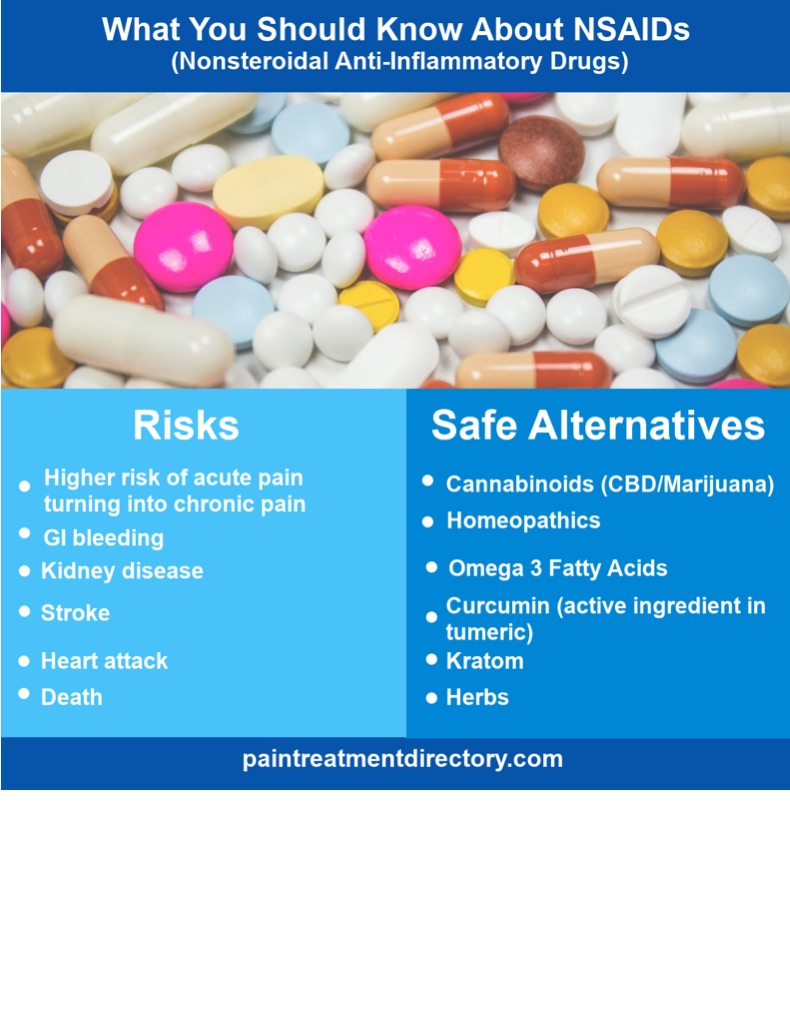
If you take any of the following nonsteroidal anti-inflammatory drugs (NSAIDs) for pain relief you are putting your life at risk: aspirin, celecoxib (Celebrex), diclofenac (Cambia, Cataflam, Voltaren-XR, Zipsor, Zorvolex), ibuprofen (Motrin, Advil), indomethacin (Indocin), naproxen (Aleve, Anaprox, Naprelan, Naprosyn), oxaprozin (Daypro), piroxicam (Feldene). This may come as a shock to you. After all, these drugs have been around for decades and many are available over the counter.

It has long been known that NSAIDs increase the risk of potentially fatal stomach and intestinal adverse reactions including bleeding, ulcers, and perforation of the stomach or intestines. These events can occur at any time during treatment and without warning symptoms. Elderly patients are at greater risk for these adverse events. Aspirin alone causes over 3000 deaths annually in the United States.

NSAIDs, except for aspirin, increase the risk of a potentially fatal heart attack or stroke, according to an FDA advisory issued in July, 2015. The FDA warned that “those serious side effects can occur as early as the first few weeks of using an NSAID, and the risk might rise the longer people take NSAIDs”. “There is no period of use shown to be without risk,” says Judy Racoosin, M.D., M.P.H., deputy director of FDA’s Division of Anesthesia, Analgesia, and Addiction Products. People who already have cardiovascular disease, particularly those who recently had a heart attack or cardiac bypass surgery, are at greatest risk. However, “Everyone may be at risk – even people without an underlying risk for cardiovascular disease,” says Racoosin.

Heavy or long term use of NSAIDs can also cause kidney damage.

Unfortunately, another widely available over the counter pain reliever, acetaminophen (brand name Tylenol) also carries significant risks. If used long term at higher than recommended doses or in individuals whose liver function is compromised, acetaminophen can cause liver failure. Liver failure is fatal without a liver transplant. Acetaminophen is the most frequent cause of liver failure in the United States today.

The Solution

With prescription opioids becoming increasingly restricted due to concerns about addiction, as well as growing evidence that they may cause more pain over the long term, what can a chronic pain patient do?

Fortunately, there are many safe and effective natural treatments for chronic pain. Here are some things you can take for pain relief: medical marijuana, CBD oil, kratom (a Southeast Asian herb that the FDA and DEA are currently trying to ban based on false allegations that it is unsafe), wild lettuce, turmeric, omega 3 fatty acids, homeopathic remedies such as arnica, ruta or hypericum, magnesium, vitamin D3 and many other herbs and nutrients. Here are some things that you can do: acupuncture, biofeedback, chiropractic, EMF treatment, exercise, hypnotherapy, low level laser therapy, massage, nutritional therapy, physical therapy, psychotherapy and much more. Some combination of these treatments can not only reduce your pain, they just might heal the underlying problem and eliminate your pain for good. 

To find out more about safe alternatives for pain relief, visit the online Alternative Pain Treatment Directory

Check out our recommended pain relief products HERE

Check out our alternative pain treatment providers HERE

To continue receiving important information about pain treatment, sign up for our free e-newsletter HERE

___________________

**Comment**

Lyme/MSIDS patients often cope with intractable, grueling pain.  The stuff that stops you in your tracks & brings life to a grinding halt leaving you a shell of your former self.

I have found the following to be of great help:

For more: 

Minerals and Their Effect On The Immune System

https://soundcloud.com/user-467428748/minerals-and-their-effect-on-immune-system?in=user-467428748/sets/the-candida-chronicles-podcast  Approx. 30 Min.

Podcast with Michael Biamonte, CCN and others

This lecture explores how minerals like selenium, zinc & copper work with your immune system to help regulate it. It also explains the interactions between candida, viruses, and other infections with these minerals.

For more:

FDA At It Again – Attacking Natural Thyroid

https://anh-usa.org/fda-attacks-natural-thyroid/

FDA Attacks Natural Thyroid

FDA Attacks Natural Thyroid

For years the FDA has wanted natural thyroid replacement off the market. Now the agency is moving to eliminate individualized versions of this medicine. Action Alert!

The FDA has declared natural desiccated thyroid (NDT) to be a “biologic” and thus ineligible for pharmacy compounding. This is the latest in a decades-long effort by the agency to remove natural thyroid medicines from the market in favor of FDA-approved thyroid drugs that many patients cannot use. This threatens access for millions of patients who need individualized NDT to stay healthy. We need push back against this attack.

The FDA announced this position not in a public statement or guidance, but in a letter to the National Association of Boards of Pharmacy (NABP). The FDA encouraged NABP to share the letter with its members, the state boards of pharmacy, probably hoping that they will do the agency’s dirty work by restricting the compounding of NDT.

We cannot overstate how crucial compounded NDT is to patient health. Almost 30 million Americans are estimated to have a thyroid condition, and about 5 million Americans just haven’t been diagnosed and are not aware they have a thyroid condition. One woman in eight will develop a thyroid condition during her lifetime. So will many men. One of the most common thyroid disorders is hypothyroidism, where the thyroid gland does not produce enough thyroid hormone, causing symptoms such as extreme fatigue, depression, weight gain, and forgetfulness.

Patients with hypothyroidism need medicine that will supplement the body with sufficient thyroid hormone. The human body produces five different thyroid hormones. There are two main treatment options: 1) FDA-approved hormones that are synthetic and only contain one of the hormones, either T3 or T4, and 2) NDT, made from the thyroid gland of pigs, which contains T1, T2, T3, T4, and calcitonin. Note that, to be of any help, T4 must be converted to T3, and many of us cannot do this efficiently.

Mainstream medicine preaches that it is sufficient to supplement only with T4; that the body will convert an appropriate amount of T4 into T3; and that T1, T2 and calcitonin aren’t needed. While this may be true for some hypothyroid patients, there are many others who get better only when they take NDT.

Compounded versions of NDT are crucial because pharmacies can individualize doses and delivery systems to meet individual patient needs. When thyroid glands are not functioning properly, they rarely stop producing hormones completely—they are producing the wrong levels of hormones. Doctors must determine how to correct these imbalances based on observed hormone levels in each patient. Additionally, hormone levels can fluctuate. This is why the one-size-fits-all FDA-approved options are not sufficient for many patients.

Note that compounded sustained-release T3 medications appear to be safe (for now) because they are made from a synthetic version of T3, not the natural version which is now considered a biologic and effectively banned from compounding.

Armour and other commercially available NDT products that are not compounded also appear safe for the time being, but that could change. Note that Armour and other brands of NDT are considered “grandfathered”; that is, they were in use before drugs were required to prove safety and efficacy and are allowed to remain on the market without adhering to those requirements as long as they are labeled with the same conditions for use. But the FDA has an “Unapproved Drug Initiative” to try to get these grandfathered drugs to go through FDA approval. In 2021, the FDA released a “Consumer Update” on thyroid medications, essentially warning patients from taking natural thyroid because these products have not been reviewed by the agency for safety and efficacy. Clearly, these medicines are on the FDA’s radar, and it wouldn’t be surprising to see the agency move against Armour and other commercially available NDT products in the future.

Some patients get Armour and other products from compounding pharmacies because they are more readily available than at chains like CVS or Walgreens. This should not be interrupted for the time being. Armour and other commercially available NDT products are still legal; the threat is to compounded NDT products.

Compounding allows doctors to custom-fit thyroid medications based on what you need as an individual, whether it’s a specific dose not found in FDA-approved drugs, or a time-released version, different combinations of T3 and T4, etc. It’s hardly surprising, then, that studies have found many, many patients prefer natural thyroid to synthetic options.

In order to be made into a customized medicine, a substance has to meet one of three criteria. It must either:

  1. appear on an FDA pre-approved list (the Bulk Drug list);
  2. have a USP monograph; or
  3. be a component of an approved drug.

NDT has a USP monograph. So, what’s the problem? The FDA is now claiming that NDT meets the definition of a “biologic” (medications that come from living sources, like vaccines, monoclonal antibodies, etc.) because it contains thyroglobulin, an amino acid found in the pig glands used to make NDT. Biologics are not able to be compounded unless there is an approved biological license application (BLA), which is akin to a new drug application requiring clinical trials. The FDA is using a back-door method to ban medicines it has attacked for years.

This is, of course, absurd. Clinical trials cannot be conducted on compounded medicines given the highly varied and individualized doses and delivery mechanisms used. As explained above, this is the whole point behind compounded medicine, to customize medicines to meet individual patients’ needs. With this move, the FDA is in effect banning compounded NDT. What remains to be seen is how swiftly the agency will move to enforce this position.

We will return to this in subsequent coverage, but this is part of a years-long FDA campaign against natural thyroid. This stems from the fact that natural thyroid competes with Big Pharma’s FDA-approved T4 thyroid drugs, which include Levothyroxine and Synthroid. The market size of Levothyroxine alone is $2.3 billion, expected to grow to $3.5 billion by 2027. In a list of the top 300 most prescribed drugs of 2020, Levothyroxine was listed at number two with over 20 million patients and just under 99 million prescriptions. For many years, Synthroid was the top prescribed medicine in the US. Natural thyroid, and the compounding pharmacies that produce it, therefore represent an annoyance to the government-sponsored monopolists running Big Pharma.

As we’ve seen with the FDA’s campaign against other compounded bioidentical hormones, the agency also has an innate distrust of anything not FDA-approved. The FDA claims that these medicines, having not gone through FDA approval, cannot be guaranteed to be safe or effective, nor can hormone levels be guaranteed from batch to batch. We believe this is all a smoke screen. Natural thyroid has been compounded for years without any apparent safety issues. The FDA simply doesn’t like that it doesn’t have authority over natural thyroid and that there is significant competition for Big Pharma’s synthetic drugs.

The Alliance for Pharmacy Compounding, a trade group for compounding pharmacists, is holding a town hall event on this issue on October 13, 2022. Pharmacists and consumers interested in learning more are welcome to attend.

This is also concerning given the separate process by which the FDA is deciding whether bioidentical estriol, progesterone, and estradiol can continue to be compounded. This action is further proof that the FDA wants to see these hormones disappear. We can’t let that happen.

In the big picture, this is a direct threat to the very future of traditional compounding pharmacies. If they can’t make thyroid medications, or estriol, or estradiol, or progesterone, or curcumin, or many of the other natural medicines the FDA is attempting to ban from compounding, these pharmacies will go out of business. By all accounts, this appears to be the FDA’s goal. Time and time again in the agency’s communications on compounding, the FDA bemoans the lack of clinical trials that would attest to the safety and efficacy of compounded medicines—the standard used to approve new drugs. But legally compounded drugs are exempted from new drug approval requirements. What the agency is really saying is that it does not want compounded drugs to exist, period, because the agency doesn’t control them and they compete with Big Pharma’s drugs. We cannot let the FDA wipe out traditional compounding pharmacies.

Action Alert! Write to Congress and the FDA, telling them to retain consumer access to compounded natural thyroid medications. Please send your message immediately.

Go to top link to act against this government tyranny and overreach.

FDA Corruption:

FDA’s long history of coming against anything it considers competition: